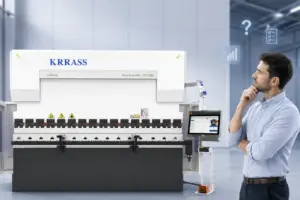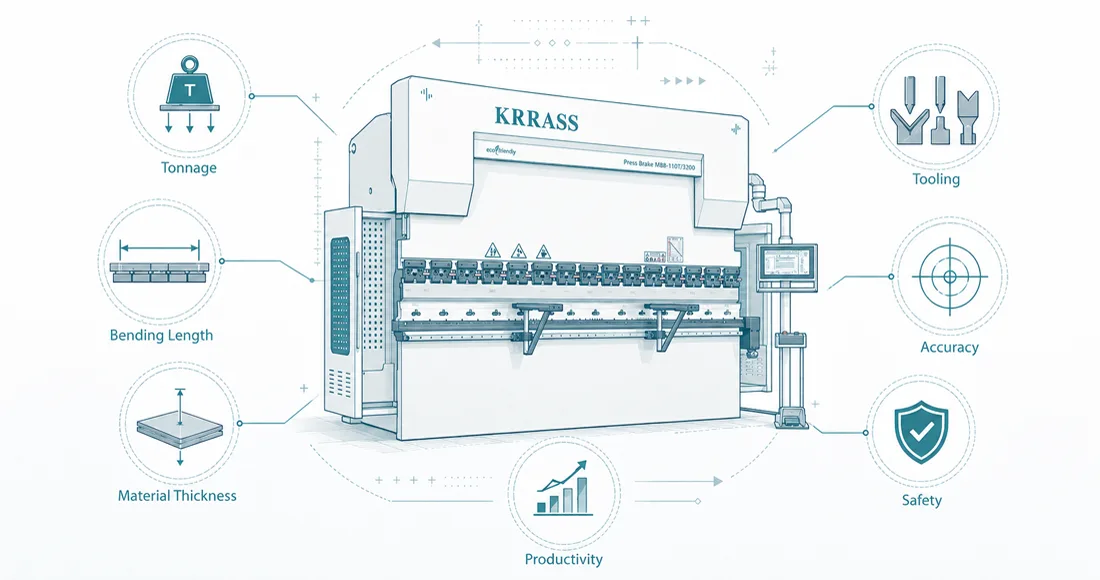
Choosing a sheet metal press brake is not only a machine purchase. It is a production decision that will influence part quality, delivery speed, operator workload, tooling investment, power consumption, floor layout, and long-term manufacturing flexibility. A press brake that looks suitable on a quotation can become too small, too slow, or too difficult to operate if it is selected only by tonnage and price. A machine with more tonnage than necessary can also become an expensive mistake if the factory really needs better tooling, a more flexible backgauge, a crowning system, or faster setup support.
At KRRASS, we design, manufacture, and recommend sheet metal forming equipment for global customers. Our product range includes press brakes, hydraulic shearing machines, fiber laser cutting machines, ironworker machines, panel benders, and related tooling and accessories. In real projects, we rarely begin with the question, “How many tons do you want?” We start with the parts the buyer needs to produce. Material, thickness, bend length, flange size, tolerance, batch size, surface requirement, operator skill, and future product plans are more important than a single headline specification.
This guide explains how to choose a sheet metal press brake for different production needs in a practical, buyer-friendly way. The goal is not to turn every purchasing manager into a bending engineer. The goal is to help your team ask the right questions before ordering a machine. If you understand how tonnage, tooling, bending length, controller level, crowning, backgauge configuration, and safety devices work together, you can choose a press brake that supports your production today and still has room for tomorrow.
Table of Contents
Start with the production picture, not the machine model
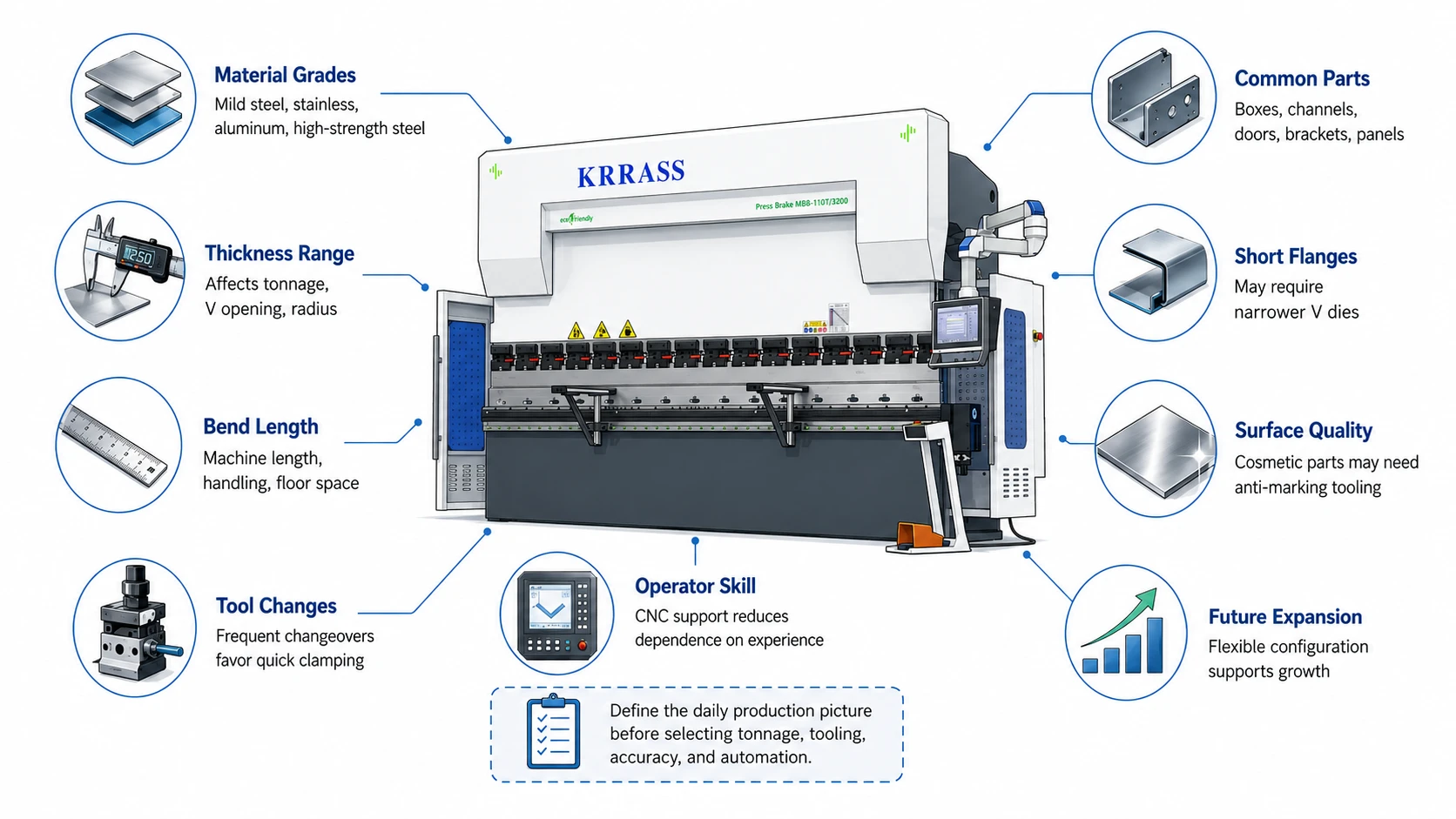
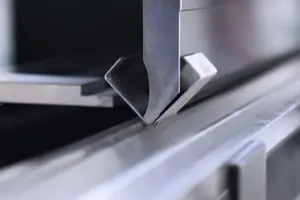
A sheet metal press brake bends metal by pressing the workpiece between an upper punch and a lower die. That sounds simple, but production bending is full of variables. The same 3,200 mm machine can be suitable for light cabinet parts, unsuitable for long stainless decorative panels, underpowered for heavy structural brackets, or too slow for high-mix daily production. The correct machine depends on the production picture.
Before selecting a model, define what the factory needs to bend most often. Occasional extreme parts matter, but they should not control the entire investment unless they are strategically important. A buyer making electrical enclosures may need a flexible CNC hydraulic press brake with segmented tooling and reliable repeatability. A buyer bending agricultural machinery plates may need more tonnage, larger daylight, deeper throat, stronger tooling, and careful die selection. A buyer producing thin stainless cosmetic panels may need anti-marking tooling, accurate crowning, stable backgauge movement, and good operator control. A buyer processing small batches of many different parts may benefit more from CNC programming and quick clamping than from simply buying a larger frame.
A practical purchasing discussion should cover these questions:
| Production question | Why it matters when choosing a sheet metal press brake |
|---|---|
| What material grades are used most often? | Stainless steel, aluminum, mild steel, and high-strength steel require different bending force and springback planning. |
| What is the thickness range? | Thickness strongly affects tonnage, die opening, inside radius, and minimum flange length. |
| What is the longest bend length? | Bending length affects machine length, frame deflection, crowning, handling, and floor space. |
| What is the most common bend length? | The most common length is often more important than the maximum possible length. |
| What are the shortest flanges? | Short flanges may require a narrower V opening, which increases tonnage. |
| Are the parts boxes, channels, doors, brackets, or panels? | Part geometry determines punch style, gooseneck clearance, backgauge movement, and collision risk. |
| Are surfaces cosmetic? | Stainless panels, painted sheets, and visible appliance parts may need anti-marking film, larger radii, or polished tooling. |
| How many tool changes happen per shift? | Frequent changeovers justify quick clamping, segmented tooling, organized storage, and better CNC support. |
| How experienced are operators? | Better controllers, offline programming, and clear tooling libraries reduce dependence on individual experience. |
| Will production expand? | A slightly stronger or more flexible configuration may avoid another purchase too soon. |
When we recommend a press brake, we try to separate daily production from rare work. If 90% of a factory’s parts are 1.5 to 4 mm mild steel below 3,200 mm, a medium CNC hydraulic press brake may be more practical than a heavy-duty machine chosen for one occasional 8 mm part. If that occasional 8 mm part is critical to a major contract, then the machine configuration should be built around it. This is why a good recommendation requires drawings or at least a clear list of parts.
Understand the main press brake types
Different production needs point to different machine types. The most common choices are NC hydraulic press brakes, CNC hydraulic press brakes, servo-electric press brakes, hybrid press brakes, and heavy-duty or tandem press brake systems. Each has a place. A buyer should not select a machine type only because it sounds more advanced; the best machine is the one that matches the work.
An NC hydraulic press brake is often suitable for simpler bending, lower budgets, and factories where the part mix is stable. It can be a practical choice for straightforward angles, simple brackets, and less demanding tolerances. However, it may rely more heavily on operator adjustment and trial bending. For a factory that changes products frequently, this can increase setup time and scrap.
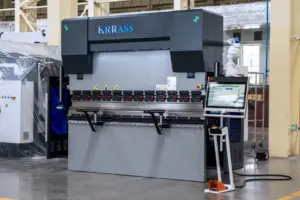
A CNC hydraulic press brake is more flexible and widely used in modern sheet metal manufacturing. With independent Y1/Y2 control, programmable backgauge movement, tooling libraries, angle programs, and optional crowning systems, it can improve repeatability and reduce setup difficulty. For example, the KRRASS MB8-110T3200 CNC press brake with DELEM DA-53T is configured around a 3,200 mm bending length, 1100 kN bending pressure, and Y1+Y2+X+R+W crowning axis structure. This type of configuration is often a practical starting point for general fabrication, cabinet manufacturing, and medium-duty production.
A servo-electric press brake is attractive for thin to medium sheet work that requires clean operation, fast response, lower maintenance, and energy efficiency. It does not use a traditional hydraulic system in the same way, so it can reduce oil-related maintenance. It is commonly considered for precision sheet metal parts, electronics cabinets, small components, and factories with strong energy-saving requirements. However, very heavy bending still often favors hydraulic power because hydraulic systems are robust and economical at high force levels.
A heavy-duty hydraulic press brake is used when material thickness, bend length, and required force rise together. Heavy structural components, thick plates, long construction panels, truck parts, machinery frames, and shipbuilding parts may require higher tonnage, larger machine opening, stronger tooling, and more careful deflection compensation. In this category, die opening choice becomes especially important because a wider V opening can reduce tonnage but also increases inside radius and minimum flange size. Our article on choosing a hydraulic press brake for heavy bending goes deeper into this kind of project.
For very long parts, tandem press brakes may be considered. Two press brakes can operate together to bend long workpieces, or separately to handle smaller jobs. This solution can offer flexibility for factories that produce long poles, long panels, frames, and construction components. The trade-off is that tandem bending needs more space, better synchronization, skilled operation, and careful safety planning.
| Machine type | Best-fit production need | Main advantage | Common limitation |
|---|---|---|---|
| NC hydraulic press brake | Simple bends, stable part mix, budget-sensitive production | Lower initial cost and simple operation | More operator adjustment; less flexible for complex parts |
| CNC hydraulic press brake | General sheet metal fabrication, cabinets, panels, mixed batches | Good balance of power, flexibility, and repeatability | Higher initial cost than NC machines |
| Servo-electric press brake | Thin and medium sheet, clean production, precision parts | Fast response, energy efficiency, lower hydraulic maintenance | Not usually the first choice for very heavy bending |
| Heavy-duty hydraulic press brake | Thick plate, structural parts, long bends | High force and strong frame capacity | Requires stronger tooling, handling equipment, and floor planning |
| Tandem press brake | Very long workpieces and flexible large-part production | Can bend long parts or work as separate machines | Needs more space, synchronization, and safety control |
Calculate bending force before choosing tonnage
Tonnage is one of the most visible specifications on any sheet metal press brake, but it is also one of the easiest to misunderstand. Buyers often ask for a 100-ton, 160-ton, or 220-ton machine because they have seen those sizes in other factories. A better method is to calculate the required bending force from material, thickness, bend length, and V-die opening.
For practical air bending of mild steel, a common metric planning formula is:
Bending force in kN ≈ 650 × material thickness² × bend length ÷ V opening
In this formula, material thickness is in millimeters, bend length is in meters, and V opening is in millimeters. The constant is a simplified planning value for mild steel. For stainless steel, force is usually higher because tensile strength is higher. For aluminum, force is usually lower, although cracking and radius requirements still need careful attention. Online tools such as the KRRASS bending force calculator and industry resources such as the RMFG press brake tonnage calculator use the same basic idea: tonnage depends on thickness, die opening, material strength, and bend length, not on machine size alone.
The table below gives approximate mild steel force values for a 3,200 mm bend using a V opening equal to eight times material thickness. The final column adds a 20% planning reserve. These values are only first estimates. Real production should confirm material grade, tensile strength, tooling rating, bending method, angle, radius, and machine condition.
| Mild steel thickness | Starting V opening | Bend length | Approx. force | Approx. metric tons | Suggested capacity with 20% reserve |
|---|---|---|---|---|---|
| 1.5 mm | 12 mm | 3.2 m | 390 kN | 40 t | 48 t |
| 2.0 mm | 16 mm | 3.2 m | 520 kN | 53 t | 64 t |
| 3.0 mm | 24 mm | 3.2 m | 780 kN | 80 t | 96 t |
| 4.0 mm | 32 mm | 3.2 m | 1,040 kN | 106 t | 128 t |
| 6.0 mm | 48 mm | 3.2 m | 1,560 kN | 159 t | 191 t |
| 8.0 mm | 64 mm | 3.2 m | 2,080 kN | 212 t | 255 t |
This table explains why a 3,200 mm press brake cannot be selected by bending length alone. A 3,200 mm machine bending 2 mm mild steel may need around 64 tons with reserve, while the same length in 6 mm mild steel may need around 190 tons with reserve. If stainless steel is used, the required capacity can increase significantly. If the V opening is narrowed to support a shorter flange, force rises again.
A useful purchasing rule is to choose the machine capacity based on the hardest realistic bending case, then add a reasonable reserve. Running at maximum tonnage every day is not ideal for machine life, tooling life, accuracy, or operator confidence. At the same time, buying far more tonnage than needed can waste money, increase power demand, and reduce flexibility if the machine is physically too large for small work.
Match material behavior to machine and tooling
Material type affects bending force, springback, minimum radius, cracking risk, and surface quality. Mild steel is usually the baseline for press brake calculations because it is common and comparatively forgiving. Stainless steel often requires more force and shows more springback. Aluminum can require less force but may crack if the bend radius is too tight, especially in harder tempers. High-strength steel requires more attention to radius, grain direction, die opening, and tooling load.
The table below gives practical planning comparisons. The tensile values are broad reference ranges, not purchase specifications. Always use the actual mill certificate or supplier data when the part is critical.
| Material family | Typical bending behavior | Practical purchasing impact |
|---|---|---|
| Mild steel / low-carbon steel | Good general formability, moderate springback, common baseline for tonnage charts | Suitable for many standard CNC hydraulic press brakes; use calculated tonnage plus reserve. |
| 304 stainless steel | Higher strength and springback than mild steel; surface marking can be a concern | Consider higher tonnage, better crowning, anti-marking protection, and stable tooling. |
| Aluminum 5052 | Good sheet formability and lower tonnage than steel | Good for cabinets, covers, and panels; check radius and surface protection. |
| Aluminum 6061-T6 | Stronger but less forgiving in tight bending; cracking risk can rise | Use larger inside radius, larger V opening, and confirm bend direction and temper. Material databases such as MakeItFrom show 6061-T6 as a high-strength aluminum temper. |
| High-strength steel | High springback and greater cracking risk at small radii | Requires careful tonnage calculation, larger radius, strong tooling, and sometimes special bending strategy. |
| Pre-painted or polished sheet | Surface finish may be more important than raw tonnage | Consider anti-marking film, clean tools, polished dies, and controlled handling. |
From a machine selection point of view, material behavior determines more than pressure. It determines whether the buyer should prioritize extra tonnage, a more advanced controller, angle correction, CNC crowning, special tooling, or part support. For example, stainless steel cabinet panels may not be very thick, but they can demand high repeatability and surface care. A heavy mild steel bracket may not require cosmetic protection, but it may demand more force and stronger tooling.
Select the V-die opening carefully
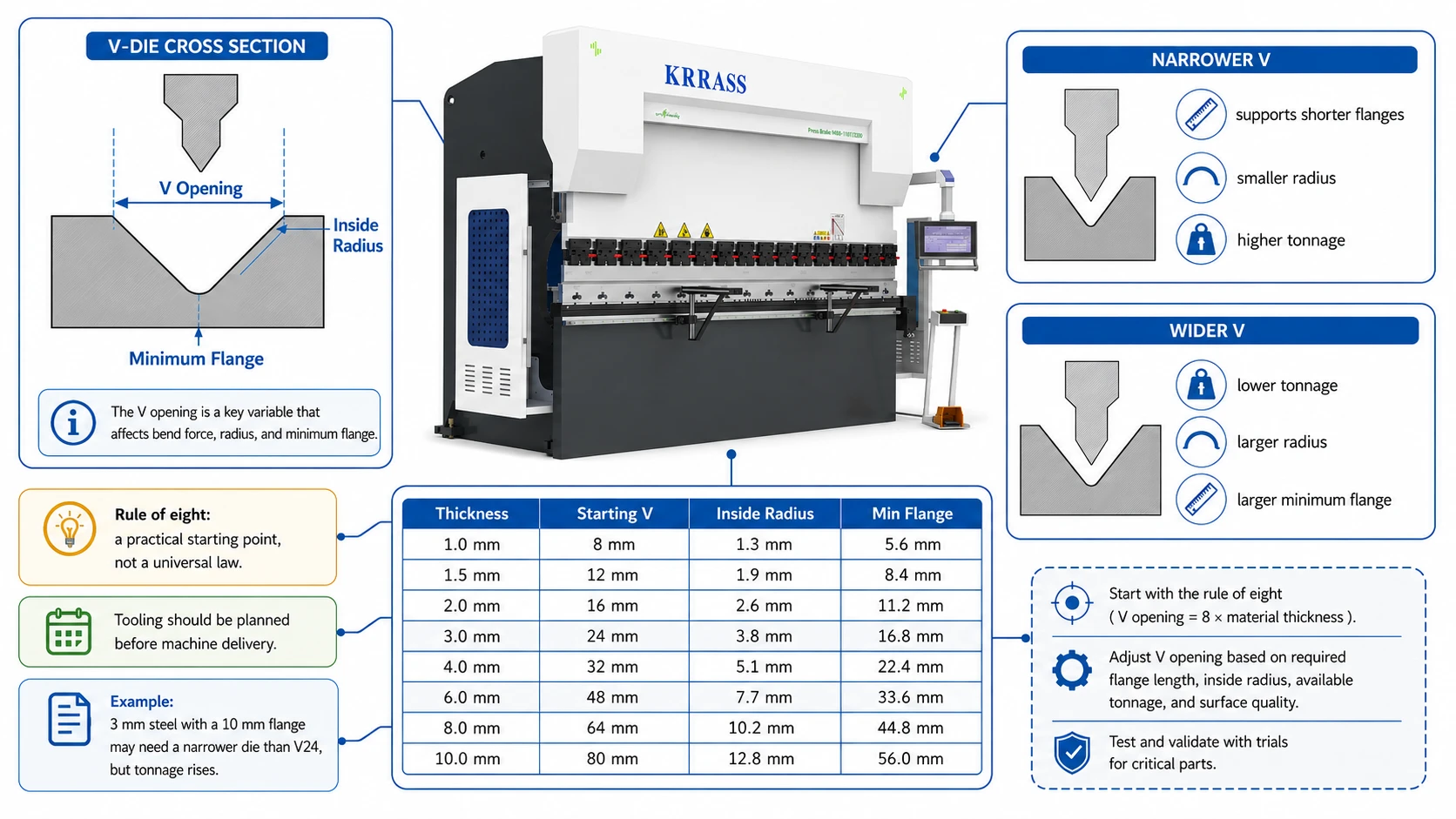
The lower die opening is one of the most important variables in press brake selection. Many fabricators begin with the “rule of eight,” meaning the V opening is about eight times the material thickness. The RMFG tonnage reference explains the same practical rule and notes that smaller die openings increase required tonnage while larger openings reduce tonnage but increase bend radius. KRRASS also discusses die choice in our press brake tooling guide and press brake tonnage guide.
The rule of eight is not a universal law. It is a starting point. Short flanges, thick plates, stainless steel, aluminum, cosmetic surfaces, and high-strength materials may require different values. A narrow V opening supports shorter flanges and smaller radii, but it increases force and may create more marking. A wide V opening reduces force and surface pressure, but it increases inside radius and the minimum flange required for stable bending.
| Material thickness | Common starting V opening | Approx. air-bending inside radius at 0.16 × V | Approx. minimum flange at 0.70 × V | Main purchasing concern |
|---|---|---|---|---|
| 1.0 mm | 8 mm | 1.3 mm | 5.6 mm | Thin sheet handling and surface marking |
| 1.5 mm | 12 mm | 1.9 mm | 8.4 mm | Cabinet parts and smaller flanges |
| 2.0 mm | 16 mm | 2.6 mm | 11.2 mm | Common enclosure and panel work |
| 3.0 mm | 24 mm | 3.8 mm | 16.8 mm | General fabrication and machinery covers |
| 4.0 mm | 32 mm | 5.1 mm | 22.4 mm | Higher tonnage and crowning control |
| 6.0 mm | 48 mm | 7.7 mm | 33.6 mm | Heavy parts and tooling load |
| 8.0 mm | 64 mm | 10.2 mm | 44.8 mm | Strong frame, wide V, handling equipment |
| 10.0 mm | 80 mm | 12.8 mm | 56.0 mm | Heavy-duty press brake selection |
This table also explains why buyers should not choose tooling after the machine is delivered. Tooling can decide whether the machine can actually make the part. If the drawing requires a 10 mm flange on 3 mm steel, a standard V24 die may not support it well because the flange planning value is about 16.8 mm. A narrower die may help the flange, but it raises tonnage. If the selected machine has no reserve, the factory may discover too late that the “correct” die for the part overloads the machine or tooling.
Choose bending length based on real workpieces
Bending length is the second headline specification after tonnage. A 3,200 mm press brake is popular because it covers many common sheet sizes and panels. However, the right length depends on the workpiece, not on habit. A factory producing small brackets may not need a long machine. A factory producing doors, cabinets, duct panels, or architectural parts may need 2,500 mm, 3,200 mm, 4,000 mm, or 6,000 mm. A factory producing poles, long roofing parts, or transportation components may need tandem bending.
When choosing bending length, consider the longest required part and the daily average part. A machine that is much longer than the workpiece can still bend short parts, but the buyer should consider setup efficiency, floor space, support arms, and tooling segmentation. Long beds also require more attention to deflection. If the factory bends long parts across most of the bed, crowning becomes important. Without proper compensation, the angle in the center of the part may differ from the angle near the side frames.
For example, a buyer bending 3,000 mm cabinet panels in 2 mm mild steel may find a 3,200 mm CNC hydraulic press brake practical. A buyer bending 6,000 mm construction panels may need a longer single machine or a tandem solution. KRRASS offers examples such as the MB8-210T6000 press brake bending machine for long bending applications, while compact models such as smaller 1,600 mm or 2,500 mm configurations may be more efficient for smaller parts.
| Production need | Typical bending length choice | Selection comment |
|---|---|---|
| Small brackets and components | 1,600-2,500 mm | Faster setup and smaller footprint may matter more than length. |
| Electrical cabinets and enclosures | 2,500-3,200 mm | Flexible CNC control and segmented tooling are usually important. |
| Standard sheet metal panels | 3,200 mm | Common balance of capacity, availability, and production flexibility. |
| Long doors, frames, and construction panels | 4,000-6,000 mm | Crowning, support arms, and handling space become critical. |
| Very long poles or structural parts | Tandem system | Requires synchronization, skilled operation, and safety planning. |
Decide how much accuracy and repeatability you need
Accuracy is not the same for every factory. A general bracket may allow wider tolerance than a stainless elevator panel, a medical equipment cover, or a precision electrical enclosure. If the tolerance is tight, the machine must provide more than enough force. It must control ram position, backgauge position, tooling data, crowning, and operator workflow.
In a CNC hydraulic press brake, Y1 and Y2 axes control ram synchronization. A programmable backgauge positions the workpiece. X-axis controls front-back position, R-axis adjusts height, and Z1/Z2 fingers can move laterally for different flange positions. CNC crowning compensates bed and ram deflection during bending. The controller connects these elements into repeatable programs.
Controller selection matters because the operator must turn drawings into stable bending programs. The Delem DA-53T is an example of a compact touch control for synchronized press brakes. Delem describes it as a numerical press brake control with 10.1-inch color TFT, hot-key touch navigation, up to four axes, crowning control, tool/material/product library, and USB interfacing. For many factories, this level of control is a practical balance between cost and capability. More advanced controllers may add 2D or 3D graphical programming, automatic bend sequence calculation, collision support, and offline software functions.
| Accuracy requirement | Recommended configuration focus | Why it matters |
|---|---|---|
| General brackets and simple parts | NC or basic CNC, standard backgauge | Lowest practical investment if part mix is simple. |
| Cabinets, doors, and panels | CNC hydraulic, Y1/Y2, X/R backgauge, crowning | Improves repeatability across longer bends. |
| High-mix custom production | CNC controller with tooling library, quick clamping, offline support | Reduces setup time and dependence on memory. |
| Cosmetic stainless panels | CNC crowning, anti-marking tooling, stable backgauge, careful handling | Controls angle, surface finish, and repeatability. |
| Complex boxes and return flanges | Multi-axis backgauge, segmented/gooseneck tooling, collision review | Prevents tool and part interference during bending sequence. |
A buyer should be careful with the phrase “high precision.” Every supplier can say it. The better question is: which configuration controls the source of error? For long parts, crowning is critical. For repeat batches, controller memory and tooling libraries matter. For short flanges, tool selection matters. For operators with limited experience, clear programming and training matter. For cosmetic parts, surface protection matters.
Evaluate crowning before long-part production
Crowning is the method used to compensate for deflection in the press brake frame and bed. During bending, the machine structure can flex slightly under load. On a long workpiece, this can make the center angle different from the ends. Crowning corrects this by adjusting the bed or tooling support so that bending force is distributed more evenly.
For short bends, crowning may be less visible. For long bends, thick material, stainless steel, and tight angle tolerances, crowning becomes much more important. Manual crowning can work when setups are stable and operators are experienced. CNC crowning is more efficient when programs change often or when consistency is important.
The KRRASS MB8-110T3200 CNC press brake shows a configuration with Y1+Y2+X+R+W crowning. In practical terms, W crowning gives the controller a way to compensate for deflection according to bending conditions. This is one reason a CNC press brake can be more predictable than a basic machine in mixed production.
A good purchasing question is: “At what bend length and material thickness will crowning become necessary for our tolerance?” If your factory bends mostly short brackets, crowning may be less central. If your factory bends 2,500 mm to 4,000 mm panels with visible angle requirements, crowning should be considered early, not added as an afterthought.
Choose the backgauge for the parts you really make
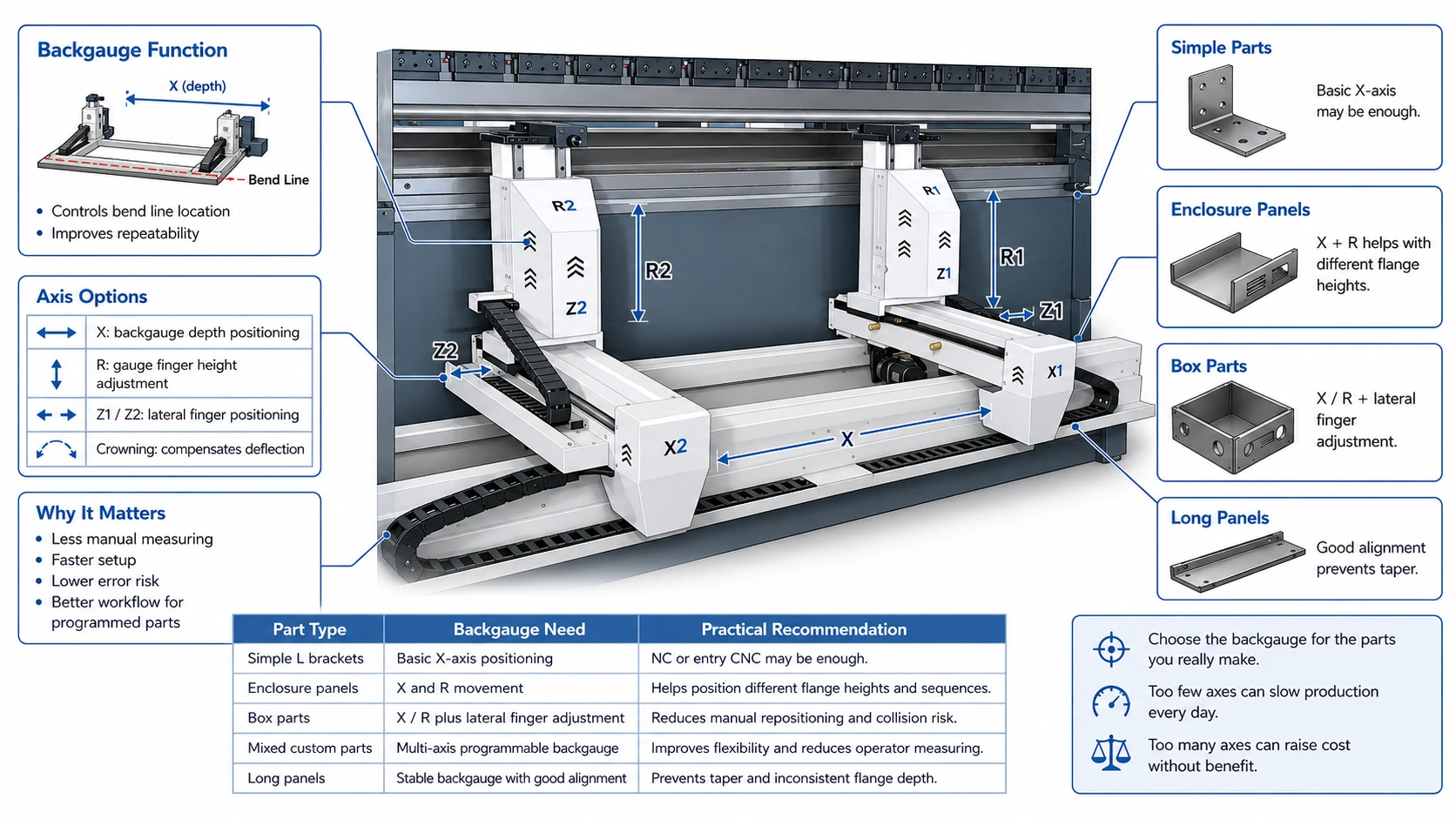
The backgauge is often underestimated. It is not only a stopper behind the machine. It controls where the bend line is located. For simple straight flanges, a basic X-axis backgauge may be enough. For parts with different flange heights, step bends, return flanges, or complex sequences, R-axis and Z-axis movement can save setup time and reduce error.
A 2-axis system may control basic ram and backgauge movement. A 3+1 axis system may add crowning. A 4+1 axis system may include Y1, Y2, X, R, and crowning. Higher configurations can add Z1/Z2 fingers and other features. The best choice depends on the complexity of the part. Buying more axes than needed raises cost, but buying too few axes can slow production every day.
| Part type | Backgauge need | Practical recommendation |
|---|---|---|
| Simple L brackets | Basic X-axis positioning | NC or entry CNC may be enough. |
| Enclosure panels | X and R movement | Helps position different flange heights and sequences. |
| Box parts | X/R plus lateral finger adjustment | Reduces manual repositioning and collision risk. |
| Mixed custom parts | Multi-axis programmable backgauge | Improves flexibility and reduces operator measuring. |
| Long panels | Stable backgauge with good alignment | Prevents taper and inconsistent flange depth. |
The backgauge should also match the operator’s working style. If operators frequently use manual stops and tape measures, a better backgauge can immediately improve repeatability. If the factory already uses digital drawings and programmed sequences, a more capable CNC system can reduce trial bends and improve workflow.
Treat tooling as part of the machine, not an accessory
A sheet metal press brake without the right tooling is not a complete solution. Punches, V-dies, adapters, clamps, segmented tools, hemming tools, radius tools, gooseneck punches, and anti-marking solutions determine what the machine can actually bend. Many purchasing problems happen because the buyer focuses on machine tonnage and asks about tooling only at the end.
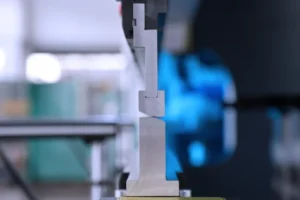
Tooling affects minimum flange length, inside radius, surface marking, collision clearance, tonnage capacity, setup time, and operator safety. A wide V opening may reduce tonnage but increase radius and minimum flange size. A narrow V opening may support a short flange but overload the tool. A gooseneck punch may allow box bending but has lower load capacity than a straight punch of similar size. Segmented tooling can make boxes and small parts easier, but it must be clamped and stored correctly.
KRRASS provides tooling discussions because press brake tooling is a process decision. Our press brake tooling guide explains how punch and die selection affects production. When we review a project, we prefer to check drawings before recommending tooling. If drawings are not available, we ask about the shortest flange, deepest box, inside radius, material type, thickness, and surface requirement.
| Tooling decision | Production effect | Common mistake |
|---|---|---|
| V-die opening | Tonnage, radius, flange stability, marking | Using one die opening for too many jobs. |
| Punch shape | Collision clearance and load capacity | Choosing a straight punch for parts that need gooseneck clearance. |
| Segmentation | Boxes, small parts, setup flexibility | Buying only full-length tools for mixed production. |
| Clamping system | Changeover speed and safety | Ignoring tool change time in high-mix work. |
| Tool material and hardening | Wear resistance and life | Using low-quality tools in stainless or heavy production. |
| Anti-marking protection | Surface finish | Treating cosmetic parts like structural brackets. |
| Tool load rating | Safety and tool life | Assuming machine tonnage and tool capacity are the same. |
The last point is especially important. A machine may have 160 tons of nominal force, but a specific tooling section may not be rated for that load, especially in short bending. Concentrated tonnage can damage tools and create serious safety risks. Tooling capacity should always be checked.
Match the press brake to common production scenarios
Different factories need different solutions. The following scenarios show how production needs can point to different sheet metal press brake configurations.
Electrical cabinets and enclosure production
Electrical cabinets, control boxes, server cabinets, switchgear panels, and similar products usually require clean bends, repeatable flange dimensions, and efficient changeovers. Material is often mild steel, galvanized steel, stainless steel, or aluminum from about 1.0 to 3.0 mm, although heavier bases may be used.
For this type of production, a CNC hydraulic press brake in the 80-ton to 160-ton range with 2,500 mm or 3,200 mm bending length is often practical. Segmented tooling is important for box shapes. X/R backgauge movement helps with different flange heights. CNC crowning is useful for longer doors and panels. If surface appearance matters, anti-marking film or appropriate die choices should be added.
The KRRASS 80-ton CNC press brake and the MB8-110T3200 CNC press brake are examples of configurations that can fit many cabinet and enclosure projects, depending on actual drawings.
HVAC ductwork and light sheet metal fabrication
HVAC ductwork and light sheet metal production often involve thin galvanized sheet, long flanges, and repetitive shapes. The priority may be speed, simple setup, and cost control rather than extreme tonnage. A 2,500 mm or 3,200 mm machine may be sufficient for many products, but the workflow should also consider upstream cutting and downstream assembly.
For simple ducts and covers, an NC hydraulic press brake may be acceptable if the part mix is stable and operators are skilled. For mixed jobs, a CNC press brake is usually easier to control. If the factory bends thin material all day, a servo-electric or hybrid solution may also be worth considering because energy use and response speed can influence long-term cost.
Stainless steel kitchen, elevator, and decorative panels
Stainless steel cosmetic panels are not always heavy, but they are demanding. Surface scratches, tool marks, angle inconsistency, and poor handling can create expensive rework. The press brake should provide stable control, accurate crowning, clean tooling, and controlled handling. Operators should use suitable protective film, polished tools, or anti-marking solutions where necessary.
For stainless steel, the buyer should not assume mild steel tonnage tables are enough. Stainless generally requires higher bending force and shows more springback. The machine should have enough reserve, and the controller should make angle correction practical. If the factory produces long decorative panels, crowning and support arms become more important.
Construction panels and structural parts
Construction panels, truck parts, machinery covers, agricultural components, and structural brackets can involve thicker mild steel or high-strength steel. Tonnage, tooling load, daylight, stroke, and handling equipment become major factors. A heavy-duty hydraulic press brake is often more appropriate than a standard machine.
For thick parts, the buyer must consider die opening and inside radius. A wider die reduces force but may create a larger radius. If the drawing demands a small radius, the machine may require much more tonnage, and the material may crack. This is why heavy bending projects should be reviewed with drawings before ordering the machine.
High-mix custom fabrication
High-mix factories change parts frequently. In this environment, setup time and error prevention can matter as much as bending force. The best machine is not always the largest. A CNC press brake with a good controller, tooling library, segmented tooling, quick clamping, and organized tool storage can produce more value than a larger machine with slow setup.
For high-mix production, offline programming may also be useful. Operators can prepare programs before the job reaches the machine. This reduces machine idle time and makes production more predictable. The controller should support clear material and tooling data so the operator does not need to rebuild knowledge from memory every shift.
Heavy plate and long workpieces
Heavy plate and long workpieces should be treated as engineering projects. The buyer should provide material grade, thickness, length, inside radius, bend angle, flange size, production volume, and handling method. The machine may need higher tonnage, longer bending length, larger daylight, a deeper throat, stronger tool clamping, CNC crowning, rear support, front support arms, or tandem operation.
A common mistake is to buy a machine that can theoretically reach the required tonnage but cannot hold the correct tooling, cannot support the flange, or cannot handle the part safely. For heavy parts, material handling and safety are part of machine selection.
Consider the full production line
A sheet metal press brake does not work alone. Most bent parts start as blanks cut by laser, plasma, punching, or shearing. After bending, they may go to welding, riveting, hardware insertion, coating, or assembly. The press brake should fit the full production line.
If the factory uses laser cutting, blank accuracy is usually good, and the press brake can focus on bending repeatability. A fiber laser cutting machine can support flexible cutting before bending, especially for complex profiles. If the factory processes many straight rectangular blanks, a hydraulic shearing machine may be cost-effective for cutting sheet to size before bending. For heavier cutting or combined punching and notching, an ironworker machine may be part of the broader forming department.
When buying a press brake, ask how material will arrive at the machine. Are blanks stacked correctly? Are bend lines marked? Is the operator manually carrying large sheets? Are support arms needed? Is there enough space behind the machine for the backgauge and part rotation? Is there enough front space for long panels? Poor layout can make a good machine slow.
| Production line factor | Press brake impact |
|---|---|
| Laser-cut blank accuracy | Improves bending consistency if bend allowance is correct. |
| Sheared blank burr direction | Burrs and edge condition can influence cracking and surface finish. |
| Part nesting and grain direction | Important for aluminum and high-strength materials. |
| Material handling | Large parts may require front supports, lifting tools, or two operators. |
| Welding after bending | Bend sequence should reduce distortion and assembly difficulty. |
| Coating or painting | Surface scratches before coating can become visible defects. |
| ERP or job scheduling | Offline programming and tooling organization improve flow. |
Do not ignore safety and compliance
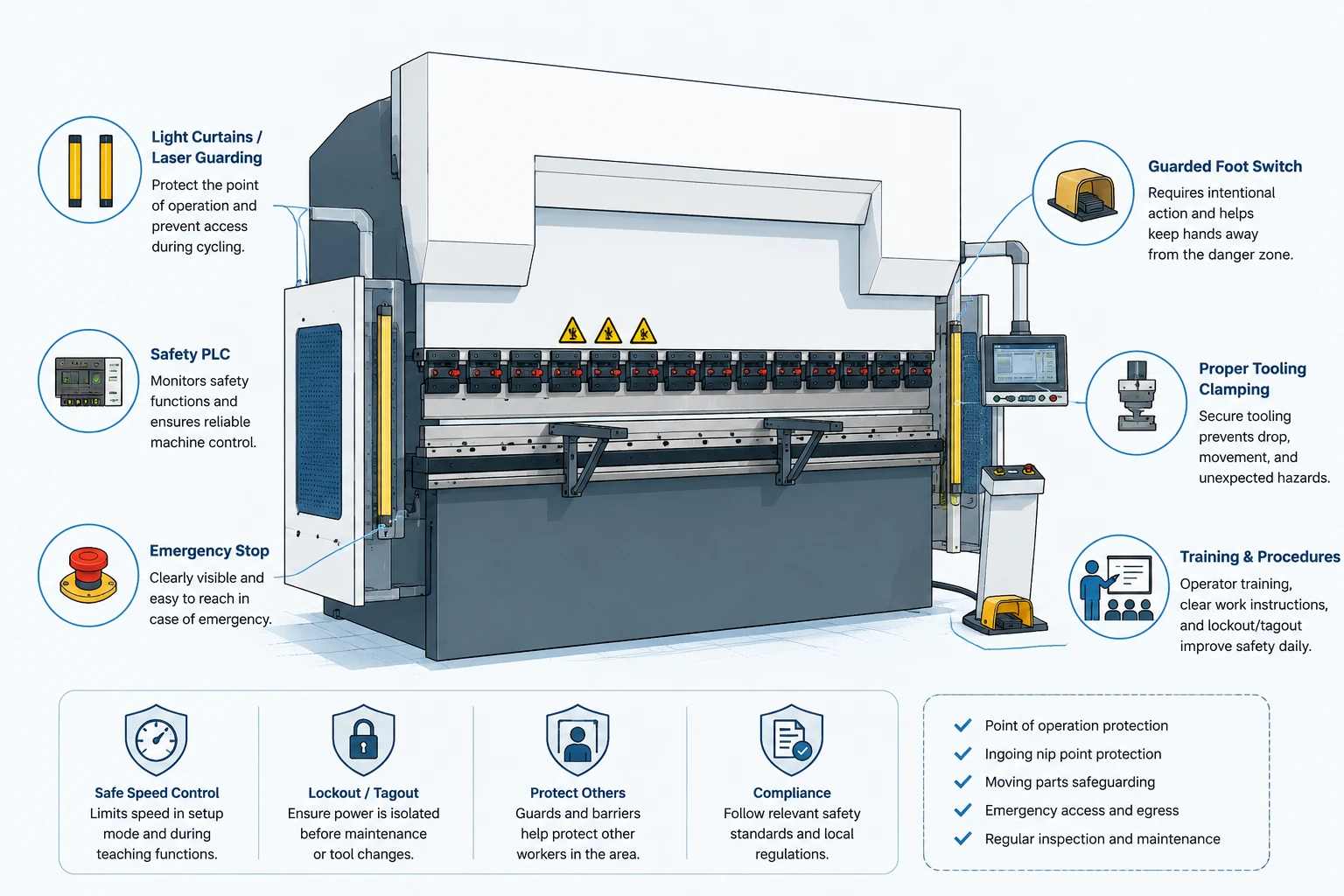
A press brake is powerful equipment. Safety must be part of the purchase decision, not a final accessory. The point of operation is where the punch and die form the material, and it can create crushing hazards. OSHA’s machine guarding guidance explains that safeguards are essential for protecting workers from moving machine parts and point-of-operation hazards. The U.S. regulation 29 CFR 1910.212 states that one or more methods of machine guarding must protect the operator and other employees from hazards such as point of operation, ingoing nip points, rotating parts, flying chips, and sparks. OSHA’s machine guarding eTool also highlights examples such as barrier guards, light curtains, and two-hand operating devices.
For press brakes specifically, ANSI B11.3-2022 is a machine-specific safety standard for power press brakes. ASSP’s ANSI B11 machine guarding standards describe the B11 series as a framework to identify and address machinery safety hazards through task-based risk assessment. Even when a buyer is outside the United States, these references are useful because they show how modern buyers think about risk assessment, safeguarding, and operator protection.
Typical press brake safety features and practices include light curtains, laser guarding, safety PLCs, emergency stops, guarded foot switches, safe speed control, proper tooling clamping, operator training, lockout/tagout procedures, and clear work instructions. For European markets, buyers should also evaluate CE-related requirements and the machinery safety framework applicable to their region.
Safety is not only a legal issue. It is a productivity issue. Operators work better when the machine is predictable, tools are secure, backgauge movement is clear, and the safety system does not need to be bypassed to finish ordinary work. If operators feel forced to bypass safety devices, the process design is wrong.
Evaluate total cost of ownership
The lowest quotation is not always the lowest cost. A press brake affects production for many years. Total cost of ownership includes purchase price, tooling, controller capability, hydraulic maintenance, power consumption, installation, training, spare parts, downtime, scrap, operator efficiency, and resale value.
A cheaper machine may become expensive if it causes repeated trial bending, slow setup, poor angle consistency, or limited tooling compatibility. A more advanced machine may be worthwhile if it reduces scrap, supports more products, and lowers dependence on a few senior operators. The business decision should compare the cost of the machine with the value of daily production.
| Cost area | What to check before purchase |
|---|---|
| Initial machine price | Compare configuration, not only tonnage and length. |
| Tooling package | Confirm punch, die, segmentation, adapters, and clamping. |
| Setup time | Evaluate controller, quick clamping, and tooling organization. |
| Scrap rate | Better programming and crowning can reduce trial parts. |
| Operator training | A machine is only productive if operators can use it correctly. |
| Maintenance | Hydraulic system, seals, oil, electrical parts, linear guides, and sensors all matter. |
| Energy use | Servo-electric and hybrid systems may reduce consumption in some applications. |
| Spare parts | Check availability of controllers, valves, seals, motors, pumps, and electrical components. |
| Future flexibility | Consider whether new products may require more axes, more tonnage, or longer length. |
At KRRASS, we often explain trade-offs openly. A buyer may want the lowest price, but if the production requires fast tool changes, we recommend discussing clamping and segmentation. A buyer may want high tonnage, but if the real problem is long-panel angle variation, we discuss crowning. A buyer may ask for a standard machine, but if future products may involve larger panels, we discuss length and daylight. Good selection is not about adding every option. It is about adding the right options.
Use a practical machine selection workflow
A clear workflow makes the purchase safer and more efficient. The following process is how we prefer to approach sheet metal press brake recommendations.
| Step | What to define | Output for machine selection |
|---|---|---|
| 1 | Main products and drawings | Part family, bend length, geometry, tolerance |
| 2 | Material grade and thickness range | Tonnage estimate and springback expectation |
| 3 | Shortest flange and inside radius | V-die opening and punch radius planning |
| 4 | Longest and most common bend lengths | Machine length and crowning need |
| 5 | Production volume and changeover frequency | Controller level, quick clamping, tooling package |
| 6 | Surface requirement | Anti-marking tooling and handling method |
| 7 | Part complexity | Backgauge axes, gooseneck tools, collision review |
| 8 | Safety and market requirements | Guarding, foot switch, CE-related configuration |
| 9 | Future products | Reserve capacity and optional upgrades |
| 10 | Budget and delivery needs | Final configuration and quotation balance |
This workflow prevents common mistakes. It prevents a buyer from ordering too little tonnage for short flanges. It prevents a buyer from ignoring tooling until the machine arrives. It prevents a buyer from choosing a long machine without crowning. It also helps the supplier recommend a configuration that fits the buyer’s real production instead of simply quoting the most popular model.
The KRRASS press brake configurator can be used as an initial step to organize tonnage, length, opening, and working area. For a serious project, we still recommend sending drawings, photos, material information, and production expectations so our engineering and sales team can review the complete requirement.
Common mistakes when buying a sheet metal press brake
The first common mistake is selecting only by tonnage. Tonnage is important, but it does not solve tooling clearance, short flanges, long-part deflection, operator workflow, or surface marking. A 160-ton machine can still fail a job if the required die opening, punch shape, or backgauge setup is wrong.
The second mistake is assuming bending length equals useful production capacity. A 3,200 mm machine may have the length, but not the tonnage for thick full-length bends. A 6,000 mm machine may bend long parts, but it needs floor space, material handling, and crowning.
The third mistake is treating tooling as a free accessory. Tooling should be selected from the parts. If the factory makes boxes, segmented tools and gooseneck punches may be essential. If the factory bends stainless cosmetic sheets, anti-marking solutions may be essential. If the factory bends heavy plate, tool load rating may be essential.
The fourth mistake is ignoring minimum flange length. Buyers often calculate thickness and length but forget flange support. A wide V opening may reduce tonnage, but a short flange may become unstable. A narrow V opening may support the flange, but it may exceed machine or tool capacity.
The fifth mistake is underestimating setup time. In high-mix work, the machine is not making money while operators search for tools, adjust stops, correct programs, and perform trial bends. Quick clamping, tooling storage, and CNC libraries can improve daily output.
The sixth mistake is ignoring operators. A machine that is technically capable but hard to program may not deliver value. Training, clear documentation, and a controller that matches the factory’s skill level are important parts of the investment.
KRRASS recommendation examples by production need
The examples below are not fixed rules. They are practical starting points for discussion. Final selection should always be based on actual drawings and materials.
| Buyer profile | Typical need | Possible KRRASS direction |
|---|---|---|
| Startup fabrication factory | General mild steel parts, budget control, simple products | NC hydraulic or entry CNC press brake with standard tooling. |
| Electrical enclosure manufacturer | 1-3 mm sheet, many flanges, box shapes, repeated batches | CNC hydraulic press brake, segmented tooling, X/R backgauge, crowning. |
| Stainless decorative panel producer | Thin to medium stainless, visible surfaces, long bends | CNC press brake with accurate crowning, anti-marking tooling, support arms. |
| Agricultural machinery supplier | 4-8 mm mild steel, brackets, covers, structural parts | Higher-tonnage hydraulic press brake, stronger tooling, larger V-dies. |
| Construction component producer | Long panels and profiles | Long-bed hydraulic press brake or tandem solution with crowning. |
| High-mix custom manufacturer | Many part numbers, frequent setup changes | CNC controller, quick clamping, segmented tools, organized tool storage. |
| Factory upgrading from old manual/NC brake | Better repeatability and lower scrap | CNC hydraulic press brake with modern controller and training support. |
A buyer comparing models can review KRRASS product examples such as the MB8-80T2500 DA-53T CNC press brake, MB8-110T3200 DA-53T CNC press brake, MB8-175T3200 CNC press brake, and long-bed models such as MB8-210T6000. These pages are useful starting references, but the final recommendation should be configured according to your parts.
Questions to send before requesting a quotation
A clear inquiry helps us recommend the correct sheet metal press brake faster. Instead of sending only “I need a 160-ton press brake,” prepare the information below.
| Information to send | Example |
|---|---|
| Material | Mild steel, stainless steel 304, aluminum 5052, galvanized steel |
| Thickness range | 1.0-6.0 mm, with 3.0 mm most common |
| Maximum bend length | 3,200 mm |
| Most common bend length | 800-2,500 mm |
| Shortest flange | 12 mm |
| Required inside radius | R2, R3, or same as material thickness |
| Part drawings | PDF, DXF, STEP, or photos with dimensions |
| Production volume | 50 parts/day, 500 parts/month, or high-mix custom batches |
| Surface requirement | Structural, painted, polished stainless, pre-coated sheet |
| Existing tooling | European style, American style, WILA-style, custom tools |
| Operator skill level | Experienced, new operators, mixed team |
| Market requirement | CE, local safety requirement, voltage, language |
This information allows a supplier to calculate tonnage, check tooling, evaluate machine length, select backgauge axes, review crowning need, and prepare a meaningful quotation. It also reduces the chance of receiving a low-price quote that does not actually solve the production requirement.
Final buying advice
The best sheet metal press brake is not simply the strongest machine in the catalog. It is the machine that matches the material, thickness, bend length, flange design, tolerance, tooling, operator skill, and production volume of your factory. A good purchase should answer five questions clearly.
First, can the machine bend the hardest realistic part with enough tonnage reserve? Second, can the tooling support the shortest flange and required radius without overloading the machine? Third, can the machine hold angle consistency across the required length? Fourth, can operators set up and repeat jobs efficiently? Fifth, can the machine support future production without becoming too small too quickly?
If these questions are answered before purchase, the press brake becomes a production asset instead of a daily bottleneck. It will help the factory reduce trial bending, improve part consistency, protect operators, and deliver products with more confidence.
KRRASS supports global buyers with online product preview, configuration discussion, engineering review, and factory-direct sheet metal forming equipment supply. If you are planning to purchase a sheet metal press brake, start by reviewing our press brake product range, checking the press brake configurator, and preparing drawings or production details for our team. The more clearly we understand your production, the more accurately we can recommend the right machine, tooling, controller, and support options.