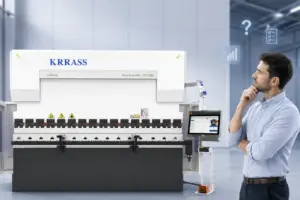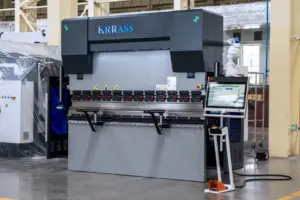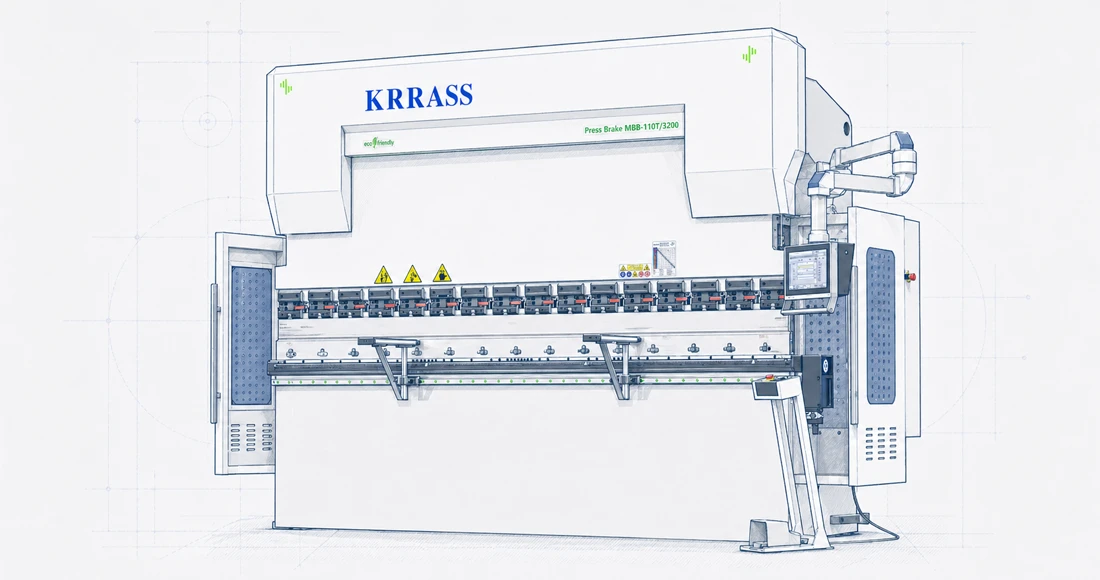
A hydraulic press brake is still one of the most practical machines for factories that need reliable sheet metal bending across many part sizes, materials, and production volumes. Servo-electric and hybrid bending machines are becoming more common, but the hydraulic press brake remains a strong choice because it combines high tonnage, mature control technology, flexible tooling, and a familiar maintenance model. For many buyers, especially those producing structural parts, electrical cabinets, elevator components, HVAC parts, agricultural machinery covers, construction profiles, trailer parts, or general fabrication work, it is often the safest starting point for building a dependable bending cell.
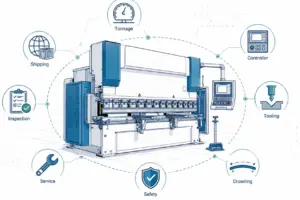
At KRRASS, we look at a hydraulic press brake as more than a machine body with two cylinders. It is a complete bending system: welded frame, ram, worktable, hydraulic cylinders, proportional valves or torsion-bar synchronization, CNC or NC controller, backgauge, crowning system, tooling, safety devices, oil circuit, electrical cabinet, and operator workflow. When those elements are specified correctly, the machine can produce accurate parts for years. When they are selected only by headline tonnage and bending length, the factory may face slow setups, poor angle consistency, tool overload, part collision, or unnecessary energy cost.
This guide explains the key benefits, limits, and best applications of a hydraulic press brake in plain language. It also includes engineering reference tables that a purchasing team can use before requesting a quotation. The numbers are not a substitute for a formal bending calculation or sample test, but they help connect commercial decisions with real production requirements. For more model options, our main KRRASS press brake category shows NC, CNC, hydraulic, hybrid, tandem, and electric servo press brakes available for different bending needs.
Table of Contents
What a hydraulic press brake does in a fabrication workflow
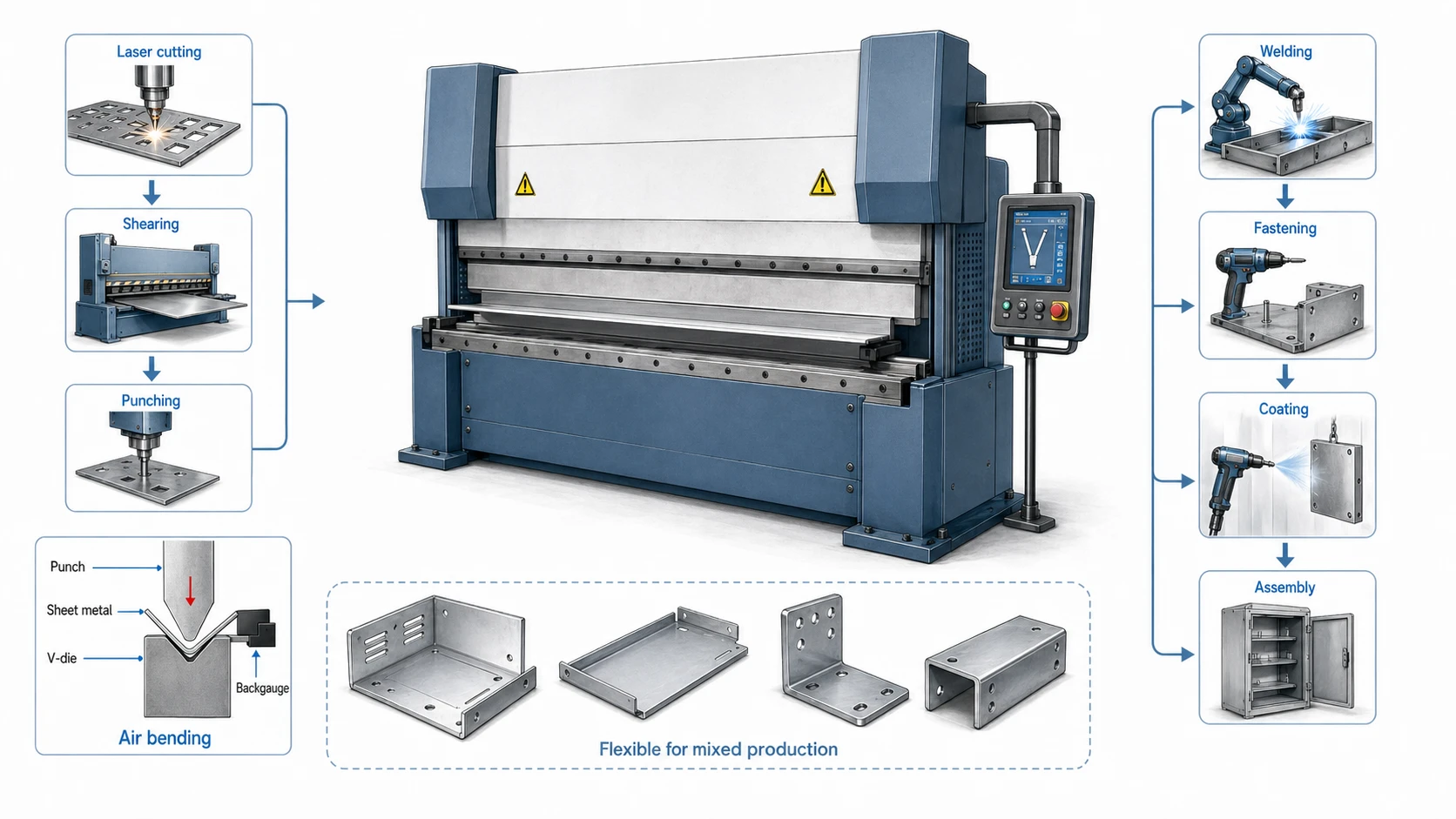
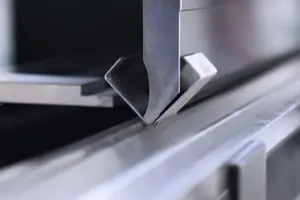
A hydraulic press brake bends sheet metal by driving a ram downward with hydraulic force. The punch mounted on the ram pushes the sheet into a die mounted on the worktable. The material plastically deforms around the tooling radius, and the resulting bend angle depends on ram position, die opening, material thickness, material strength, tool geometry, crowning compensation, and springback. In air bending, the sheet contacts the punch tip and the two die shoulders; in bottom bending or coining, the punch drives the material more deeply into the die profile. Air bending is the most common modern method because it needs less force and allows many angles with the same die, but it also requires better control of ram depth and material variation.
In a complete sheet metal line, the press brake usually works after cutting and before welding, fastening, coating, or assembly. For example, a factory may cut blanks with a fiber laser, shear rectangular panels with a hydraulic shearing machine, punch holes with an ironworker, then bend the parts on a hydraulic press brake. That is why equipment selection should be considered as a process chain, not as isolated machines. A bending cell is more efficient when the cutting method, blank tolerance, tooling plan, bend sequence, operator skill, and quality inspection method are aligned.
A hydraulic press brake is especially valuable when the product mix changes often. Unlike dedicated roll forming or stamping lines, a press brake can bend many different part profiles by changing programs, backgauge positions, and tooling. A cabinet factory may produce short flanges in the morning, long door panels in the afternoon, and thick mounting brackets the next day. This flexibility is one reason hydraulic machines remain common in job shops and mixed-production factories.
Key benefits for business-oriented buyers
The first benefit is force capacity. Hydraulic systems can deliver high bending force in a compact machine format. When a factory needs to bend thick carbon steel, stainless steel, long profiles, or high-strength plates, hydraulic drive is often the most economical route. Large electric servo systems can be efficient, but for many high-tonnage requirements the hydraulic press brake still gives a strong price-to-capability ratio.
The second benefit is application flexibility. A hydraulic press brake can support many tooling styles: standard punches and dies, gooseneck punches, segmented tooling, hemming tools, radius tools, flattening tools, offset tools, and special tools. The tooling plan determines what the machine can actually produce. A machine with enough tonnage but poor tooling coverage may still fail in real production. That is why we usually discuss tooling at the quotation stage, especially when the customer provides drawings with short flanges, box shapes, deep channels, stainless surfaces, or collision-sensitive return flanges. Our press brake tooling chart guide and press brake tooling basics guide are useful internal references when a buyer wants to understand punch, die, and V-opening selection.
The third benefit is mature control technology. A modern CNC hydraulic press brake can use independent Y1/Y2 control, multi-axis backgauges, crowning control, angle compensation, tool libraries, material libraries, and stored bending programs. A controller such as the Delem DA-53T supports a 10.1-inch touch interface, up to four axes, crowning control, tool and material libraries, servo and frequency inverter control, USB exchange, and offline software capability. In practical production, this means fewer manual adjustments, more repeatable programs, and faster training for operators moving from simple NC bending to CNC bending.
The fourth benefit is serviceability. Hydraulic press brakes use components that maintenance teams already understand: oil tanks, filters, pumps, seals, valves, cylinders, hoses, electrical cabinet components, linear scales, backgauge motors, and lubrication points. A disciplined maintenance routine can keep the machine stable. The main responsibility is to control oil cleanliness, temperature, leakage, mechanical alignment, tool condition, and safety devices. If maintenance is neglected, the same hydraulic system becomes a weakness. If it is managed well, it is a predictable production asset.
The fifth benefit is commercial scalability. A buyer can start with an economical NC hydraulic press brake for basic bending, move to a CNC hydraulic machine for better accuracy and productivity, then later add a hybrid or electric servo model for energy-sensitive work. KRRASS supplies different press brake configurations so that a factory can match investment level to real production value instead of overbuying technology that does not improve its parts.
Quick selection table: where hydraulic press brakes fit best
| Factory requirement | Hydraulic press brake fit | Why it fits | What to verify before buying |
|---|---|---|---|
| Thick mild steel bending | Excellent | High force capacity and strong frame options | Required tonnage per meter, tool load rating, deflection control |
| Long sheet bending | Excellent | Available in long beds and tandem configurations | Bending length, throat depth, crowning, handling support |
| Mixed job shop production | Excellent | Flexible tooling and programmable backgauge | Tooling range, controller level, setup workflow |
| Low to medium batch production | Excellent | Good balance of cost and capability | Operator skill, program storage, quick clamps |
| Very high-volume small-part bending | Good, but not always best | Can run repeatably, but cycle time and handling matter | Automation, part support, robot compatibility, electric alternatives |
| Ultra-low energy consumption target | Moderate | Conventional hydraulics consume more standby energy | Hybrid servo or electric servo comparison |
| Clean-room or oil-free preference | Limited | Hydraulic oil is part of the system | Electric servo press brake or strict oil control plan |
| Very high angle precision with thin sheets | Good to excellent | CNC, crowning, tooling, and material control can deliver high accuracy | Linear scales, controller, angle measurement, tool quality |
This table is intentionally practical. A hydraulic press brake is not “best” because it is traditional; it is best when its strengths match the part mix. When the buyer understands the bending length, thickness range, material grade, monthly volume, tolerance target, and tooling needs, machine selection becomes a business decision rather than a catalog comparison.
How hydraulic force translates into bending capacity
Many buyers ask for a 100-ton, 160-ton, or 220-ton hydraulic press brake without first calculating the parts they need to bend. Tonnage is important, but the real question is force per bending length. A short bracket may concentrate force in a small tool section. A long door panel may require a lower force per meter but demand excellent straightness across the entire bend. The machine, tooling, and part geometry must all be considered together.
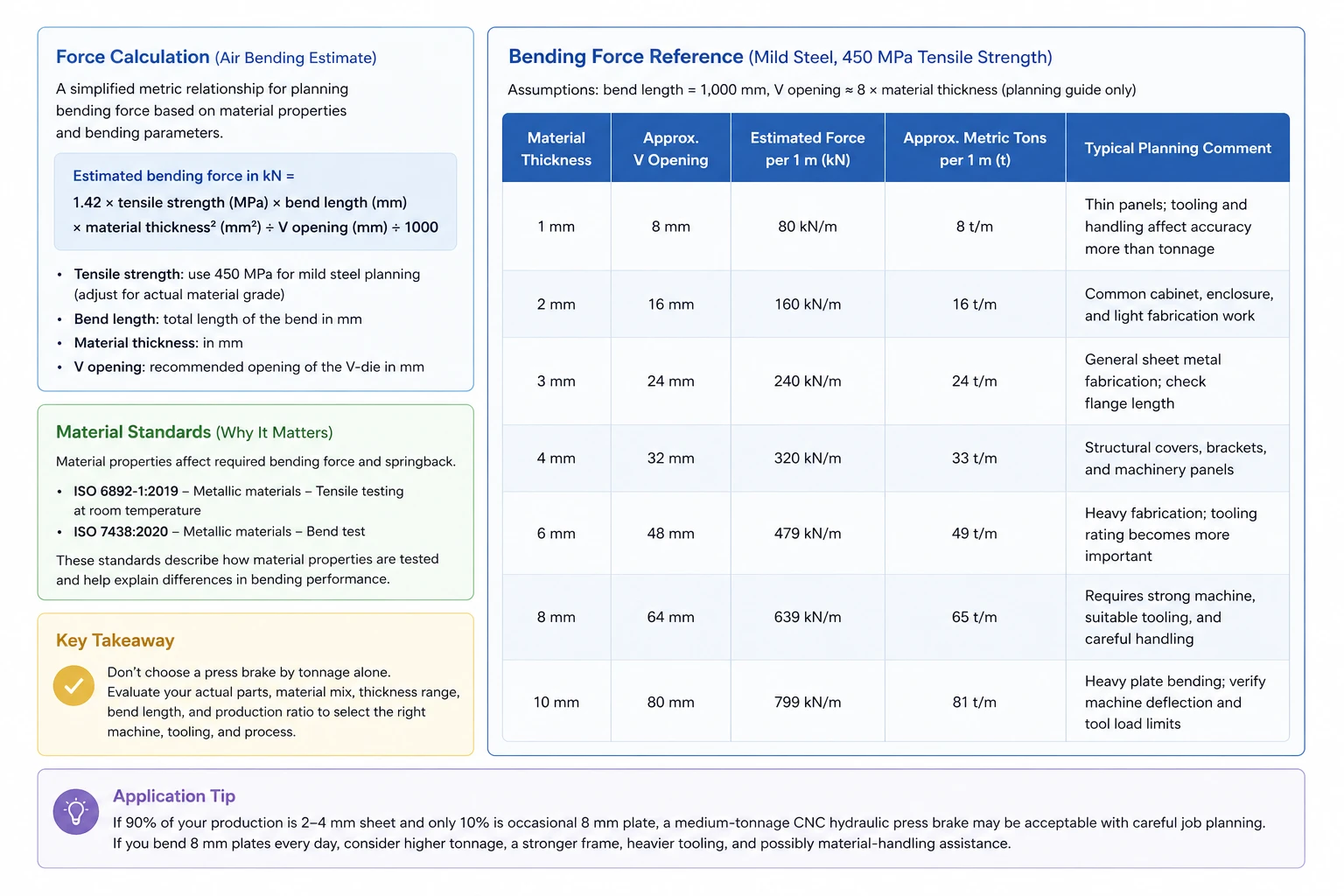
A common air-bending estimate is based on material tensile strength, bend length, material thickness, and V-die opening. The simplified metric relationship below is useful for planning:
Estimated bending force in kN = 1.42 × tensile strength (MPa) × bend length (mm) × material thickness² (mm²) ÷ V opening (mm) ÷ 1000
For mild steel planning, many factories use a tensile strength near 450 MPa as a reference value. The exact value depends on the steel grade and mill certificate. When the material changes to stainless steel, aluminum, wear-resistant plate, or high-strength steel, the force requirement changes. Material testing standards such as ISO 6892-1:2019 define tensile testing methods for metallic materials at room temperature, while ISO 7438:2020 specifies a method for determining the ability of metallic materials to undergo plastic deformation in bending. These standards are not press brake buying manuals, but they explain why material properties matter when we calculate bending force and springback.
The following table uses mild steel at 450 MPa, a 1,000 mm bend length, and a V opening of about 8 times material thickness. It is only a planning guide; final machine selection should include actual material, tooling, bend angle, flange length, and safety margin.
| Material thickness | Approx. V opening | Estimated force per 1 m | Approx. metric tons per 1 m | Typical planning comment |
|---|---|---|---|---|
| 1 mm | 8 mm | 80 kN/m | 8 t/m | Thin panels; tooling and handling affect accuracy more than tonnage |
| 2 mm | 16 mm | 160 kN/m | 16 t/m | Common cabinet, enclosure, and light fabrication work |
| 3 mm | 24 mm | 240 kN/m | 24 t/m | General sheet metal fabrication; check flange length |
| 4 mm | 32 mm | 320 kN/m | 33 t/m | Structural covers, brackets, and machinery panels |
| 6 mm | 48 mm | 479 kN/m | 49 t/m | Heavy fabrication; tooling rating becomes more important |
| 8 mm | 64 mm | 639 kN/m | 65 t/m | Requires strong machine, suitable tooling, and careful handling |
| 10 mm | 80 mm | 799 kN/m | 81 t/m | Heavy plate bending; verify machine deflection and tool load limits |
This table also explains why a customer should not select a machine only by the thickest material. If 90% of production is 2 to 4 mm sheet and only 10% is occasional 8 mm plate, the buying decision may be different from a factory that bends 8 mm plates every day. In the first case, a medium-tonnage CNC hydraulic press brake may be acceptable with careful job planning. In the second case, the buyer should consider higher tonnage, a stronger frame, heavier tooling, and possibly material-handling assistance.
The commercial value of a stable frame and crowning system
A hydraulic press brake frame looks simple from a distance, but it is one of the most important parts of the machine. During bending, force is not applied only at the tooling. It travels through the ram, side frames, cylinders, worktable, and foundation. Every structure deflects under load. If the center of the machine opens slightly under force, the bend angle in the middle can be different from the angle near the side frames. This is why crowning exists.
Crowning compensates for machine deflection so the bend angle remains more consistent across the length. It may be manual, mechanical, hydraulic, or CNC controlled. For long panels, stainless steel, visible parts, or repeat production, crowning is not a luxury. It is a quality-control requirement. A factory producing electrical cabinet doors or elevator panels cannot accept a part that is correct on the left and right but open in the middle. Rework consumes operator time, damages surfaces, and delays assembly.
From a business perspective, crowning reduces hidden cost. The purchase price of a machine without sufficient crowning may look attractive, but the cost appears later in scrap, trial bends, operator correction, and poor consistency between shifts. When we review a bending project at KRRASS, we look at not only total tonnage but also whether the customer needs better straightness control across the full bed length.
Why hydraulic press brakes remain strong for thick and long parts
High-tonnage bending is the natural territory of hydraulic press brakes. Hydraulic cylinders can generate large force with controllable motion, and the machine frame can be designed for long bed lengths and heavy-duty applications. This makes hydraulic machines suitable for construction machinery, agricultural equipment, shipyard components, trailer parts, steel cabinets, structural profiles, and general heavy fabrication.
Long parts create another challenge: handling. A 3,200 mm or 4,000 mm sheet may not be difficult to bend on paper, but it can be difficult for two operators to support, align, and rotate safely. The buyer may need front support arms, sheet followers, backgauge fingers with suitable range, or tandem machines for very long components. The hydraulic press brake gives the base force and length, but the complete solution must include how the part enters and leaves the bending line.
For very long workpieces, tandem hydraulic press brakes can be configured so two machines work together or separately. This is useful when the factory needs occasional long bends but also wants each machine to remain productive on shorter parts. A single very long press brake may occupy more floor space and sit idle when short jobs dominate. A tandem arrangement can improve flexibility if the product mix justifies the investment.
Limits every buyer should understand before ordering
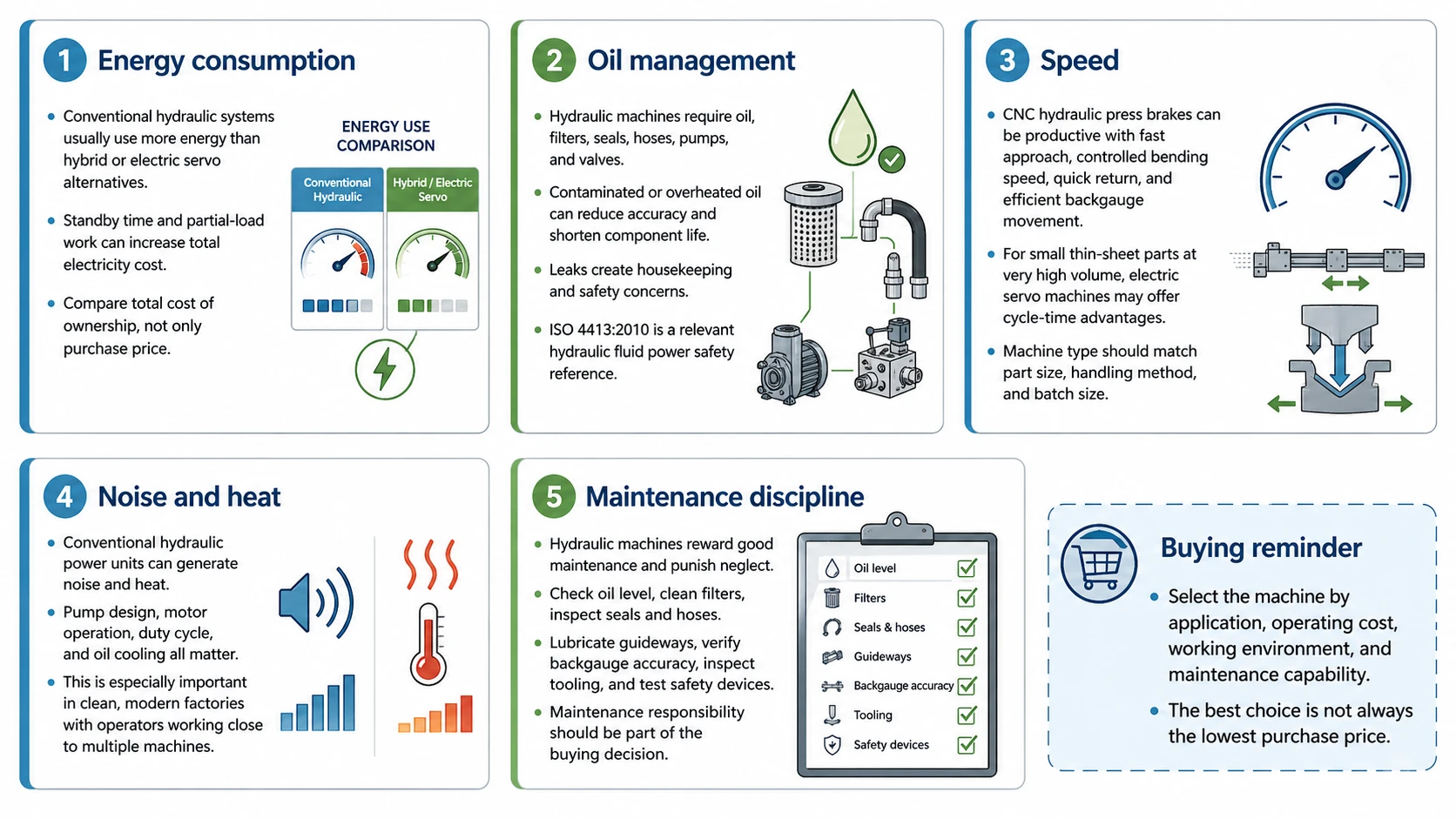
The first limit is energy consumption. A conventional hydraulic press brake usually consumes more energy than a well-designed hybrid or electric servo press brake, especially during standby and partial-load work. For factories with high electricity cost, strict sustainability targets, or many short-cycle jobs, this matters. KRRASS also provides hybrid press brake options; our press brake category notes that some hybrid systems are designed to reduce hydraulic oil and energy consumption while maintaining bending performance. The right comparison is not only purchase price but total cost of ownership over years of use.
The second limit is oil management. Hydraulic machines require oil, filters, seals, hoses, pumps, valves, and temperature control. Contaminated oil can damage valves and reduce accuracy. Hot oil can change system behavior and accelerate seal aging. Leaks create housekeeping and safety problems. Hydraulic system design and maintenance should follow recognized safety principles; ISO 4413:2010 specifies general rules and safety requirements for hydraulic fluid power systems and components used on machinery.
The third limit is speed. Hydraulic machines can be productive, especially with CNC control, fast approach, adjustable bending speed, quick return, and efficient backgauge movement. However, for small thin-sheet parts at very high volume, an electric servo press brake may provide advantages in acceleration, energy use, and cycle efficiency. The machine type should be matched to part size, handling method, and batch size.
The fourth limit is noise and heat. A conventional hydraulic power unit can generate noise and heat, depending on pump design, motor operation, duty cycle, and oil cooling. This may not matter in a heavy fabrication area, but it can matter in a clean, modern factory where operators work close to several machines.
The fifth limit is maintenance discipline. A hydraulic press brake rewards good maintenance and punishes neglect. It is not difficult to maintain, but the factory must actually do the work: check oil level, clean filters, inspect seals and hoses, lubricate guideways, verify backgauge accuracy, inspect tooling, test safety devices, and keep the machine level. Buyers should include maintenance responsibility in the purchase decision instead of treating it as an afterthought.
Application fit by industry
| Industry or product type | Common materials | Why hydraulic press brake works well | Buying focus |
|---|---|---|---|
| Electrical cabinets and enclosures | 1-3 mm mild steel, galvanized sheet, stainless steel | Flexible bending programs, good repeatability, many flange styles | CNC controller, backgauge accuracy, segmented tooling, surface protection |
| HVAC and ventilation | Thin galvanized sheet, stainless sheet, aluminum | High mix, many channels and flanges, moderate tonnage | Tooling variety, fast setup, safe handling of large sheets |
| Elevator and architectural panels | Stainless steel, coated steel, aluminum | Long visible bends require straightness and surface protection | Crowning, polished tooling, protective film, angle consistency |
| Construction machinery covers | 3-8 mm mild steel and high-strength steel | Thick and medium-length parts need strong force | Tonnage reserve, frame rigidity, tool load capacity |
| Agricultural machinery | Carbon steel, wear parts, formed covers | Mixed production and robust part geometry | Heavy-duty tooling, simple operation, reliable hydraulics |
| Trailer and vehicle components | Mild steel, aluminum, high-strength steel | Long profiles and structural bends | Bed length, tandem option, material springback planning |
| General fabrication factories | Mixed materials and drawings | Job-shop flexibility and broad tooling options | CNC/NC choice, quick clamps, tooling library, service support |
A hydraulic press brake can work in all these industries, but each industry stresses a different part of the machine. Thin stainless elevator panels are not difficult because of tonnage; they are difficult because of surface requirements and angle consistency. Thick construction covers are not difficult because of programming; they are difficult because of force, tooling load, and handling. The same machine model may be perfect for one application and inefficient for another if the accessories are wrong.
Tooling is where many bending decisions become real
A press brake without the correct tooling is only a force generator. The tooling determines inside radius, minimum flange length, surface marking, collision clearance, angle stability, and load capacity. For air bending, the V opening is often selected as a multiple of thickness. A larger V opening lowers tonnage but increases inside radius and minimum flange length. A smaller V opening supports shorter flanges but raises tonnage and can mark the workpiece more aggressively.
Minimum flange length is a common problem. The sheet must sit safely on the die shoulders. If the flange is too short for the selected V opening, the part becomes unstable, drops into the die, or bends inaccurately. As a planning rule, minimum flange length is often around 70% of the V opening, but this depends on die geometry, material thickness, punch radius, die shoulder radius, and bend angle.
| V opening | Approx. minimum flange at 70% of V | Typical use | Main caution |
|---|---|---|---|
| 8 mm | 5.6 mm | Thin sheet and small components | Higher marking risk and higher force per length |
| 16 mm | 11.2 mm | 2 mm mild steel class work | Good general-purpose range |
| 24 mm | 16.8 mm | 3 mm sheet and light structural parts | Check short flanges and return bends |
| 32 mm | 22.4 mm | 4 mm sheet | Requires more flange room and larger inside radius |
| 48 mm | 33.6 mm | 6 mm plate | Tool load and part handling become important |
| 64 mm | 44.8 mm | 8 mm plate | Heavy tooling and deflection control are critical |
Tooling collision is another issue. A straight punch may bend the first flange well but collide with the part on the second bend. A gooseneck punch may solve the collision but have lower load capacity than a heavy straight punch. Segmented tooling may allow boxes and pans but requires safe clamping and organized storage. Hemming tools can create folded edges but need correct tonnage and process sequence. These details are why we prefer to review sample drawings instead of quoting only by tonnage and length.
CNC, NC, and control choice
A hydraulic press brake may be NC or CNC. NC machines are suitable for simple bending where the operator can manage adjustments and the factory does not need advanced multi-axis control. CNC machines are better for repeatability, program storage, multi-step parts, Y1/Y2 synchronization, backgauge control, crowning, material libraries, and reduced setup time.
For buyers moving from manual or NC bending to CNC bending, the commercial value is not only better accuracy. It is lower dependence on a single experienced operator. When bending knowledge is stored in programs and tool libraries, the factory can train new operators more consistently. This reduces the risk that production quality changes when one skilled operator is absent.
A controller such as Delem DA-53T is common in CNC hydraulic press brake configurations because it balances functionality and usability. KRRASS also provides models using different controller levels depending on the customer's budget and production complexity. Our CNC Press Brake with DELEM DA53T Controller page is a useful internal reference for customers comparing controller options in a practical machine configuration.
The backgauge also matters. A basic backgauge positions the sheet for bend depth. A more advanced backgauge may support multiple axes, allowing better positioning for complex parts. For cabinet work, deep boxes, offset flanges, and parts with irregular edges, backgauge capability can directly affect setup time and scrap rate.
Accuracy: what the machine controls and what it cannot fully control
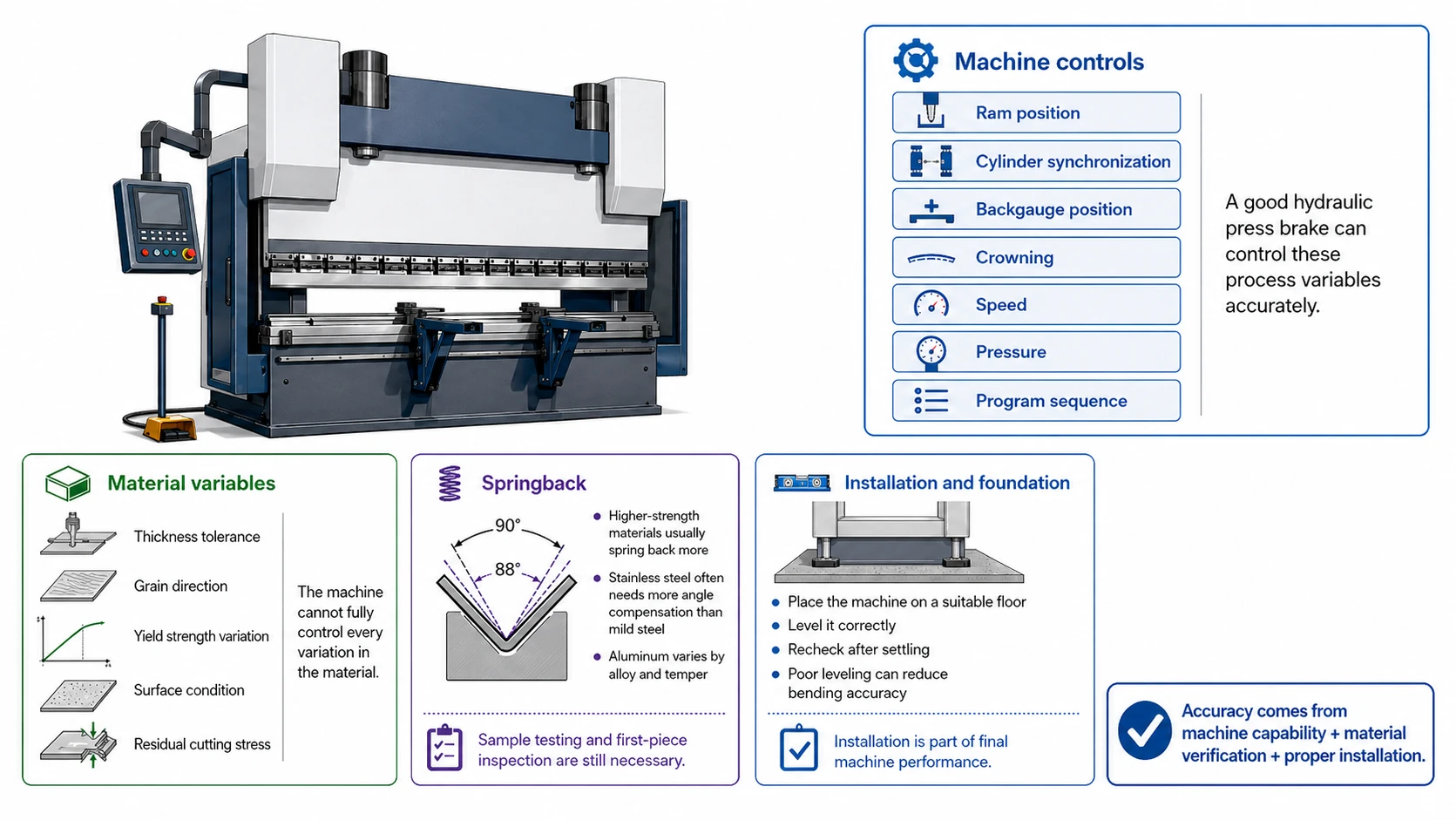
A good hydraulic press brake can control ram position, cylinder synchronization, backgauge position, crowning, speed, pressure, and program sequence. It cannot fully control every variable in the material. Material thickness tolerance, grain direction, yield strength variation, surface condition, and previous cutting stress all affect the final bend angle. This is why sample testing and first-piece inspection are still necessary.
Springback is especially important. Higher-strength materials usually spring back more. Stainless steel often needs more angle compensation than mild steel. Aluminum can vary depending on alloy and temper. A CNC controller and experienced operator can compensate, but the buyer should understand that the machine is part of a controlled process, not a magic correction device.
Accuracy also depends on the foundation and installation. A press brake should be placed on a suitable floor, leveled correctly, and checked after settling. If a machine twists because the foundation is poor or the leveling is neglected, bending accuracy will suffer. KRRASS provides setup guidance because installation is part of the machine's final performance. A high-quality machine installed carelessly may behave like a poor machine.
Safety and compliance should be part of the buying decision
A hydraulic press brake creates a pinch point between punch and die. Safety must be designed into the machine and the workflow. Typical safeguards may include light curtains, laser guarding, two-hand controls for certain operations, emergency stops, safety covers, foot pedal protection, safe speed modes, operator training, tooling handling rules, and written procedures.
The applicable regulations vary by country and factory environment, so buyers should consult local safety requirements. In the United States, ANSI B11.3-2022 covers safety requirements for power press brakes, and OSHA has published interpretations related to press brake safeguarding, including the use of laser guarding systems with hydraulic press brakes. OSHA notes that ANSI B11.3 is recognized as the national consensus standard covering power press brake guarding in the context discussed in its laser guarding interpretation. For general machinery risk reduction, ISO 12100:2010 provides principles and methodology for risk assessment and risk reduction in machinery design.
Safety is not only a compliance issue. It affects productivity. Operators work faster when they trust the machine and the process. Poor guarding, confusing procedures, or unsafe part handling slows production and increases risk. A good bending cell makes the safe method the easiest method.
Maintenance planning table
| Maintenance area | Daily / shift check | Weekly / monthly check | Business reason |
|---|---|---|---|
| Hydraulic oil | Check level, temperature, unusual noise | Inspect contamination, replace filters as scheduled | Protects valves, pump, cylinders, and repeatability |
| Tooling | Check damage, cleanliness, correct seating | Inspect wear, radius damage, segmentation condition | Prevents marking, angle errors, and tool failure |
| Backgauge | Confirm smooth movement and obvious positioning errors | Verify accuracy with test pieces or measuring tools | Reduces scrap from flange-length errors |
| Ram and guides | Listen for abnormal movement | Lubricate and inspect guide clearance | Maintains repeatability and reduces wear |
| Safety devices | Test emergency stop and guards according to procedure | Review stop distance and safety function checks as required | Protects operators and reduces legal risk |
| Electrical cabinet | Keep clean and dry | Inspect terminals, fans, drive alarms, and cable condition | Prevents downtime from avoidable electrical faults |
| Machine level | Observe unusual angle inconsistency | Recheck level after installation or floor changes | Supports long-term bending accuracy |
The exact schedule depends on the machine model, usage intensity, factory environment, and local standards. Dusty, hot, or heavy-duty environments need stricter maintenance. A factory that bends thick plate all day should inspect tooling and hydraulic performance more frequently than a factory bending light galvanized sheet in small batches.
Hydraulic vs hybrid vs electric servo press brakes
Machine selection is not about declaring one technology superior in every case. It is about matching the drive system to the work. Conventional hydraulic press brakes are strong, familiar, and cost-effective for broad fabrication. Hybrid servo-hydraulic press brakes improve energy use, noise, oil stress, and responsiveness by controlling hydraulic power more intelligently. Electric servo press brakes can be excellent for thin-sheet precision work, high-speed small parts, and factories prioritizing oil-free operation.
| Machine type | Best strengths | Typical limits | Best buyer profile |
|---|---|---|---|
| Conventional hydraulic press brake | High tonnage, mature technology, broad tooling compatibility, strong value | More oil, higher standby energy, more hydraulic maintenance | General fabrication, thick parts, mixed production, budget-sensitive buyers |
| CNC hydraulic press brake | Better repeatability, Y1/Y2 control, program storage, crowning, productivity | Higher investment than NC, still requires hydraulic maintenance | Factories needing consistent quality and faster setups |
| Hybrid servo-hydraulic press brake | Lower energy use, lower noise, less oil stress, better efficiency | Higher purchase price, more advanced system integration | Medium to high productivity factories focused on total cost |
| Electric servo press brake | High efficiency, low maintenance, no hydraulic oil, fast response | Tonnage and application range may be less economical for heavy plate | Thin to medium sheet, high mix, clean factories, energy-sensitive work |
For many factories, the best answer is not one machine type for all work. A practical factory may use a hydraulic press brake for heavy and long parts, an electric servo press brake for small thin parts, and a shearing or laser cutting machine upstream depending on blank requirements. KRRASS supports this broader equipment view through solutions such as hydraulic shearing machines, fiber laser cutting machines, and ironworker machines for cutting, punching, and preparation processes.
Best applications for hydraulic press brakes
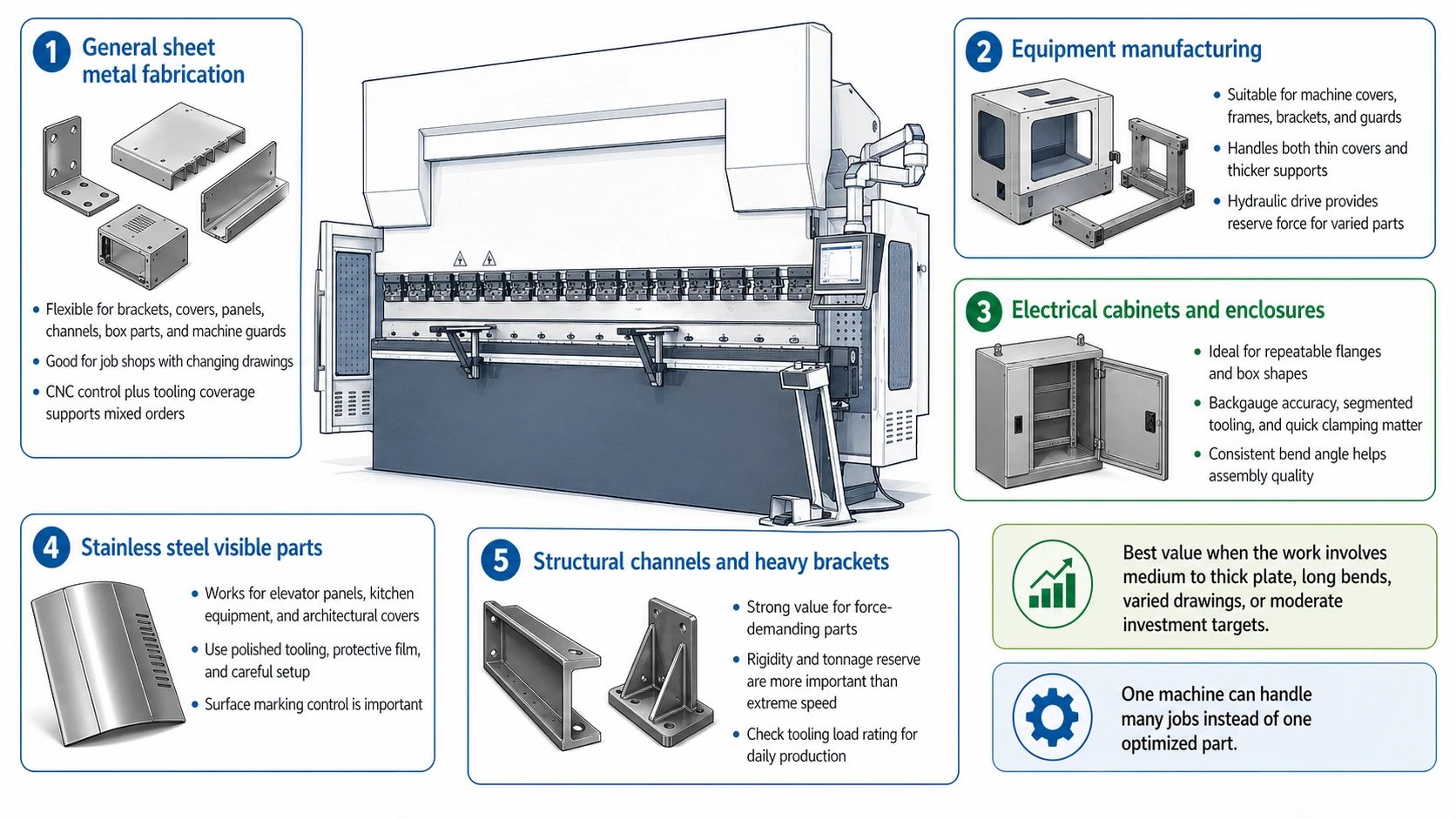
A hydraulic press brake is often the best choice when the work involves medium to thick plate, long bends, varied drawings, or moderate investment targets. It is also a strong choice when the factory needs one machine to handle many jobs rather than one optimized part. Below are the application groups where hydraulic bending usually delivers the clearest value.
For general sheet metal fabrication, the hydraulic press brake gives the flexibility to accept different orders. Job shops rarely control the customer's drawings. They need a machine that can adapt quickly. A CNC hydraulic press brake with enough tooling coverage allows the factory to bend brackets, covers, panels, channels, small boxes, and machine guards without buying dedicated equipment for each shape.
For equipment manufacturing, hydraulic press brakes are useful because machine covers, frames, brackets, and guards vary in size and thickness. A factory making agricultural equipment, construction machinery, packaging machines, or industrial ovens may need to bend both thin covers and thick supports. Hydraulic drive gives the reserve force needed for this mix.
For electrical cabinets and enclosures, hydraulic press brakes are common because the part family uses repeatable flanges and box shapes. The key is not only tonnage. It is backgauge accuracy, segmented tooling, quick clamping, and a good controller. A cabinet factory should also care about surface protection and consistent bend angles so doors and panels assemble correctly.
For stainless steel visible parts, such as elevator panels, kitchen equipment, and architectural covers, hydraulic press brakes can perform well when equipped with polished tooling, protective film, crowning, and careful setup. The risk is surface marking. The buyer should discuss tooling and bending method before ordering.
For structural channels and heavy brackets, hydraulic press brakes offer strong commercial value. These parts need force and rigidity more than extreme speed. The machine should be selected with enough tonnage reserve and tooling load rating to avoid working at the limit every day.
When a hydraulic press brake may not be the best first choice
If a factory bends only very small thin parts in high volume, a compact electric servo press brake may offer better speed and energy efficiency. If the factory requires an oil-free production area, electric drive may be preferable. If the parts are extremely repetitive and high volume, a dedicated forming die, panel bender, or automated bending system may be more productive than manual press brake bending. If the product requires continuous long profiles with the same cross-section, roll forming may be better.
A hydraulic press brake also may not solve poor upstream blank quality. If laser cutting leaves burrs, if shearing is not square, if material thickness varies widely, or if holes are too close to the bend line, the bending process will be unstable. The buyer should look at the complete production process. Good bending starts before the sheet reaches the press brake.
How to specify a hydraulic press brake before requesting a quotation
A useful quotation request should include more than “100 ton 3200 mm.” A supplier needs enough information to understand the real work. The following data helps us recommend the correct machine and options.
| Information to prepare | Why it matters | Example |
|---|---|---|
| Maximum bending length | Determines bed length and frame size | 3,200 mm full-length bending |
| Material type and grade | Changes tonnage and springback | Mild steel, stainless steel 304, aluminum 5052 |
| Thickness range | Determines tonnage and tooling | 1.0-6.0 mm regular; 8.0 mm occasional |
| Shortest flange | Determines V opening and tooling feasibility | Minimum 12 mm flange on 2 mm sheet |
| Bend angles and radius | Determines tooling and process | 90 degree air bending, large radius bends |
| Part drawings | Reveals collision and sequence issues | Boxes, channels, return flanges |
| Monthly volume | Helps choose NC, CNC, hybrid, or automation | 500 parts/month vs 50,000 parts/month |
| Accuracy target | Defines controller, crowning, and inspection needs | ±0.5 degree angle tolerance |
| Surface requirement | Affects tooling finish and protective measures | No visible marks on stainless panels |
| Factory power and layout | Affects installation and options | Voltage, floor space, crane, foundation |
This preparation saves time and prevents wrong quotations. If the buyer provides drawings, we can evaluate bend sequence, tooling risk, tonnage, flange length, and possible collision before the machine is ordered. That is far more reliable than guessing from a product name.
Practical cost factors beyond the machine price
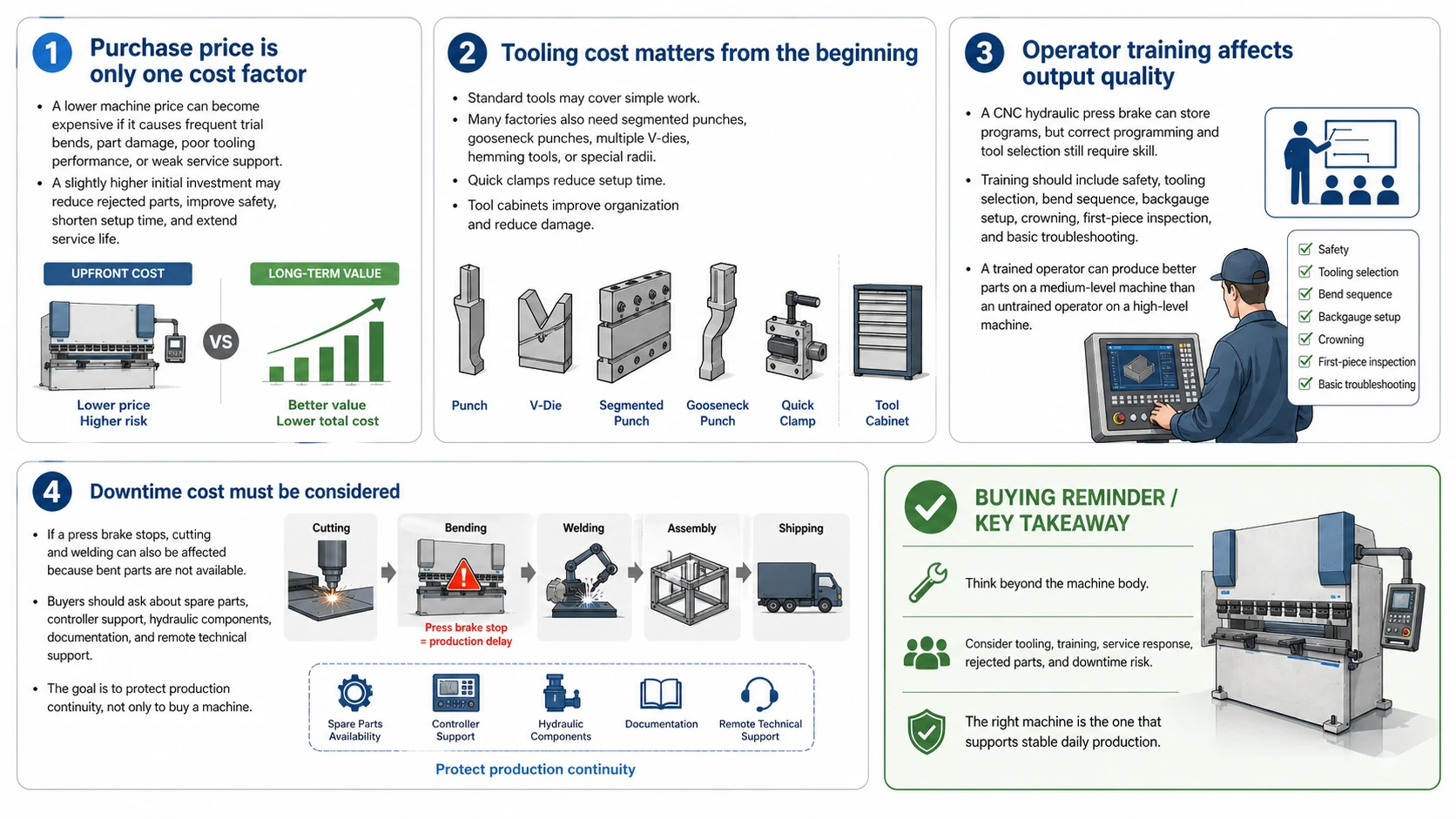
The purchase price is only one part of the cost. A cheaper hydraulic press brake may become expensive if it requires frequent trial bends, damages parts, uses poor tooling, or lacks local service support. A slightly higher initial investment may save money through faster setup, fewer rejected parts, better safety, and longer service life.
Tooling cost should be planned from the beginning. Standard tools may cover simple work, but many factories need segmented punches, gooseneck punches, multiple V dies, hemming tools, or special radii. Quick clamps can reduce setup time. Tool cabinets improve organization and reduce damage. These items may not look as impressive as the machine body, but they directly affect daily productivity.
Operator training also matters. A CNC hydraulic press brake can store programs, but someone must create correct programs and choose suitable tools. Training should include safety, tooling selection, bend sequence, backgauge setup, crowning, first-piece inspection, and basic troubleshooting. A trained operator can produce better parts on a medium-level machine than an untrained operator on a high-level machine.
Downtime cost should be considered. If a press brake stops, cutting and welding areas may also be affected because bent parts are not available. Buyers should ask about spare parts, controller support, hydraulic components, documentation, and remote technical support. The goal is not only to buy a machine, but to protect production continuity.
Recommended hydraulic press brake configuration by production level
| Production level | Recommended configuration | Why it makes sense |
|---|---|---|
| Basic fabrication | NC hydraulic press brake, standard backgauge, essential tooling | Lower investment for simple bends and occasional work |
| Growing factory | CNC hydraulic press brake, Y1/Y2 control, CNC crowning, quality tooling | Better repeatability, less operator dependence, faster setup |
| Cabinet and enclosure production | CNC hydraulic press brake, multi-axis backgauge, segmented tooling, quick clamps | Supports many flanges, boxes, and repeated programs |
| Heavy fabrication | High-tonnage hydraulic press brake, heavy tooling, robust frame, front supports | Handles thick materials and long workpieces safely |
| High-mix professional production | CNC hydraulic or hybrid servo press brake, advanced controller, tool library, angle support | Reduces setup time and improves consistency across different jobs |
| Long-part production | Tandem hydraulic press brakes or long-bed machine, support systems | Enables long bends while preserving flexibility |
This table is a starting point. The final configuration should be based on actual drawings and production strategy. A buyer who plans to upgrade from simple bending to export-quality components should not specify only for today's easiest jobs. The machine should support the factory's next stage of growth.
Quality checks after installation
After a hydraulic press brake is installed, the factory should verify more than whether the ram moves. Installation acceptance should include leveling, hydraulic pressure check, oil leakage inspection, backgauge positioning check, safety function test, tool clamping inspection, sample bending across left-center-right positions, and controller program verification. If the machine has crowning, sample parts should be checked across the bending length to confirm angle consistency.
A simple acceptance test can include bending the same material at several positions across the bed, measuring the angle, measuring flange length, and checking surface marks. If there are differences, the cause may be crowning, tooling seating, material variation, leveling, or operator setup. This test creates a baseline for future maintenance.
The factory should also define who is responsible for daily checks. If nobody owns the routine, it will be skipped. A hydraulic press brake is a production machine, not a decorative asset. The best-performing customers usually treat maintenance, tooling storage, and operator training as part of the same system.
How KRRASS approaches hydraulic press brake recommendations
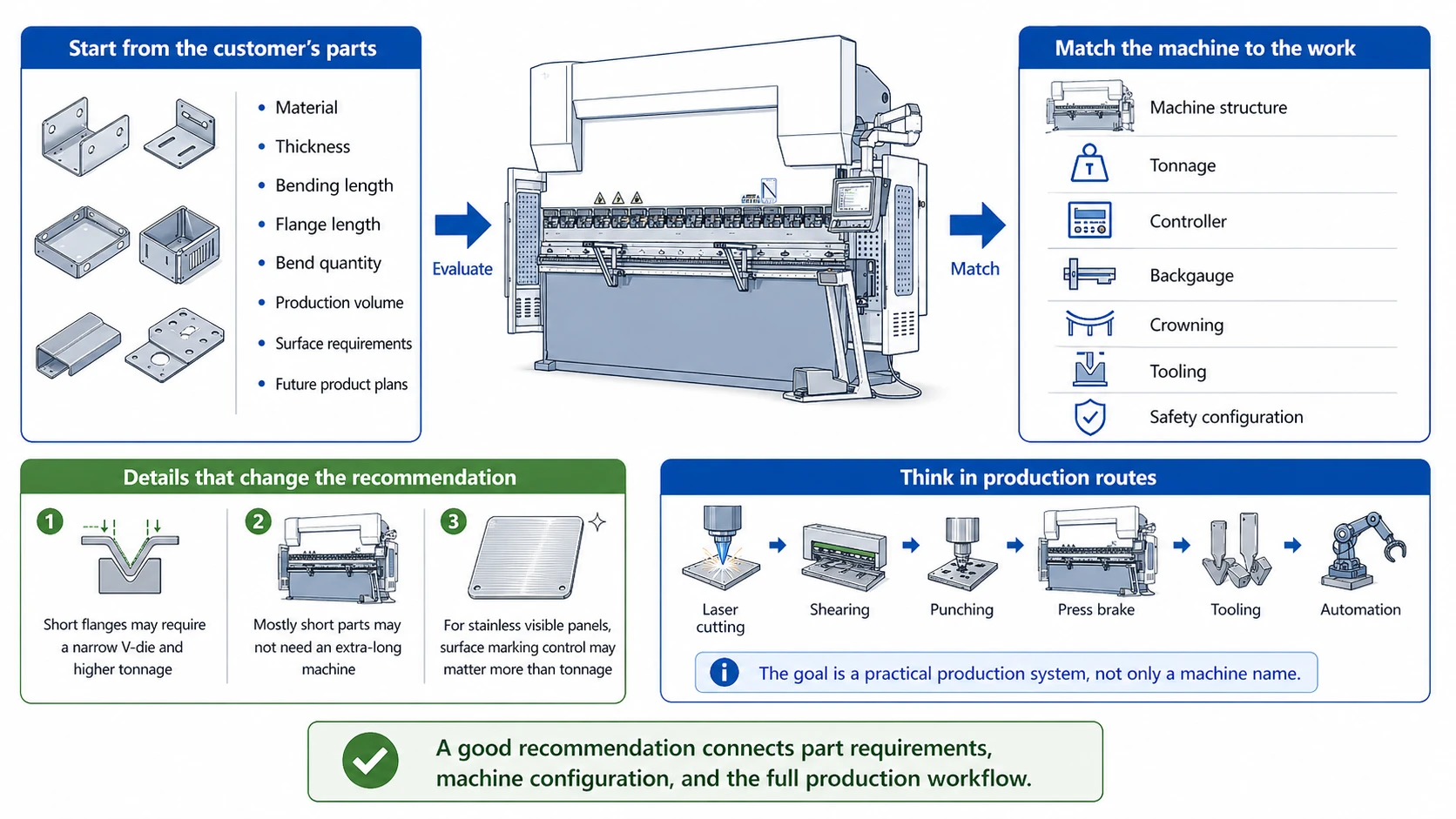
When we recommend a hydraulic press brake, we start with the customer's parts. We ask about material, thickness, bending length, flange length, bend quantity, production volume, surface requirements, and future product plans. Then we match the machine structure, tonnage, controller, backgauge, crowning, tooling, and safety configuration to that work.
Our experience in sheet metal forming equipment manufacturing helps us identify details that may not appear in a simple inquiry. For example, a buyer may ask for a 160-ton 3200 mm machine, but the drawings show short flanges requiring a narrow V opening. That raises tonnage and tooling load. Another buyer may ask for a long machine, but most parts are short except one occasional product. In that case, a tandem solution or different production route may be worth discussing. A third buyer may focus on tonnage, while the real problem is surface marking on stainless steel panels. Then tooling selection becomes the priority.
KRRASS provides press brakes together with other sheet metal equipment because many customers need a complete production route. A bending project may start with a press brake inquiry but expand into shearing, laser cutting, punching, tooling, or automation. Our role is to help the customer buy a practical production system, not simply a machine name.
Common mistakes when buying a hydraulic press brake
The first mistake is buying too little tonnage. A machine that barely meets the estimated force may work for sample parts but struggle in daily production. Operators then use wider dies, change bend sequence, reduce part quality, or overload tools. It is better to include reasonable reserve based on the actual material and bend length.
The second mistake is buying too much length without a reason. A longer machine costs more, uses more floor space, and may not improve productivity if most parts are short. Bed length should match real parts and future plans.
The third mistake is ignoring tooling. Tooling is not an accessory to be solved later. It is part of the bending process. If the quotation includes only the machine body, the buyer may discover after delivery that the machine cannot produce key parts efficiently.
The fourth mistake is underestimating safety. A press brake can be dangerous if guarding, procedures, and training are weak. Safety devices should be selected according to the parts and local rules, not only to reduce cost.
The fifth mistake is comparing machines only by price. Two machines with the same nominal tonnage may differ in frame rigidity, controller capability, backgauge precision, crowning design, hydraulic components, tooling compatibility, documentation, and service support. The cheaper machine is not always the lower-cost machine.
FAQ
Is a hydraulic press brake accurate enough for modern sheet metal production?
Yes, when specified correctly. A CNC hydraulic press brake with Y1/Y2 control, linear scales, suitable backgauge, crowning, quality tooling, and proper installation can produce accurate and repeatable bends for many modern sheet metal applications. The remaining variables are material consistency, tooling condition, setup method, and operator practice.
What tonnage should I choose?
Start with the material type, thickness, bend length, V opening, and bend method. Use a bending force estimate, then add a practical safety margin. Do not select tonnage only from the thickest material name. Provide drawings to KRRASS so we can check flange length, tooling feasibility, and collision risk.
Is an NC hydraulic press brake still worth buying?
Yes, for simple bends, lower budgets, and factories where the operator has enough experience. However, if the factory needs repeated programs, better consistency, shorter setup time, or multiple operators, CNC control usually provides stronger long-term value.
Does a hydraulic press brake need special tooling?
It depends on the parts. Simple 90-degree bends may use standard punches and dies. Box parts, return flanges, hems, large radii, stainless visible surfaces, or short flanges may need special tooling. Tooling should be discussed before purchase.
When should I consider a hybrid or electric servo press brake instead?
Consider hybrid or electric servo technology when energy use, noise, oil reduction, high-speed small parts, or clean production are major priorities. For heavy plate, long bends, and broad general fabrication, a hydraulic press brake may still be the stronger commercial choice.
Conclusion: the best hydraulic press brake is the one matched to your parts
A hydraulic press brake remains one of the most valuable machines in sheet metal fabrication because it offers strong force, flexible tooling, mature control, and broad application coverage. Its limits are also clear: energy consumption, hydraulic maintenance, oil management, speed in certain small-part applications, and the need for disciplined setup. Buyers who understand both sides make better decisions.
For most factories, the correct question is not “Is a hydraulic press brake good?” The correct question is “Which hydraulic press brake configuration fits our material, drawings, volume, tolerance, tooling, safety requirements, and future growth?” When that question is answered carefully, the machine becomes a long-term production asset.
KRRASS can help evaluate your bending requirements and recommend a practical configuration based on real workpieces. If your factory is planning a new bending cell, upgrading from an older machine, or comparing hydraulic, hybrid, and electric servo press brakes, start by preparing your part drawings, material range, thickness range, and expected production volume. With that information, we can help you build a bending solution that supports reliable production, controlled cost, and better sheet metal quality.