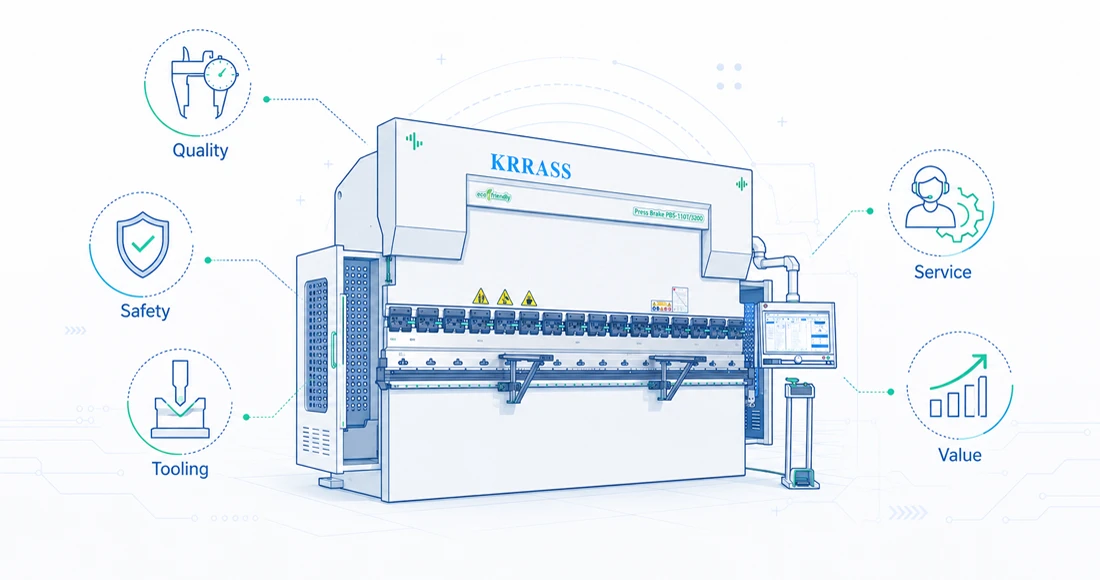
When buyers compare press brake manufacturers, the first number they often notice is the machine price. That is understandable. A press brake is a major capital investment, and every factory has a budget. However, after many years working with sheet metal forming equipment, we have learned that the lowest quotation is not always the lowest-cost decision. A press brake is not only a welded frame with cylinders, a control system, and a backgauge. It is a production system that influences bending accuracy, operator efficiency, tooling cost, safety compliance, spare parts availability, and the customer's ability to accept more difficult jobs in the future.
At KRRASS, we manufacture and supply sheet metal forming equipment for global customers, including press brakes, hydraulic shearing machines, fiber laser cutting machines, ironworker machines, and related tooling and automation options. This gives us a practical view of how buyers actually use machines after delivery. A machine that looks inexpensive during quotation can become expensive if it needs constant adjustment, cannot hold the required angle, lacks suitable tooling, creates avoidable safety concerns, or cannot be supported quickly when production stops.
This guide explains how to compare press brake manufacturers beyond price alone. It is written for purchasing managers, factory owners, engineers, production supervisors, and distributors who need a clear and practical evaluation method. The purpose is not to make the decision complicated. The purpose is to make the comparison fair, technical, and connected to real production results.
Table of Contents
Why price-only comparison is risky
A press brake quotation can look simple: tonnage, bending length, controller, number of axes, main motor, shipping terms, and price. But two quotations with the same headline capacity can represent very different machines. One 110-ton 3200 mm press brake may include basic NC control, manual crowning, simple backgauge movement, standard clamping, and limited safety options. Another 110-ton 3200 mm machine may include CNC Y1/Y2 synchronization, CNC crowning, multi-axis backgauge, laser safety, higher-grade hydraulic components, European-style precision clamping, offline programming support, and more complete training.
For a purchasing team, the real question is not only, "Which manufacturer gives the lowest number?" The better question is, "Which manufacturer gives the most reliable bending result for our products, operators, compliance needs, and future workload?" That question immediately changes the evaluation. You begin to compare the machine as a complete production asset instead of a commodity.
A price-only comparison also hides indirect costs. A machine that saves money on the first invoice may cost more through scrap, rework, slower setup, longer tool changes, difficult troubleshooting, or additional retrofits. If one machine requires ten extra minutes of setup per job and the factory changes jobs several times per day, the production loss becomes real money. If poor crowning control causes inconsistent angles on long parts, the buyer may lose material, operator time, and customer confidence. If the manufacturer cannot provide correct manuals, electrical drawings, hydraulic diagrams, or spare parts, the factory may face downtime that far exceeds the original price difference.
The following table shows why a lower purchase price should never be evaluated alone.
| Quotation item | What buyers often compare | What should also be checked | Possible hidden cost if ignored |
|---|---|---|---|
| Machine price | Initial invoice | Configuration, frame design, controller level, tooling, safety, service | Rework, scrap, downtime, retrofit cost |
| Tonnage and length | Nominal capacity | Material type, thickness, V opening, bend length, flange size | Underpowered machine or oversized machine |
| CNC controller | Brand and screen size | Axis control, programming logic, material library, offline software, operator workflow | Longer setup time and more trial bends |
| Backgauge | Number of axes | Speed, repeatability, finger design, linear guide quality, collision clearance | Poor part positioning and operator delay |
| Crowning | Manual or CNC | Long-part accuracy, material thickness range, operator skill requirement | Angle inconsistency along the bend |
| Tooling | Included or not included | Punch style, die opening, segmentation, load rating, clamping compatibility | Extra tooling purchase and part collision problems |
| Safety | CE or basic guards | Point-of-operation protection, laser guarding, light curtains, safety PLC, documentation | Compliance risk and unsafe operation |
| After-sales support | Warranty length | Spare parts list, remote support, training, response process, local partner network | Longer downtime and uncertain maintenance |
A professional comparison should convert price into value. Value means the machine can produce the required parts accurately, safely, and repeatedly while keeping the factory productive over many years.
Start with your real bending requirement
The most reliable way to compare press brake manufacturers is to begin with the buyer's own parts. A press brake is selected for work, not for a brochure. Before asking for quotations, the buyer should prepare drawings, materials, thickness ranges, bending length, minimum flange size, required inside radius, tolerance, surface requirements, production volume, and expected future products.
This is why KRRASS provides tools such as the Press Brake Configurator and the Bending Force Calculator. These tools are useful starting points because they help buyers think beyond tonnage. Tonnage is important, but it is only one part of the selection. The die opening, material strength, bending length, tooling type, and flange geometry can change the real requirement.
For example, a buyer may request a 160-ton 3200 mm press brake because a competitor has that machine in stock. But after reviewing the drawings, the main product might be stainless steel cabinets with short flanges and cosmetic surfaces. That job may require careful die selection, segmented tooling, anti-marking film or tooling, precise backgauge positioning, and good crowning. Another buyer may request the same tonnage and length, but the real application could be thick carbon steel brackets with short production runs. In that case, tooling load capacity, hydraulic stability, and heavy-duty frame design become more important than cosmetic surface protection.
The more accurate the production information, the more meaningful the comparison between manufacturers becomes.
| RFQ information to prepare | Why it matters for manufacturer comparison | Practical example |
|---|---|---|
| Material type and grade | Affects bending force, springback, tooling wear, and surface protection | Mild steel, stainless steel, aluminum, high-strength steel |
| Thickness range | Determines tonnage, V opening, tool load, and minimum flange | 1.0-3.0 mm cabinets vs. 8-12 mm brackets |
| Maximum and common bend length | Determines machine length and whether crowning is important | 3000 mm panels need better deflection control |
| Shortest flange | Limits the die opening and may increase tonnage | Short flanges may require narrower V dies |
| Required inside radius | Affects punch nose radius, die opening, cracking risk, and appearance | Decorative stainless panels may need controlled radius |
| Part shape | Determines punch clearance, gooseneck need, and collision risk | Boxes, channels, return flanges, deep parts |
| Tolerance | Determines CNC level, crowning, tooling precision, and process control | +/-0.5 degrees is different from simple construction bending |
| Production volume | Affects controller, backgauge, clamping, automation, and tool change speed | High mix, low volume needs faster setup |
| Operator skill level | Determines how much CNC support and training are needed | Less-experienced operators benefit from graphic programming |
| Compliance target | Determines required guarding, documentation, and electrical design | EU, North America, local market, internal safety policy |
A manufacturer that asks these questions before quoting is usually doing a better job than a manufacturer that quotes only from a tonnage number. Asking questions is not a delay. It is an engineering filter.
Understand what a press brake manufacturer actually controls
A press brake manufacturer controls many factors that directly affect machine behavior. Some buyers focus only on branded components, such as the controller, hydraulic valve, motor, or electrical parts. Component brands matter, but they do not replace machine design. A good controller cannot compensate for a weak frame. A good hydraulic valve cannot solve poor assembly. A famous backgauge rail cannot produce accuracy if the machine structure, calibration, or installation is wrong.
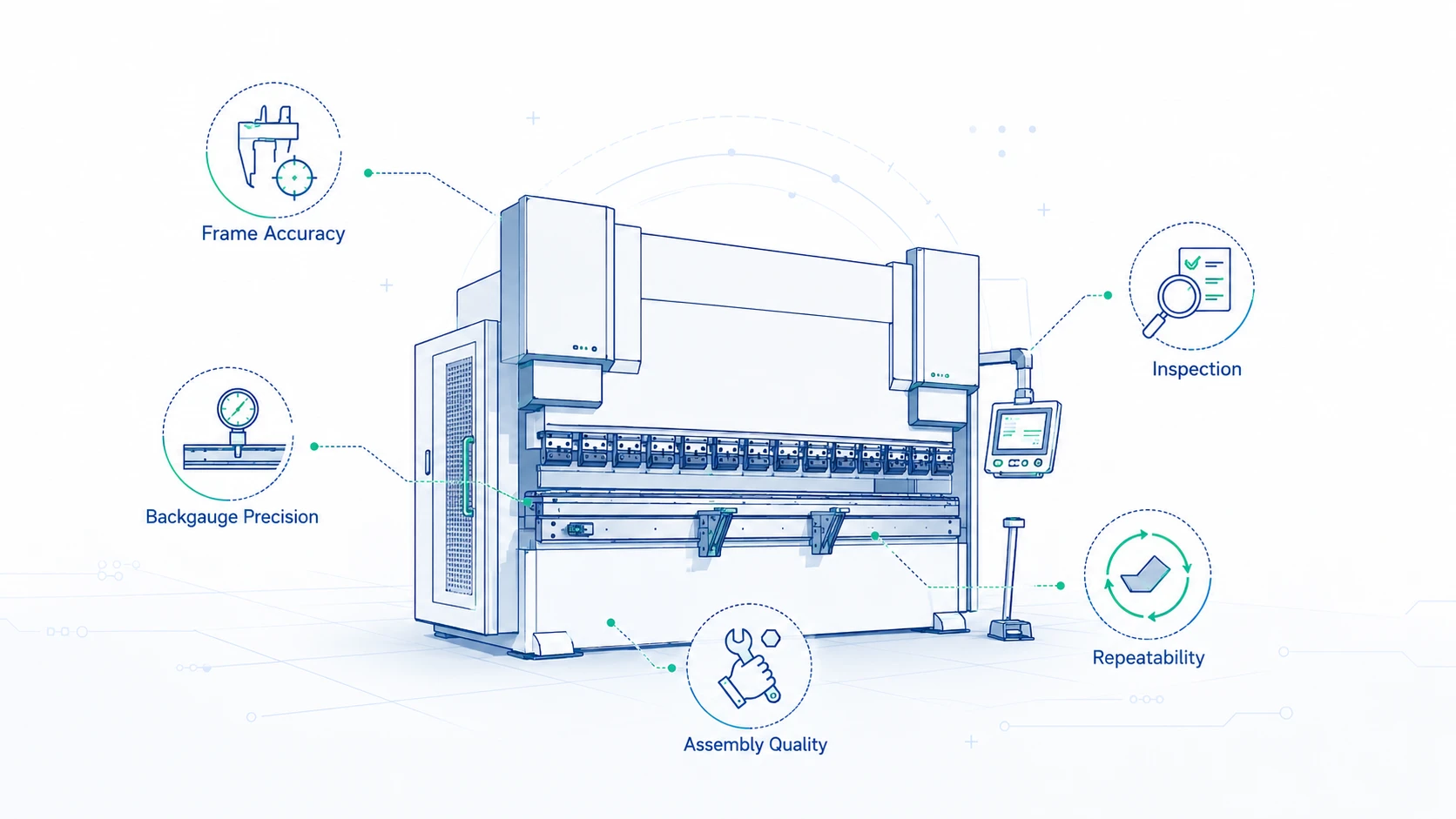
A serious manufacturer should be able to explain how the frame is designed, how stress relief is handled, how machining accuracy is controlled, how the ram and table are aligned, how Y1/Y2 synchronization is achieved, how crowning is selected, how the backgauge is built, and how the machine is tested before shipment. These details are not marketing decoration. They are the reasons why a press brake can or cannot produce repeatable bends.
The frame and ram are especially important. During bending, the machine is under high load. The table and ram naturally deflect. If deflection is not managed, the bend angle may be different at the left, center, and right side of a long part. This is why crowning exists. Manual crowning may be enough for simpler work, while CNC crowning is more suitable for factories that bend different lengths, different materials, and different thicknesses throughout the day.
Synchronization is another key area. NC press brakes typically use torsion-bar synchronization and can be suitable for simpler work where the budget is tighter and operator experience is strong. CNC hydraulic press brakes use independent Y1/Y2 axis control with feedback, allowing better control of ram parallelism and partial load bending. This is one reason KRRASS offers different machine families on the Press Brake page, including NC, CNC, hydraulic, hybrid, tandem, and electric servo options.
| Manufacturer-controlled area | Basic comparison question | Better engineering question |
|---|---|---|
| Frame and ram | Is the machine heavy? | How is the structure designed, processed, stress-relieved, machined, and inspected? |
| Hydraulic system | Which valve brand is used? | How are pressure stability, synchronization, leakage control, and service access handled? |
| CNC system | Which controller is included? | Which axes are controlled, what programming workflow is supported, and how does it reduce trial bends? |
| Backgauge | How many axes? | What are the speed, repeatability, guide system, finger design, stroke, and collision limitations? |
| Crowning | Is crowning included? | Is it manual or CNC, and how is it matched to bend length, material, and tolerance? |
| Tooling and clamping | Are tools included? | Are tool type, load rating, segmentation, punch clearance, V opening, and clamping compatibility checked? |
| Safety system | Is the machine CE marked? | What specific safeguards are installed and what documentation is supplied? |
| Factory testing | Is the machine tested? | What inspection report, bending test, axis test, pressure test, and alignment record are available? |
The manufacturer who can answer the better engineering questions usually has stronger process control.
Compare machine type by application, not by popularity
Press brake manufacturers usually offer several machine types. Buyers sometimes ask for the model that looks most popular in videos or advertisements. That can be a starting point, but it is not the best selection logic. The correct machine type depends on production need.
A simple NC press brake can be a practical choice for basic bending, lower production complexity, and budget-sensitive factories. It is often easier to maintain and cheaper to purchase. However, it depends more on operator skill, and setup can take longer when parts change frequently. A CNC hydraulic press brake is more suitable when the buyer needs better repeatability, Y1/Y2 control, backgauge flexibility, and crowning support. A hybrid press brake can reduce energy consumption and hydraulic stress while maintaining strong bending performance. An electric servo press brake can be attractive for clean, quiet, high-precision, fast-response production, especially for thinner sheets and high-efficiency workshops.
KRRASS also supplies tandem press brakes for long parts. A tandem system can run two machines together for long bending or independently for smaller jobs. This is useful when a factory produces long panels but does not want one oversized machine to block all daily work. Instead of thinking only about one large press brake, buyers should compare whether a tandem solution improves flexibility.
| Production situation | Machine type to consider | Why it may fit | What to confirm with the manufacturer |
|---|---|---|---|
| Simple parts, limited budget, experienced operators | NC hydraulic press brake | Lower purchase cost, practical operation, simpler structure | Torsion-bar accuracy, manual adjustment, tooling plan, operator training |
| General sheet metal fabrication with varied jobs | CNC hydraulic press brake | Better repeatability, Y1/Y2 control, CNC crowning options | Axis configuration, backgauge travel, controller functions, safety options |
| High mix, medium to high precision | CNC press brake with multi-axis backgauge | Faster setup, better positioning, reduced trial bending | X/R/Z axis details, finger movement, collision clearance, offline software |
| Long panels, poles, structural profiles | Tandem press brake | Can bend long workpieces and still operate separately | Synchronization method, tandem control, foundation, material handling |
| Energy-saving production with stable accuracy needs | Hybrid press brake | Reduced energy and hydraulic oil demand compared with conventional machines | Servo pump system, heat management, cycle speed, service knowledge |
| Clean, quiet, thin to medium sheet work | Electric servo press brake | Fast response, no hydraulic oil system, lower maintenance in suitable applications | Force range, screw or belt system, overload protection, application limits |
The best manufacturer is not simply the one that offers the most expensive model. It is the one that recommends the correct model for the work.
Evaluate bending accuracy as a system
Accuracy in press brake bending is not produced by one part. It is produced by the complete system: material behavior, tooling, machine structure, ram repeatability, crowning, backgauge, operator method, and programming. This is one reason buyers should be careful when a quotation promises very high accuracy without asking about the actual parts.
The material itself is a variable. Even sheets with the same nominal grade and thickness can have different yield strength, grain direction, surface condition, and thickness tolerance. The international standard ISO 7438:2020 describes a bend test method used to determine the ability of metallic materials to undergo plastic deformation in bending. For press brake buyers, the practical lesson is simple: bending is not only a machine movement; it is a material forming process.
Tooling is another major factor. The V opening affects bending force, inside radius, and minimum flange. A wider V opening can reduce tonnage and marking but increases the inside radius and minimum flange requirement. A narrower V opening can support shorter flanges but increases tonnage and tooling load. A gooseneck punch can help with return flanges and box shapes, but it has load limits. Segmented tooling supports boxes and small parts but requires proper clamping and storage.
This is why we advise buyers to read KRRASS resources such as Common Press Brake Tooling Mistakes and How to Avoid Them and review our Tooling and Tool Storage Solutions page during the buying process. A press brake quotation without tooling discussion is incomplete.
A practical accuracy comparison should ask the manufacturer to explain these items:
| Accuracy factor | Why it affects real bends | What to request from manufacturers |
|---|---|---|
| Ram repeatability | Controls depth consistency in air bending | Y1/Y2 repeatability data and calibration method |
| Crowning | Compensates machine deflection across the bend length | Manual or CNC crowning specification and setup method |
| Backgauge accuracy | Controls flange dimensions and multi-bend positioning | Positioning accuracy, repeatability, travel, finger design |
| Tooling precision | Controls bend angle, radius, marking, and part collision | Tool material, hardness, load rating, segmentation, clamping type |
| Controller compensation | Helps manage springback, material library, bend sequence | Controller functions, material/product library, offline software |
| Machine installation | Leveling and foundation influence long-term accuracy | Installation requirements and leveling procedure |
| Operator training | Reduces trial bends and wrong program input | Training scope, manuals, videos, remote support |
If a manufacturer says the machine is accurate but cannot explain the system, the buyer should slow down.
Compare controllers and backgauge systems by workflow
The CNC controller is the operator's daily interface with the machine. It should not be evaluated only by brand name. Buyers should compare how the controller helps operators create programs, manage tools, store materials, control axes, compensate crowning, and avoid mistakes.
KRRASS offers press brakes with controller options such as DELEM DA-53T, DA-58Tx, DA-66S, DA-69S, ESTUN E21, E310P, and other configurations depending on machine type and buyer requirement. For example, the KRRASS MB8 Series Advanced Sheet Metal Press Brake is positioned for precise part bending with CNC control and different tool options, while the DA66S CNC Press Brake represents a higher-level configuration with multi-axis capability and advanced graphical control.
The backgauge should also be compared carefully. Many quotations say "3+1 axis," "4+1 axis," or "8+1 axis," but the buyer should ask what those axes actually do. The X axis controls front-back positioning. The R axis controls vertical height. Z1 and Z2 control left-right finger movement. Some advanced systems include X1/X2 and R1/R2 for independent positioning. CNC crowning is often represented as W axis. More axes are not automatically better for every factory, but the right axes can reduce setup time and make complex parts easier.
| Axis or function | Practical meaning | When it matters most |
|---|---|---|
| Y1/Y2 | Independent ram position control | CNC accuracy, partial load bending, repeatability |
| X | Backgauge front-back movement | Basic flange size control |
| R | Backgauge up-down movement | Multi-step parts with different flange heights |
| Z1/Z2 | Left-right finger movement | Different part widths, fast setup, multiple stations |
| X1/X2 | Independent backgauge depth movement | Tapered flanges, complex parts, high flexibility |
| R1/R2 | Independent vertical finger movement | Complex part support and advanced positioning |
| W | Crowning control | Long bends, varied thickness, angle consistency |
| Offline software | Program preparation outside the machine | High mix production and reduced machine idle time |
A useful test is to ask each manufacturer to show how a real part would be programmed. The best comparison is not a controller brochure. It is a workflow demonstration using the buyer's drawings.
Do not separate machine selection from tooling selection
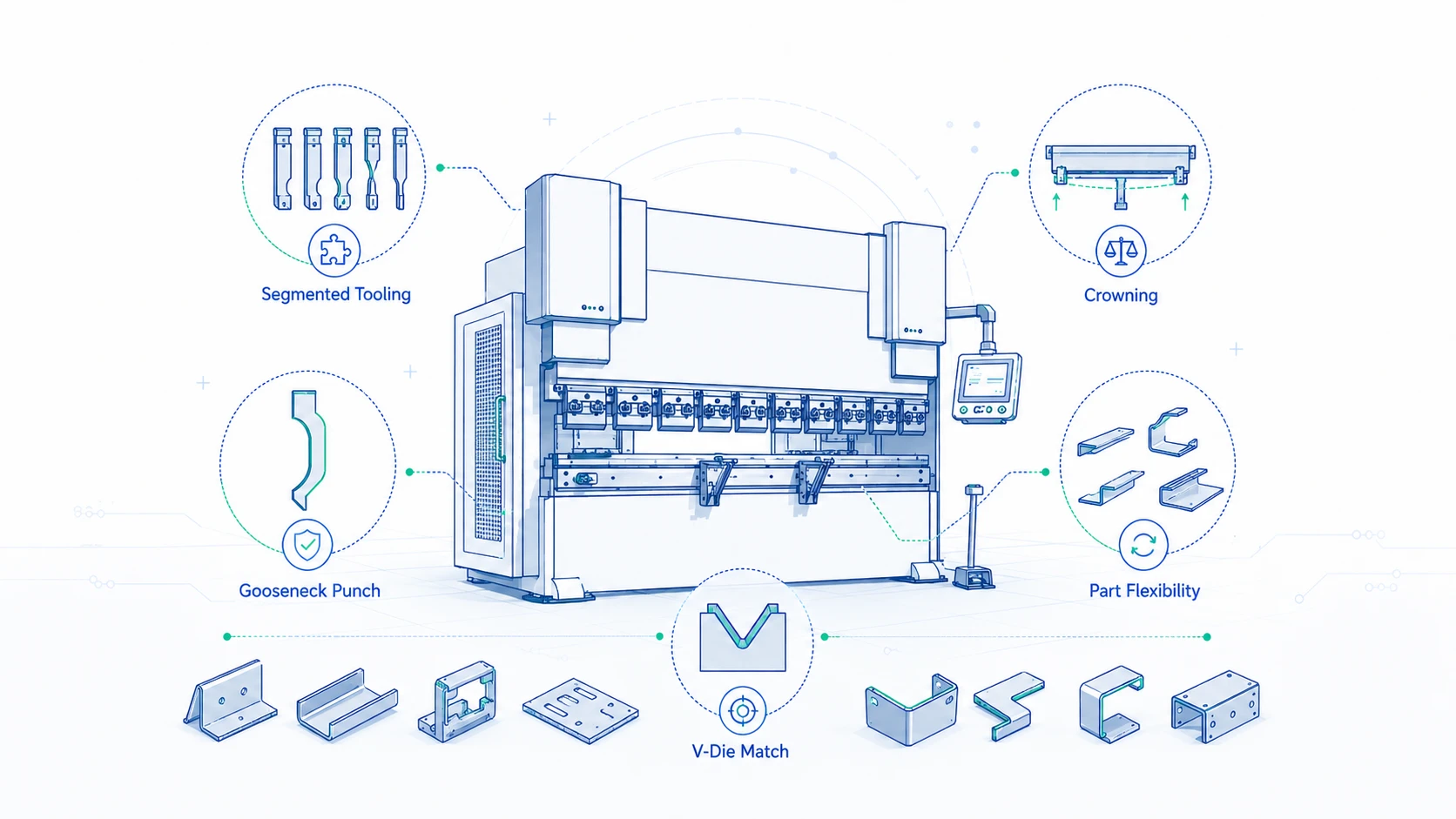
Tooling is sometimes treated as a small accessory in a press brake project. In reality, it can decide whether the machine can make the part. A press brake without the correct tooling is like a machining center without the correct cutting tools. The machine may have enough tonnage, but the part can still fail because the flange is too short, the punch collides with a return flange, the die marks the surface, or the tool load rating is too low.
When comparing press brake manufacturers, buyers should ask whether the manufacturer can review tooling together with the machine. The quotation should identify at least the initial punch and die plan, V openings, segmentation, clamping style, tool height, punch nose radius, and any special tools required for boxes, channels, hems, or radius bends.
A common mistake is to buy a press brake first and solve tooling later. This can lead to a mismatch between tool style and clamping system. For example, a factory may want faster tool changes later, but the machine was purchased with a basic clamping system. Or the buyer may plan to use existing tools, but the tool height and style do not fit the new machine properly. A manufacturer with real process knowledge will check compatibility before shipment.
KRRASS provides related options such as Tooling Clamping System, Crowning System, and Press Brake Bending Angle Measurement support. These links are not only accessory pages; they represent production decisions that affect speed, accuracy, and operator safety.
| Tooling decision | Low-cost shortcut | Better purchasing approach |
|---|---|---|
| V-die opening | Use one die for too many thicknesses | Build a practical die range based on real materials |
| Punch style | Choose only a standard straight punch | Check return flanges, box depth, and collision clearance |
| Segmentation | Buy only full-length tools | Use segmented tools for boxes, small parts, and flexible setup |
| Clamping | Accept basic manual clamping without review | Compare manual, quick, hydraulic, or precision clamping based on tool change frequency |
| Tool load rating | Assume machine tonnage is enough | Confirm tool capacity per meter and concentrated load limits |
| Surface protection | Ignore marking until production starts | Plan anti-marking film, special dies, or surface-friendly tooling |
| Storage | Put tools wherever space is available | Use organized storage to protect precision edges and reduce changeover time |
A strong manufacturer should help the buyer prevent tooling mistakes before the machine is shipped.
Compare safety and compliance as part of the machine value
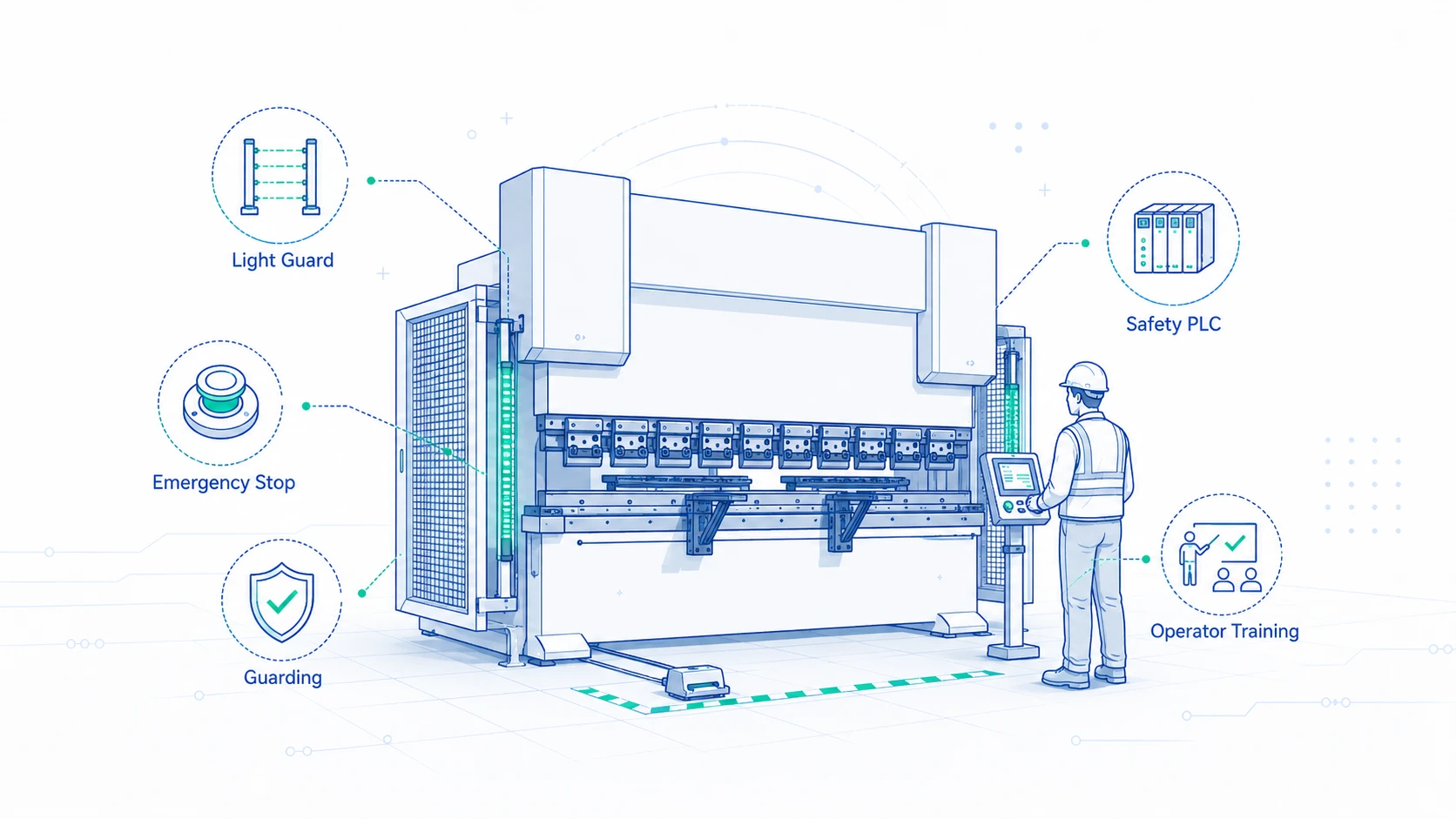
Safety should be part of the purchase decision from the beginning. A press brake forms metal at the point of operation, where the punch and die close on the material. This creates crushing and trapping hazards if the machine is not guarded and operated correctly. The U.S. regulation OSHA 29 CFR 1910.212 requires one or more methods of machine guarding to protect operators and other employees from hazards such as point of operation, ingoing nip points, rotating parts, flying chips, and sparks. OSHA's Machine Guarding eTool also explains that safeguards are essential for protecting workers from preventable machinery injuries.
For press brakes specifically, ANSI B11.3-2022 is a machine-specific safety standard for power press brakes in the United States. In Europe, machinery placed on the market must address essential health and safety requirements. The EU's Machinery Regulation, Regulation (EU) 2023/1230, replaces the older Machinery Directive framework and focuses on health and safety requirements for machinery products placed on the European market.
For the buyer, the practical issue is not to memorize every regulation. The practical issue is to compare whether each manufacturer can supply appropriate safety devices, correct electrical design, risk-related documentation, and clear operator instructions for the target market.
| Safety and compliance area | Why it matters | What to ask the manufacturer |
|---|---|---|
| Point-of-operation protection | The bending zone is the highest-risk area | What laser guarding, light curtain, or safeguarding system is available? |
| Safety control system | Safety functions must be monitored and reliable | What safety controller or safety PLC is used? |
| Standards reference | Buyers may need compliance for local rules or customer audits | Which standards are considered for the target market? |
| Electrical documentation | Maintenance teams need safe troubleshooting | Are wiring diagrams, component lists, and manuals supplied? |
| Safety distance and stopping performance | Guarding must work with machine stopping behavior | Is stopping distance monitored or documented? |
| Operator training | A safe machine can still be misused | What operation, maintenance, and lockout guidance is provided? |
| Future audits | Large customers may audit machinery safety | Can the manufacturer provide documentation and support after delivery? |
KRRASS offers a Safety Arrangements page that discusses optical safety systems, press brake control safety systems, and related advanced guarding options. A buyer comparing manufacturers should request the actual safety configuration in writing, not only a general statement that the machine is safe.
Evaluate quality management and production process
A press brake is built through many steps: steel preparation, welding, stress relief, machining, assembly, hydraulic installation, electrical wiring, controller setup, axis calibration, testing, packing, and shipment. Weakness in any step can affect the final machine. This is why quality management matters.
The international standard ISO 9001:2015 is a globally recognized quality management standard. ISO explains that ISO 9001 helps organizations improve performance, meet customer expectations, and continually improve a quality management system. More than one million certificates have been issued in 189 countries, according to ISO's own ISO 9001 page. Certification alone does not guarantee that every machine is perfect, but it gives buyers a useful framework for asking about process control, documentation, inspection, corrective action, and continual improvement.
A purchasing team should ask each manufacturer how quality is controlled during production. Does the factory keep inspection records? Are hydraulic components tested for leakage? Are the Y1/Y2 axes calibrated? Is the backgauge tested for positioning? Is the machine bent under load before shipment? Are the controller parameters backed up? Are the manuals and drawings matched to the shipped configuration?
| Quality process question | Strong answer from a manufacturer | Weak answer from a manufacturer |
|---|---|---|
| How is the frame controlled after welding? | Stress relief, machining process, inspection records | "Our frames are strong" without details |
| How is ram-table parallelism checked? | Measurement process and final calibration record | Visual check only |
| How is hydraulic leakage prevented? | Pressure test, seal inspection, component traceability | No written test record |
| How is electrical assembly verified? | Wiring inspection, I/O test, safety function test | Only power-on test |
| How is bending performance tested? | Trial bends using defined material, length, and tool setup | No-load movement test only |
| How are shipped parameters preserved? | Controller backup, documentation, service files | No parameter backup |
| How are nonconformities handled? | Corrective action process and responsible team | Informal repair without traceability |
Good manufacturers are not afraid of these questions. They understand that serious buyers need documentation as much as hardware.
Compare after-sales support before you need it
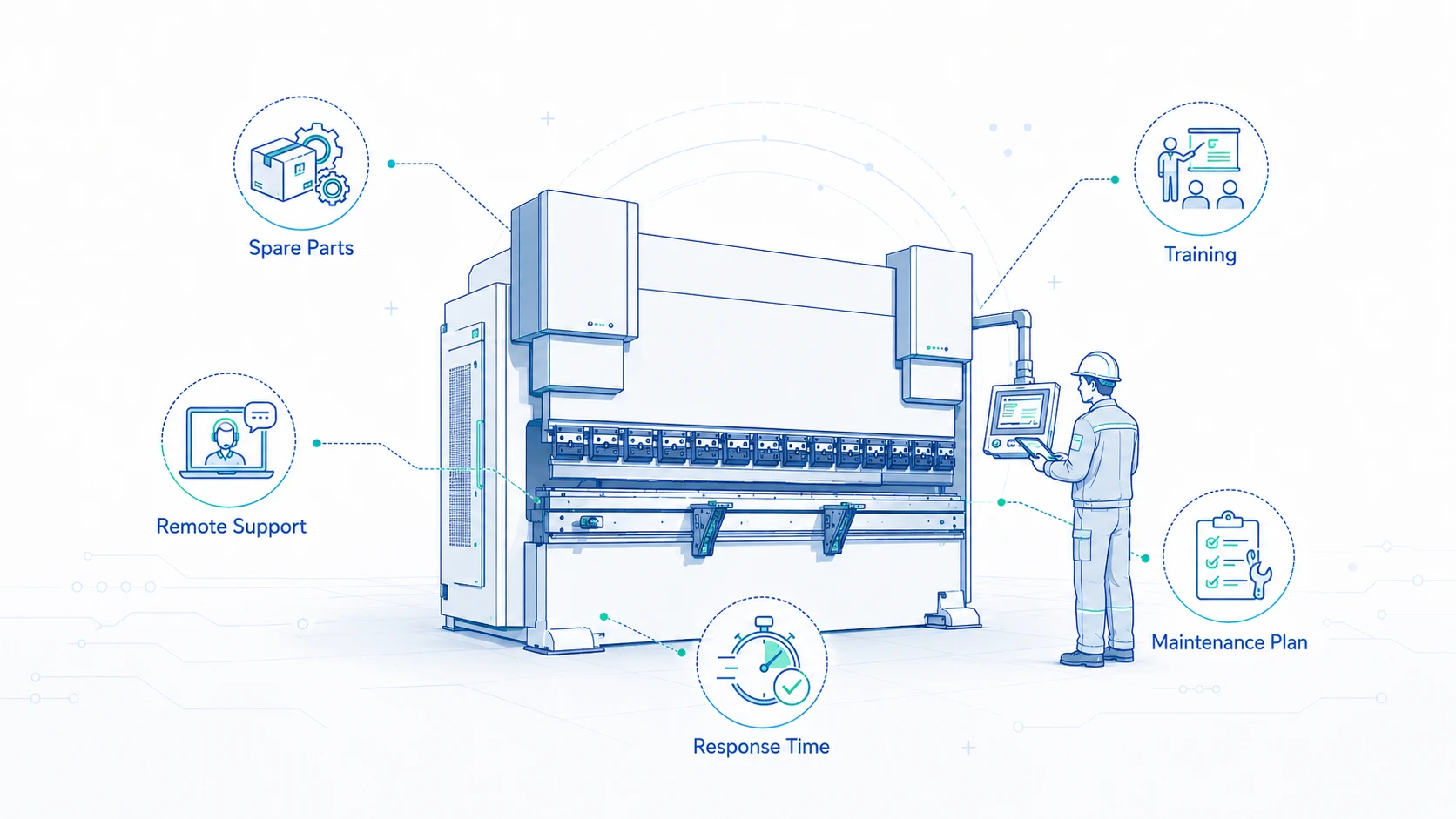
After-sales support is one of the most important differences between press brake manufacturers. Every machine requires installation, leveling, training, maintenance, and spare parts. Even a well-built machine can need adjustment after transportation or years of operation. The manufacturer should be able to support the customer with manuals, videos, remote diagnosis, spare parts, and practical troubleshooting.
KRRASS publishes support-related service pages such as CNC Control System, Back Gauge Modification, Crowning System, and Software Support. This type of service structure matters because a press brake buyer is not only buying a machine on shipment day. The buyer is also buying the manufacturer's ability to keep the machine productive after installation.
The KRRASS website also lists company-level indicators such as 30 years of experience, exports to 80 countries, 3,200 sets of production capacity, and 24 months warranty time on the KRRASS homepage. Buyers should still verify the latest commercial terms in the quotation, but these indicators help explain why manufacturer maturity should be part of the comparison.
| Support item | Why it matters | How to compare manufacturers |
|---|---|---|
| Installation guidance | Incorrect leveling affects accuracy | Ask for foundation, leveling, oil, power, and commissioning instructions |
| Operator training | Reduces wrong programs and trial bends | Ask for training materials, videos, remote support, and language options |
| Spare parts | Production downtime depends on parts availability | Ask for recommended spare parts list and delivery process |
| Remote diagnosis | Many issues can be solved without site visit | Ask whether electrical drawings, controller backup, and video support are available |
| Warranty scope | Warranty wording differs between suppliers | Ask what is covered, what is excluded, and how claims are processed |
| Local partner or distributor | Useful for installation and urgent support | Ask whether local support is available in your market |
| Documentation | Maintenance teams need clear records | Ask for manuals, wiring diagrams, hydraulic diagrams, and parameter backups |
A manufacturer that avoids support questions may be selling only a machine. A manufacturer that answers them clearly is more likely to become a long-term equipment partner.
Compare total cost of ownership, not only invoice price
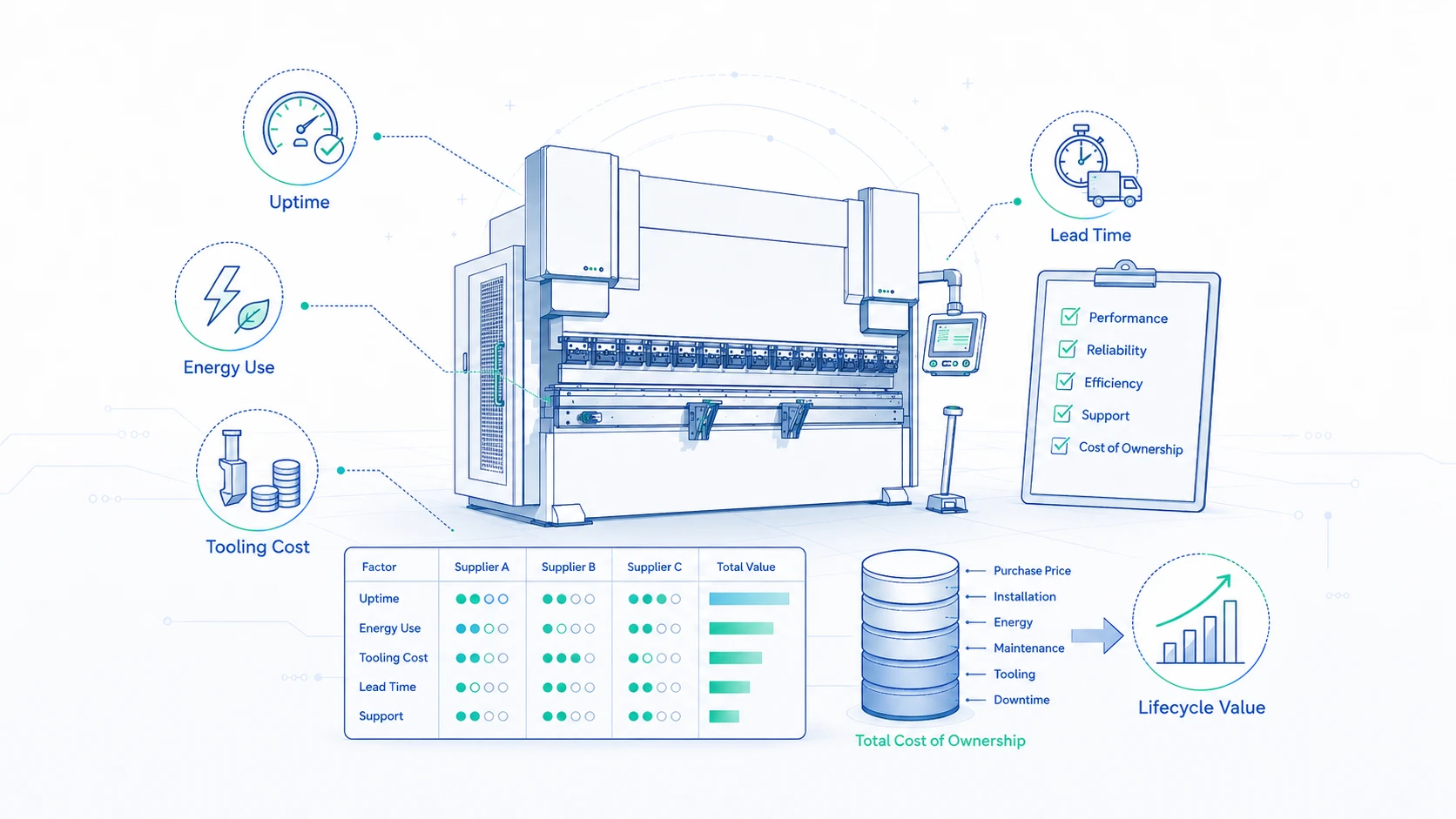
Total cost of ownership, often called TCO, is the real financial picture of a press brake. It includes purchase price, tooling, freight, installation, training, energy, consumables, maintenance, scrap, rework, downtime, and resale value. A cheaper machine may still win if the application is simple and the manufacturer is reliable. But buyers should prove that with numbers, not assumptions.
The following simplified example shows how a lower invoice price can lose its advantage if the machine creates more setup time, scrap, or downtime. The numbers are illustrative only. Each factory should replace them with its own labor rate, production schedule, scrap value, and downtime cost.
| Cost element over 5 years | Lower-price machine | Better-matched machine | Comment |
|---|---|---|---|
| Purchase price | $38,000 | $48,000 | Lower-price machine saves $10,000 initially |
| Tooling and clamping upgrades | $8,000 | $5,000 | Better quotation includes more suitable tooling plan |
| Installation and training | $2,500 | $3,500 | More complete training costs more but reduces errors |
| Extra setup time | $18,000 | $7,000 | Assumes repeated job changes and operator labor cost |
| Scrap and rework | $15,000 | $6,000 | Caused by trial bends, angle inconsistency, wrong tooling |
| Downtime and service delays | $12,000 | $4,000 | Depends on support response and spare parts |
| Energy and maintenance difference | $6,000 | $4,000 | Depends on hydraulic, hybrid, or electric configuration |
| Estimated 5-year total | $99,500 | $77,500 | Higher purchase price becomes lower total cost |
The numbers are not universal, but the logic is universal. If the press brake affects daily production, then setup time, scrap, service, and tooling compatibility must be part of the comparison. Buyers should ask each manufacturer to clarify what is included in the quotation and what will require later investment.
A practical TCO evaluation should include these questions:
| TCO question | Why it changes the decision |
|---|---|
| How many tool changes happen per shift? | Determines the value of quick clamping and organized tooling |
| How often do part programs change? | Determines the value of advanced CNC and offline programming |
| How expensive is scrap material? | Determines the value of better first-part accuracy |
| How costly is machine downtime? | Determines the value of spare parts and service response |
| How strict are customer tolerances? | Determines the value of CNC crowning and better control |
| How much operator training is needed? | Determines whether a cheaper but less friendly system is really economical |
| Will future products be larger or thicker? | Determines whether current capacity is enough |
Price is visible. TCO must be calculated. Serious buyers calculate both.
Ask for an apples-to-apples quotation
A fair comparison requires equivalent scope. If one manufacturer includes CNC crowning, laser safety, segmented tooling, hydraulic clamping, an advanced controller, spare parts, and training, while another quotation includes only a basic machine body, the two prices are not comparable. Buyers should create a quotation checklist and ask each supplier to complete it.
This is especially important for international purchases because shipping terms, voltage, standards, documentation, and local installation support can differ. A quotation should be clear enough that the buyer can understand the exact machine being purchased.
| Quotation item | Must be stated clearly | Reason |
|---|---|---|
| Machine model | Tonnage, bending length, open height, stroke, throat depth | Confirms physical capacity |
| Controller | Brand, model, axis control, software options | Defines operation and programming capability |
| Backgauge | Axis count, travel, speed, fingers, guide system | Affects flange positioning and setup |
| Crowning | Manual, CNC, or not included | Affects long-part angle accuracy |
| Tooling | Punches, dies, segmentation, V openings, tool style | Prevents missing tooling costs |
| Clamping | Standard, quick, hydraulic, European style, custom | Affects tool change and compatibility |
| Safety | Guarding type, light curtain, laser, safety controller | Affects compliance and operator protection |
| Electrical | Voltage, frequency, components, wiring documentation | Prevents installation problems |
| Hydraulic | Pump, valve, seals, oil requirement, pressure data | Affects service and maintenance |
| Packaging and shipping | Incoterms, container loading, insurance, delivery time | Affects landed cost |
| Warranty and service | Duration, coverage, spare parts, response process | Affects long-term risk |
| Documentation | Manual, drawings, certificate, test report, parameter backup | Supports installation and maintenance |
This checklist also protects the manufacturer. When the scope is clear, misunderstandings are reduced and the project can move faster.
Use a weighted scorecard instead of a simple price ranking
A weighted scorecard helps the purchasing team compare press brake manufacturers in a structured way. The weights should reflect the factory's priorities. A job shop with high mix production may give more weight to controller workflow, backgauge flexibility, tooling, and support. A heavy fabrication factory may give more weight to frame strength, tonnage, tooling load, and long-part performance. A company exporting finished products to strict customers may give more weight to safety documentation and process traceability.
The following example can be adapted by purchasing teams.
| Evaluation factor | Suggested weight | What a score of 5 means |
|---|---|---|
| Correct technical recommendation | 15% | Manufacturer reviews drawings and recommends machine, tooling, and options logically |
| Frame, ram, hydraulic, and synchronization design | 15% | Clear engineering explanation, suitable structure, reliable components, test records |
| Controller and backgauge workflow | 10% | Axis configuration and programming method match production requirements |
| Tooling and clamping plan | 12% | Tools, V openings, segmentation, load rating, and clamping compatibility are reviewed |
| Safety and compliance | 12% | Suitable guarding, safety control, documentation, and target-market compliance support |
| Quality management and factory inspection | 10% | Inspection records, bending tests, calibration, and documentation are available |
| After-sales service and spare parts | 12% | Clear support process, spare parts list, remote service, training, warranty terms |
| Delivery, packaging, and export experience | 6% | Realistic lead time, export packaging, shipping experience, language support |
| Total cost of ownership | 8% | Supplier helps reduce setup, scrap, downtime, and maintenance cost |
| Price | 10% | Competitive price for equivalent scope, not simply the lowest number |
This model deliberately gives price only part of the decision. That does not mean price is unimportant. It means price is meaningful only after the technical scope is correct.
Red flags when comparing press brake manufacturers
Some warning signs appear repeatedly in international machine purchasing. A buyer should not automatically reject a supplier because of one weak point, but several red flags together indicate risk.
The first red flag is a quotation that is too fast and too generic. If a manufacturer gives a price without asking about material, thickness, bending length, flange size, tooling, tolerance, or target market, the quotation may be based on a standard machine rather than the buyer's real production. The second red flag is unclear configuration language. Phrases such as "famous brand controller," "high precision," "European standard," or "best quality" are not enough. Buyers need model numbers, axis details, safety configuration, and documentation.
A third red flag is ignoring tooling. If the supplier does not ask what parts will be bent, what V opening is needed, or whether existing tooling must be compatible, the machine may arrive without the process support required to make parts. A fourth red flag is weak after-sales information. A good manufacturer should provide manuals, wiring diagrams, hydraulic diagrams, controller parameters, remote support, and a spare parts process.
| Red flag | Why it matters | Buyer action |
|---|---|---|
| Quotation based only on tonnage and length | Production details may be ignored | Send drawings and ask for a revised technical recommendation |
| No clear axis definition | Buyers may misunderstand machine capability | Ask for axis list and backgauge drawing |
| No tooling discussion | Machine may not produce the required parts | Request punch, die, V opening, segmentation, and load rating details |
| Safety described only as "safe" | Compliance may not be documented | Ask for actual guarding configuration and safety references |
| No test report | Machine performance may be unverified | Request factory inspection and bending test information |
| Vague warranty | Claims may be difficult after delivery | Ask for written warranty scope and service process |
| Very low price with many missing items | Hidden cost may appear later | Compare total scope and landed cost |
A reliable manufacturer does not need to hide details. The details are part of the value.
How KRRASS approaches press brake manufacturer comparison
As a press brake manufacturer, KRRASS believes the buying process should begin with the customer's production requirement. We prefer to review drawings, material types, thickness ranges, maximum bend length, common flange dimensions, tolerance, surface requirements, monthly or annual production volume, and future product plans. If drawings are not available, we ask practical questions until the production picture is clear enough to recommend a realistic configuration.
Then we match the machine to the work. This may lead to a WC67K NC press brake for simpler bending, an MB8 CNC press brake for general precision fabrication, a PBS or PBE series configuration for higher productivity, a hybrid press brake for energy-conscious production, an ePP electric servo press brake for suitable precision work, or a tandem press brake for long parts. We also discuss tooling, clamping, crowning, backgauge, controller, and safety devices because these items decide how the machine performs after installation.
KRRASS's Press Brake page shows a broad range of machine types, including NC, CNC, hydraulic, hybrid, tandem, and electric servo press brakes. Our Hydraulic Press Brake for Heavy Bending guide explains how buyers should think through heavy-duty bending requirements. Our CNC Hydraulic Press Brake guide explains the value of CNC hydraulic systems for precision, efficiency, and modern production. These internal resources help buyers move from a simple price request to a better technical discussion.
| Buyer need | KRRASS discussion focus | Useful KRRASS resource |
|---|---|---|
| General press brake model selection | Machine type, tonnage, length, controller, backgauge, crowning | Press Brake |
| Initial configuration thinking | Tonnage, length, opening, options, customization | Press Brake Configurator |
| Bending force estimation | Material, thickness, length, V opening | Bending Force Calculator |
| Heavy bending | Force, frame strength, tooling load, long-part support | Hydraulic Press Brake for Heavy Bending |
| CNC hydraulic production | Y1/Y2 control, backgauge, crowning, productivity | CNC Hydraulic Press Brake Guide |
| Tooling mistakes | V opening, flange, collision, surface marking, tool load | Common Press Brake Tooling Mistakes |
| Safety configuration | Optical safety, laser guarding, safety controller | Safety Arrangements |
| Tool change and precision clamping | Manual, quick, hydraulic, WILA-type solutions | Tooling Clamping System |
Our recommendation is simple: compare press brake manufacturers by asking how each one will help your factory produce better parts, not only how low each one can make the first price.
Practical questions to send to every manufacturer
A good buyer can improve quotation quality by asking better questions. The following questions can be copied into an RFQ email or used during supplier meetings.
| Question | What the answer reveals |
|---|---|
| Based on our drawings, what tonnage, length, stroke, open height, and throat depth do you recommend? | Whether the manufacturer has reviewed the real application |
| What V-die openings and punch types do you recommend for our material and thickness range? | Whether tooling is part of the process plan |
| Is manual or CNC crowning better for our parts, and why? | Whether long-part accuracy is understood |
| Which axes are included in the backgauge, and what does each axis do? | Whether axis numbers are clearly defined |
| Can you provide a controller workflow demonstration for one of our parts? | Whether programming is practical for operators |
| What safety system is included for our market? | Whether compliance is treated seriously |
| What documents will be shipped with the machine? | Whether installation and maintenance will be supported |
| What factory tests are completed before shipment? | Whether the machine is verified under meaningful conditions |
| What spare parts should we keep for the first two years? | Whether after-sales support is practical |
| What is not included in the quotation? | Whether hidden costs may appear later |
The quality of the answers often tells more than the price itself.
A simple decision framework for buyers
When all quotations are received, purchasing teams can use a three-step decision framework.
First, remove technically unsuitable quotations. If the machine cannot bend the required material, cannot handle the required flange, lacks needed tooling, or does not meet safety expectations, a low price should not save it. Technical mismatch is expensive.
Second, compare complete scope. Make sure each quotation includes the same level of controller, axes, crowning, tooling, clamping, safety, documentation, service, and shipping terms. If one quotation is missing tooling or safety devices, add the expected cost before comparing.
Third, compare risk and long-term value. Look at factory experience, engineering communication, documentation quality, after-sales process, spare parts, and ability to support future production. A press brake may remain in service for many years. The manufacturer should be capable of supporting that life cycle.
| Decision step | Main question | Result |
|---|---|---|
| Technical fit | Can this machine make our parts safely and accurately? | Remove unsuitable options |
| Scope equality | Are all quotations comparing the same configuration? | Normalize the price comparison |
| Long-term value | Which manufacturer reduces production risk over time? | Select the best business decision |
This method helps buyers avoid two common mistakes: paying too much for features they do not need, or paying too little for a machine that cannot support the work.
FAQ for buyers comparing press brake manufacturers
Is the cheapest press brake always a bad choice?
No. A lower-priced machine can be a good choice when it is correctly matched to the work, built by a reliable manufacturer, and supported properly. The danger is not low price itself. The danger is a low price created by removing important configuration, tooling, safety, testing, or service.
Should I choose CNC instead of NC?
Not always. NC press brakes can be suitable for simpler bending, experienced operators, and lower budgets. CNC press brakes are better for higher precision, frequent job changes, more complex parts, and factories that want stronger process repeatability. The correct answer depends on production.
How much tonnage should I add for future work?
A reasonable safety margin is useful, but oversizing can increase cost, footprint, energy use, and tooling expense. The better approach is to calculate force based on current and future materials, thickness, bend length, and die opening. Buyers can start with the KRRASS Bending Force Calculator and then confirm with our engineering team.
Why do two 160-ton 3200 mm machines have different prices?
Because the headline size does not define the whole machine. Differences may include frame design, controller, Y1/Y2 system, backgauge axes, crowning, hydraulic components, electrical components, tooling, safety, clamping, documentation, testing, warranty, and service.
What should I check before using existing tooling on a new press brake?
Check tool style, height, tang, clamping compatibility, load rating, straightness, wear, segmentation, and whether the punch and die combination can make the required parts without collision. Existing tooling can save money, but only if it fits the new machine and process.
How important is safety if my local regulations are less strict?
Safety remains important even when local enforcement is different. Press brake hazards are real, and global customers increasingly expect safe production. Using recognized references such as OSHA machine guarding guidance, ANSI B11.3, ISO 13849-1, and EU machinery requirements helps buyers think about risk more professionally.
Final recommendation
Comparing press brake manufacturers beyond price alone is not about making purchasing slower. It is about avoiding a costly mismatch. A press brake affects accuracy, labor efficiency, tooling cost, safety, maintenance, and production flexibility. The best manufacturer is the one that understands the buyer's parts, recommends the right machine type, explains the configuration clearly, supports tooling selection, provides appropriate safety options, controls quality during production, and remains available after delivery.
A good quotation should answer three questions: Can this machine make the parts? Can it make them repeatedly and safely? Can the manufacturer support the machine when production depends on it?
At KRRASS, our role is to help buyers move from a basic price inquiry to a complete bending solution. Whether the project requires an NC press brake, CNC hydraulic press brake, hybrid system, electric servo press brake, tandem solution, tooling package, or safety upgrade, the comparison should always begin with real production needs. Price matters, but it should be the price of the right solution - not the price of an incomplete machine.