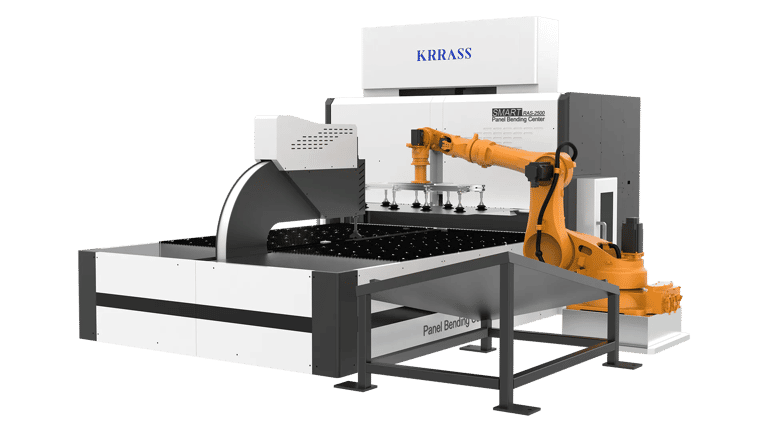
A panel bender is one of the most effective ways to automate repetitive sheet metal bending when a factory produces cabinets, electrical enclosures, HVAC panels, appliance housings, elevator components, doors, trays or other parts with multiple flanges. Instead of asking an operator to lift, flip, reposition and gauge a sheet for every bend, an automatic panel bender clamps and positions the blank while servo-controlled bending tools form the edges according to a CNC program.
For a buyer, however, the difficult question is rarely “What is a panel bender?” The more important questions are practical: How much does a panel bender machine cost? Which parts are suitable for automated panel bending? How does a panel bender compare with a CNC press brake? What bending length, flange height, material capacity and automation level should you buy? And how do you compare panel bender manufacturers when quotations can differ by hundreds of thousands of dollars?
This guide is written for production managers, sheet metal fabricators, OEM purchasing teams and factory owners who need an investment-oriented answer. It focuses on the applications where automated bending creates the clearest value—especially cabinet, enclosure and HVAC manufacturing—and explains the technical and commercial details that should be checked before requesting a quotation.
KRRASS currently offers a dedicated range of automatic panel bender solutions for repeatable sheet metal production, with model selection based on panel size, material, flange height and automation requirements. The goal of this guide is not to suggest that a panel bender is always better than a press brake. The goal is to help you determine where a panel bender is the better production system and where a press brake remains the more flexible choice.

Quick Answer: Is a Panel Bender Right for Your Factory?
A panel bender is usually a strong investment candidate when most of the following statements describe your production:
- You repeatedly bend thin or medium-gauge sheet metal into boxes, panels, doors, trays or enclosure-type parts.
- Parts contain several bends around two, three or four sides.
- Operators currently spend significant time rotating, supporting and repositioning large sheets on press brakes.
- Part families repeat daily or weekly, even if batch sizes are relatively small.
- Cosmetic surfaces, consistent flange dimensions and repeatable bending angles matter.
- You want to reduce dependence on highly experienced press brake operators.
- Your laser cutting or punching process already produces accurate blanks and bending is becoming the bottleneck.
- You want a path toward automatic loading, unloading or a connected flexible manufacturing cell.
A traditional CNC press brake can still be the better choice when production is dominated by thick plate, long structural components, very deep or unusual profiles, low-volume one-off work, or parts requiring highly specialized punch-and-die combinations.
Panel Bender Buying Snapshot
| Buying question | Practical answer |
|---|---|
| What does a panel bender do? | Automatically positions and clamps a sheet while bending blades form flanges upward and/or downward according to a CNC program. |
| Best applications | Cabinets, electrical enclosures, HVAC panels, appliance housings, elevator panels, trays, doors, furniture, architectural sheet metal. |
| Typical material range | Common systems focus on approximately 0.5-3.2 mm mild steel, around 2.0-2.5 mm stainless steel and up to about 4.0 mm aluminum, depending on model, bending length and angle. |
| Common bending lengths | Roughly 1.4 m to 3.2 m for mainstream machines; premium ranges may extend beyond this. |
| Main advantage | High repeatability with much less manual sheet handling than conventional press brake bending. |
| Main limitation | Part geometry must fit the machine’s blank size, rotation, flange-height, re-entrant bend and tooling envelope. |
| Budget range | Public 2025-2026 listings show roughly US$58,000-130,000 for some factory-direct/basic systems, while locally delivered, supported and highly configured systems can reach US$250,000-580,000 or more. |
| Best buying method | Send actual DXF/STEP drawings, annual volumes, materials and finish requirements to the manufacturer for a part feasibility study and cycle-time quotation. |
The broad price spread in the table is intentional. A panel bender is a configured production system rather than a commodity machine. For example, public listings from STYLECNC show a basic/pro range around US$58,000-128,000, while U.S. supplier UmproTech publishes delivered project prices that can exceed US$500,000 depending on width, gauge, automatic tool change and support scope. These prices should be treated only as public market references, not as a universal price list.
What Is a Panel Bender Machine?
A panel bender machine is a CNC-controlled sheet metal folding system designed to automate the bending of flat blanks into finished or semi-finished panels. The machine normally clamps the sheet close to the bend line while an upper or lower bending blade moves around the material edge to create the programmed flange.
This differs from conventional press brake bending. On a press brake, a punch pushes the sheet into a die opening and the operator or robot typically positions the workpiece for each bend. On a panel bender, the blank is generally supported on a table and manipulated by an automatic positioning system. The machine performs multiple bends around the perimeter with much less manual handling.
The basic structure commonly includes:
- Machine frame and bending unit – provides rigidity and supports the bending and clamping forces.
- Blank holder or clamping beam – fixes the sheet during each bending operation.
- Upper and lower bending blades – move along controlled trajectories to form positive and negative bends.
- Manipulator or positioning system – grips, centers, feeds and rotates the workpiece.
- CNC control – calculates bend sequence, axis positions, compensation and motion.
- Servo drive system – powers the controlled axes in an electric panel bender.
- Safety system – scanners, light curtains, interlocks, guarding or other devices depending on the machine design and market.
- Optional automation – automatic loading, unloading, stacking, tool changing, robotic handling or integration with upstream cutting and punching systems.
KRRASS provides a more machine-oriented description on its Panel Bender Machine page, while the current KRRASS Panel Bender product family focuses on automatic handling, repeatable bending and selection by real part dimensions.
Why panel benders are closely associated with automated bending
The panel bender was developed around the idea that the machine should control the sheet rather than requiring the operator to manually present the sheet to the bending line for every operation. That design philosophy changes the economics of repetitive fabrication.
A large electrical cabinet door may require four perimeter bends plus hems or return flanges. On a press brake, each bend can involve repositioning the sheet, supporting its weight, aligning it against the backgauge and sometimes changing operator position. On an automatic panel bender, one loading action can be followed by multiple CNC-controlled bends and automatic rotations.
That does not make the process “operator-free” in every configuration. Semi-automatic machines still need loading and unloading, and fully automatic cells require material logistics, programming and supervision. However, the amount of direct manual handling per bend can be dramatically reduced.
How an Automatic Panel Bender Works
Understanding the bending cycle helps a buyer recognize which features actually affect productivity.
A typical automatic panel bending sequence looks like this:
- The operator or loading system places a laser-cut or punched blank on the worktable.
- The machine references the blank using centering devices, sensors or programmed geometry.
- A manipulator clamps or grips the sheet.
- The sheet is moved to the first bending position.
- The blank holder clamps the material near the bend line.
- The bending blade follows a programmed path to create the flange.
- If another bend is required on the same side, the machine changes the sheet position and repeats the process.
- The manipulator rotates the part for another edge.
- Upper and lower tools create positive or negative bends as required by the part.
- The finished workpiece is returned to the operator or transferred to an automatic unloading system.
On advanced systems, the CNC also manages springback correction, different material databases, bend sequencing, collision checking and three-dimensional simulation. KRRASS’s automatic panel bender system operation instructions show how parameters such as material thickness, holding pressure time, positioning width and bending simulation are incorporated into the control workflow.
Why the blade trajectory matters
A panel bender does not simply “push” the sheet. The bending tool follows a controlled movement around the clamped edge. By changing the trajectory, the machine can create different angles and bend directions without using a separate V-die for every geometry.
This is especially useful for visible products such as electrical cabinet doors, stainless appliance panels and architectural covers. Because the sheet is well supported and the bending motion is controlled, there is less need for an operator to drag a large finished surface over tooling or supports.
Automatic rotation is often more valuable than fast bending speed
Manufacturers frequently advertise bend cycle time, but the commercial advantage of a panel bender is often found in the time between bends.
On a conventional press brake, the ram may complete a bend quickly, but the operator still has to:
- remove the workpiece from the backgauge,
- rotate or flip it,
- support a growing flange,
- reorient the part,
- locate the next edge,
- confirm the correct bend program or tool station,
- and protect cosmetic surfaces during handling.
An automatic manipulator performs much of this positioning consistently. Therefore, a buyer should compare complete part cycle time, not only “seconds per bend.”
Panel Bender vs. Press Brake: Which Is Better?
A panel bender and a CNC press brake overlap in capability, but they optimize different production problems.
KRRASS explains conventional punch-and-die forming in its guide to how sheet metal bending works. A press brake remains one of the most universal bending machines because tooling, tonnage and operator technique can be adapted to a huge variety of parts. A panel bender trades some of that universal geometry freedom for automated handling and highly repeatable panel production.
Panel Bender vs. CNC Press Brake
| Factor | Automatic panel bender | CNC press brake |
|---|---|---|
| Workpiece handling | Mostly automatic after loading | Usually manual or robotic |
| Typical strength | Multi-side thin-sheet panel parts | Very broad range from simple brackets to heavy bending |
| Tool changes | Often limited or automatic depending on design | Tooling changes common; very flexible punch/die combinations |
| Operator skill dependence | Lower for repeated programmed parts | Higher, especially for complex manual handling and tooling |
| Large panel ergonomics | Excellent when within manipulator envelope | Can require two operators or sheet followers |
| Thick material | Usually limited compared with heavy press brakes | Strong advantage |
| Complex cabinet/enclosure parts | Excellent | Good, but more handling steps |
| One-off unusual parts | Good if geometry is compatible | Often better |
| Surface protection | Strong due to supported handling | Depends on tooling, supports and operator technique |
| Automation potential | Designed around automation | Excellent with robot/cobot cells, but integration is more complex |
| Floor space | Can be substantial | Standalone press brake is often more compact |
| Investment | Usually higher than a comparable standalone press brake | Wide range; entry cost generally lower |
Choose a panel bender when the part family is the business case
A panel bender makes sense when your revenue depends on repeatedly making the same type of geometry: cabinets, enclosure doors, HVAC skins, shelves, appliance panels or similar components. The machine becomes a dedicated productivity platform for that part family.
Choose a press brake when flexibility across unknown jobs is the business case
A job shop may receive thick brackets today, long channels tomorrow and a special stainless prototype next week. In that environment, the broad tooling library of a press brake can be more valuable than automated panel handling.
KRRASS also offers conventional and high-productivity press brake routes, including the AdvancedBend press brake and electric/hybrid press brake solutions. A serious bending strategy does not need to choose one technology exclusively. Many modern factories use panel benders for repeat panel families and press brakes for everything that falls outside the panel-bending envelope.
Panel Bender Machine Price in 2026: What Should You Budget?
There is no single global “panel bender price.” The final investment depends on bending length, material thickness, flange height, drive system, automatic tooling, loading/unloading, software, safety configuration, shipping, installation, training and local support.
Public prices illustrate how wide the market can be. A STYLECNC automatic panel bender is publicly advertised at approximately US$58,000-128,000 for different editions. A Made-in-China automatic panel bending centre has been listed around US$80,000-95,000, while we publishes a price around US$66,800 for one configuration. These are examples of factory/direct or online equipment pricing and may not include the project scope expected by a factory in Europe or North America.
At the other end of the commercial spectrum, U.S. supplier UmproTech publishes automatic panel bender configurations from roughly US$250,000 into the US$500,000+ range, depending on working size, gauge capability, automatic tool changing and service scope. The difference is not necessarily a simple “machine quality multiplier.” It can include local warehousing, application engineering, installation, commissioning, training, financing, warranty obligations, spare-parts support and higher regional business costs.
Practical 2026 Budgetary Price Bands
| Project level | Indicative budgetary range | Typical scope |
|---|---|---|
| Factory-direct / entry automatic panel bender | US$60,000-100,000 | Basic CNC panel bender, standard tooling, limited automation, export packing; local installation may be extra. |
| Higher-spec factory-direct / larger electric panel bender | US$100,000-180,000 | Longer bending length, more axes, higher gauge capability, better controls, expanded tooling or options. |
| Regional dealer-supported automatic panel bender | US$180,000-350,000 | Local sales engineering, installation, training, safety configuration, warranty and stocked service capability. |
| High-spec locally delivered system | US$300,000-600,000+ | Automatic tool change, higher material capacity, large format, advanced software, automation and extensive service scope. |
| Integrated bending cell / FMS project | US$500,000 to seven figures | Panel bender plus automatic loading/unloading, storage, robots, conveyors, punching/laser integration and production software. |
Important: These ranges are budgetary planning bands synthesized from public market references and common configuration logic. They are not KRRASS list prices and should not be used as a substitute for an application-specific quotation.
Why premium European panel benders are often quotation-only
Leading European panel bender manufacturers such as Salvagnini, Prima Power and RAS publish detailed technical specifications but commonly require a configured quotation rather than posting a universal online price. This is logical because a production-ready panel bender can be sold as anything from a semi-automatic standalone bending center to a fully automated line with material storage, part loading, unloading and software integration.
For example, Prima Power’s BCe bending centre is available with different lengths and bend heights, while the company’s EBe Express Bender extends bending length up to 3,800 mm. Salvagnini’s P4 panel bender is offered in multiple sizes with different clamping and bending capacities. RAS offers systems ranging from compact automatic machines to Multibend-Center and UpDown bending systems.
When a supplier gives you a price, the correct comparison is therefore scope-to-scope, not simply machine-to-machine.

What Changes the Price of a Panel Bender?
1. Bending length
A 1,400 mm machine for small electrical boxes is not mechanically equivalent to a 3,200 mm machine handling elevator doors or large HVAC panels. Longer bending beams require greater structural stiffness, longer precision components and larger positioning systems.
Before buying the largest machine available, examine your part distribution. If 90% of annual volume fits inside 2,000 mm, a 3,200 mm machine may add capital cost and floor space without increasing profitable output.
2. Material thickness and tensile strength
A quotation should never state capacity only as “3 mm.” The relevant question is 3 mm of what material and at what bend length?
Mild steel, high-strength steel, stainless steel and aluminum have different tensile strengths and springback behavior. Published industry data demonstrate this clearly. Prima Power’s BCe range, for example, lists up to approximately 3.0-3.2 mm steel at UTS 410 N/mm², around 2.0-2.2 mm stainless steel and 4.0 mm aluminum, depending on model. Salvagnini’s P4 also publishes different thickness limits based on material strength and bend angle.
A buyer should send the actual material grades used in production, such as:
- DC01 / SPCC low-carbon steel,
- galvanized steel,
- 304 or 316 stainless steel,
- 5052 aluminum,
- pre-painted steel,
- high-strength sheet,
- or coated appliance-grade material.
3. Maximum flange height
For cabinet and enclosure manufacturing, maximum bend height can be more important than tonnage. A part may fit the bending length but fail because a completed flange collides with the blank holder, manipulator or machine structure.
Published industry values show why this parameter deserves attention. Prima Power offers configurations with roughly 204 mm and 264 mm maximum bend height, Salvagnini offers models from around 203 mm to 350 mm, and RAS UpDownCenter data list four-sided box heights up to 400 mm on certain models. These values are manufacturer-specific and geometry-dependent, but they provide useful benchmarks.
4. Automatic tool change
Some panel benders use universal blades with little setup for common part families. Others add automatic blank-holder tool configuration or tool-changing systems to increase flexibility.
Automatic tool change can increase machine price, but it becomes commercially attractive when production frequently switches between different panel widths, corner conditions or profiles. The correct metric is not “Does the machine have ATC?” but how many minutes of setup will ATC remove from your actual production mix?
5. Loading and unloading automation
Manual loading keeps investment lower and can be perfectly appropriate for high-mix, lower-volume work. Fully automatic loading and unloading makes sense when:
- production runs for long unattended periods,
- blanks are already supplied from a tower or punching line,
- repetitive parts dominate the schedule,
- labor is expensive or difficult to recruit,
- or the panel bender would otherwise wait for the operator.
Prima Power’s published panel-bender range illustrates this automation ladder: some models use manual loading with automatic positioning and bending, while the EBe can be configured for automatic loading and unloading. RAS similarly offers automated handling and stacking strategies on its Multibend-Center.
6. CNC software and offline programming
Programming cost is part of machine cost. A low machine price can lose its advantage if every new part requires slow manual programming at the control.
Useful software capabilities include:
- DXF/STEP import,
- automatic bend sequence generation,
- 2D/3D simulation,
- collision detection,
- material databases,
- automatic springback compensation,
- remote program management,
- production scheduling,
- and integration with ERP/MES or factory software.
The ideal system allows engineering to prepare programs while the machine keeps producing.
7. Safety package and market compliance
Machines shipped into different countries may require different guarding, electrical standards, safety devices and documentation. In the United States, OSHA’s 29 CFR 1910.212 requires machinery to be guarded against hazards such as points of operation and moving parts.
For Europe, buyers should also pay attention to the transition from the Machinery Directive to the EU Machinery Regulation 2023/1230, which applies from 20 January 2027. A machine purchased in 2026 may have a service life of 10-20 years, so compliance documentation, risk assessment and future maintainability matter.
8. Local service and spare parts
The cost of the machine is paid once; the cost of downtime is paid every time the machine stops. A quotation with local commissioning, remote diagnostics, spare-parts availability and response commitments will naturally be higher than a machine sold ex-works with remote-only support.
This is one reason buyers should compare total ownership risk, not only purchase price.
How to Calculate the ROI of an Automatic Panel Bender
A panel bender should be justified by cost per good part, not by enthusiasm for automation.
The strongest ROI usually comes from four areas:
- reduced direct labor,
- shorter cycle time,
- reduced setup and material handling,
- lower rework and more consistent quality.
Labor cost is a measurable starting point
The U.S. Bureau of Labor Statistics reports that the median pay for sheet metal workers was US$29.71 per hour in May 2025 in its Occupational Outlook Handbook.
That wage is not the fully loaded factory cost. Payroll taxes, insurance, benefits, overtime, training and supervision can raise the employer’s real cost substantially. For a simple planning example, assume a 35% labor burden:
- base wage: US$29.71/hour,
- illustrative loaded labor cost: approximately US$40.11/hour,
- 2,000 productive hours/year: approximately US$80,217 per full-time employee.
If automatic panel bending allows one operator to run work that previously required two people to handle large sheets, the theoretical labor capacity released is about US$80,000 per year at this assumption. The real saving may be lower if the second person is reassigned rather than eliminated—but reassignment still creates capacity elsewhere in the factory.
Example ROI model
Assume a cabinet manufacturer is considering a US$180,000 automatic panel bender.
| ROI item | Annual assumption | Annual value |
|---|---|---|
| Labor capacity released | 1 operator equivalent | US$80,217 |
| Reduced rework/scrap | 0.8% of US$2.0M bent-part value | US$16,000 |
| Additional contribution from higher throughput | 300 productive machine hours × US$100/hour | US$30,000 |
| Added maintenance/software/energy cost | -US$12,000 | -US$12,000 |
| Illustrative annual net benefit | US$114,217 | |
| Simple payback on US$180,000 | about 1.6 years |
This is only an example. A real ROI model should use your own wage rates, shift pattern, scrap history, actual cycle studies, overhead and contribution margin.
Do not count “speed” twice
A common mistake is to calculate labor savings and throughput savings from the same hours without checking whether the factory can actually sell the additional output.
If your bending department is already a bottleneck and orders are waiting, extra throughput has immediate economic value. If demand is low, faster bending may only create idle time downstream.
Measure complete part cycle time
For a fair comparison, run the same actual component on:
- your current press brake process,
- the proposed panel bender,
- and any alternative automated press brake cell.
Measure from blank arrival to finished bent part, including:
- program selection,
- tool setup,
- loading,
- every bend,
- part rotation,
- inspection,
- unloading,
- and changeover to the next batch.
This approach is much more reliable than comparing advertised “bend speed.”
Application 1: Cabinet Manufacturing
Cabinet production is one of the strongest use cases for a panel bender because the geometry aligns naturally with automated perimeter bending.
Typical products include:
- electrical control cabinets,
- switchgear cabinets,
- server racks,
- network cabinets,
- industrial storage cabinets,
- tool cabinets,
- battery cabinets,
- automation equipment housings,
- and machine enclosures.
These parts often start as rectangular laser-cut or punched blanks and require several long, parallel or perpendicular bends. The same part family repeats frequently, but dimensions may vary by model.
Why cabinet manufacturers benefit from panel bending
Repeated four-side geometry: Doors, side panels, shelves and trays frequently use similar flange structures. A CNC panel bender can store programs for many sizes and switch between them quickly.
Large visible surfaces: Cabinet doors are highly visible. Scratches and handling marks increase rework. A supported panel-bending process reduces uncontrolled manual dragging and flipping.
Dimensional consistency: Assembly depends on accurate flange dimensions because doors, frames, hinges, seals and hardware must align.
Labor ergonomics: A 2,000 mm cabinet panel may not be extremely heavy, but rotating it hundreds of times per shift creates fatigue and variability.
Mixed-model production: Electrical cabinet manufacturers often build multiple SKUs in small or medium batches. Automatic programming and rapid changeover can be more important than pure high-volume speed.
Cabinet part suitability matrix
| Cabinet component | Panel bender suitability | Notes |
|---|---|---|
| Door panel | Excellent | Multiple perimeter flanges; high cosmetic requirement. |
| Side wall | Excellent | Large thin sheet; automatic handling reduces manual rotation. |
| Top/bottom panel | Excellent | Repetitive box/pan geometry. |
| Internal shelf | Excellent | Simple repeated flanges; high volume potential. |
| Cable tray | Excellent | Repeated long flanges and returns. |
| Mounting plate | Low to medium | Often mostly flat; may need only a few bends. |
| Thick structural base | Low | Usually better suited to press brake fabrication or welding. |
| Complex welded frame member | Low | Geometry may exceed panel-bender envelope. |
For a factory primarily making electrical cabinets, the best feasibility test is to select the 20 highest-volume bent parts, not the easiest sample part. If a panel bender can absorb 60-80% of your bending hours, it can reshape the economics of the department even if some structural components stay on press brakes.
Application 2: Electrical Enclosures and Control Boxes
Electrical enclosure production overlaps with cabinet manufacturing but places even more emphasis on repeatable small-to-medium box geometry.
Common parts include:
- wall-mounted electrical boxes,
- junction boxes,
- control enclosures,
- terminal boxes,
- PLC housings,
- outdoor stainless enclosures,
- meter boxes,
- telecommunications enclosures,
- and battery-management housings.
Important geometry questions for enclosure parts
A buyer should not evaluate an enclosure only by overall width and height. Check:
- minimum flange length,
- maximum flange height,
- re-entrant bends,
- hems,
- offset bends,
- corners with tabs or reliefs,
- openings close to bend lines,
- welded vs. folded corner design,
- and whether the manipulator can grip the remaining flat area.
The best panel bender manufacturers should be able to review your DXF or STEP files and identify which features need design adjustments.
Design-for-panel-bending can reduce downstream work
Panel bending is not only a replacement for press brake labor. It can also influence product design.
For example, a welded box may be redesigned with:
- folded tabs,
- interlocking corners,
- formed returns,
- hems,
- or more accurate mating flanges.
If the formed geometry replaces welding or grinding operations, the ROI extends beyond the bending department.
This is why purchasing should involve the design engineering team. A small CAD change can sometimes make a difficult part ideal for automated bending.
Application 3: HVAC Panels and Duct Components
HVAC manufacturing is a natural target for automated panel bending because it uses large volumes of thin galvanized, coated and stainless sheet.
Potential parts include:
- air handling unit panels,
- rooftop unit skins,
- fan coil housings,
- filter housings,
- access doors,
- duct panels,
- plenums,
- equipment bases,
- drip trays,
- service covers,
- and sound attenuation housings.
Why HVAC is especially attractive
HVAC manufacturers often deal with a high number of size variations built from similar design rules. One air handling unit may be 1,200 mm wide while another is 1,800 mm, but the edge geometry can remain nearly identical.
This creates an ideal automation pattern:
- CAD/CAM generates flat blanks.
- A fiber laser or punching machine cuts many sizes.
- The panel bender receives the corresponding CNC program.
- The same bending tools process a family of dimensions.
- Finished panels move to insulation, fastening or assembly.
KRRASS already positions automatic panel bending for HVAC panels and construction-related sheet metal on its current panel bender page, making this application especially relevant to a production-focused buying guide.
HVAC production factors to check
Galvanized coating protection: Tool contact and worktable surfaces should avoid damaging the coating.
Large panel support: Thin HVAC sheets can flex even when light. The machine should control the blank without allowing uncontrolled sagging.
Size variation: Offline programming and parametric part creation can matter more than raw bend speed.
Insulated panel strategy: Determine whether bending occurs before insulation, after lamination or as part of a multi-step panel assembly process.
Duct vs. enclosure geometry: Not every duct fitting is a panel-bender part. Complex transitions, elbows and round duct components may require different forming equipment.

Application 4: Appliance and Commercial Kitchen Equipment
Home appliances and commercial kitchen products use large quantities of thin, cosmetic sheet metal.
Typical components include:
- oven and dishwasher housings,
- refrigerator panels,
- washing machine panels,
- stainless kitchen equipment,
- vending machine covers,
- stainless cabinets,
- food-service enclosures,
- and equipment access doors.
Panel bending is attractive because part appearance is commercially important. A small angle inconsistency can create visible gaps after assembly. Surface marks on brushed stainless steel may require expensive polishing or scrapping.
Where an electric panel bender has an advantage
Servo-electric machines are particularly attractive for this sector because they combine precise axis control with lower hydraulic complexity and quieter operation. Prima Power, for example, describes its panel bender range as fully servo-electric and publishes average absorbed-power values for several models. Its BCe page lists approximately 6.5 kWh average absorbed power for the standard machine.
This does not mean every electric panel bender consumes the same amount. Energy consumption depends on machine size, cycle, part geometry and auxiliary equipment. But it shows why buyers should request measured energy consumption per representative part or per production hour, not only motor nameplate power.
Application 5: Elevator, Door and Architectural Panels
Elevator doors, wall panels, facade cassettes and architectural metal products benefit from accurate long bends and careful surface handling.
However, this application introduces a critical selection issue: length.
A 2,000 mm panel bender may be ideal for electrical cabinets but too short for certain elevator doors. A 3,200 mm machine may be needed for long panels. RAS publishes an UpDownCenter model with 3,200 mm working length and another at 4,060 mm, while Salvagnini’s P4 range includes models with bending lengths around 3,100-3,200 mm.
For long decorative parts, verify:
- full-length material thickness capability,
- straightness over the complete bend,
- crowning or compensation strategy,
- scratch protection,
- maximum rotating diagonal,
- maximum box height,
- and loading/unloading space.
What Materials Can a Panel Bender Process?
Most modern panel benders are designed for common sheet metals:
- mild steel,
- galvanized steel,
- stainless steel,
- aluminum,
- pre-painted steel,
- coated sheet,
- and selected high-strength materials within the manufacturer’s force limits.
But material capability should always be stated with tensile strength, thickness, bend length and angle.
Industry Capability Benchmarks
| Manufacturer / model family | Mild steel reference | Stainless reference | Aluminum reference | Bending length examples |
|---|---|---|---|---|
| KRRASS RAS current range | up to 1.5 mm carbon steel on listed models | 1.0-1.5 mm listed by model | 2.0-2.5 mm listed by model | 1,400-3,200 mm |
| Prima Power BCe | up to 3.0-3.2 mm, UTS 410 N/mm² | up to 2.0-2.2 mm | up to 4.0 mm | 2,250 / 2,750 mm |
| Salvagnini P4 | up to 3.2 mm at selected angle/model | up to 2.5 mm at selected angle/model | up to 4.0 mm at selected angle/model | approx. 2,180-3,200+ mm |
| RAS Multibend-Center | up to 2.0-2.5 mm at 400 N/mm² depending model | manufacturer-specific | manufacturer-specific | 2,160 / 2,560 / 3,060 mm |
| RAS UpDownCenter | up to 4.0 mm at 400 N/mm² on 3,200 mm model | manufacturer-specific | manufacturer-specific | 3,200 / 4,060 mm |
Sources: KRRASS Panel Bender, Prima Power BCe, Salvagnini P4, RAS Multibend-Center technical data and RAS UpDownCenter technical data.
These figures are not intended as a brand ranking. They demonstrate an important buying principle: machines with the same nominal bending length can have very different thickness and geometry envelopes.
Stainless steel deserves special attention
Stainless steel is stronger and often has more springback than mild steel. It is also more likely to be a visible finished surface.
When requesting a quotation for stainless enclosures or kitchen equipment, send:
- exact grade,
- thickness,
- surface finish,
- protective film requirement,
- bend radius expectation,
- grain direction if relevant,
- and permitted surface marking criteria.
Aluminum is not simply “easy because it is soft”
Aluminum can require less bending force, but it is sensitive to cracking, surface damage and springback depending on alloy and temper. A 5052-H32 enclosure behaves differently from a harder heat-treated alloy.
Again, the answer is a part trial, not a brochure assumption.
Electric Panel Bender vs. Hydraulic Panel Bender
The market increasingly emphasizes the electric panel bender, especially in automatic bending centers.
Advantages of servo-electric panel bending
Precise motion control: Servo drives allow the CNC to control axis position, speed and acceleration accurately.
Energy on demand: Electric axes consume significant power when moving rather than requiring a hydraulic pump to run continuously at full demand.
Lower hydraulic maintenance: Fewer hydraulic components can mean fewer oil-related service requirements.
Clean production environment: This can be attractive for electronics, appliance and high-finish manufacturing.
Lower noise potential: Electric drives can reduce continuous pump noise, although total machine noise still depends on tooling, material handling and auxiliary systems.
Strong automation integration: Servo axes are naturally suited to coordinated multi-axis motion.
Prima Power’s panel bender range is a useful industry example of servo-electric technology. KRRASS also positions its panel bending system around servo-electric automatic operation.
Where hydraulic or hybrid systems can still make sense
Hydraulic systems remain common in metal forming because they can deliver high force with mature, robust components. Hybrid systems can combine hydraulic power with variable-speed or servo-controlled pumping to reduce idle energy use.
The correct choice depends on:
- required force,
- duty cycle,
- maintenance capability,
- local component availability,
- energy cost,
- noise goals,
- and the manufacturer’s proven design.
Do not choose a machine solely because the brochure says “electric.” Ask for the complete electrical load, average consumption, peak load and maintenance schedule.
Semi-Automatic vs. Fully Automatic Panel Bender
“Automatic panel bender” can describe very different levels of automation.
Level 1: Manual loading, automatic bending
The operator loads the blank, the machine centers and manipulates it, all bends are completed automatically, and the operator removes the finished part.
This is often the best value for high-mix production because the expensive bending process is automated without the cost and floor space of robotic logistics.
Level 2: Assisted loading and unloading
The machine may use loading tables, lift systems or staging areas so the operator prepares the next blank while the current part is bending.
Prima Power’s BCe concept is a good example: its loading/unloading arrangement is designed to keep the machine productive while the operator works with the next part.
Level 3: Automatic loading
A robot, gantry or sheet-handling system loads blanks from pallets or storage.
This can reduce labor further, but blank separation, surface protection and part identification become important.
Level 4: Automatic unloading and stacking
Finished parts are removed and stacked according to programmed strategies.
RAS describes intelligent unloading and multiple stacking strategies for its Multibend-Center, including horizontal and vertical stacking.
Level 5: Integrated flexible manufacturing system
The panel bender is connected to:
- sheet storage,
- punching,
- fiber laser cutting,
- part sorting,
- buffering,
- robots,
- conveyors,
- and production management software.
At this point, the buying decision is no longer “which panel bender?” It is how should the complete sheet metal flow be designed?

How to Choose a Panel Bender: A 12-Step Buying Method
Step 1: Build a real part database
Do not begin with machine catalogs. Begin with production data.
Export at least 6-12 months of bent-part history and identify:
- part number,
- annual quantity,
- material,
- thickness,
- blank length and width,
- finished dimensions,
- number of bends,
- press brake cycle time,
- setup time,
- scrap/rework rate,
- and labor requirement.
Then rank the parts by annual bending hours.
The machine that fits your highest-hour part families is usually more valuable than the machine that can bend the most impressive demonstration part.
Step 2: Define the largest practical blank, not the theoretical largest part
A machine needs enough length for the bend, but the manipulator also needs room to rotate the blank.
Check:
- maximum incoming sheet length,
- maximum incoming sheet width,
- maximum rotatable diagonal,
- and collision envelope after each flange is formed.
A 2,500 mm-long blank may require a larger rotation envelope than expected after one side is bent.
Step 3: Record minimum and maximum flange dimensions
Many quotations emphasize maximum bend height while ignoring small flanges.
For electrical boxes and precision enclosures, minimum flange dimension may be critical. Send your shortest normal flange and any narrow return bends to the manufacturer.
Step 4: Identify re-entrant bends and special geometries
A part can fit every basic dimension and still be impossible to complete automatically because one flange interferes with the next bend.
Mark:
- inward returns,
- closed hems,
- offsets,
- Z-bends,
- deep boxes,
- tabs,
- louvers,
- embossed features,
- hardware inserts,
- welded studs,
- and formed features near the bend line.
Ask the supplier to return a bend simulation, not merely “yes, it can bend this part.”
Step 5: Define material by grade and tensile strength
A specification such as “steel 2 mm” is incomplete.
Create a material table such as:
| Material | Grade | Thickness range | Annual percentage | Surface |
|---|---|---|---|---|
| Mild steel | DC01 / equivalent | 0.8-2.0 mm | 45% | powder coated after bending |
| Galvanized steel | DX51D+Z | 0.8-1.5 mm | 25% | visible/semi-visible |
| Stainless | 304 | 0.8-1.5 mm | 20% | brushed + film |
| Aluminum | 5052-H32 | 1.0-2.0 mm | 10% | anodized or powder coated |
A good panel bender manufacturer can then recommend capacity with far less risk.
Step 6: Specify finished-part tolerance, not machine positioning accuracy
Machine brochures may quote axis accuracy to hundredths of a millimeter, but buyers care about:
- flange length tolerance,
- bend-angle tolerance,
- diagonal/squareness,
- flatness,
- and consistency across batches.
Request an acceptance standard based on your real drawings.
Step 7: Decide how much automation you actually need
Ask three questions:
- Is bending time or material handling currently the bottleneck?
- Will the machine run long enough per shift to justify robots?
- Is the product mix stable enough for automated stacking?
A manually loaded CNC panel bender can deliver most of the bending benefit at a much lower investment than a full FMS.
Step 8: Compare programming workflow
Request a live demonstration:
- import one of your DXF files,
- generate the bend sequence,
- simulate it,
- make a revision,
- send the program to the machine,
- and run the part.
Time the complete process.
If your plant produces 50 new part numbers each week, programming efficiency can be worth more than a small difference in bending speed.
Step 9: Review tooling philosophy
Ask:
- Which bends can standard tools make?
- Which parts need special tools?
- How long does tool setup take?
- Is automatic tool change available?
- How much does additional tooling cost?
- Can the machine hem?
- Can it make negative bends?
- What is the minimum internal radius?
- How are cosmetic materials protected?
A machine with “no tool change” can be extremely productive, but only if your parts fit the universal tool envelope.
Step 10: Evaluate service capability
Panel benders are multi-axis automation systems. Service quality matters.
Compare:
- remote diagnostics,
- PLC/CNC backup procedures,
- local technician availability,
- spare servo motors and drives,
- sensor and safety component availability,
- warranty response,
- software support,
- operator training,
- maintenance training,
- and expected spare-parts lead time.
KRRASS emphasizes global service, warranty coverage and localized support on its panel bender product page. These promises should be converted into written project terms in the final contract.
Step 11: Run a factory acceptance test using your parts
A useful FAT should include:
- multiple material grades,
- thin and thick parts,
- your shortest and longest flange,
- a cosmetic-surface part,
- one high-volume part,
- one complex part,
- and repeated parts to test consistency.
Measure cycle time and finished tolerance.
Step 12: Compare total cost per part
Your final spreadsheet should include:
- machine price,
- tooling,
- shipping,
- duties/taxes,
- installation,
- foundation/electrical work,
- air requirements,
- training,
- software,
- annual maintenance,
- consumables,
- labor,
- energy,
- planned utilization,
- expected scrap,
- and residual value.
The cheapest quotation can easily produce the highest cost per part if it creates more downtime or manual handling.
How to Compare Panel Bender Manufacturers
Searching “panel bender manufacturers” produces suppliers with very different engineering depth, production volume, service networks and commercial models.
A professional comparison should use a scored evaluation rather than brand familiarity alone.
Manufacturer Evaluation Scorecard
| Evaluation area | Suggested weight | What to verify |
|---|---|---|
| Part feasibility | 20% | Can the manufacturer simulate and successfully bend your top-volume parts? |
| Machine capability | 15% | Length, thickness, flange height, angle, re-entrant bends, tooling envelope. |
| Repeatability / finished quality | 15% | Measured results from repeated sample parts. |
| Automation and software | 10% | Programming, simulation, loading, unloading, integration. |
| Service and spare parts | 15% | Local/remote support, response time, stocked components. |
| Safety and compliance | 10% | Documentation, guarding, electrical standards, risk assessment. |
| Total cost of ownership | 10% | Purchase + tooling + maintenance + labor + energy + downtime risk. |
| Delivery and project management | 5% | Factory schedule, commissioning plan, training, documentation. |
Ask every manufacturer the same questions
If different suppliers receive different information, their quotations cannot be compared fairly.
Send one RFQ package containing:
- 10-20 representative part drawings,
- annual volumes,
- material list,
- tolerance requirements,
- required automation level,
- target cycle time,
- destination country,
- electrical standard,
- desired delivery date,
- and installation expectations.
Then require every supplier to return:
- part feasibility result,
- estimated cycle time,
- machine configuration,
- excluded items,
- tooling list,
- installation scope,
- warranty scope,
- spare-parts recommendation,
- training plan,
- and acceptance criteria.
This transforms purchasing from “collect three prices” into an engineering comparison.
Technical Specifications That Matter Most
Bending length
This is the maximum length of the bend line the machine can process. KRRASS’s current product range is organized around approximately 1,400, 2,000, 2,500 and 3,200 mm classes.
Incoming blank size
Always verify both length and width. A machine may have a 2,500 mm bend length but a different maximum sheet width.
Rotating diagonal
This determines whether the manipulator can rotate rectangular blanks inside the machine envelope.
Maximum bend height
Critical for boxes, cabinets and deep enclosures.
Re-entrant bend capacity
If the product contains return flanges, this number can decide feasibility.
Material thickness at full length
Some machines can bend a stated maximum thickness only over a shorter length. Ask for full-length capacity.
Tensile strength basis
Compare capacities using material strength, not just thickness.
Minimum flange
Especially important for small electrical boxes and compact enclosures.
Bending angle range
Check positive and negative bends, hems and special angles.
Manipulator grip limits
Holes, cutouts or very narrow parts may leave insufficient gripping area.
Accuracy and compensation
Ask how the machine responds to:
- thickness variation,
- tensile-strength variation,
- grain direction,
- temperature,
- tool wear,
- and springback.
Salvagnini, for example, markets adaptive technologies that compensate for material and process changes, while Prima Power uses an angle correction database and dynamic adjustment technologies on its panel benders.
KRRASS Panel Bender Selection by Production Type
KRRASS currently presents four practical size classes on its Panel Bender page:
| KRRASS size class | Typical production fit | Example applications |
|---|---|---|
| RAS-1400 | Compact panels | Small electrical boxes, electronics housings, compact trays. |
| RAS-2000 | Medium cabinet work | Cabinet doors, drawers, shelves, HVAC access panels. |
| RAS-2500 | Larger enclosures | Industrial cabinets, elevator parts, larger HVAC housings. |
| RAS-3200 | Extra-wide panels | Long doors, architectural panels, high-mix automated lines. |
The correct size should be selected from your part portfolio rather than from a desire to “future-proof” the purchase with the biggest machine.
A larger system normally means:
- higher investment,
- more floor space,
- larger safety zone,
- longer axes,
- more expensive transport,
- and potentially higher service cost.
If future growth is uncertain, it can be better to buy a machine optimized for current profitable parts and retain a press brake for occasional oversized work.
Integrating a Panel Bender with Fiber Laser Cutting
Panel bending becomes especially powerful when upstream blank production is already automated.
A typical flow is:
sheet storage → fiber laser cutting → part sorting → buffer → panel bending → assembly
The laser produces accurate profiles, relief cuts, holes and corner geometry. The panel bender then forms the part without the operator repeatedly measuring bend positions.
KRRASS manufactures both bending and cutting equipment, including fiber laser cutting machines such as the RAS-3015 3000W system. For factories buying a complete line, the commercial discussion should include not only individual machine capacities but also flow balance.
Avoid creating a new bottleneck
If a new high-power laser produces blanks twice as fast as the bending department can consume them, work-in-process inventory grows.
Conversely, if a panel bender is starved by slow upstream cutting, its automation investment is underutilized.
Estimate:
- laser parts/hour,
- panel-bender parts/hour,
- buffer requirement,
- shift pattern,
- changeover frequency,
- and part-family mix.
The goal is balanced throughput.

Safety, Guarding and Compliance
Automated bending reduces some manual handling but introduces moving manipulators, clamps, blades and automated material movement. Safety must be designed into the complete cell.
In the United States, OSHA 1910.212 states that machine guarding must protect operators and other employees from hazards including the point of operation and moving parts.
Depending on machine design, safety measures may include:
- fixed guarding,
- interlocked doors,
- laser scanners,
- light curtains,
- safety mats,
- emergency stops,
- safe-speed functions,
- monitored zones,
- and controlled loading/unloading areas.
For European buyers, verify CE-related documentation and the applicable machinery safety framework. The EU Machinery Regulation 2023/1230 applies from 20 January 2027, replacing the current directive framework for newly placed machinery.
A buyer should request:
- Declaration of Conformity or applicable compliance documentation,
- risk assessment,
- electrical schematics,
- pneumatic/hydraulic schematics where relevant,
- safety circuit documentation,
- safety component list,
- operating manual,
- maintenance manual,
- and lockout/tagout procedures.
Safety should never be treated as an optional accessory added after the purchase order.
Installation Requirements You Should Confirm Before Ordering
A panel bender is usually more installation-intensive than a standalone small press brake.
Floor and foundation
Request:
- machine weight,
- point loads,
- floor flatness,
- anchoring method,
- foundation drawing,
- and service-access clearance.
Electrical supply
Confirm:
- voltage,
- frequency,
- phase,
- installed power,
- peak power,
- transformer requirements,
- grounding,
- and local electrical-code requirements.
Compressed air
Even an electric panel bender may use pneumatic actuators or air for auxiliary devices.
Ask for:
- pressure,
- flow,
- air quality,
- and dryer/filter requirement.
Network and IT
Modern CNC machines may need:
- Ethernet,
- remote diagnostic access,
- software licenses,
- server connection,
- file-transfer permissions,
- and cybersecurity approval.
Involve your IT department before commissioning day.
Material logistics
Draw the complete floor layout, including:
- raw blank pallets,
- forklift path,
- loading area,
- operator position,
- finished-part staging,
- robot envelope,
- maintenance access,
- and scrap/reject location.
A machine that fits physically but blocks forklift traffic is not a successful installation.
Factory Acceptance Test: What Should Be in the Contract?
A strong purchase contract converts promises into measurable acceptance criteria.
Recommended FAT items
Part quality
- bend-angle tolerance,
- flange-length tolerance,
- diagonal/squareness,
- surface quality,
- repeated-part consistency.
Performance
- complete cycle time for agreed parts,
- program load/change time,
- tool setup time,
- automatic loading/unloading performance if included.
Capacity
- agreed materials and thicknesses,
- maximum representative panel,
- critical re-entrant bend,
- minimum flange.
Software
- CAD import,
- simulation,
- program storage,
- network transfer,
- backup and recovery.
Safety
- all interlocks,
- emergency stops,
- safety scanners/light curtains,
- fault recovery procedures.
Documentation
- manuals,
- electrical drawings,
- spare-parts list,
- maintenance schedule,
- software/license records.
A useful FAT should include repeated runs rather than one successful demonstration. If a cabinet door is critical, bend 10 or 20 consecutive parts and measure variation.
Maintenance and Long-Term Reliability
A panel bender contains more automation axes and sensors than a simple manual folding machine, so preventive maintenance matters.
Typical maintenance areas include:
- bending blade inspection,
- blank-holder tools,
- manipulator grippers,
- guideways,
- ball screws or linear drives,
- lubrication points,
- servo motors and drives,
- encoders,
- safety scanners,
- pneumatic components,
- worktable brushes or support surfaces,
- electrical cabinet filters,
- cooling systems,
- and software backups.
KRRASS has published a guide on panel bender machine adjustments for optimal performance covering mechanical and process adjustment concepts.
Create a spare-parts strategy before the machine arrives
Ask the manufacturer to classify spare parts into:
- critical parts that can stop production immediately,
- recommended one-year service parts,
- long-lead parts,
- and locally available standard components.
A US$200 sensor kept in stock can protect a US$200,000 machine from days of avoidable downtime.
Back up the machine configuration
Keep offline copies of:
- CNC parameters,
- PLC programs where permitted,
- servo parameters,
- part programs,
- material databases,
- network settings,
- software licenses,
- and machine calibration data.
Automation without backup discipline creates unnecessary operational risk.
Common Buying Mistakes
Mistake 1: Buying by maximum bending length only
Length is only one dimension. A part can fail because of diagonal rotation, flange height, grip area or re-entrant geometry.
Mistake 2: Comparing brochure thickness without tensile strength
“3 mm steel” is not a complete engineering specification.
Mistake 3: Using the easiest sample part for the demonstration
The supplier should test your highest-volume and most difficult economically important parts.
Mistake 4: Paying for full automation before proving utilization
A robot that waits for small batches and frequent engineering changes does not automatically create ROI.
Mistake 5: Ignoring programming labor
In high-mix manufacturing, programming can become the bottleneck.
Mistake 6: Treating service as a secondary issue
The more automated the system, the more valuable fast diagnostics and parts support become.
Mistake 7: Assuming a panel bender replaces every press brake
Most factories still need press brakes for parts outside the panel-bending envelope.
Mistake 8: Forgetting downstream processes
If welding, hardware insertion, powder coating or assembly cannot absorb the additional output, faster bending will only move the bottleneck.

A Practical RFQ Checklist for Panel Bender Manufacturers
Send the following information when requesting a quotation.
Company and production
- Factory location
- Industry
- Number of shifts
- Working days/year
- Current bending equipment
- Current bending bottleneck
- Target annual production increase
Part data
- DXF/STEP drawings for 10-20 representative parts
- Annual quantity per part
- Number of bends per part
- Largest blank
- Smallest blank
- Maximum flange
- Minimum flange
- Re-entrant bends
- Hems
- Cosmetic surface requirements
Material data
- Material grade
- Tensile strength if known
- Thickness
- Surface finish
- Protective film
- Grain direction requirements
Quality requirements
- Bend angle tolerance
- Flange tolerance
- Flatness
- Squareness
- Cosmetic acceptance criteria
- Inspection method
Automation
- Manual or automatic loading
- Automatic unloading
- Stacking
- Tool change
- Barcode/QR identification
- ERP/MES integration
- Remote diagnostics
- Desired unattended production time
Commercial scope
- Incoterm
- Freight
- import duties responsibility
- installation
- commissioning
- operator training
- maintenance training
- warranty
- spare parts
- local support
- delivery schedule
- payment milestones
- FAT/SAT acceptance
A manufacturer that responds with only a price and a brochure has not completed the engineering work needed for a serious automation project.
Panel Bender Price Comparison: How to Read Quotations Correctly
Suppose you receive three quotations:
- Supplier A: US$92,000
- Supplier B: US$145,000
- Supplier C: US$285,000
It is tempting to assume Supplier C is “three times more expensive” than Supplier A. But the first step is to normalize the scope.
Quotation normalization table
| Cost / feature | Supplier A | Supplier B | Supplier C |
|---|---|---|---|
| Machine base price | Included | Included | Included |
| Automatic tool change | No | Option | Included |
| Loading system | Manual | Assisted | Automatic |
| Unloading | Manual | Manual | Robotic |
| Safety package for destination | Basic | Included | Included |
| Offline software | Option | Included | Included |
| Installation | Remote guidance | Included | Included |
| Training | Online | 3 days | 5 days |
| Local service | No | Regional | Local |
| Spare-parts kit | Extra | Included | Included |
| Freight | Extra | Extra | Included/quoted |
| Warranty labor | Remote only | Regional | Local |
Only after filling this table can you decide whether the higher price buys value that your factory will use.
Separate “must have” from “nice to have”
For example:
Must have
- 2,500 mm bend length,
- 1.5 mm stainless capability,
- 200 mm flange,
- negative bending,
- DXF import,
- CE/required safety,
- remote diagnostics.
Nice to have
- automatic tool change,
- robotic unloading,
- MES integration,
- automatic stacking,
- extended unattended operation.
This prevents overbuying.
When a Panel Bender Is Not the Right Machine
An honest buying guide should also identify weak applications.
A panel bender may not be the best choice when:
You mainly bend heavy plate
Heavy-duty press brakes offer much greater tonnage and a wider tooling ecosystem for thick material.
Parts are mostly simple one-bend brackets
The automation advantage may not justify the investment.
Every job is a prototype
If geometry changes constantly and many parts are outside the standard panel envelope, a flexible press brake may respond faster.
Components are extremely deep
Finished flanges or walls may collide with machine structure.
Parts have complex pre-installed hardware
Studs, inserts, welded components or formed features can interfere with the manipulator and clamping.
Your upstream cutting accuracy is poor
Automatic bending cannot compensate for inconsistent blank dimensions indefinitely. The complete process must be stable.
Your downstream factory is already overloaded
Increasing bending output without increasing assembly, welding or coating capacity can worsen work-in-process inventory.
Frequently Asked Questions
What is the average price of a panel bender machine?
There is no reliable single average. Public factory-direct automatic panel benders can appear around US$60,000-130,000, while larger or locally supported systems may cost US$180,000-600,000 or more. Fully integrated automated cells can reach seven-figure project values. Always compare delivered scope and actual part capability.
Is an electric panel bender better than a hydraulic panel bender?
Servo-electric systems generally offer precise multi-axis control, lower hydraulic maintenance and strong energy-on-demand characteristics. Hydraulic or hybrid systems can still be appropriate where high force, proven local service or a specific machine design makes them advantageous. Evaluate the complete machine, not only the drive label.
What is the difference between a panel bender and a press brake?
A press brake bends the sheet between punch and die tooling and usually depends on manual or robotic repositioning. A panel bender keeps the sheet supported and uses an automatic manipulator plus bending blades to form multiple sides with much less manual handling.
Can a panel bender make boxes?
Yes, box and pan-type parts are core applications, but the maximum four-sided height, re-entrant geometry and collision envelope must fit the specific machine.
Can a panel bender make hems?
Many panel benders can produce hems or closed-edge operations, but tooling and geometry requirements vary by manufacturer. Send the exact hem drawing for confirmation.
Can a panel bender bend stainless steel?
Yes. Stainless steel capacity is normally lower than mild-steel capacity because of its higher strength. Check the manufacturer’s stated UTS reference, thickness, bending length and angle.
What industries use CNC panel benders?
Common users include electrical cabinet manufacturing, switchgear, HVAC, appliances, commercial kitchens, elevators, architectural sheet metal, industrial equipment, automotive enclosures and general precision sheet-metal fabrication.
How fast is a panel bender?
Manufacturers may quote individual bend times below one second on certain systems, but complete part cycle time depends on sheet positioning, rotation, clamping, bend sequence, loading and unloading. Compare a real finished part, not one bend.
Does a panel bender need special tooling?
Many machines use flexible universal blade systems for a wide range of bends, while certain geometries or blank-holder configurations may require special or automatically changed tooling. The supplier should perform a tooling review for your part portfolio.
Can one operator run a panel bender?
Many semi-automatic panel benders are designed for one operator to load and unload while positioning and bending occur automatically. Fully automated cells may require only supervision for long periods, but staffing depends on material logistics, quality inspection and local safety rules.
Is a panel bender good for small batches?
Yes, if programming and setup are fast. Modern semi-automatic bending centers are specifically marketed for mixed production, kits and small batches. The key is whether setup time is low enough to keep cost per part competitive.
Is a panel bender suitable for HVAC manufacturing?
Yes, especially for AHU panels, access doors, equipment housings, drip trays and other rectangular sheet-metal components. Complex duct transitions may require other forming processes.
What information does KRRASS need to quote a panel bender?
For an accurate recommendation, provide sheet size, material grade and thickness, maximum/minimum flange, representative drawings, annual quantity, automation expectations, destination country and required finished-part tolerance. KRRASS can then match the application to the appropriate panel bender configuration.
Final Buying Recommendation
The best panel bender machine is not the one with the highest number of CNC axes, the fastest advertised bend time or the largest maximum sheet size. It is the machine that converts your most expensive bending hours into the lowest repeatable cost per good part.
For cabinet, electrical enclosure and HVAC manufacturing, automatic panel bending is particularly compelling because the products usually share the geometry that panel benders handle best: thin sheet, multiple perimeter flanges, repeated part families, large visible surfaces and significant manual repositioning on conventional press brakes.
A professional selection process should therefore follow this order:
- identify the parts that consume the most bending hours,
- confirm geometry and material feasibility,
- compare complete part cycle time,
- define the right level of automation,
- calculate labor, quality and throughput value,
- normalize supplier quotations,
- verify service and compliance,
- and require an FAT using your own parts.
If your production mix includes cabinet doors, electrical boxes, equipment enclosures, HVAC panels, appliance housings or other repeated panel-style parts, KRRASS can review your drawings and recommend a machine size from its automatic panel bender range. For parts that fall outside the panel-bending envelope, KRRASS can also evaluate whether a CNC press brake or a combined bending strategy is more appropriate.
The most useful first step is not asking “What is your panel bender price?” It is sending the parts you need to make. With real drawings, annual volumes, material specifications and target cycle times, a panel bender quotation becomes a production-engineering proposal instead of just a machine price.
Share