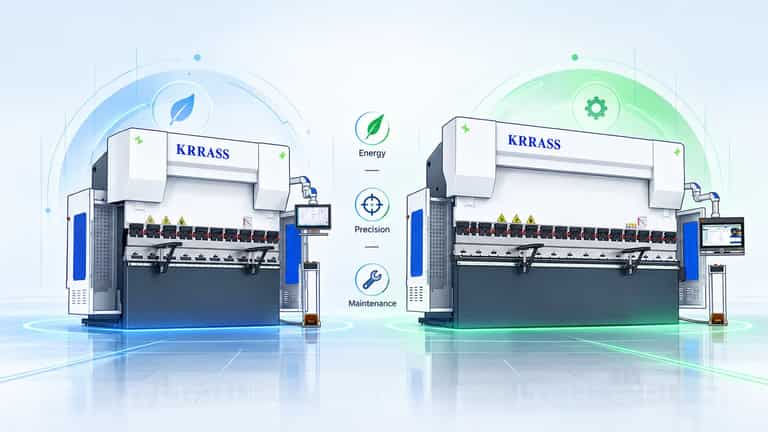
A hydraulic vs electric press brake comparison starts with the parts your workshop needs to produce. Material strength, bend length, tooling, finished-part tolerances and annual workload determine whether a machine is suitable. Its drive system then influences motion, energy use and maintenance within that application.
The selection process therefore asks two questions: can both machines make the required parts, and which complete production setup offers the better ownership cost? This guide explains how to answer those questions, including where a servo-hydraulic hybrid may fit. You can explore the KRRASS press brake range alongside the selection criteria below.
Hydraulic vs Electric Press Brake: Quick Comparison
An electric press brake is a strong candidate for repeated small and medium sheet-metal parts when the required force, working length and part clearance fit the selected model. Frequent short strokes, substantial idle periods and a desire to reduce hydraulic-fluid servicing can make its operating profile attractive.
A hydraulic CNC press brake deserves early consideration for long bends, heavy plate or varied work requiring greater force and a larger working envelope. Modern hydraulic CNC machines can also meet demanding tolerances when their controls, tooling and compensation systems suit the job.
A hybrid press brake retains hydraulic force generation while using a controlled motor or pump arrangement that can reduce unnecessary running losses. It belongs on the shortlist when hydraulic capacity is needed and measured energy use is an important purchasing criterion.
| Selection factor | Servo electric press brake | Hydraulic CNC or hybrid press brake |
|---|---|---|
| Capacity and part size | Confirm the specific model’s force, length and clearance | Broad choices for high-force and long-bend applications; verify each model |
| Finished-part accuracy | Depends on feedback, tooling, material and process control | Depends on the same factors; hydraulic drive does not imply poor precision |
| Production speed | Responsive motion can benefit frequent short cycles | Complete-part output can be competitive with suitable controls and handling |
| Energy use | Can offer lower demand in suitable intermittent workloads | Conventional and variable-speed hydraulic systems have different energy profiles |
| Maintenance | Mechanical transmission, lubrication, drives and electrical systems | Hydraulic fluid and components, plus mechanical and electrical systems |
| Initial investment | Compare the installed quotation for equivalent work | Compare the same capacity, controls, tooling, safeguards and service scope |
The final choice should follow a trial on representative parts and a cost comparison between technically suitable machines.
How Electric, Hydraulic and Hybrid Press Brakes Work
Servo Electric Press Brake: Electromechanical Ram Drive
For this guide, a servo electric press brake, also commonly written as a servo-electric press brake, uses an electromechanical primary ram drive. Servo motors transmit force and motion through a mechanical system, which may use screws, belts or another arrangement depending on the design. The ram does not need a main hydraulic power circuit. Mechanical lubrication and other service requirements still apply.
Hydraulic Press Brake: Oil Pressure and Cylinders
A hydraulic press brake generates ram force through pressurized oil and cylinders. An electric motor powers the pump, while valves and controls regulate movement as required by the machine. A basic torsion-bar hydraulic machine and a closed-loop CNC hydraulic machine have different capabilities, so they should not be treated as one performance category.
Hybrid Press Brake: Servo-Hydraulic Force Generation
A servo-hydraulic or hybrid press brake uses controlled motors, pumps or other components within a hydraulic architecture. Manufacturer terminology varies. A servo motor on a hydraulic pump does not make the ram electromechanical: bending force still passes through the hydraulic circuit. Ask the supplier to describe the force path in the proposed machine. The KRRASS hybrid press brake overview provides background on this category.
Drive architecture does not determine backgauge axes, programming functions, tool clamping, crowning or angle measurement by itself. Specify these features separately. If one candidate has automatic crowning and advanced programming while another has a basic configuration, their results reflect more than the difference between electric and hydraulic drives.
Check Bending Capacity and Part Geometry First
Build a production profile for the machine shortlist
Collect drawings for the parts that account for most recurring production, the most demanding regular components and any confirmed future work. Maximum thickness and length alone can produce an incomplete recommendation. A workshop bending short brackets throughout the day has a different workload from one producing a few large panels, even if both occasionally use the same material thickness.
| Production information | What to record | How it affects selection |
|---|---|---|
| Material and condition | Grade, thickness range, surface requirements and relevant grain direction | Force, springback, tooling and finish protection |
| Part geometry | Longest bend, inside radius, minimum flange and return flanges | Machine length, clearance and bend sequence |
| Acceptance requirements | Angle, flange and assembly tolerances | Measuring method, corrections and process capability |
| Batch and job mix | Typical quantity, bends per part and changes per shift | Setup effort, handling and repeated-cycle demand |
| Annual workload | Actual machine-on hours, idle share and expected shifts | Energy comparison and investment utilization |
| Site and support | Available power, space, handling and local service | Installation scope and recovery from faults |
Separate daily core work, regular seasonal work and rare exceptions. Confirm whether the new machine must handle all three groups or can share work with existing equipment. Include the most difficult profitable recurring part in the acceptance test; a demonstration using only an easy bracket may miss the limitation that matters most to the business.
Future capacity should follow credible production needs. Buying a larger envelope for a confirmed part family can be reasonable, while sizing the entire investment around an unlikely heavy job can tie up capital and space. Record which requirements are mandatory and which are preferences before requesting quotations.
Force depends on more than sheet thickness
Required bending force depends on material properties, thickness, bend length, die opening and forming method. For conventional air bending with other variables fixed, force rises approximately with the square of thickness and increases with bend length and material strength. Widening the V-die opening reduces the force requirement, but it also changes the achievable radius and minimum flange.
For example, increasing thickness from 2 mm to 3 mm gives an approximate force multiplier of 2.25 if the material, bend length, V opening and process remain unchanged. This is an engineering ratio, not an approved tooling choice or machine capacity rating. Real jobs often require a different die opening as thickness changes. The Bystronic tonnage calculation guide describes the underlying air-bending relationship and the need for material and process factors.
Avoid selecting either drive type from an isolated claim such as “bends 6 mm steel.” Without the material grade, bend length, tooling and forming method, that statement does not define a usable capacity.
Working length and clearance can decide the purchase
Rated force alone cannot establish whether a machine can produce a deep box, long panel or return flange. Check working length, distance between columns, throat depth, usable stroke, open height, tool height and backgauge reach. Review the complete bend sequence for collisions and confirm that the workpiece can be positioned for the final operation.
Long bends also require attention to frame and tooling deflection, crowning, ram parallelism and angle consistency along the part. Request the manufacturer’s permitted loading conditions, including restrictions on concentrated or off-center loads. Confirm the punch, die and clamping load limits as well as the machine limit.
The KRRASS tooling selection guide explains how punch geometry, die opening, flange length and compatibility affect the process. Use these checks to create a feasible shortlist before comparing prices.
For a workshop with mixed jobs, distinguish everyday parts from occasional exceptions. A compact electric cell may be suitable if larger work already has another machine available. If every job must pass through one cell, capacity for the largest recurring parts becomes more important.

Electric vs Hydraulic Press Brake: Accuracy and Productivity
Confirm finished-part accuracy
A machine-axis specification and a finished-part tolerance describe different things. Ram positioning resolution indicates a commanded or displayed increment. Ram repeatability describes repeated positioning under defined conditions. Bend-angle and flange accuracy describe the component the customer receives.
Material variation, springback, tooling, crowning, sheet positioning and process corrections affect finished parts on both architectures. Servo-electric motion can provide highly repeatable positioning, while well-equipped hydraulic CNC machines can also deliver strong production results. Ask which axis or measurement a published accuracy figure describes and how it was tested.
For quality acceptance, agree on the material batch, drawing revision, tools, inspection method and sample quantity. Check first-piece results and repeated parts, including a representative period of production. On long components, measure at agreed positions along the bend. A repeatability result should identify the test conditions rather than appear as an unrestricted guarantee.
In a workshop with frequent job changes, first-piece acceptance deserves its own measure. Record the adjustments needed to reach the drawing tolerance and whether those corrections are stored for repeat orders. Include a return flange or a multi-bend component where those shapes are part of normal work. This tests the proposed process rather than an isolated positioning specification.
Measure complete-part output and setup effort
Productivity needs the same discipline. Fast approach speed and an unloaded stroke omit loading, alignment, rotation, inspection, unloading and changeover. For a heavy panel, material handling may dominate. For small repeated brackets, responsive ram motion may have more influence.
During an electric vs hydraulic press brake trial, measure accepted parts per hour over an agreed job or batch. Record rejects, setup time, handling and interruptions. If a supplier reports a percentage advantage, establish whether it means shorter cycle time or higher output: the two calculations use different denominators.
Frequent setups also depend on programming, tool storage, clamping and operator workflow. These configuration choices can matter more than drive type. For further control-system considerations, see NC versus CNC press brake selection.
Use a defined starting condition for each changeover. For example, agree whether tools and programs are already prepared or must be selected from the normal storage system. Record time to the first accepted part and total time for the production batch. A quick repeat stroke and a quick new-job setup answer different purchasing questions, so both should be visible in the test report.
Electric Press Brake Energy Consumption: Measure the Whole Machine
An electric press brake can use less electricity than a conventional fixed-speed hydraulic machine, particularly with intermittent bending and meaningful idle periods. A variable-speed hydraulic or servo-hydraulic system may narrow that difference. The size of any saving depends on the actual machines and duty cycle.
Installed motor power is not average electrical demand. The U.S. Energy Information Administration’s electricity measurement guide distinguishes power, measured in kilowatts, from energy, measured in kilowatt-hours. A motor nameplate therefore cannot establish annual electricity consumption.
To compare electric press brake energy consumption fairly, meter each complete machine while it produces the same accepted parts under agreed conditions. Include its controller, backgauge, cooling and relevant accessories. Record bending, setup and idle periods, total production time, good-part count and rejects. Any equipment needed only by one candidate should be included in that candidate’s cost boundary.
Use both total kWh for a defined workload and kWh per accepted part. A lower average power reading is insufficient if the machine takes substantially longer to complete the same order. Conversely, higher output has value only when the factory can use the released capacity or sell additional production.
A hypothetical annual electricity calculation
For a simplified energy-only estimate:
Annual electricity cost = average whole-machine input power (kW) × annual operating hours × energy rate per kWh.
The following teaching scenario assumes equivalent accepted output over the same 2,000 annual operating hours, including the agreed setup and idle periods. Average input powers of 10.0 kW and 3.0 kW, and an energy rate of US$0.12/kWh, are hypothetical inputs. They are not KRRASS measurements, customer tariffs or an industry benchmark.
| Hypothetical input or result | Hydraulic candidate | Electric candidate |
|---|---|---|
| Assumed average whole-machine input power | 10.0 kW | 3.0 kW |
| Assumed annual operating hours | 2,000 | 2,000 |
| Calculated annual electricity use | 20,000 kWh | 6,000 kWh |
| Assumed energy rate | US$0.12/kWh | US$0.12/kWh |
| Calculated annual electricity cost | US$2,400 | US$720 |
Under these assumptions, the annual electricity difference is US$1,680. With the same assumed power gap and tariff, 800 hours would give US$672 and 3,000 hours would give US$2,520. Actual average demand may change with utilization and product mix.
Replace the assumptions with your production data and local industrial tariff. Include applicable demand charges, time-of-use rates, taxes or other billing items in a real comparison. This example covers energy charges only.

Press Brake Ownership Cost: Purchase Price, Maintenance and Payback
To estimate press brake ownership cost, use a consistent boundary for purchase, installation, operation, service and the machine’s value at the end of the analysis period. Keep supplier quotations, test measurements and planning assumptions identifiable. A transparent model lets the buyer see which cost difference comes from the machine and which comes from the production plan.
Compare equivalent installed quotations
An electric press brake may carry a purchase premium over some hydraulic alternatives, but neither architecture has a universal price advantage. Force, working length, controller, axes, tooling, safeguards, options, warranty and destination all affect the quotation.
Ask both suppliers to price equipment that can make the same required parts. Check freight, packing, insurance, duties, site electrical work, commissioning and training. State the currency, quotation date, validity, Incoterm and named place. Installation and training scope should be explicit rather than inferred from the trade term.
Include programming licenses, tooling adapters, clamping, angle measurement and handling equipment when the productivity assumptions depend on them. The KRRASS press brake buying guide offers additional specification checks.
Illustrative five-year cash costs
The example below uses the same hypothetical energy scenario. Purchase, installation and maintenance figures are teaching assumptions prepared for this guide on October 12, 2026. All amounts are USD; they are not dated market prices, KRRASS quotations or region-specific cost estimates. No market region is represented. Assume both candidates are technically suitable for the same work.
| Illustrative cash-cost item | Hydraulic CNC candidate | Servo-electric CNC candidate |
|---|---|---|
| Assumed machine purchase | US$75,000 | US$95,000 |
| Assumed freight, site work and commissioning | US$5,000 | US$5,000 |
| Calculated five-year electricity cost | US$12,000 | US$3,600 |
| Assumed maintenance and repairs per year | US$2,000 | US$1,200 |
| Calculated five-year maintenance and repairs | US$10,000 | US$6,000 |
| Five-year cash cost: purchase + installation + electricity + maintenance | US$102,000 | US$109,600 |
The annual maintenance row is an input; the total includes its five-year value once. In this scenario, the electric candidate saves US$8,400 in electricity and US$4,000 in assumed maintenance over five years. Its US$20,000 purchase premium leaves its five-year cash cost US$7,600 higher.
This is a partial cost comparison. Labor, scrap, downtime, tooling and software differences, financing, taxes and residual value are excluded; they are not assumed to be zero. Add them when preparing a full total cost of ownership model. Higher specialist repair costs or different resale values can also change the result.
Using only the assumed annual electricity and maintenance savings gives a simple purchase-premium payback of:
US$20,000 ÷ (US$1,680 + US$800) ≈ 8.1 years.
That result applies only to this undiscounted teaching scenario. It demonstrates why energy savings alone may not repay a purchase premium within a chosen ownership period.
A verified productivity benefit can change the business case. Establish whether faster production reduces paid labor, avoids overtime or generates additional saleable output. Avoid counting the same released time as both a labor saving and an output benefit. Incremental contribution belongs in a separate business-case calculation, with evidence for demand and downstream capacity.
For a real investment decision, compare a base case with lower-utilization and higher-service-cost cases. Use measured production data and written quotations, and include the financial assumptions required by your business.
Inputs to add to a full ownership-cost comparison
The partial example above is a starting point. Before choosing a machine, check whether the following items differ between the actual quotations:
- Tooling and software: initial punches, dies and adapters, replacement tooling, programming licenses and any ongoing charges.
- Operator and setup time: paid hours for the expected mix of jobs, with savings included only when staffing, overtime or productive capacity can actually change.
- Quality losses: material, rework and inspection costs associated with the measured rejection rate on representative parts.
- Maintenance and downtime: scheduled service, critical replacement components, outside labor, travel and the production consequence of an unavailable machine.
- Financial and end-of-period items: applicable taxes, financing, discounting and residual value under the business’s accounting assumptions.
Use the same workload and analysis period for both candidates. If production is split between an electric cell and an existing hydraulic machine, include both workloads in the proposed arrangement. Record where estimates remain uncertain, then check whether the decision changes under more conservative inputs.
Maintenance, Reliability and Safeguarding
Compare model-specific maintenance requirements
A fully electric primary ram drive avoids the pump, oil reservoir, valves, hoses and cylinders associated with a hydraulic ram circuit. It can remove those particular servicing tasks and leakage risks. Mechanical drives, bearings, lubrication, encoders, servo electronics and cabinet cooling still require care. “Oil-free ram drive” does not mean a lubricant-free or maintenance-free machine.
A hydraulic or hybrid machine needs appropriate fluid management, filtration, leak inspection and servicing of its hydraulic components, alongside mechanical and electrical maintenance. Follow the specific manufacturer’s manual for tasks and intervals. Generic oil-change schedules or assumptions about continuous pump operation do not apply to every design.
Ask for the preventive-maintenance schedule and a list of critical spares for the quoted configuration. Establish which tasks your staff can perform, which require trained outside support and which parts may have a longer lead time. Compare the service plan with your available maintenance skills. Removing one category of hydraulic service does not remove the need to budget for a mechanical transmission or a specialist electronic component.
Check the installation environment and service arrangements
For both architectures, review ambient temperature, dust, humidity, supply voltage and grounding requirements. Ask about critical spare parts, remote diagnosis, parameter backups, warranty scope and on-site support in the destination market. Service availability and recovery time influence ownership cost as well as reliability.
Confirm any required transformer, electrical work, cabinet conditioning, floor preparation and handling equipment before comparing installed prices. Request a practical fault-recovery plan: who diagnoses the machine, whether parameter backups are available, how replacement parts are supplied and what on-site labor costs are included. These details matter most when one press brake is a bottleneck for the rest of the production line.
Evaluate noise and cleanliness under working conditions
Where a quieter work area is a purchasing objective, assess the actual machines during comparable bending and idle periods. Drive architecture can influence the noise profile, while tooling contact, workpiece handling and auxiliary equipment also contribute. Obtain a defined measurement if a supplier gives a noise figure. Likewise, removing hydraulic oil from the primary ram drive does not establish that the entire cell is free from lubricants, dust or surface-marking risks.
Include safeguarding in the supplied configuration
Safeguarding also belongs in the base configuration. The OSHA powered press brake guidance describes hazards around the point of operation, foot controls and moving workpieces. ANSI B11.3-2022 addresses safety requirements for power press brakes; applicable requirements depend on the destination and intended use.
Review supplied front, side and rear protection, foot controls, emergency functions and operating modes with competent personnel. Witness the agreed protective-function tests, include large-sheet handling in the assessment, and confirm safe maintenance isolation. The OSHA hazardous-energy guidance provides background on lockout/tagout. Use the machine-specific procedure for mechanical, electrical and hydraulic stored energy as applicable. Safety devices must remain active during production trials.

Which Production Scenarios Favor Each Option?
Consider an electric press brake for suitable repeated sheet-metal work
Electrical cabinets, brackets, trays and small enclosures can involve frequent short cycles, repeated positioning and many bends per shift. An appropriately sized electric machine may suit this workload when its motion and energy profile provide a measurable benefit.
Confirm the largest recurring component, return-flange clearance and most demanding material. Stainless-steel parts also require attention to grade, springback and surface finish. Where work-area cleanliness matters, the absence of a main hydraulic ram circuit can be useful, while mechanical lubricants and handling still need control.
Consider hydraulic CNC for broad capacity and larger parts
Long structural bends, heavy equipment components and thicker plate often lead buyers toward hydraulic capacity. A suitably configured hydraulic CNC machine may also serve a mixed workshop that needs one cell for a wide part range.
For low annual utilization, a lower installed quotation can carry more weight than modest annual energy savings. Check the actual bids and service arrangements. Tooling, inspection or handling improvements may provide more value than paying for a different drive architecture.
Evaluate a hybrid press brake and existing capacity together
Servo-hydraulic systems deserve comparison where the required work favors hydraulic cylinders and variable-demand operation matters. Verify their energy behavior and hydraulic maintenance requirements on the proposed model.
A two-machine strategy may suit sustained small-part demand alongside occasional heavy work: allocate suitable repeated parts to an electric cell and retain hydraulic capacity for larger jobs. Include staffing, space, maintenance and workload distribution in that calculation. Only the work actually transferred contributes to the new cell’s savings.
KRRASS Product Options for an Application-Based Quotation
The KRRASS E-Bend range provides a starting point for all-electric product selection. Individual model pages identify published configurations that can be checked against your drawings.
| Published product example | Force and bending length | Buyer follow-up |
|---|---|---|
| EPP-70T2500 pure electric press brake | 700 kN; 2,500 mm; listed with DA-69S control | Confirm current model configuration, tooling, safeguards and application capacity |
| PBE-135T3200 hybrid press brake | 1,350 kN; 3,200 mm | Confirm the hydraulic architecture, quoted equipment and application capacity |
These are different force and length classes. Their displayed prices cannot establish the cost difference between equivalent electric and hydraulic machines. Public specifications describe listed products, while the quotation and agreed acceptance criteria define the equipment for your order.
Browse electric press brake products and CNC press brake products, then request recommendations against the same part requirements. Avoid using a catalog’s motor rating or general savings statement as a substitute for application data.
What to Request Before Ordering
Prepare representative drawings, including everyday parts and a challenging recurring component. Supply material grade, thickness, maximum bend length, minimum flange, inside radius, return geometry, tolerances, batch size and production volume. State annual operating hours, destination, site power and handling restrictions.
Request a written configuration covering rated force, working length, usable stroke, open height, throat, loading limits, controller, axes, crowning, tool interfaces and safeguards. Identify which tooling, software, training and commissioning services are included. Ask for trade terms, warranty conditions, service scope, lead time and quote validity.
Put the quoted configurations side by side before the trial. If an energy or production claim depends on angle measurement, quick clamping, offline programming or a sheet follower, identify whether that feature is supplied on both machines and included in the price. This prevents a comparison of drive systems from quietly becoming a comparison of different accessory packages.
Agree on a practical acceptance test using the submitted parts. Use the same material and drawing revision, equivalent process conditions and an agreed inspection method. Record the tested configuration so that optional equipment shown in the demonstration is not mistaken for the quoted package.
| Acceptance item | Record during the agreed test |
|---|---|
| Setup and first piece | Starting changeover condition, time to first accepted part and required corrections |
| Quality and repeatability | Angle and dimensional results from an agreed sample, with rejects recorded |
| Productivity | Complete accepted parts, total production time, handling and interruptions |
| Energy | Whole-machine kWh, elapsed time and kWh per accepted part, including the defined duty cycle |
| Safeguarding and support | Agreed protection tests, operating documentation, maintenance and recovery arrangements |
When a supplier cannot provide a measurement, identify the gap and use a conservative assumption until suitable evidence is available. An acceptance record should separate actual results, supplier estimates and planning inputs.

Frequently Asked Questions
Is an electric press brake better than a hydraulic press brake?
It depends on the parts, capacity, configuration and workload. Electric equipment can be attractive for suitable repeated sheet-metal work, while hydraulic machines offer broad options for force and length. Compare finished-part results and ownership costs for specific candidates that can make the same required components.
Can an electric press brake bend stainless steel or thicker plate?
Yes, when the selected machine and tooling are approved for the material grade, thickness, bend length, die opening and process. Stainless grades vary in strength and springback. There is no universal thickness cutoff between electric and hydraulic equipment; verify force, clearance and loading limits for the actual job.
Are electric press brakes more accurate?
They can provide highly repeatable ram positioning, but that does not establish every finished-part tolerance. Hydraulic CNC machines can also produce accurate parts. Check whether a specification describes resolution, axis repeatability or formed components, and request inspection results on your material and drawings.
Does an electric press brake always use less electricity?
No universal saving applies. A fully electric drive can have an advantage over conventional fixed-speed hydraulics under suitable duty cycles, while modern hydraulic pump control may reduce the gap. Compare whole-machine kWh for equivalent accepted output, including setup, idle periods and necessary accessories.
Is a hybrid press brake fully electric?
In the servo-hydraulic category discussed here, it still uses a hydraulic circuit to generate ram force. Controlled motors or pumps change how that system operates. Ask for a description of the primary force path because product labels vary between manufacturers.
Which type is cheaper to maintain?
A fully electric ram drive avoids main hydraulic-circuit servicing but still needs mechanical and electrical maintenance. Hydraulic equipment requires fluid and component care. Compare model-specific schedules, planned repairs, parts availability and local support instead of assuming one architecture always costs less.
How much does an electric press brake cost?
The price depends on capacity, working length, control package, axes, tooling, safeguards, options and delivery scope. Request a dated quotation with currency, trade terms and inclusions. A public reference price does not establish the landed and commissioned cost for your workshop.
How long is the payback period for an electric press brake?
Payback depends on the extra installed investment and savings your business can actually realize. Energy, maintenance, labor, output and downtime may contribute, but each input needs evidence. The hypothetical example in this guide gives about 8.1 years using only its assumed energy and maintenance savings; it is not a product payback claim.
Choose the Machine Around Your Parts and Production Costs
A sound hydraulic vs electric press brake decision follows a clear sequence: establish capacity and clearance, confirm finished-part quality, measure accepted output and energy, and compare installed quotations and ownership costs. Include hybrid equipment where its architecture fits the work.
Send KRRASS your drawings and production requirements for an application-based recommendation. Include material grades, thicknesses, bend lengths, tolerances, batch sizes, annual workload and destination so the proposed configuration and quotation can be evaluated against your actual production needs.
Share