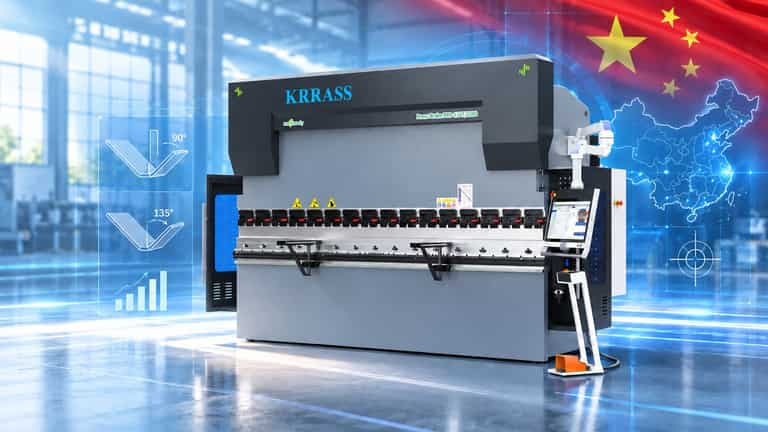
Choosing a China press brake supplier starts with your parts: material, thickness, bend length, geometry, tolerances and production mix. KRRASS, ACCURL, ADH, HARSLE, JFY, World Precise Machinery and Jiangsu Yawei are seven manufacturers to investigate through their published press brake ranges. The right shortlist depends on which suppliers can document a suitable machine, demonstrate the required bends and provide a workable service arrangement at your factory.
When researching Chinese press brake manufacturers, a familiar brand name is a starting point. It does not tell you whether a particular quotation includes the correct tooling, usable working space, programming functions or installation support. Even machines with the same nominal tonnage and length can represent different production capabilities. The useful comparison is between complete proposals for the same work.
This guide introduces the manufacturers, explains the differences between their published product ranges and shows how to evaluate a supplier’s proposed solution. For the available machine families, explore the KRRASS press brake range.
Editorial note: KRRASS publishes this guide and is one of the manufacturers listed. Brands are arranged alphabetically, using “Yawei” for Jiangsu Yawei. The descriptions draw on public product catalogues reviewed on October 13, 2026; they do not represent independent machine tests or a performance ranking. Exact capabilities, included equipment and service arrangements depend on the proposed model and quotation.
How to Use a China Press Brake Manufacturer Shortlist
Start with a manageable group of suppliers whose published products address your production task. A manufacturer offering a relevant machine category belongs in the initial investigation; it belongs in the final shortlist only after its proposed configuration and support scope have been checked.
Apply the same requirements to every candidate. Send identical drawings, material information and tolerance requirements, then compare the returned configuration sheets and test proposals. If you send one supplier a detailed drawing package and another only a tonnage request, the resulting offers will not be meaningfully comparable.
Keep three kinds of information separate: what the manufacturer publishes, what it commits to in your quotation and what you verify through documents or tests. A catalogue feature may be optional, a demonstration may use a different machine, and a local service arrangement may depend on the selling distributor. Record those differences before making a decision.
For a broader evaluation framework that applies across countries, see how to compare press brake manufacturers beyond price.
Seven Press Brake Manufacturers in China
The following table summarizes product directions visible in the reviewed catalogues. It does not establish market share, comparative accuracy, current stock or the configuration of any future order.
| Manufacturer | Published product range | What the range helps buyers evaluate |
|---|---|---|
| KRRASS | StandardBend, EssentialBend, E-Bend and SyncBend ranges | Configuration choices across routine hydraulic, entry-level, electric and tandem bending |
| ACCURL | SMART and EURO PRO CNC, GENIUS PLUS hybrid and eB Ultra electric ranges | Alternative drive and configuration choices within one manufacturer’s portfolio |
| ADH | NC, CNC, electric and tandem press brakes; WAD/WADE CNC ranges | Different machine architectures for recurring bends, varied parts and long-workpiece requirements |
| HARSLE | NC and CNC press brake offerings | The control functions and setup requirements of different proposed configurations |
| JFY | TPM 8 and TPM+ L bending ranges | Working-space requirements for taller tooling and larger formed parts |
| World Precise Machinery | WC67Y hydraulic and WE67K CNC hydraulic listings | Hydraulic press brake proposals within a broader metalworking equipment portfolio |
| Jiangsu Yawei | PBM, PBE electric-servo, PBH and PB heavy-duty ranges | Different series for electric-servo, CNC and heavy-duty bending requirements |
KRRASS
KRRASS organizes its published press brake range into several product families: StandardBend for multi-axis hydraulic bending, EssentialBend for entry-level requirements, E-Bend for electric bending and SyncBend for tandem applications. The website also separates NC, CNC and electric product categories, giving buyers different routes to the relevant machine proposals.
The families address different starting points in a purchasing decision. A workshop assessing routine bends can begin with setup and tooling requirements; a factory with varied parts needs to consider programmed axes and gauge access. Electric equipment introduces a separate drive choice, while a tandem arrangement concerns coordinated bending over an extended working length. The selected model still determines which parts and operating conditions are feasible.
A KRRASS recommendation should connect those choices to the buyer’s drawing package and production mix. Its value lies in an explained configuration: machine, synchronization, controller, working envelope, tooling and support scope. That recommendation can then be assessed against the same sample results and documentation used for other candidates, including any difficult parts that require a different configuration.
ACCURL
ACCURL’s published press brake portfolio includes SMART and EURO PRO CNC families, GENIUS PLUS hybrid equipment and the eB Ultra electric range. These families provide several routes through the same manufacturer’s catalogue, allowing a purchasing team to examine drive architecture and machine configuration together.
For a shop deciding between hydraulic, hybrid and electric bending, this breadth makes it possible to compare proposals without changing the supplier at every step. The relevant differences include the model’s working envelope, positioning hardware and programming package, as well as the drive itself. A proposal for frequent small batches may prioritize setup and tool changes, while a different part mix may make available working space more important.
The series name identifies a product family; the configuration sheet identifies the machine being purchased. Controllers, axes, crowning, tooling and illustrated accessories must therefore be read at model level. Energy-use claims also require the stated operating conditions before they can inform a comparison with another proposal.
ADH
ADH publishes NC, CNC, electric and tandem press brake categories, including WAD and WADE CNC ranges. Its catalogue separates several machine architectures, giving buyers an initial way to distinguish everyday bending requirements from applications involving more varied geometry or extended workpiece lengths.
For recurring straightforward parts, a proposal can be assessed around the tooling, adjustment procedure and operator workload. For varied CNC work, synchronization, programmed positioning and gauge access become central to the application review. A tandem proposal introduces a different consideration: the coordinated working envelope and handling arrangement for the long parts involved. These are production requirements to evaluate against the selected model, rather than benefits established by the category name.
The useful comparison is the connection between the recommended ADH series and the buyer’s drawings. A complete proposal needs to show the machine configuration, compatible tooling and any additional supports or handling equipment. That connection makes the recommendation easier to compare with a supplier offering a different architecture for the same work.
HARSLE
HARSLE’s public product offering includes NC and CNC press brakes. These categories give buyers a starting point for evaluating how much programmed control their work requires and which adjustments remain part of the operator’s setup routine.
The distinction matters for a shop with repeated simple bends as well as one changing frequently between different parts. Program storage, gauge movement and the method of entering a bend sequence influence the work required between jobs. A controller brand or screen size alone does not establish those functions: the controller must be considered with the synchronization arrangement, positioning hardware and installed software.
For a HARSLE proposal, a clear description of that complete arrangement is more useful than a broad NC or CNC label. A setup demonstration can show how the operator creates a program, positions the part and adjusts the tooling before producing a finished sample. The same demonstration criteria should apply to every manufacturer in the shortlist so that control options are compared on their practical role in production.
JFY
JFY’s public bending catalogue includes TPM 8 and TPM+ L. The TPM+ L is described as extending the working space through increased stroke and open height, with taller tooling and larger formed parts among the intended applications. This provides a specific product direction for buyers whose difficult parts are constrained by clearance.
Deep enclosures, return flanges and tall formed parts illustrate why working space deserves attention alongside bending force. A part can fit between the tools before forming yet become difficult to gauge, rotate or remove later in the sequence. The practical value of additional open height and stroke therefore depends on the complete tooling and part-handling arrangement.
A JFY model can be evaluated against the full formed geometry and bend sequence, including tool heights, usable daylight and throat clearance. Where programming software is included, the relevant comparison also covers file compatibility and the machine/tooling model used in simulation. A larger working envelope is meaningful when it enables the required sequence, rather than simply producing a larger number in the specification table.
World Precise Machinery
World Precise Machinery lists hydraulic press brakes including WC67Y and WE67K CNC hydraulic equipment within a broader metalworking portfolio. The press brake listings establish a relevant bending product category even though the company’s range also includes other types of machinery.
For a factory sourcing several equipment types, that broader range can provide a starting point for discussing multiple proposals with one supplier. Each machine still needs its own application review and acceptance requirements. Experience with a stamping machine, for example, does not establish the bending results of a particular press brake; the relevant evidence comes from the proposed bending setup.
Familiar model prefixes help identify catalogue entries but do not fully specify a machine. For World Precise Machinery, the meaningful comparison is the named model together with its control arrangement, usable working space, tooling and accessories. Inspection records, technical contacts and service responsibilities also need to relate to that press brake, particularly when it forms one item in a larger equipment order.
Jiangsu Yawei
Jiangsu Yawei’s public catalogue includes PBM, PBE electric-servo, PBH and PB heavy-duty press brake ranges. This gives buyers several series to examine when distinguishing electric-servo equipment from other CNC and heavy-duty bending proposals.
The range is relevant to purchasing teams comparing substantially different production requirements. An electric-servo model must be assessed within its rated capacity and operating conditions; a heavy-duty proposal brings material strength, tooling load and workpiece handling into the application review. Where the work includes both routine parts and occasional demanding jobs, the model choice should address that mix rather than only the most extreme part in the drawing package.
The complete configuration determines how a Jiangsu Yawei series translates into usable production capability. Bending force, working space and supplied tooling need to be assessed together, with sample results for the required parts. The manufacturer and selling entity should also be clearly identified when similar names or regional distributors appear in the purchasing process.
Match the Manufacturer to Your Production Task
The most useful shortlist is organized around work the machine must perform. A small workshop with recurring simple bends and a factory producing deep enclosures may need very different proposals, even when both buyers initially request the same nominal capacity.
| Your production task | What the supplier needs to demonstrate | Evidence to compare |
|---|---|---|
| Straightforward, recurring bends | Suitable capacity, tooling and manageable setup | Sample parts, adjustment procedure and operator workflow |
| Frequent changes between different parts | Practical programming, gauge access and tool changes | A setup demonstration using several nominated drawings |
| Deep boxes or return flanges | Clearance through the entire bend sequence | Machine/tooling envelope and a formed-part demonstration |
| Long panels | Angle consistency along the required bend length | Measurements at agreed positions under stated test conditions |
| Thick or high-strength material | Adequate force, tooling load rating and handling | Material assumptions, force assessment and supported sample test |
| Automation plans | Feasible handling, gripping and cell integration | Part accessibility, integration scope and responsibility map |
There is no need to request every available option. Ask suppliers to distinguish features needed for current work from options associated with a credible future task. This prevents a feature-heavy proposal from appearing better merely because it is longer.
For a fuller introduction to machine categories, consult the press brake types and configuration overview.
Compare the Technical Answers Behind the Quotation
Two China press brake machine manufacturers may quote the same headline tonnage and length while proposing different tooling, control functions and operating envelopes. Give both suppliers the same technical questions and look for answers that refer to your actual parts.
Capacity, Geometry and Tooling
Ask for a bending assessment based on material grade, thickness, bend length, tooling and process. Rated machine force alone does not establish whether the shortest flange, inside radius or return bend is feasible. Check the usable working space, tool clearance and the load ratings of punches, dies and clamps. A machine proposal must remain within both machine and tooling limits.
The press brake tooling guide provides more detail on punch, die and compatibility considerations. In a manufacturer comparison, the key question is whether each supplier has identified the tooling required for the nominated parts and included it clearly in the proposal.
Control, Backgauge and Programming
Ask which movements are programmed, how the gauges support awkward flanges and how operators create and recover a part program. Confirm the installed controller and software rather than judging by a brand logo or screen size. Offline programming requires compatible files, licenses and machine/tooling information; it is not demonstrated by a screenshot alone.
Separate positioning specifications from finished-part tolerances. Final bending results also depend on material variation, tooling, setup and the bending process. Request measured parts with stated test conditions instead of accepting a single accuracy number without its definition.
Quality and Safety Documents in a Supplier Comparison
Quality documentation should relate to the proposed equipment. Request the relevant specification revision, inspection record format, machine identification and the process used to handle nonconforming results. A useful answer explains how the supplier checks the machine and what records will accompany your order.
If a supplier presents ISO 9001 certification, check the certified organization, scope, issuing body and validity. ISO describes ISO 9001 as a quality management system standard. It should not be treated as proof that a particular press brake will meet your part tolerances or every destination-specific safety requirement. The ISO overview of the ISO 9000 family explains this management-system context.
Ask a qualified safety specialist to review the proposed safeguarding for the actual machine, operations and destination. Distinguish devices intended to protect operators from equipment that measures bending angles or assists positioning. For U.S. workplaces, the OSHA powered press brake guarding resource is a useful starting reference; it is not a universal compliance certificate or a substitute for an application-specific assessment.
Use the Same Trial-Bending Plan for Finalists
A supplier demonstration is most useful when you can compare it with the others. Agree a small set of representative parts: routine work, a demanding geometry and a long or heavy part where relevant. Define the material, thickness, tooling, drawing revision and acceptable results before the test.
Request measurements at agreed locations, including several positions along a long bend when appropriate. State how many pieces will be checked and how the measurements will be taken. Record setup changes, operator adjustments and rejected pieces, as well as successful parts. A single selected sample provides less evidence than a documented repeatable process.
| Trial item | What to record |
|---|---|
| Machine identity | Model, serial number where available, controller and installed options |
| Test inputs | Drawing revision, material grade, thickness, tooling and bend sequence |
| Part results | Angle, flange dimensions, surface condition and agreed measurement locations |
| Repeatability | Consecutive results and adjustments needed between pieces |
| Setup practicality | Programming, tool changes, gauge access and handling steps |
| Open issues | Deviations, proposed corrections and whether another test is required |
If the demonstration uses a showroom machine rather than the ordered unit, record the configuration differences. A remote video can help assess a method, but it should not be described as independent inspection or final acceptance. Keep supplier selection evidence distinct from the final acceptance agreement for the machine you purchase.
Compare Service Where the Machine Will Operate
After-sales support is a delivery arrangement to verify, not a slogan. Ask who will help at your factory, whether support is direct or through a distributor, and what installation and training include. Confirm available languages, remote diagnostic access, the escalation process and the charges associated with an on-site visit.
Ask for a recommended spare-parts list and a clear route for ordering parts. The supplier should identify which items are consumables, which are model-specific and which may require controller or drive support. A statement about a global network does not establish local availability for your particular machine.
Compare warranty scope alongside exclusions, start date and responsibility for labor, shipping and travel. Avoid treating a longer headline warranty as automatically better if the practical claim process or local support remains unclear. Ask for these terms before selecting the supplier, while the competing proposals are still open.
Put Price and Delivery on the Same Basis
Compare quotations only after normalizing the technical and commercial scope. Record included tooling, software, safeguards, packaging, training and installation responsibilities. A lower machine price can represent a narrower supply package rather than a better offer for the same production task.
Use a named delivery location and the stated Incoterms rule and edition. The International Chamber of Commerce’s Incoterms overview explains how these rules allocate delivery tasks, costs and risks. Ask separately about customs requirements, site preparation and service obligations; a delivery term does not describe the complete purchase.
For configuration-related pricing questions, see the CNC hydraulic press brake price guide. For the wider process of sourcing, inspection and procurement, use the guide to buying a press brake from China. Your shortlist should compare suppliers on the same complete scope before a purchase decision is made.
Build an Evidence-Based Comparison Sheet
Avoid assigning impressive-looking scores to incomplete information. Use a simple evidence status for each criterion: confirmed, requires clarification or not demonstrated. These are internal purchasing statuses, not ratings of a manufacturer’s overall quality.
| Criterion | Confirmed evidence | Follow-up when evidence is incomplete |
|---|---|---|
| Part feasibility | Application review and suitable tooling/envelope | Identify difficult bends and request a revised proposal |
| Configuration | Named model and complete option list | Separate included equipment from catalogue options |
| Bending results | Documented sample measurements | Agree common conditions and repeat the test |
| Quality and safety documents | Relevant records reviewed by responsible personnel | Clarify scope, identity and destination requirements |
| Service | Written installation, training and support arrangement | Identify the local contact and cost responsibilities |
| Commercial scope | Comparable quotation and stated delivery basis | Request the missing items and exclusions |
Resolve essential feasibility and safety questions before using commercial preferences to select a finalist. A low price cannot compensate for a part the proposed machine cannot produce. Where two technically suitable suppliers remain, compare the practical setup work, support and complete delivered scope that matter to your operation.
Warning Signs That Need Clarification
Pause the comparison when a supplier cannot explain its proposed configuration, avoids questions about difficult parts or substitutes a general promotional video for the agreed demonstration. These issues do not prove misconduct, but they leave the purchasing decision unsupported.
Other warning signs include conflicting model descriptions, unexplained changes to controller or tooling, performance promises without test conditions, and a quotation that omits important delivery or service responsibilities. Brand names, the manufacturer, the seller and the payment recipient may differ legitimately, but the relationship must be explained and verified before payment.
Be equally careful with claims that sound favorable: “all-inclusive,” “highest precision,” “guaranteed savings” and “worldwide service” need defined scope. Ask what the statement means for your machine, drawings and destination. Record the answer in the proposal rather than relying on verbal reassurance. A supplier willing to explain limits gives you a more useful basis for evaluation.
What to Send Every Manufacturer
A compact, consistent request gives suppliers a fair opportunity to recommend a suitable machine. Include:
- Representative drawings and their revision numbers, including difficult formed parts.
- Material grades, thickness range, common and maximum bending lengths.
- Required angles, inside radii, minimum flanges, tolerances and surface requirements.
- Batch sizes, production mix, setup frequency and handling constraints.
- Existing tooling, preferred programming workflow and realistic automation plans.
- Factory location, electrical supply, available space and required support language.
- Requested configuration sheet, trial-bending proposal and clear quotation scope.
Ask each supplier to identify missing information and the assumptions used in its recommendation. A proposal based on an assumed material or radius should show that assumption clearly. This makes differences easier to resolve and reduces the chance of selecting a machine around an incomplete description of your work.
Frequently Asked Questions About China Press Brake Manufacturers
Which China press brake manufacturer is best?
There is no single best manufacturer for every application. Build a shortlist from suppliers with relevant published products, then compare their proposed configuration, part feasibility, test evidence, safety documentation and service at your destination. The strongest proposal is the one that addresses your production requirement with verifiable details and clear responsibilities, rather than the one with the largest catalogue or most confident claims.
Are Chinese press brakes reliable?
Reliability should be assessed at the manufacturer, model and support-package level. Review the machine configuration, inspection records, maintenance documentation, demonstrated bending process and parts support. Country of manufacture alone cannot establish reliability. Where available, seek relevant operating references with permission and verify that they concern comparable equipment and applications rather than treating an anonymous review as sufficient evidence.
Should I buy directly from a manufacturer or through a distributor?
Compare the responsibilities and support available through each route. A direct purchase may give close access to the supplying factory, while a distributor may offer local installation or service. Neither arrangement guarantees a better result. Establish who supplies the machine, who accepts the order, who provides technical support and what happens if the machine requires on-site assistance.
How many manufacturers should I compare?
Use a manageable shortlist with relevant products and enough information for a meaningful comparison. Two or three well-documented proposals can be more useful than numerous incomplete quotations. Narrow the group as evidence arrives, but do not select a supplier solely because it responds first. Keep the requirements and test conditions consistent so that the final comparison remains fair.
Does the same tonnage and bending length mean equivalent machines?
No. The usable working envelope, synchronization, controller, backgauge, crowning, tooling, safeguards and software can differ. Nominal capacity also does not resolve short-flange feasibility, deep-part clearance or tooling load limits. Compare the complete specification and demonstrated part results. If a supplier changes a key configuration item, reassess the application and quotation rather than assuming the original evaluation still applies.
Can I compare bending accuracy from a catalogue number?
Only after understanding what the number measures and under which conditions. Backgauge positioning, ram repeatability and finished-part angle or dimension are different measurements. Ask for the definition, test method and relevant part results. Material variation, tooling and setup influence finished parts, so a catalogue figure without context is not a complete acceptance standard for your order.
Is ISO 9001 certification enough to choose a supplier?
No. It is relevant information about a quality management system when its scope and validity are verified. You still need to evaluate the proposed machine, part feasibility, inspection evidence, applicable safety requirements and practical support. Certification should be one item in the supplier file, alongside the technical and commercial information needed to decide whether the equipment suits your production.
What should I verify before placing an order?
Verify the transaction parties, complete configuration, agreed acceptance conditions, required documentation, delivery scope and support responsibilities. Resolve any assumptions about materials, tooling or difficult parts. Check the destination requirements with qualified local advisers. Keep important commitments in the purchase documents so that the order describes the same machine and obligations that were evaluated during supplier selection.
Discuss Your Shortlist and Parts with KRRASS
Bring your drawings, material information and production requirements to the comparison. We invite you to evaluate a KRRASS proposal against the same criteria used for other manufacturers: application fit, documented configuration, demonstrable bending results and a clear support arrangement.
Review the NC press brake, CNC press brake and electric press brake categories, or contact KRRASS with your part requirements. A useful next step is a written recommendation that explains the proposed machine, tooling, included options and any conditions that need further review.
Share