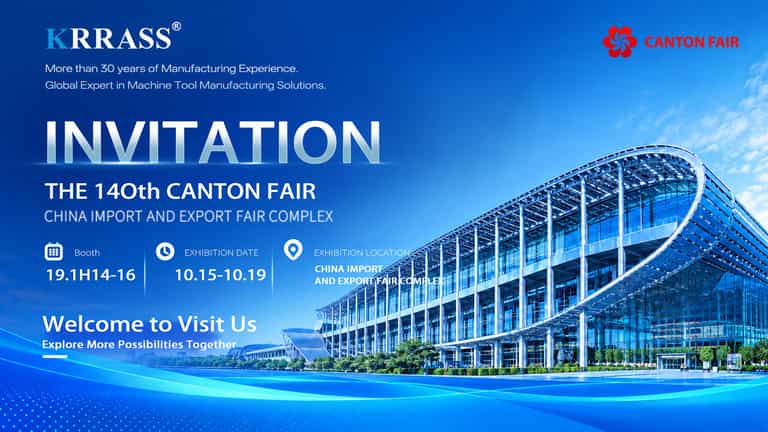
GUANGZHOU, CHINA — October 2026. KRRASS warmly invites sheet metal fabricators, machine distributors, engineering companies, procurement professionals, and manufacturing partners from around the world to visit us at the 140th China Import and Export Fair (Canton Fair). From October 15 to 19, 2026, our team will be at the China Import and Export Fair Complex in Guangzhou, ready to discuss a practical question that matters to every fabrication business: How can we bend better parts, more consistently, with a machine that fits the work and the budget?
Find us at Hall 19.1, Booth H14-16. This year, KRRASS will bring two familiar and highly relevant solutions back to the fair: the EPP-35T1350 pure electric press brake, equipped with a 6+1-axis SCS800 CNC system, and the PBS-50T1600 servo-hydraulic CNC press brake, equipped with a 4+1-axis Delem DA-53Tx controller. Rather than introducing them as new releases, we want visitors to take a closer look at the technologies, ask more specific questions, and evaluate which approach makes the greatest difference on their own production floors.
The invitation is open to businesses looking for a first CNC bending machine, established workshops considering an upgrade, and overseas partners seeking a long-term machinery supplier. Bring your drawings, materials, production goals, or simply your questions. We look forward to meeting you face to face.
Save the Date: KRRASS Exhibition Information
| Exhibition detail | Information |
|---|---|
| Event | 140th China Import and Export Fair (Canton Fair) |
| Exhibition phase | Phase 1: Advanced Manufacturing |
| Dates | October 15-19, 2026 |
| Venue | China Import and Export Fair Complex, Guangzhou, China |
| Complex address | No. 382, Yuejiang Zhong Road, Haizhu District, Guangzhou |
| KRRASS location | Hall 19.1, Booth H14-16 |
| Featured machine 1 | EPP-35T1350 Pure Electric Press Brake — 6+1 Axis, SCS800 |
| Featured machine 2 | PBS-50T1600 Servo-Hydraulic CNC Press Brake — 4+1 Axis, Delem DA-53Tx |
| Meeting and inquiry contact | Contact KRRASS |
| Official fair information | Canton Fair official website |
The fair’s official schedule identifies October 15-19 as Phase 1, with an emphasis on advanced manufacturing. Product areas include processing machinery and equipment, industrial automation, intelligent manufacturing, hardware, and other industrial technologies. Visitors can check current registration, buyer badges, exhibition services, and venue information directly through the official Canton Fair website. The dates and program are also described in the Ministry of Commerce’s introduction to the 140th Canton Fair.
An Invitation Built Around Real Manufacturing Decisions
An industry exhibition can be exciting, but a machine purchase is a serious decision. A press brake may become part of a factory’s daily workflow for years. Buyers are not simply purchasing a rated bending force or a touchscreen. They are choosing a process: how operators program bends, how material is positioned, how quality is checked, how production responds to new orders, and how the machine will be maintained.
That is why our 140th Canton Fair invitation focuses on two complementary bending technologies. One machine represents a fully electric approach, where servo-driven motion performs the bending work without a hydraulic drive circuit. The other represents servo-hydraulic bending, combining the familiar force-delivery characteristics of hydraulics with motor control intended to reduce unnecessary running and improve practical operation. Both approaches have advantages; neither is automatically right for every part or production schedule.
For an electrical cabinet manufacturer, repeatable short bends and rapid product changeovers may be more important than maximum tonnage. For a contract fabricator handling varied steel grades and sizes, flexibility, available force, tooling selection, and comfortable CNC operation can matter more. For a distributor, local service access, spare parts, documentation, and reliable technical communication may be just as important as the machine itself.
KRRASS encourages every visitor to discuss the complete bending application rather than only the catalog price. If you want to begin that process before traveling, explore our press brake solutions and the practical press brake buying guide. These resources explain how force, bending length, backgauge configuration, tooling, and safety fit together in a production-ready machine.
Why the 140th Canton Fair Matters to International Buyers
The Canton Fair has connected buyers and suppliers in Guangzhou since 1957. Held in spring and autumn, it remains a major meeting place for international trade and industrial sourcing. The 140th edition is especially relevant for manufacturing businesses because its first phase puts advanced production technologies in the spotlight.
The scale is significant. According to the Ministry of Commerce’s official overview, the 140th Canton Fair is planned around an exhibition area of approximately 1.55 million square meters, with more than 30,000 enterprises expected to participate across the fair. These are organizer plans and expectations for the upcoming edition, not attendance results.
For another useful benchmark, the 139th Canton Fair, which concluded in May 2026, welcomed about 314,000 overseas buyers from 220 countries and regions across its three phases. The organizers also reported approximately US$25.7 billion in intended orders. These are historical fair-wide figures, not statistics for KRRASS, not figures for Phase 1 alone, and not guaranteed outcomes for October. They nevertheless illustrate why a face-to-face trade event can be valuable to manufacturers evaluating international suppliers. The figures are reported in the Ministry of Commerce’s English-language summary of the 139th Canton Fair.
For a machine buyer, the value is not the size of the crowd alone. It is the opportunity to compare equipment approaches, speak directly with technical and sales personnel, inspect physical machine details, and start practical conversations about future production. A visitor can use one trip to investigate the right machine capacity, learn how CNC systems differ, and identify what documentation and support an international order would require.
Two Press Brakes, Two Ways to Approach Efficient Production
Visitors to the KRRASS booth will be able to compare the thinking behind the two technologies presented in our exhibition lineup. Both machines are designed for sheet metal bending, yet they respond to different manufacturing priorities.
| Comparison point | EPP-35T1350 | PBS-50T1600 |
|---|---|---|
| Machine concept | Pure electric CNC press brake | Servo-hydraulic CNC press brake |
| Nominal model class | 35-ton / 1,350-mm class | 50-ton / 1,600-mm class |
| Exhibited controller | SCS800 | Delem DA-53Tx |
| Advertised exhibit axis configuration | 6+1 Axis | 4+1 Axis |
| Drive principle | Servo-electric bending without a hydraulic bending circuit | Hydraulic bending force with servo-controlled main drive |
| Typical discussion priority | Responsive bending, oil-free drive, repeatable small-part work | Flexible bending, hydraulic force, CNC control, production versatility |
| Ideal questions to ask | Cycle behavior, precision, motion synchronization, electrical consumption | Material range, tonnage, hydraulic response, crowning, controller workflow |
The nominal classes follow the machine model designations and published exhibition lineup. The final machine specification, usable bending length, axis allocation, tooling limits, and optional equipment must be confirmed against the quotation and applicable technical documents.
Neither machine should be judged only by how impressive it looks in an exhibition hall. The most useful comparison begins with a buyer’s actual material thickness, tensile strength, bend length, part geometry, expected volume, and tolerance requirements. Our team welcomes those conversations at Booth H14-16 in Hall 19.1.
Featured Machine: EPP-35T1350 Pure Electric Press Brake
The KRRASS EPP-35T1350 represents the pure electric side of our bending portfolio. As presented in KRRASS’s 139th Canton Fair announcement, this exhibition configuration pairs a 6+1-axis setup with the SCS800 CNC controller. Its model class corresponds to a nominal 35-ton capacity and 1,350 mm bending length, making it especially relevant to discussions about precision components, smaller formed parts, and compact production environments.
What makes a pure electric press brake different?
A conventional hydraulic press brake uses hydraulic pressure to drive the bending movement. A pure electric press brake uses electric servo drive technology for that movement instead. The distinction matters because the machine does not need the hydraulic bending circuit associated with conventional designs. That can reduce concerns about hydraulic oil leaks, fluid-related maintenance, and energy use during parts of the production cycle when bending force is not required.
The useful question, however, is not simply whether a machine has hydraulic oil. It is how accurately and efficiently the complete machine makes your parts. An electric drive can offer responsive motion, but finished-part quality still depends on the stiffness of the machine, servo synchronization, feedback, tooling, material variation, programming, and operator practice.
KRRASS’s EPP electric press brake engineering guide explains the relationship between electric drive architecture, machine structure, positioning feedback, tooling, and bending outcomes. The broader E-Bend product platform also introduces the pure-electric bending concept and published specifications across the range. These resources help visitors prepare informed questions before arriving at the booth.
Why the SCS800 and 6+1-axis setup deserve attention
The CNC controller is where the operator converts a bending requirement into a repeatable sequence of machine movements. With the EPP-35T1350, visitors can ask how the SCS800 manages the relevant machine axes, stores production jobs, supports tool setup, and presents information to the operator. The exhibition description specifies 6+1 axes, but the precise axis allocation should be checked on the physical machine rather than assumed from a generic notation.
For factories producing electrical enclosures, mounting brackets, furniture hardware, electronics housings, or similar parts, the discussion should extend beyond the interface. How quickly can an operator prepare a job? What happens when material thickness varies? Which backgauge movements are included? How are bend corrections handled? Which punches and dies work best for the intended geometry? These questions turn a touchscreen demonstration into a serious production evaluation.
Energy efficiency: ask for a relevant comparison
KRRASS’s previous exhibition materials describe an up-to-50% energy-saving potential for this electric press brake approach compared with traditional hydraulic systems. That is a manufacturer-reported comparative claim, not a universal measurement for every factory. Actual electricity consumption depends on the compared machines, material and tooling, part mix, work cycle, idle time, and measurement method. Visitors should request a comparison suited to their own operating conditions.
This system-level thinking also aligns with advice from the U.S. Department of Energy’s motor systems program, which emphasizes energy management practices and efficient motor-driven equipment. A sensible buying decision assesses the whole production process, not just a headline percentage.
Featured Machine: PBS-50T1600 Servo-Hydraulic CNC Press Brake
The second machine is the KRRASS PBS-50T1600, equipped for the fair with a 4+1-axis configuration and Delem DA-53Tx CNC controller. Its model identifies the 50-ton / 1,600-mm nominal class. Compared with the EPP model, this machine offers visitors a different approach: keep a hydraulic bending mechanism while applying servo technology to the main drive and CNC technology to programming and motion control.
This arrangement is worth studying for companies that need a balance of bending force, day-to-day flexibility, familiar hydraulic machine behavior, and improved energy management over a conventional continuously running pump-motor arrangement. The right choice still depends on the workload and on the actual configuration supplied.
Why combine hydraulic power with servo control?
Hydraulics remain widely used in metal fabrication because they are effective at delivering controlled forming forces. In a servo-hydraulic arrangement, the main motor can be managed according to machine demand, rather than being operated in the same way as an always-running conventional system. This can reduce energy wasted during waiting and setup periods and may also help limit unnecessary heat generation. The scale of the benefit depends on the system design and duty cycle.
KRRASS’s detailed PBS Series servo CNC press brake guide discusses the main-motor servo concept, machine structure, controller choices, and typical production considerations. Visitors can use that background to compare the architecture with their current equipment and ask for the technical documents that matter to their facility.
Meet the Delem DA-53Tx controller
An important feature of the displayed PBS-50T1600 is the Delem DA-53Tx. According to Delem’s official product information, the controller uses a high-resolution 15.6-inch touchscreen, supports 2D graphical programming, and provides functionality for crowning, servo and frequency-inverter control, and USB interaction. Delem describes the standard control platform as capable of controlling up to four axes; the exhibited KRRASS machine’s advertised 4+1 configuration refers to the machine package and should be clarified with the team at the booth.
Those features matter because everyday productivity is influenced by how quickly an operator can move from a drawing to a safe, consistent bending program. Screen usability, tool information, accessible settings, and a clear workflow may save valuable time when a workshop handles many different parts during a shift.
For visitors who want to understand the operating experience ahead of the fair, KRRASS has published a Delem DA-53Tx controller operation guide covering basic programming, setup, and practical precautions. Reviewing it beforehand can help production teams ask targeted questions while inspecting the machine.
Electric or Servo-Hydraulic? Let Your Parts Make the Decision
The two featured machines are not intended to create a simple winner-versus-loser comparison. A pure electric drive may be attractive where compact precision work, oil-free operation, responsive movements, and frequent short bending cycles are central priorities. A servo-hydraulic machine may be attractive where hydraulic force delivery, flexible forming requirements, or a familiar maintenance environment play a larger role.
A responsible machine selection starts with what the factory bends, not a broad preference for one technology. Two shops that manufacture visually similar metal boxes may need different machines if one uses thin aluminum in short batches while the other produces heavier stainless-steel assemblies. Similarly, a machine with more nominal tonnage is not necessarily more productive if it spends its days processing small, lightweight parts with frequent setup changes.
A useful comparison should cover at least the following areas:
- Materials and thicknesses. Identify the common material grades and realistic minimum-to-maximum thickness range, including tougher jobs that occur occasionally.
- Part geometry. Record the longest bend, shortest flange, deepest box, return-flange clearance, and whether finished parts will collide with tooling or the machine frame.
- Required quality. Define acceptable angle variation, flange-length tolerance, cosmetic requirements, and the method used to inspect production parts.
- Production pattern. Decide whether the priority is short custom batches, repeat orders, long shifts, or frequent design changes.
- Cost over time. Compare energy use, tooling, maintenance, training, spare parts, and expected utilization alongside purchase price.
- Site and safety requirements. Confirm available power, physical space, operator protection, delivery constraints, and local compliance requirements.
KRRASS’s press brake buying guide covering ten key specifications explores these criteria in greater depth. A visit to the Canton Fair is the right time to ask the team to translate them into a model recommendation rather than a generic quotation.
Numbers That Matter: A Practical Way to Assess Energy and Productivity
Energy efficiency and productivity are frequently discussed in machine marketing, but the most useful numbers are the ones that can be connected to a factory’s actual work. A bending machine spends time approaching the material, applying force, returning, positioning parts, waiting for loading, and changing jobs. Different machines use different amounts of electricity during each part of that cycle. Comparing only the peak motor rating will not provide an accurate picture of operating cost.
Consider a hypothetical calculation, not a KRRASS test result. If Machine A used an average of 5 kW during a defined operating period and Machine B used 3 kW over an equivalent period, the difference would be 2 kW. Across 1,000 operating hours, that would be 2,000 kWh less electricity. At an illustrative electricity rate of US$0.15 per kWh, the difference would represent US$300 in electricity cost for those hours. Different shift patterns, tariffs, production rates, and measured power values would produce different answers.
The example illustrates why a buyer should request the same measurement boundaries for both machines: equivalent part requirements, similar output, clearly stated idle periods, and electricity measured over a representative cycle. The U.S. Department of Energy’s motor-system resources support this wider view of efficiency: good outcomes come from selecting and operating the whole drive system appropriately.
Productivity needs similar care. A machine may have an impressive approach speed, yet the operator may spend most of the day identifying tools, rotating parts, correcting bend angles, or waiting for material. A stronger evaluation asks: How many acceptable parts are made per hour? How long does a new job take to set up? How often does rework occur? What is the operator’s actual workload? And are the gains repeatable when the batch changes?
A visit to KRRASS Booth 19.1 H14-16 offers an opportunity to discuss how these measurements could be carried out for your own part family. A convincing machine proposal should explain which outcomes are directly supported by a product specification, which are manufacturer estimates, and which require a trial using customer samples.
The Hidden Essentials: Tooling, Force Calculation, and Bend Quality
A press brake does not bend metal by controller software alone. The punch and die physically form the material, while the machine supplies force and positions the workpiece. Tooling selection influences required tonnage, inside bend radius, marking, minimum flange length, and even whether a part can be manufactured safely.
For example, material thickness and V-die opening are connected to bending force. As a general engineering principle for similar material and geometry, a thicker sheet requires substantially more force, and a wider die opening generally reduces the required force while affecting the resulting geometry. Material strength and bend length also matter. That is why estimating the machine from a single brochure photograph can be misleading.
KRRASS provides a guide to calculating press brake tonnage and a separate punch-and-die selection guide. We recommend that visiting buyers prepare a few representative drawings showing material grade, thickness, bend length, inside radius, and required angle. With these details, a technical discussion can quickly move from a general machine category to meaningful tooling and capacity choices.
Bend quality is also a system issue. Even a well-programmed machine cannot remove all variation caused by differences in material strength, grain direction, sheet thickness, tooling wear, and springback. Buyers should therefore discuss how first-piece inspection is performed, how angle corrections are recorded, and how the proposed machine supports repeat production. For longer bends, ask about machine deflection and the applicable crowning method; for complex boxes, discuss bend sequence and clearance.
Our aim at the fair is to encourage these practical questions because a correct application review at the beginning can prevent costly surprises after delivery.
From the Exhibition Hall to Your Factory: Think Beyond the Purchase Order
When sourcing machinery internationally, the machine’s performance is only one part of a successful project. The buyer must also consider transport, site preparation, electrical compatibility, tooling selection, operating documents, service, and future technical assistance. A competitive purchase price has little value if the machine cannot be installed safely or used reliably when it arrives.
KRRASS encourages international buyers to discuss their operating environment early. Tell us about your workshop voltage and frequency, available floor space, handling equipment, preferred tooling style, local safety expectations, and operator experience. For projects involving multiple machine types, explain the wider production flow: cutting, deburring, bending, welding, and assembly. That makes it easier to identify where the press brake fits within the process and what its likely production constraints will be.
It is also useful to ask what will be included with a proposed order. The answer may involve a final equipment configuration list, machine drawings, tooling details, operation and maintenance documents, recommended spare parts, training arrangements, and agreed acceptance criteria. The exact scope depends on the contract and model; it should never be assumed from a trade-show display alone.
Visitors who want to explore these issues ahead of time can read KRRASS’s guide to evaluating CNC press brakes from overseas suppliers and learn more about our service and support capabilities. We welcome detailed questions from both end users and distributors because transparent expectations are the foundation of long-term cooperation.
Safety and Compliance Belong in Every Press Brake Conversation
A productive machine must also be a safe machine. During press brake operation, the moving ram, tooling contact area, sheet movement, foot controls, and material handling can create hazards. A demonstration environment is not a substitute for an installation-specific risk assessment or proper operator training.
The U.S. Occupational Safety and Health Administration’s powered press brake guidance describes point-of-operation risks and examples of safeguarding approaches. Specific legal requirements differ by country, industry, machine configuration, and installed protective systems. Visitors should therefore ask which safeguards are supplied on the exact machine they plan to purchase and which standards, documentation, and procedures will apply in their market.
This conversation can include access to emergency stops, installed optical protective systems where applicable, guarding of transmission parts, safe tool change procedures, and maintenance isolation. It should also address how the intended part geometry affects the operating method. A machine suitable for simple flat strips may require additional consideration when the factory bends large sheets that move substantially during the cycle.
We believe safety should be part of the initial technical review, not a last-minute question after the quotation. KRRASS looks forward to discussing realistic operating procedures and configuration choices with visitors at the fair.
Who Should Visit KRRASS at Booth 19.1 H14-16?
We are pleased to welcome a broad range of visitors. Sheet metal fabrication workshops can discuss machine upgrades, changeover time, and tooling compatibility. Electrical enclosure and cabinet manufacturers may be interested in repeatable flange dimensions, multiple-bend programs, and effective handling of smaller formed parts. HVAC and industrial equipment producers may want to compare force requirements, part dimensions, and production scheduling across different machines.
OEM manufacturers and engineering contractors can bring technical drawings and discuss how bending equipment fits into wider assembly processes. Importers and machinery distributors can explore model ranges, application support, documentation, training expectations, and opportunities for business cooperation. New factory owners are welcome as well; choosing a first CNC press brake is easier when the discussion begins with products and realistic output targets instead of a long list of unfamiliar features.
The machines shown in Guangzhou are only a starting point for the conversation. The wider KRRASS press brake range covers multiple production scenarios, and our team can discuss other machine families when the exhibited models do not match a visitor’s specific capacity or part size.
Make Your Canton Fair Visit More Productive
Because the Canton Fair is a large international event, a little preparation can make a short meeting much more useful. First, save the booth location: Hall 19.1, H14-16. Then decide which questions matter most to your company and, when possible, contact KRRASS in advance to request a meeting during October 15-19.
Bring two or three real examples of the parts you manufacture. A PDF drawing or photo with dimensions is often enough to begin a conversation, although detailed force and tooling decisions will require complete specifications. Include the material grade, thickness, required bend length, acceptable tolerance, approximate monthly quantity, and any visible problem with your current process. If you are replacing an existing machine, describe its capacity and the reasons for considering an upgrade.
Distributors may prefer to prepare a short market profile: common local fabrication industries, target price bands, typical machine sizes, expected service capabilities, and after-sales requirements. These details allow the discussion to focus on what customers in that market actually need.
For international visitors, the official Canton Fair website provides information about buyer registration, invitations, badges, and event services. The official 140th Canton Fair overview from the Ministry of Commerce also explains advance buyer registration and related visitor support. Please verify current entry and badge requirements through the organizer before traveling. Booth meeting times and the availability of particular on-site machine demonstrations should be confirmed directly with KRRASS.
What We Hope to Discuss With You in Guangzhou
The best outcome of a trade fair is not necessarily an immediate order. Often, it is a clearer understanding of a manufacturing problem and a practical plan for solving it. For a growing fabrication company, that could mean identifying a more suitable bending length. For an established factory, it could mean comparing energy use or simplifying the way operators manage frequent product changes. For a distributor, it may be the beginning of a service-oriented supplier relationship.
At this exhibition, we want to hear what manufacturers are experiencing: tighter lead times, changing material specifications, more complex small-batch orders, labor and training challenges, energy cost concerns, or the need to document part quality more consistently. We also want to explain what our two exhibited machines can—and cannot—reasonably offer for those conditions.
The EPP-35T1350 provides a basis for examining compact pure electric bending and CNC-controlled motion. The PBS-50T1600 provides a basis for examining servo-hydraulic bending and the Delem DA-53Tx interface. Side by side, they give buyers an accessible starting point for understanding two important machine architectures without assuming that a single technology is ideal for every application.
Whether this is your first conversation with KRRASS or a chance to continue a discussion begun at an earlier exhibition, our team will be pleased to welcome you. The purpose of our return to the Canton Fair is straightforward: share practical engineering knowledge, understand real production needs, and explore opportunities to work together.
Frequently Asked Questions About the KRRASS 140th Canton Fair Invitation
When will KRRASS attend the 140th Canton Fair?
KRRASS plans to exhibit during Phase 1, October 15-19, 2026. This is the advanced manufacturing phase of the fair. Visitors should check the official organizer’s website for the latest entry information and exhibition arrangements.
Where is the KRRASS booth?
The KRRASS booth location shown on our official invitation artwork is Hall 19.1, Booth H14-16, at the China Import and Export Fair Complex in Guangzhou, China. Save this information before traveling and use the organizer’s venue navigation resources as needed.
Which press brake models will be shown?
The two announced exhibit configurations are the EPP-35T1350 pure electric press brake with a 6+1-axis SCS800 controller and the PBS-50T1600 servo-hydraulic CNC press brake with a 4+1-axis Delem DA-53Tx controller.
Is the pure electric model suitable for every bending job?
No single press brake is suitable for every job. The right machine depends on material, thickness, bend length, bend geometry, force requirements, tooling, tolerance, production mix, and available space. A pure electric solution may be an excellent fit for certain precision and shorter-part workloads, while other projects may favor a hydraulic or servo-hydraulic machine. KRRASS recommends an application review before selection.
Can visitors bring drawings for a machine recommendation?
Yes. We encourage visitors to bring representative part drawings, photos, and relevant production details. A preliminary discussion can identify the right questions and likely machine categories. Final sizing and an accurate quotation require engineering review of the complete specifications.
Can overseas distributors discuss cooperation opportunities?
Yes. KRRASS welcomes discussions with machinery distributors, service partners, and international buyers. Please share the industries you serve, common machine specifications in your market, expected support needs, and your business goals so the meeting can be as productive as possible.
How should I arrange a meeting?
Use the official KRRASS contact page to share your company name, country, preferred meeting date, and areas of interest. You can mention “140th Canton Fair — Hall 19.1 H14-16” in your inquiry so the team can identify your request. Contacting us before the event is the best way to discuss a convenient meeting time.
See You at the 140th Canton Fair — Let’s Explore More Possibilities Together
A better bending process begins with understanding the work. That is the spirit behind the KRRASS invitation to the 140th Canton Fair. From October 15 to 19, 2026, we look forward to welcoming you in Hall 19.1, Booth H14-16, where our EPP-35T1350 pure electric press brake and PBS-50T1600 servo-hydraulic CNC press brake will provide two practical starting points for a discussion about precision, efficiency, and reliable sheet metal production.
If you are planning to attend, please get in touch with KRRASS and tell us what you would like to discuss. If you cannot travel to Guangzhou, you can still explore our machine range, review our technical tutorials, and contact our team with your project requirements.
We warmly invite you to visit KRRASS at the 140th Canton Fair. Welcome to Booth 19.1 H14-16 — we look forward to exploring more possibilities together.
Share