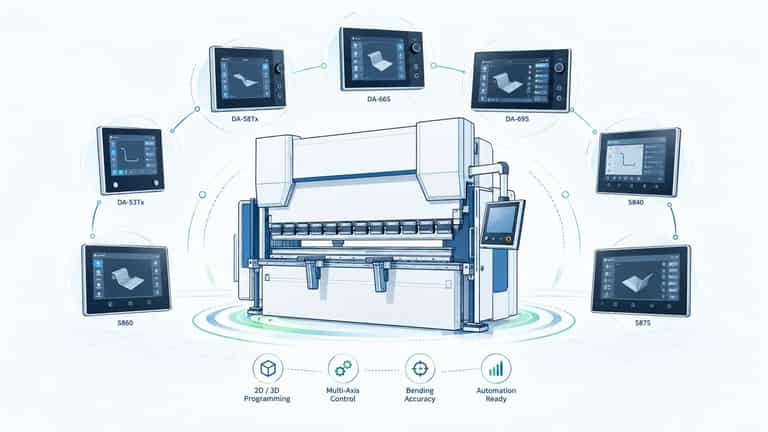
Choosing a press brake CNC controller is not the same as choosing a screen size. The controller sits at the center of the bending process: it coordinates the synchronized ram, backgauge, crowning system, tooling data, bend sequence, safety interfaces, correction values and, on advanced machines, angle-measurement devices and automated handling. A controller that is too basic can slow down a capable machine, while an unnecessarily high-end controller can add cost without creating a measurable return for a workshop that produces only simple repeat parts.
For this reason, KRRASS treats the controller as part of the complete bending system rather than as an isolated electronic accessory. Buyers comparing a new machine should first review the available KRRASS press brake range and then match the machine architecture to the available CNC control systems for press brakes. The correct sequence is machine requirement first, controller second.
This guide focuses on seven current and commercially relevant controller choices for modern synchronized, hydraulic, hybrid and electric press brakes:
- Delem DA-53Tx
- Delem DA-58Tx
- Delem DA-66S
- Delem DA-69S
- ESA S840, corresponding to the current Esautomotion VIS-840 family
- ESA S860, corresponding to the current VIS-860W family
- ESA S875, corresponding to the current VIS-875W family
The older DA-53T is intentionally excluded. Although it remains installed on many machines worldwide, buyers specifying a new KRRASS press brake should evaluate newer hardware and software platforms that provide a stronger path for graphical programming, connectivity and future integration.
The comparison below uses current manufacturer information from Delem and Esautomotion, combined with practical press brake integration experience. Where a manufacturer lists a platform-level maximum axis count, this guide distinguishes that value from the number of axes normally fitted to an actual press brake. That distinction matters: a CNC platform may technically support dozens of axes, but a real bending machine may use only Y1, Y2, X, R, Z1, Z2 and crowning, or another application-specific combination.

Why the CNC Controller Has a Direct Business Impact
A modern press brake is a coordinated mechatronic system. Accuracy depends on frame rigidity, ram guidance, hydraulic or servo response, linear scales, tooling, material variation, crowning, backgauge mechanics and the controller’s ability to calculate and coordinate all of them. The CNC is the layer that converts a drawing and a production target into a repeatable sequence of machine movements.
For the purchasing manager, this means controller selection affects more than operator convenience. It can influence five commercial variables:
- Setup time. Graphical programming, automatic bend sequencing and collision checking can reduce the time required to prepare a new part.
- First-part success. Tool libraries, material databases, bend allowance calculations and angle correction reduce unnecessary trial bends.
- Operator dependence. A strong visual interface can make complex work less dependent on one highly experienced operator.
- Machine utilization. Offline programming allows programs to be prepared while the press brake continues producing parts.
- Future automation. Network interfaces, sensor bending, barcode selection, robot integration and additional axes matter when the factory moves toward higher automation.
A controller therefore has value only when its functions solve a real production problem. If a workshop bends the same ten simple brackets every day, a flagship 3D controller may not improve throughput enough to justify its premium. If the factory processes a high-mix stream of cabinets, complex enclosures, stainless assemblies and short-run custom work, the opposite can be true: saving several minutes on each setup can be more valuable than the difference in controller price.
KRRASS uses the same system-level approach in its press brake buying guide: controller, axis configuration, backgauge, crowning, tooling and safety should be specified together. A controller cannot compensate for an under-specified backgauge, and a sophisticated backgauge cannot deliver its full value if the control interface makes programming slow or error-prone.
Seven Controllers at a Glance
The table below is a practical purchasing overview rather than a substitute for final engineering confirmation. Exact machine compatibility, axis mapping, safety hardware and optional functions should always be confirmed on the KRRASS quotation and electrical specification.
| Controller | Display | Programming level | Axis / platform note | Typical KRRASS use case |
|---|---|---|---|---|
| Delem DA-53Tx | 15-inch-class HD touch | Numerical + 2D graphical programming | Standard control up to 4 axes; options depend on integration | Cost-conscious synchronized CNC press brakes and routine parts |
| Delem DA-58Tx | 18.5 in, 1366 × 768 | Full 2D graphical, auto sequencing, collision detection | Standard control up to 4 axes; Z-Link/tandem options available | Production bending, cabinets, enclosures and frequent job changes |
| Delem DA-66S | 24 in, 1920 × 1080 | 2D programming + 3D machine representation | Modusys modular expansion to suit the application | Advanced multi-axis hydraulic/electric press brakes |
| Delem DA-69S | 24 in, 1920 × 1080 | Full 2D/3D programming and simulation | Modusys plus advanced sensor/auxiliary functions | Complex 3D parts, high-mix work and automation-ready machines |
| ESA S840 / VIS-840 | 15 in HD touch | Graphical bending HMI; 2D/3D capability depends on package | Esautomotion lists up to 6 axes | Mid-range synchronized press brakes and compact multi-axis layouts |
| ESA S860 / VIS-860W | 18.5 in HD multitouch | Advanced 2D/3D bending HMI and connected workflows | High-performance Windows-PC CNC platform | High-productivity machines needing stronger HMI and connectivity |
| ESA S875 / VIS-875W | 21.5 in Full HD multitouch | Advanced 2D/3D bending and integration | Platform supports up to 128 axes; real press brakes use far fewer | Premium bending, tandem/automation and complex architectures |
Two points from this table deserve emphasis.
First, the Delem DA-53Tx and DA-58Tx are often described by resellers as “six-axis controllers.” Delem’s current official product pages state that both are standard capable of controlling up to four axes. Additional Z-axis control, tandem capability and related functions are handled through options and OEM integration. The DA-53Tx official page and DA-58Tx official page should therefore be treated as the primary source when interpreting the base CNC specification.
Second, ESA platform axis capacity should not be read as a recommendation to configure a press brake with that many axes. Esautomotion lists the VIS-840 at up to six axes and the VIS-875W at up to 128 axes on the VIS-800 product page. The larger figure reflects the capability of the CNC platform for complex machine architectures. A typical press brake still uses a much smaller set of coordinated axes.
Start With the Press Brake, Not With the Controller Brand
The most common purchasing mistake is to ask, “Which controller is best?” without first defining the machine. There is no universally best controller. There is only a controller that is well matched or poorly matched to the press brake and production mix.
A buyer should define at least the following before selecting the control:
- Hydraulic synchronized, hybrid or pure-electric drive
- Required tonnage and bending length
- Backgauge architecture
- Number of independently controlled rear axes
- Mechanical or hydraulic crowning
- Need for automatic angle measurement
- Tooling system and number of tool stations
- Typical part complexity
- Average batch size
- Frequency of program changes
- Need for offline programming
- Need for network production data or Industry 4.0 integration
- Possibility of future robot loading, tandem operation or sheet followers
The KRRASS press brake category shows why this matters. A cost-effective synchronized machine for standard brackets has a different control requirement from an advanced six- or eight-axis machine designed for multi-station bending. Likewise, a servo-electric press brake may place more emphasis on fast digital response and integrated motion control than a basic hydraulic machine.
For many buyers, the best economic result comes from allocating budget to the complete system. A DA-69S on a machine with a simple X-only backgauge may provide an excellent interface but cannot create the positioning flexibility of X-R-Z1-Z2 hardware. Conversely, a capable six-axis backgauge paired with a control that makes graphical sequencing difficult can increase programming time and operator workload.
Delem DA-53Tx: Compact Control for Practical CNC Bending
The DA-53Tx is the logical starting point among the four Delem models in this comparison. It belongs to Delem’s DA-50Touch family, which is designed around compact, versatile control for economic press brake applications.
According to the official DA-53Tx specification, the control is standard capable of controlling up to four axes. It uses a large high-resolution PCT touchscreen, supports 2D graphical product and tool programming, includes crowning control, supports servo and frequency inverter control, provides USB connectivity and works with Profile-53TL offline software. Optional functions include Windows networking, Z-Link, TandemLink, OPC UA and an external handwheel.
The important commercial point is that the DA-53Tx is no longer just a “number-entry” control in the old sense. Its current generation supports graphical programming, while still retaining the compact architecture and relatively simple workflow that many operators prefer.
Where the DA-53Tx Makes Sense
The DA-53Tx is attractive for factories that want a modern synchronized CNC press brake but do not routinely need advanced 3D simulation. Typical examples include:
- General fabrication shops producing brackets and frames
- HVAC component manufacturers with repeatable bend families
- Electrical enclosure factories with relatively standardized panels
- Small and medium job shops moving from NC to CNC
- Production lines where most programs are already known and reused
- Buyers who prioritize machine hardware, tooling and backgauge capability over flagship HMI features
The controller’s value is especially strong when the production process is structured. If the operator works from validated drawings, the tooling is standardized and the backgauge layout is conventional, the DA-53Tx can offer a good balance between purchase cost and CNC capability.
Practical Limitation
The limitation appears when part geometry becomes more difficult to visualize. Complex return flanges, multi-station tooling, interference risk and frequent low-volume custom work benefit from stronger simulation. In those environments, the DA-58Tx, DA-66S or DA-69S can reduce the amount of mental geometry the operator must manage.
A useful rule is this: if your operators spend more time thinking about bend order and collision risk than typing dimensions, the business case for moving above the DA-53Tx becomes stronger.
Delem DA-58Tx: The 2D Production Workhorse
The DA-58Tx is one of the most balanced controls in the current Delem range for mainstream CNC press brakes. Its larger 18.5-inch display and true 2D graphical programming make it especially suitable for factories that process many different parts but do not require full 3D part programming.
Delem states on the DA-58Tx product page that the control provides 2D programming with automatic bend sequence calculation and collision detection. The control can generate CNC programs with a quick program-to-production workflow, automatically compute axis positions and simulate the bend sequence with the machine and tools shown in real scale.
The official technical data lists an 18.5-inch high-brightness TFT at 1366 × 768 resolution, 1 GB storage, USB exchangeable memory and Profile-58TL offline software. Options include networking, Z-Link, TandemLink, protractor interfacing and OPC UA.
Why 2D Graphical Programming Has Real Production Value
For many sheet metal parts, 2D is the commercial sweet spot. The majority of brackets, boxes, covers, channels, cabinets and enclosure components can be described clearly as a 2D profile with a sequence of bends. The control can show the profile, tools and bending sequence without requiring the operator to build a full 3D model.
That has several advantages:
- Faster learning for operators transitioning from conventional machines
- Easier verification of flange orientation
- Automatic sequence calculation for common geometries
- Reduced risk of selecting an impossible bend order
- More predictable setup before material is placed in the machine
- Lower chance of damaging tooling or the workpiece through an avoidable collision
This is why KRRASS often positions the DA-58Tx as a strong choice for production hydraulic press brakes. Buyers can review how it fits within the broader controller range on the KRRASS CNC control system page.
Best-Fit Production Profile
The DA-58Tx is particularly strong when the factory has a medium-to-high product mix and operators create programs at the machine. If you process 20 to 50 different part numbers in a shift, reducing each programming and setup event by even a few minutes can add up to a meaningful capacity gain.
It is also a sensible option for companies that want graphical programming now but do not yet need the cost and integration complexity of a high-end 3D platform.
Delem DA-66S: High-End 2D With 3D Machine Visualization
The DA-66S moves into Delem’s modular DA-60S architecture. This is an important transition because the control is designed not only as a more powerful HMI, but as part of a scalable system for sophisticated press brakes.
The DA-66S official page describes it as a 2D modular press brake control. It provides 2D graphical touchscreen programming, automatic bend sequence calculation, collision detection and 3D machine representation during simulation and production. It uses a 24-inch 1920 × 1080 PCT touchscreen and supports Delem Modusys scalability.
Delem also lists sensor bending and correction interfaces, Profile-S2D offline software, part support control, X1-X2 angle programming, barcode reader interfacing, protractor correction, frame deflection compensation, sheet thickness measurement, TandemLink, a second HSB Modusys bus and OPC UA as supported or optional functions.
Why DA-66S Is More Than a Larger DA-58Tx
The difference is architectural. Delem’s DA-60S series is built around the Modusys concept, where Y axes, auxiliary axes, I/O expansion and real-time sensor interfaces can be added according to the press brake application. This makes the DA-66S a better fit for a machine that may include advanced rear gauges, angle sensors, sheet followers or special OEM functions.
The DA-60S family also uses an embedded real-time Linux operating system, which Delem positions as a reliability feature for industrial operation.
Where DA-66S Is Strongest
The DA-66S is an excellent choice when the factory wants premium machine integration but most parts can still be efficiently programmed in 2D. This is common in:
- High-volume enclosure production
- Stainless steel cabinet manufacturing
- Elevator and architectural sheet metal
- Contract fabrication with multi-axis backgauges
- Factories using automatic angle correction
- Press brakes with several tool stations
- Plants that need networked production preparation
It can also be a smart choice when a company values the 24-inch operator interface and modular hardware architecture but does not need full 3D part programming on every job.
Delem DA-69S: Full 3D for Complex and High-Mix Bending
The DA-69S is Delem’s flagship 3D control in the DA-60S series. It is designed for buyers who need more than graphical convenience; they need a complete 3D programming and simulation environment integrated with the machine.
On the official DA-69S page, Delem specifies both 2D and 3D programming, automatic bend sequence calculation, collision detection and full 3D machine setup with multiple tool stations. The 24-inch Full HD touchscreen provides 3D machine representation in simulation and production. The control supports Modusys, sensor bending and correction, USB peripherals and Profile-S3D offline software.
The technical options are extensive: part support control, X1-X2 angle programming, barcode selection, protractor interfacing, frame deflection compensation, sheet thickness measurement, tandem control, a second HSB bus, an additional control panel and OPC UA.
KRRASS also maintains a detailed DA-69S system introduction that covers programming, tooling, calculated values and correction functions in greater depth.
When Full 3D Changes the Economics
Full 3D matters when the operator cannot easily judge the part from a flat profile. Consider a component with several return flanges, asymmetric bends and multiple tool stations. The risk is not only choosing a wrong angle; it is discovering late in the process that the workpiece cannot physically be rotated into the next bend without contacting the ram, tooling, machine frame or backgauge.
A 3D system can move that discovery to the programming stage. That is particularly valuable for:
- Aerospace and precision subcontracting
- Complex stainless enclosures
- Architectural parts with multiple returns
- High-value materials where scrapping one blank is expensive
- Small batches where there is little opportunity to amortize manual setup experience
- Factories with multiple operators and frequent shift changes
- Automated or semi-automated bending cells
The DA-69S is therefore not simply a premium screen. It is a risk-reduction and setup-reduction tool for geometrically demanding production.

ESA S840 / VIS-840: Compact Full-Digital Control for Mid-Range Machines
KRRASS customers often refer to this controller as ESA S840. In current Esautomotion documentation, the model is presented as VIS-840 within the VIS-800 family. This article uses both names so buyers can connect market terminology with the current manufacturer’s nomenclature.
The Esautomotion VIS-800 page lists the VIS-840 as a compact CNC with a 15-inch HD GlassOnly touch display and support for up to six axes. The VIS-800 family is built around EtherCAT communication, full-touch interfaces, Wi-Fi connectivity and modular integration with Esautomotion drives, motors and expansion boards.
For a press brake buyer, the most relevant information comes from Esautomotion’s metalforming application page. The company states that its bending software supports conventional, synchronized, hybrid, electric, tandem and multi-tandem press brakes; provides 2D and 3D interfaces; manages Y1-Y2 with rear backgauge axes; optimizes bending sequences; integrates mechanical, hydraulic and hybrid crowning; interfaces with major pump and valve suppliers; and can connect to real-time angle measurement and safety systems.
Why the S840 Is Competitive
The S840/VIS-840 is appealing when a builder wants a compact controller with a modern digital architecture and up to six axes at the platform level. In a KRRASS press brake, that can align well with a practical multi-axis configuration without moving immediately to the larger Windows-PC-based VIS-860W or VIS-875W.
It is especially suitable for buyers who value:
- EtherCAT-based digital architecture
- Compact panel size
- Up to six-axis platform capability
- Touch-focused HMI
- Integration with ESA/Esautomotion motion components
- A scalable software environment for bending applications
The final decision should still be based on the exact KRRASS machine configuration. A six-axis platform does not automatically mean that every six-axis combination is included in every machine quotation.
ESA S860 / VIS-860W: Larger HMI and Integrated Windows PC
The ESA S860 is represented in the current product line by the VIS-860W. Esautomotion describes it as a high-performance CNC with an integrated Windows PC, Intel CPU and an 18.5-inch 16:9 HD multitouch GlassOnly display.
The key commercial difference from the S840 is not merely screen size. The integrated PC architecture gives the machine builder more computing resources for advanced HMI, 3D interfaces, connected applications and production workflows. In a factory where the press brake is becoming part of a digital production system rather than a stand-alone machine, this can be valuable.
Esautomotion’s VIS-800 architecture emphasizes:
- 100% digital EtherCAT communication
- Wi-Fi connectivity
- Full-touch GlassOnly displays
- Advanced HMI graphics
- Turn-key bundled software
- Remote technical assistance
- Integration with motors, drives and expansion boards
For bending applications, Esautomotion states that both 2D and 3D visualization can be available on the machine and offline, with automatic bend-sequence optimization and interfaces for crowning, valves, safety systems, robots and angle measurement.
Best-Fit Production Profile
The S860/VIS-860W makes sense for a buyer who wants a stronger digital platform but may not need the very large 21.5-inch VIS-875W display or extreme platform scalability. Typical applications include:
- High-mix subcontract fabrication
- Multi-axis synchronized press brakes
- Electric press brakes with fast servo motion
- Production cells using networked job data
- Shops planning remote service and diagnostics
- Factories where the control HMI is expected to host richer visualization or connected applications
ESA S875 / VIS-875W: High-End Platform for Complex Machine Integration
The ESA S875 corresponds to Esautomotion’s VIS-875W high-end CNC platform. The manufacturer lists a 21.5-inch Full HD multitouch GlassOnly display, an integrated Windows PC with Intel i5 CPU and platform support for up to 128 axes.
That last number should be interpreted correctly. It demonstrates the scalability of the CNC platform across complex machine systems; it does not mean a standard press brake should be configured with 128 bending axes. In real KRRASS applications, the value of the S875 is its ability to sit comfortably at the top end of a machine architecture that may include numerous coordinated devices, auxiliary motions, automated handling or tandem functions.
Where the S875 Becomes Rational
The S875/VIS-875W is most relevant when the machine itself is already premium. Examples include:
- Advanced six-, seven- or eight-axis backgauge systems
- Tandem or multi-machine configurations
- Complex electric or hybrid bending platforms
- Automated loading/unloading or robot integration
- Real-time angle measurement
- Factories requiring substantial HMI space for visualization and process data
- OEM-specific software functions
It is less rational to select the S875 simply because it is the highest model in the group. If the machine has a simple backgauge and the factory bends repetitive channels, the additional platform headroom may remain unused.
Delem vs ESA: Two Different Engineering Philosophies
Both Delem and ESA/Esautomotion are established European control suppliers, but the way their product families are positioned differs.
Delem is extremely focused on sheet metal bending controls and presents a clear progression from compact DA-50Touch products to modular DA-60S high-end controls. The operator workflow, product programming, tooling libraries and press brake-specific functions are central to the platform.
Esautomotion takes a broader motion-control approach. The VIS-800 series is a digital CNC platform used across metalforming, cutting and other machine applications. Its strengths include EtherCAT architecture, integration with drives and motors, large Windows-PC-based models and extensive machine-builder flexibility.
Neither philosophy is inherently better. The choice depends on what the OEM and end user need.
| Decision factor | Delem tendency | ESA / Esautomotion tendency |
|---|---|---|
| Press-brake-specific user experience | Very strong, highly standardized across Delem bending families | Strong, configured through Esautomotion bending application software |
| Compact mainstream control | DA-53Tx / DA-58Tx | VIS-840 |
| High-end graphical control | DA-66S / DA-69S | VIS-860W / VIS-875W |
| Modularity | Modusys expansion for DA-60S | EtherCAT and VIS-800 hardware/software ecosystem |
| 2D/3D programming | Clearly tiered by model | Available through bending software and higher-end HMI platforms |
| Offline programming | Profile-T / Profile-S ecosystem | ESA bending software/offline workflow depending on package |
| Very large platform axis scalability | Application-based Modusys expansion | VIS-875W platform listed up to 128 axes |
| Integrated Windows PC | Networking/integration around Delem embedded architecture | Core feature of VIS-860W and VIS-875W |
For the KRRASS buyer, the important question is not which logo is more prestigious. The important question is which ecosystem best matches the machine, operator skills and future integration plan.
2D vs 3D Programming: What Does the Factory Actually Need?
“3D controller” is one of the most overused terms in press brake marketing. A buyer should separate three functions:
- 2D graphical part programming – drawing or defining the bent profile in two dimensions.
- 3D machine visualization – showing the machine, tooling and workpiece in a three-dimensional scene.
- Full 3D part programming and simulation – programming and validating the part as a 3D object, including sequence and collision behavior.
The DA-58Tx is primarily a 2D graphical controller. The DA-66S adds high-end 2D control with 3D machine representation. The DA-69S offers full 2D and 3D programming. ESA’s bending software architecture can support both 2D and 3D interfaces, with the larger VIS-860W and VIS-875W hardware giving more screen space and computing power for advanced visualization.
When 2D Is Enough
2D is usually enough when parts are prismatic and can be understood from a side profile. Examples include:
- L brackets
- U channels
- Z profiles
- Standard boxes
- Simple electrical enclosure panels
- Rails and mounting plates
- HVAC flanges
For these parts, a fast 2D workflow can actually be more efficient than creating unnecessary 3D data.
When 3D Pays Back
3D becomes more valuable as the number of bends, return flanges and tool stations increases. It is especially useful when the operator must rotate the part through several orientations or when the workpiece shape can collide with machine components.
A simple commercial indicator is the ratio of setup time to bending time. If a batch takes ten minutes to bend but thirty minutes to program, test and optimize, reducing setup time has a large impact. If a batch runs for six hours after a five-minute setup, the controller’s advanced programming capability has less influence on total cost.
Axis Count: Do Not Buy by the Number Alone
Axis count is another area where marketing language can cause confusion. A press brake may include several categories of axes:
- Y1 and Y2: independent left and right ram control on synchronized machines
- X or X1/X2: backgauge depth
- R or R1/R2: backgauge finger height
- Z1 and Z2: independent lateral movement of gauge fingers
- W: crowning or deflection compensation, depending on machine notation
- Auxiliary axes: sheet followers, supports, tool changers, robot interfaces or special devices
KRRASS explains these concepts in more detail in its press brake backgauge guide and in the PBS Series multi-axis configuration guide.
The correct question is therefore not “Does the controller support six axes?” It is “Does the complete machine configuration control the exact axes I need, simultaneously, with the required interpolation, safety and programming functions?”
A buyer producing tapered parts may gain more from independent X1/X2 positioning than from simply adding another Z axis. A factory using multiple tool stations may value Z1/Z2 automation because the fingers can move laterally without manual repositioning. A long-bed machine may place greater importance on automatic crowning than on an additional rear axis.

Crowning: Controller Capability Must Match the Mechanical System
When a long workpiece is bent, the machine frame and tooling deflect under load. Without compensation, the angle can be correct near the ends and open in the center. Crowning systems compensate for this deflection.
A CNC controller can calculate or command crowning only if the machine has the corresponding mechanical or hydraulic system. This is another reason the controller should never be specified separately from the machine.
Delem includes crowning control in the DA-53Tx and DA-58Tx feature set and supports advanced deflection systems on the DA-66S and DA-69S. Esautomotion’s metalforming software supports integration with mechanical, hydraulic and hybrid crowning systems, including real-time management in suitable configurations.
For buyers comparing machines, ask the supplier to explain:
- Is crowning manual or CNC controlled?
- Is the compensation mechanical, hydraulic or hybrid?
- Is the compensation value calculated automatically from material, length and force?
- Can the operator apply correction by job or material?
- Is the crowning axis included in the quoted axis count?
This is often more important to real bending accuracy than the difference between two controller screen sizes.
Backgauge Architecture and Controller Selection
The backgauge determines where the sheet is positioned before each bend. A basic X-axis gauge is sufficient for many repeat parts. As geometry becomes more complex, R and Z axes reduce manual repositioning and enable multi-station work.
The controller’s job is to make those axes usable. A good multi-axis HMI should allow the operator to program part dimensions rather than think constantly in raw axis coordinates. This is where graphical controllers create value.
Consider three production cases:
| Production case | Backgauge need | Controller level that usually fits |
|---|---|---|
| Repetitive brackets, fixed tooling | X or X+R | DA-53Tx / VIS-840 class |
| Cabinets, boxes, mixed flange heights | X+R, possibly Z1/Z2 | DA-58Tx / VIS-840 or VIS-860 class |
| Complex tapered or multi-station work | X1/X2, R, Z1/Z2, advanced auxiliaries | DA-66S / DA-69S / VIS-860W / VIS-875W class |
The table is not a fixed compatibility rule. It illustrates how controller value rises with the mechanical complexity of the rear gauge.
Angle Measurement and Closed-Loop Correction
Material springback is one of the main reasons a theoretically correct bend can still miss the target angle. Tensile strength, rolling direction, thickness tolerance, surface condition and temperature can all affect the result.
High-end controls can integrate with angle measurement systems so the machine measures the actual bend and applies a correction. KRRASS describes one approach in its press brake bending angle measurement guide.
Delem lists sensor bending and correction interfaces on the DA-66S and DA-69S. Esautomotion states that its VIS-800W controls can integrate with popular optical angle measurement systems and calculate springback corrections in real time. On its angle measurement system page, Esautomotion claims time and material savings of up to 50% compared with conventional methods in suitable applications. That figure should be treated as a manufacturer-reported potential benefit, not a universal guaranteed saving.
The business case is strongest when:
- Material batches vary frequently
- Stainless steel or high-strength material is used
- Angle tolerance is tight
- Parts are expensive to scrap
- Batch sizes are small and repeated trial bends are costly
- Operators must achieve good parts quickly without extensive manual correction
Offline Programming: Increase Machine Uptime
Programming at the machine consumes production time. If the press brake is idle while an operator creates a complex program, the factory is using an expensive production asset as a programming workstation.
Offline software changes the workflow. Programs can be prepared on a PC while the machine is bending another job. When the current batch ends, the next validated program can be transferred to the control.
Delem offers Profile-53TL for the DA-53Tx, Profile-58TL for the DA-58Tx, Profile-S2D for the DA-66S and Profile-S3D for the DA-69S. Delem describes its offline software as a way to prepare production and simulate bending in true scale before the job reaches the machine.
Esautomotion also supports 2D and 3D bending interfaces on-machine and offline, depending on the software package and integration.
Offline programming is especially valuable when the factory has:
- One or more expensive high-utilization press brakes
- A dedicated process engineering department
- High-mix, low-volume production
- Frequent repeat orders
- Centralized tooling and program management
- Multiple shifts where program consistency matters
A small shop with one operator and simple parts may not need a separate offline workflow. A larger factory can gain substantial utilization by moving programming away from the machine.
Connectivity, OPC UA and the Connected Factory
Modern factories increasingly want the press brake to exchange data with production systems. This can include program transfer, job tracking, barcode selection, remote diagnostics, performance monitoring or integration with a manufacturing execution system.
Delem lists OPC UA as an Industry 4.0 option on the DA-53Tx, DA-58Tx, DA-66S and DA-69S. The DA-60S controls also support broader modular integration and OEM functions.
Esautomotion designed the VIS-800 family around EtherCAT and network connectivity. Its metalforming platform also offers Industry 4.0 expansion packs such as data logging, production management and production tracing.
For buyers, connectivity should be specified with the same precision as a mechanical axis. Ask:
- What protocol is included in the quoted machine?
- Is OPC UA included or optional?
- Can programs be transferred over the factory network?
- Can the machine be remotely serviced securely?
- Can job selection be connected to barcodes or external production systems?
- What data points are available for MES or production monitoring?
- Who is responsible for network commissioning: the machine supplier, controller vendor or customer IT team?
A controller can be “Industry 4.0 ready” on paper while the delivered machine still requires licenses, network configuration or engineering work before real data exchange is possible.
Operator Usability and Training Cost
One of the most important controller specifications is difficult to put in a brochure: how quickly a new operator becomes productive.
A highly experienced press brake operator can produce good parts on relatively simple controls because experience fills the gaps. The operator knows which bend should come first, which flange may collide, how springback behaves and how to compensate for material variation. The problem is that this knowledge is hard to scale.
Graphical programming, automatic sequencing, tool libraries and simulation move part of that knowledge into the control system. This does not eliminate the need for skilled operators, but it reduces the number of decisions that depend entirely on memory.
For a factory with labor shortages or frequent staff turnover, this can be more valuable than a small difference in cycle speed.
When comparing controllers during a machine demonstration, KRRASS recommends asking an operator who has not used the system before to perform a realistic sequence:
- Create a new part.
- Select material and thickness.
- Select punch and die.
- Generate or enter the bend sequence.
- Check for collisions.
- Apply a correction after the first bend.
- Save the job.
- Recall the job after another program has been loaded.
The number of steps, the clarity of the graphics and the confidence of the operator often reveal more than the specification sheet.
Matching Controllers to Hydraulic, Hybrid and Electric Press Brakes
Controller selection also depends on drive technology.
Synchronized Hydraulic Press Brakes
These are the most common high-performance CNC bending machines. They normally use independent Y1/Y2 ram control with linear scales and servo-hydraulic valves. All seven controllers in this comparison can be engineered into synchronized bending systems, subject to the OEM’s machine design.
For standard production hydraulic machines, DA-53Tx, DA-58Tx and VIS-840 are common logical levels. For high-axis or sensor-rich machines, DA-66S, DA-69S, VIS-860W and VIS-875W become more attractive.
Hybrid Press Brakes
Hybrid machines combine hydraulic force generation with servo-driven pump technology or other energy-saving architectures. Control integration becomes more important because the CNC must coordinate the bending program with the drive response and machine-specific logic.
Both Delem and Esautomotion provide interfaces for advanced drive and valve systems. The correct choice depends heavily on the exact KRRASS machine design and components.
Pure Electric Press Brakes
Electric press brakes use servo motors and mechanical transmission systems such as belts, screws or gearboxes instead of a conventional hydraulic power unit. Fast response, synchronization and digital motion control are central.
Esautomotion explicitly lists ready-to-use software for main electric press types on its metalforming page. Delem’s DA-50Touch family also supports hydraulic, hybrid and electric press brakes, while DA-60S provides a more scalable high-end architecture.
For buyers evaluating an electric machine, the controller should be judged together with servo drive architecture, feedback resolution, safety system and mechanical transmission, not as a separate component.

Application-Based Recommendations
A controller that is ideal for one industry may be excessive or insufficient for another. The table below summarizes practical recommendations.
| Application | Production characteristics | Recommended controller level |
|---|---|---|
| General job shop | Mixed parts, moderate complexity, frequent setup | DA-58Tx or VIS-840; DA-66S/VIS-860W if part mix is very high |
| Electrical cabinets | Many box-type parts, repeat families, several flange sizes | DA-58Tx, DA-66S, VIS-840 or VIS-860W |
| HVAC ductwork | Often simpler profiles, cost-sensitive production | DA-53Tx, DA-58Tx or VIS-840 |
| Stainless kitchen / commercial equipment | Surface-sensitive material, many enclosures, frequent short runs | DA-58Tx, DA-66S, VIS-860W |
| Elevator panels | Long parts, angle consistency, multi-axis positioning | DA-66S, DA-69S, VIS-860W, VIS-875W |
| Aerospace / precision subcontract | Complex geometry, high material value, strict process control | DA-69S or VIS-875W class |
| Heavy plate fabrication | Large tonnage, fewer bends, high importance of crowning and machine mechanics | Controller chosen around machine architecture; DA-66S/69S or ESA high-end when auxiliaries justify it |
| Automated bending cell | Robot or handling integration, networked jobs, sensor feedback | DA-69S or VIS-875W class, engineered as a complete cell |
These recommendations are starting points. KRRASS should confirm the final control after reviewing drawings, material, part size, tolerance, batch size and automation plan.
Tooling Still Determines What the Controller Can Achieve
Even the best CNC cannot overcome poor tooling selection. Bend radius, minimum flange, marking, tonnage and achievable geometry depend on the punch and die.
KRRASS recommends selecting the controller and tooling plan together. The press brake tooling guide explains how punch profile, die opening, material thickness and forming method affect the bending result.
A 3D controller becomes more valuable when the tool library is accurate. If the dimensions of the punch, die and adapter in the CNC do not match the tools actually installed, collision simulation can become misleading. The same applies to segmented tooling and multi-station setups.
For this reason, a professional machine handover should include:
- Correct digital tool definitions
- Standard tool naming
- Tool segmentation data where applicable
- Material database setup
- Verification of crowning parameters
- Backgauge calibration
- Operator training on tool selection and correction
A Practical ROI Model for Controller Upgrades
Controller ROI should be estimated from saved production time, not from screen size. The following example is illustrative and intentionally conservative.
Assume a fabrication shop runs one press brake for 250 working days per year. The machine handles 8 new or changed setups per day. A more advanced graphical controller reduces average setup/programming time by 6 minutes per setup.
Annual time saved:
8 setups/day × 6 min × 250 days = 12,000 minutes = 200 hours/year
If the fully burdened value of press brake time is USD 80 per hour, the capacity value is:
200 hours × USD 80/hour = USD 16,000/year
This does not mean every upgrade will save USD 16,000. It shows how to evaluate the investment using the factory’s real numbers.
| Scenario | Setups/day | Minutes saved/setup | Days/year | Hours saved/year | Value at $80/hour |
|---|---|---|---|---|---|
| Low-mix production | 3 | 3 | 250 | 37.5 | $3,000 |
| Typical mixed shop | 8 | 6 | 250 | 200 | $16,000 |
| High-mix short-run shop | 15 | 8 | 250 | 500 | $40,000 |
The same logic can be applied to reduced scrap. Suppose a complex stainless part blank costs USD 40 and the shop avoids just two scrap parts per week because collision simulation and angle correction improve first-part success. That is another USD 4,000+ per year before considering labor and lost schedule time.
The correct controller therefore depends strongly on product mix. A high-end control can be inexpensive if it prevents costly setup losses every day. A high-end control can also be expensive if its advanced features are rarely used.
Seven-Model Decision Matrix
The following matrix converts the technical discussion into a practical purchasing score. Scores are directional, from 1 (basic) to 5 (very strong), and reflect typical capability and positioning rather than a laboratory benchmark.
Delem capability score
| Capability | DA-53Tx | DA-58Tx | DA-66S | DA-69S |
|---|---|---|---|---|
| Ease for routine parts | 5 | 5 | 5 | 5 |
| 2D graphical workflow | 4 | 5 | 5 | 5 |
| Full 3D part workflow | 2 | 2 | 3 | 5 |
| Multi-axis scalability | 3 | 3 | 5 | 5 |
| Large-screen visualization | 3 | 4 | 5 | 5 |
| Sensor / advanced integration | 3 | 3 | 5 | 5 |
| Connected-factory potential | 4 | 4 | 5 | 5 |
| Best value for simple work | 5 | 4 | 3 | 2 |
| Best fit for complex premium machine | 2 | 3 | 5 | 5 |
ESA / Esautomotion capability score
| Capability | ESA S840 | ESA S860 | ESA S875 |
|---|---|---|---|
| Ease for routine parts | 4 | 4 | 4 |
| 2D graphical workflow | 4 | 5 | 5 |
| Full 3D part workflow* | 3 | 4 | 5 |
| Multi-axis scalability | 4 | 5 | 5 |
| Large-screen visualization | 3 | 4 | 5 |
| Sensor / advanced integration | 4 | 5 | 5 |
| Connected-factory potential | 4 | 5 | 5 |
| Best value for simple work | 5 | 3 | 2 |
| Best fit for complex premium machine | 3 | 5 | 5 |
* ESA 2D/3D capability depends on the bending software package and machine-builder integration, not only the display model.
Which Controller Should You Choose?
Choose Delem DA-53Tx if:
You need a modern, compact controller for a synchronized press brake, most parts are straightforward, four-axis base control is sufficient for the intended design, and you want 2D graphical support without paying for a high-end modular platform.
Choose Delem DA-58Tx if:
You want the strongest balance of cost and 2D production capability. It is especially attractive for job shops and enclosure manufacturers where automatic sequencing, collision checking and a large 18.5-inch graphical interface can save setup time every day.
Choose Delem DA-66S if:
You want a premium 24-inch interface, high-end 2D programming, 3D machine visualization, Modusys scalability and stronger integration with sensor bending, advanced backgauges or other machine options.
Choose Delem DA-69S if:
You regularly process geometrically complex parts, need full 3D programming and simulation, use multiple tool stations, want advanced sensor and automation options, or are buying a flagship KRRASS press brake where setup efficiency and future integration justify the investment.
Choose ESA S840 / VIS-840 if:
You prefer ESA’s full-digital EtherCAT ecosystem, need a compact 15-inch controller and want platform support for up to six axes in a mid-range machine.
Choose ESA S860 / VIS-860W if:
You want an integrated Windows-PC platform, 18.5-inch multitouch HMI, richer visualization and strong connectivity for a high-productivity press brake without moving to the largest ESA platform.
Choose ESA S875 / VIS-875W if:
You are specifying a premium machine or automated system where extensive scalability, a 21.5-inch Full HD HMI, integrated PC power and complex OEM integration are more important than minimizing controller cost.
Common Buying Mistakes to Avoid
Mistake 1: Comparing Only Screen Size
A larger display improves usability, but the value comes from software, axis control, simulation and integration. A 24-inch screen does not automatically make a machine more accurate.
Mistake 2: Treating Maximum Axis Capacity as Actual Machine Configuration
The controller platform may support more axes than the machine includes. Always request the exact axis list on the quotation: Y1, Y2, X, R, Z1, Z2, W and any auxiliaries.
Mistake 3: Paying for 3D Without Accurate Tool Data
3D simulation is only as reliable as the machine and tooling models loaded into the control. Ensure the supplier configures the actual punch, die, adapter and machine geometry.
Mistake 4: Ignoring Offline Programming
For high-utilization machines, offline programming can create more value than a small improvement in cycle time because it removes non-cutting setup activity from the press brake.
Mistake 5: Ignoring Operator Skill Level
A control that is technically powerful but difficult for the available workforce can reduce productivity. The best controller is one the production team can use consistently.
Mistake 6: Buying the Controller Separately From the Safety and Automation Architecture
Sensor bending, light guards, safety PLCs, sheet followers, robots and tandem systems require engineering integration. These should be specified as one machine system.
Mistake 7: Assuming Every Optional Feature Is Included
Networking, OPC UA, barcode interfacing, sensor bending, tandem functions and offline software may require options or licenses. The quotation should state exactly what is included.

Recommended KRRASS Selection Workflow
A professional controller selection process can be reduced to eight steps.
Step 1: Define the parts. Send KRRASS representative drawings that include the easiest, most common and most difficult parts you expect to produce.
Step 2: Define materials. State material type, thickness range, maximum sheet size and any high-strength or springback-sensitive grades.
Step 3: Select the press brake platform. Review the KRRASS press brake range and decide whether the production is best served by hydraulic, hybrid, electric or another configuration.
Step 4: Define axes. Choose the backgauge architecture from the part geometry rather than from a marketing package name.
Step 5: Define accuracy aids. Decide whether CNC crowning, thickness measurement or automatic angle correction is required.
Step 6: Select the controller level. Use the KRRASS CNC control system comparison to narrow the choice to compact 2D, advanced 2D, full 3D or high-end ESA integration.
Step 7: Confirm software and connectivity. List offline programming, network protocols, barcode selection, remote service and production data requirements.
Step 8: Confirm the quotation line by line. The final machine specification should list controller model, included software, actual controlled axes, crowning, safety devices, tooling and optional interfaces.
This method prevents the controller from becoming an isolated purchasing decision and makes it easier to compare quotations from different machine configurations.
Frequently Asked Questions
Is the DA-69S always better than the DA-66S?
Technically, the DA-69S provides a more complete 3D programming environment. Commercially, it is not always the better investment. If most parts are efficiently handled in 2D, the DA-66S can deliver the same machine accuracy and many of the same modular integration benefits at a lower controller level. The DA-69S creates the most value when full 3D programming and collision simulation are used frequently.
Is the DA-58Tx enough for a six-axis backgauge?
Do not decide from the phrase “six-axis” alone. Delem’s current official specification states that the DA-58Tx is standard capable of controlling up to four axes, with functions such as Z-Link available as options. KRRASS engineering should confirm the exact axis architecture and required expansion for the machine being quoted.
What is the difference between ESA S840 and VIS-840?
They refer to the same current product family in common market usage. Esautomotion’s official naming is VIS-840 within the VIS-800 CNC range. KRRASS may use “ESA S840” as a simplified commercial label, but the final quotation should identify the exact current hardware model.
Why does the ESA S875 say up to 128 axes if a press brake usually has far fewer?
Because the VIS-875W is a general high-end CNC platform that can control complex machine systems. Its platform capacity is much larger than the number of axes required by a normal press brake. In bending applications, KRRASS configures only the axes and auxiliary systems required by the machine.
Which controller is best for a small job shop?
For a small shop doing mixed but not extremely complex work, the DA-58Tx is often a strong choice because 2D graphical programming, bend sequence calculation and collision detection directly address setup time. The DA-53Tx or ESA S840 can be more economical if the parts are simpler.
Which controller is best for complex 3D parts?
The DA-69S is the clearest choice in the Delem family because full 3D programming is part of its core positioning. In the ESA family, the VIS-860W and particularly VIS-875W provide the hardware platform for advanced 2D/3D bending software and complex integration.
Does a better controller improve bending accuracy?
It can improve repeatability, setup consistency, compensation and correction, but the controller is only one part of the accuracy chain. Frame stiffness, Y1/Y2 feedback, hydraulic or servo performance, tooling, crowning, material variation and calibration remain essential.
Should I choose automatic angle measurement?
It is worth considering when material springback varies, tolerance is tight, material is expensive or first-part accuracy is important. For simple repetitive mild-steel work, the added cost may not be necessary.
Can these controllers be used on electric press brakes?
Yes, depending on OEM integration. Delem’s current control families support hydraulic, hybrid and electric press brake applications, and Esautomotion explicitly provides software for several electric press architectures. The complete servo drive and safety system must be engineered with the controller.
Is offline programming necessary?
It is not mandatory, but it can be highly valuable in high-mix production. If the press brake is expensive and highly utilized, moving programming to an office PC keeps the machine producing parts rather than waiting for setup.
Final Recommendation
For most buyers, the seven models can be divided into three commercial levels.
Value and mainstream CNC: Delem DA-53Tx and ESA S840/VIS-840. These are suitable when the machine is relatively straightforward, the production mix is controlled and the buyer wants a modern touch interface without over-investing in high-end visualization.
High-productivity 2D and connected production: Delem DA-58Tx, Delem DA-66S and ESA S860/VIS-860W. These controls fit factories that change jobs frequently, rely on graphical setup and need stronger multi-axis or network integration.
Premium 3D and complex automation: Delem DA-69S and ESA S875/VIS-875W. These are appropriate when the press brake itself is a high-end production platform and the factory can use 3D programming, sensor feedback, extensive auxiliaries or automation to reduce setup risk and labor dependence.
The most important purchasing principle is simple: buy the controller for the production system you need, not for the model number you want. A well-matched controller, backgauge, crowning system and tooling package will outperform a poorly matched flagship control every time.
KRRASS can configure the controller as part of the complete machine specification, including axes, tooling, safety, crowning and software. Start by reviewing the KRRASS press brake lineup, then compare available press brake CNC control systems. For a final recommendation, provide representative drawings, materials, thickness range, batch size and automation requirements so the machine and controller can be engineered as one bending solution.
Share