
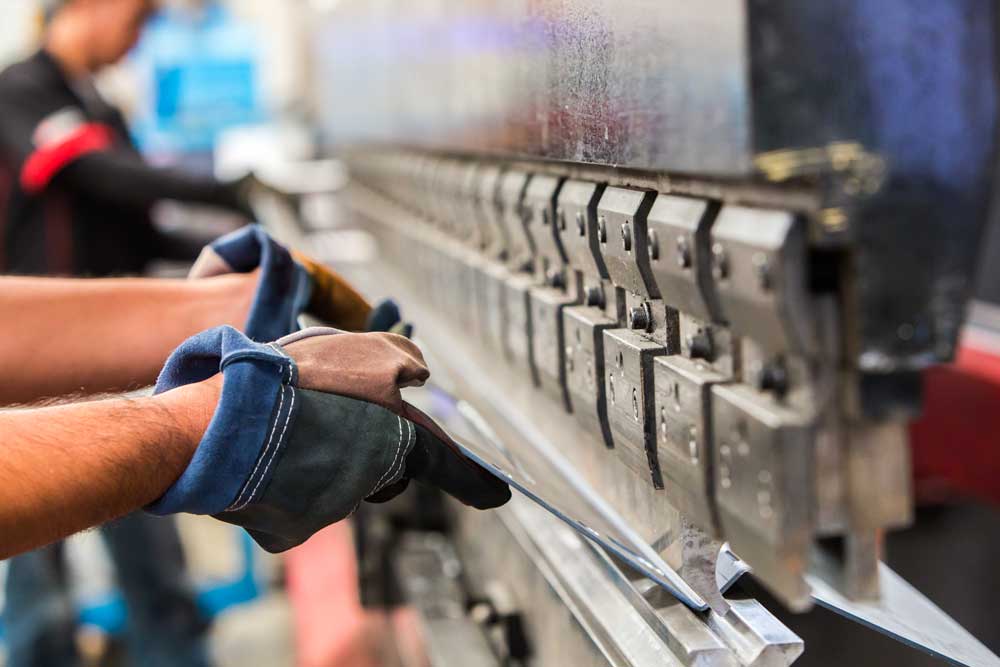
Nowadays, the presse plieuse à tôle has become an indispensable machine in the manufacturing industry. It not only improves production efficiency but also saves costs. However, many people still do not understand many things about the bending machine, such as how to buy it and the price, how to choose the controller, etc. Next, please follow my steps to understand the bending machine in an all-round way.
Description
A sheet metal press brake is a machine tool used to bend and form sheet metal into various shapes and configurations. It is a critical piece of equipment in metal fabrication and manufacturing. A press brake works by sandwiching a metal plate between a punch (located on the upper beam) and a die (mounted on the lower bed). A press brake applies force to the sheet metal to bend it to the desired angle or shape.
Composants
Table des matières
Bélier: This is the moving part of the press brake and is used to hold the punch. It exerts downward force on the sheet metal to bend it.
Lower Bed: Also called lower beam or bed, it provides support for the mold. During the bending process, the sheet metal is placed on the lower bed.
Punch: The punch is mounted on the upper beam and applies pressure to the sheet metal to bend it. The shape and size of the punch determines the bending angle and geometry.
Mold: The mold is installed on the lower bed and is used as a support for the sheet metal during the bending process. It determines the final shape of the bend.
Butée arrière : The backgauge is an adjustable stop that helps accurately position sheet metal for repeated bends, ensuring consistent bending positions.
Système de contrôle : Modern bending machines often use computer numerical control (CNC) systems that can precisely control the bending process. CNC bending machines can store bending programs, control bending angles, and automate many aspects of the bending operation.
Sheet metal press brakes come in a variety of sizes and configurations to accommodate different sheet metal sizes, thicknesses and bending requirements. They are widely used in industries such as automotive, aerospace, construction, electronics and appliance manufacturing to produce components such as brackets, panels, enclosures and chassis with precise bends and angles.
Méthodes de pliage
Due to the different materials, thicknesses, lengths, and widths of plates and the different shapes and angles that need to be formed, there are bending machines with different tonnage and size pressure equipment, equipped with upper and lower dies of different heights, shapes, and V-width sizes. Special molds for special shapes.
Sheet metal bending refers to the processing of changing the angle of the plate or plate. There are usually two bending methods: mold bending and press brake bending.
Cintrage de moules
It is used for sheet metal structures with complex structures, small volumes, and mass processing. Refers to using a mold with a specific shape to apply pressure on the sheet, causing the sheet to bend to form the desired shape. The main advantage of mold bending is that it enables precise, repeatable bends, making it easy and efficient to produce large numbers of parts of the same shape. Our common V-bends, U-bends, and Z-bends can all be realized through mold bending.
pliage sur presse plieuse
It is used to process sheet metal structures that have relatively large structural dimensions or whose output is not too large. Bending machines are divided into two types: NC bending machines and CNC bending machines. Sheet metals with high precision requirements and irregular bending shapes are generally bent with a CNC bending machine. The basic principle is to use the bending knife (upper die) and V-shaped groove (lower die) of the bending machine. Sheet metal parts are bent and formed. Press brake bending is usually used to manufacture various metal parts and components, such as boxes, casings, pallets, brackets, etc.
Classification
Classification by structure
Mechanical press brake:
Uses a mechanical transmission system to achieve bending operations, usually suitable for simpler bending tasks.
Hydraulic press brake:
The bending operation is performed through the pressure provided by the hydraulic system. It is suitable for various types and thicknesses of metal sheets and can achieve greater bending force and more complex bending shapes.
Electric press brake:
Uses an electric drive system to perform bending operations, usually with a higher degree of automation and precision.
Classification by working methods
Manual press brake:
The operator performs bending operations by manually controlling the machine, suitable for small batch production and simple bending tasks.
Semi-automatic bending machine: It has some automatic functions, such as automatic clamping and lifting, but the operator still needs to intervene in the control.
Fully automatic press brake:
A fully computer-controlled bending machine that can automatically load, bend and unload, and is suitable for mass production and complex bending tasks.
Classification by control methods
NC press brake:
The operator manually controls various parameters and operations of the machine, such as bending angle, bending force, etc.
CNC press brake:
The operation of the bending machine is controlled by a computer numerical control system, which can achieve highly precise bending and is suitable for complex parts and mass production.
Classification according to control method is the most common classification method. CNC bending machines have gradually become the mainstream choice of bending machines.
Advantages of CNC Press Brake Compared to NC Press Brake
In recent years, CNC press brake has become more and more popular due to its higher precision, versatility, efficiency and automation capabilities. However, many customers do not know the difference between NC and CNC when purchasing a bending machine. So compared with CNC press brake, what are the advantages of NC press brake?
Presse plieuse à commande numérique
- Employs a torsion shaft to join two sides of the ram to travel up and down sequentially. Ram parallelism cannot be verified and changed by itself.
- Uses the compulsive synchronous method manually. One must ensure manually that the production is error-free.
- Does not contain a crowning system.
- Cannot bend in different degrees in a single setup.
- Can control only 2 Axis - X and Y
- NC needs more skilled labour because of the need for manual precision.
Presse plieuse CNC
CNC is the current industry standard for press brakes where as NC is a dated method of production.
- Two linear encoders are put on the equipment on both ends of the ram, and the controller may analyse the sequential state on both sides of the ram using data from both encoders.
- If there is an error, the control system will automatically rectify it to keep the ram in sync.
- Has more accuracy due to its back gauge and feedback systems.
- Specifically designed for high-speed, synchronized Y1/Y2 press brakes.
- Cost-efficient and energy efficient
- Gives more opportunity for customising the production because of Computer Numerical controls.
- More accuracy at a lower labour cost as little to no skilled labour is required for production based on machine machinery set up.
How to Choose the Right Press Brake Controller
The importance of the press brake control system to the bending machine is self-evident. It directly affects the accuracy, efficiency and flexibility of the bending process. In recent years, various CNC systems for bending machines have appeared on the market, such as the commonly used Dutch DELEM series, Swiss CYBELEC series and Italian ESA series.
Famous Controller Brands
Délem :
Delem est une marque reconnue et respectée dans le domaine des commandes numériques pour presses plieuses. Réputée pour ses commandes numériques de pointe, Delem propose une gamme de fonctionnalités répondant aux besoins de l'industrie métallurgique. Ses commandes sont reconnues pour leur précision et leur fiabilité, ce qui en fait un choix privilégié pour de nombreux professionnels de la fabrication métallique. Les commandes Delem sont souvent dotées d'interfaces conviviales et sont compatibles avec différents modèles de presses plieuses, permettant une intégration fluide dans les flux de production existants.
ESA :
ESA (European Systems Automation) est une autre marque réputée qui fabrique des contrôleurs de presses plieuses de haute qualité. Les contrôleurs ESA sont reconnus pour leur innovation et leur flexibilité. Ils offrent un large éventail de fonctionnalités avancées, notamment la correction d'angle, l'évitement des collisions et la connectivité réseau. Ces contrôleurs sont souvent choisis par les fabricants qui exigent des capacités sophistiquées et des processus de production efficaces.
Cybelec :
Cybelec est une marque suisse solidement implantée sur le marché des commandes de presses plieuses. Ses commandes sont largement reconnues pour leur précision et leur adaptabilité. Cybelec propose des solutions pour les applications de pliage standard et complexes. Dotées d'interfaces conviviales et de puissantes fonctionnalités de programmation, ses commandes constituent un excellent choix pour répondre à divers besoins en travail des métaux.
Amada:
Amada, a renowned name in the manufacturing industry, also produces press brake controllers. Their controllers are known for their compatibility with Amada press brake machines, ensuring seamless integration and optimized performance. Amada controllers are engineered to provide accurate and efficient bending operations, reflecting the brand’s commitment to quality and innovation.
LVD:
LVD is a global manufacturer of press brake controllers, among other metalworking equipment. LVD controllers are designed to enhance the precision and productivity of press brake machines. They often come equipped with advanced features for programming, monitoring, and safety. LVD controllers are well-regarded for their contribution to the efficiency of metal fabrication processes.
Press Brake Controller Introduction
Generally speaking, the system selection of CNC and NC press brakes will be different.
Systems for NC Press Brake
ESTUN E21
- L'écran hydraulique haute définition est bilingue (chinois et anglais) et affiche les paramètres de programmation sur une seule page, ce qui rend la programmation plus rapide et plus pratique.
- Le positionnement intelligent des axes X et Y peut également être ajusté manuellement selon les besoins, éliminant ainsi le dispositif de positionnement manuel mécanique.
- Fonction intégrée de réglage du temps de maintien de la pression et du délai de déchargement ; l’utilisation est simplifiée et aucun relais temporisé n’est nécessaire, ce qui réduit les coûts.
- Grâce à la fonction de sauvegarde et de restauration des paramètres en une seule touche, les paramètres peuvent être restaurés à tout moment en cas de besoin afin de réduire les coûts de maintenance.
- Prise en charge de la programmation multiprocessus : des pièces complexes peuvent être traitées simultanément, améliorant ainsi l’efficacité de la production et la précision du traitement.
- Tous les boutons du panneau sont des micro-interrupteurs ayant subi des tests rigoureux de compatibilité électromagnétique (CEM), de résistance aux hautes et basses températures et aux vibrations. Ceci garantit la stabilité et la durée de vie du produit.
- Certification CE obtenue pour répondre aux exigences des marchés étrangers.
Commande ESTUN E310P
- Quatre axes sont pris en charge, à savoir l'axe X, l'axe Y, l'axe R et l'axe C.
- La butée arrière peut être contrôlée avec une grande précision puisque les systèmes servo contrôlent les axes X et R.
- Calcul automatique de la position du bloc, en fonction de l'angle de pliage, du matériau, de l'épaisseur et des paramètres du moule.
- La butée arrière peut être contrôlée avec une grande précision puisque les systèmes servo contrôlent les axes X et R.
- Commande hydraulique ou mécanique en option pour l'axe C.
- Programmer en valeur absolue ou en angle.
- Les informations relatives aux matériaux et aux matrices sont programmables.
- Paramètres de langue et d'unité.
Holland DELEM DA41T
- Écran tactile de qualité industrielle
- Écran large couleur haute résolution TFT de 7 pouces
- Commande de l'axe Y du curseur
- Commande de l'axe X de la butée arrière
Commande de l'axe R
Mémoire de programme pour 100 programmes - Programmation Angular
- Programmation d'outils
- Déplacez manuellement tous les axes
- interface de clé USB
- 4. Suisse Cybtouch 8
- Grand écran tactile haute définition à contraste élevé.
- Interface conviviale, affichage clair et grands boutons à icônes.
- La page EasyBend est très pratique pour le pliage en une seule étape.
- Une programmation parfaite peut améliorer l'efficacité du pliage par lots en plusieurs étapes.
- L'aide en ligne et les messages contextuels rendent l'interface du logiciel très conviviale.
- Prise en charge de plusieurs langues.
- Utilisez un PC ou un ordinateur portable pour mettre à jour et transférer des données via un logiciel sans fil
Systems for CNC Press Brake
Holland DELEM DA53T
- “Navigation tactile par ” raccourcis clavier »
- Écran TFT couleur haute résolution de 10,1 pouces
- Jusqu'à 4 axes (Y1, Y2 + 2 axes auxiliaires)
- contrôle du couronnement
- Bibliothèque d'outils/matériaux/produits
- Commande de servomoteurs et d'onduleurs de fréquence
- Algorithmes de contrôle avancés de l'axe Y pour la boucle fermée ainsi que pour
vannes à boucle ouverte. - TandemLink (option)
- interface de clé USB
- Logiciel hors ligne Profile-T
Holland DELEM DA58T
- Programmation d'écrans tactiles graphiques 2D
- Écran TFT couleur haute résolution de 15 pouces
- calcul de la séquence de virage
- contrôle du couronnement
- Commande de servomoteurs et d'onduleurs de fréquence
- Algorithmes de contrôle avancés de l'axe Y pour les vannes en boucle fermée et en boucle ouverte.
- USB, interface périphérique
- Logiciel hors ligne Profile-T
Holland DELEM DA66S
- Mode de programmation graphique 2D sur écran tactile
- Représentation 3D de machines, en simulation et en production
- Écran TFT couleur haute résolution de 24 pouces
- Compatibilité avec Delem Modusys (évolutivité et adaptabilité des modules)
- USB, interface périphérique
- prise en charge d'applications spécifiques à l'utilisateur au sein de l'environnement multitâche du système de contrôle
- Interface de flexion et de correction du capteur
- Logiciel hors ligne Profile-S2D
Holland DELEM DA69S
- Mode de programmation graphique tactile 3D et 2D
- Visualisation 3D, y compris la représentation 3D des machines, en simulation et en production
- Écran TFT couleur haute résolution de 24 pouces
Compatibilité avec Delem Modusys (évolutivité et adaptabilité des modules) - USB, interface périphérique
- prise en charge d'applications spécifiques à l'utilisateur au sein de l'environnement multitâche du système de contrôle
- Interface de flexion et de correction du capteur
- Logiciel hors ligne Profile-S3D
Switzerland Cybtouch 12ps
- Grand écran tactile aux couleurs vives et au contraste élevé.
- Pages simples, affichage clair, grandes touches.
- Interface utilisateur intuitive et conviviale.
- Programmation complète pour une production de masse efficace avec plusieurs pliages.
- Easy single bends with
- Page EasyBend.
- Aide en ligne et fenêtres contextuelles d'avertissement interactives.
- Sauvegarde de données et mise à jour logicielle sans fil et simplifiées sur PC ou ordinateur portable.
- Un large choix de langues est disponible.
Switzerland Cybtouch 15ps
- Écran tactile moderne et épuré de 15 pouces en verre, utilisable avec des gants.
- Interface homme-machine conviviale grâce à une programmation intuitive et une configuration facile grâce à des assistants dédiés (réglage automatique).
- Dessin de profils graphiques 2D (profil tactile) et création précise de programmes 2D.
- Calcul automatique de la séquence de pliage.
- Easy single bends thanks to the
- Page EasyBend.
- Grande capacité de stockage.
- Fonctions internes de sauvegarde et de restauration.
- Communication sans fil pour des diagnostics et des mises à jour étendus (avec ordinateur portable).
Principles of Chooing Press Brake Controller
Accuracy and repeatability requirements:
If your production requires high accuracy and repeatability, then you should choose a control system with precision control capabilities. Ensure the control system enables precise angle control, length control and position control to meet your quality standards.
Functions and modes:
Consider your bending tasks and process requirements and choose a control system with the appropriate functions and modes. Some advanced features may include multi-step bending, auxiliary functions (such as chamfering, curling, etc.), multi-step processes, etc. Make sure the control system meets your specific production needs.
User interface:
Choose a control system with an intuitive, easy-to-operate user interface so operators can get up and running quickly. Consider the layout, graphical display and interaction of the interface to ensure that operators can easily program, set parameters and monitor the production process.
Programming functions:
Consider the programming functions of the control system, including manual programming and automatic programming. Make sure the control system can support the programming you require and provide flexible programming options to accommodate different types and shapes of parts.
Automation functions:
If you want to automate your production process, you should choose a control system with rich automation functions. This may include automatic mold changing, automatic adjustment, automatic correction and other functions to reduce manual intervention and improve production efficiency.
Diagnosis and maintenance functions:
Choose a control system with diagnostic and maintenance functions to detect and solve problems in time and ensure the normal operation of the equipment. Ensure that the control system can provide real-time monitoring, alarm prompts and fault diagnosis to reduce downtime and maintenance costs.
Upgradeability and compatibility:
Consider the upgradability and compatibility of the control system to cope with future production needs and technological developments. Choose a control system with modern technology and standard interfaces for system upgrades and integration of other equipment.
How To Choose Proper Sheet Metal Press Brake
Once you make an improper choice when purchasing a bending machine, production costs will rise, and the bending machine cannot be expected to recover the cost. Therefore, several factors must be weighed when making a decision.
Artefact
The first important thing to consider is the part you want to produce. The main point is to buy a machine that can complete the machining task with the shortest table and the smallest tonnage.
Carefully consider material grade and maximum processing thickness and length. If the majority of the work is mild steel with a thickness of 16 gauge and a maximum length of 10 feet (3.048 meters), then the free bending force need not be greater than 50 tons. However, if you are engaged in a large number of bottomed die forming, you may want to consider a 160-ton machine tool.
Assuming the thickest material is 1/4 inch, 10 feet of free bending requires 200 tons, while bottom die bending (corrected bending) requires at least 600 tons.
If most of the workpieces are 5 feet or shorter, the tonnage is almost halved, thus significantly reducing acquisition costs. Part length is very important in determining the specifications of a new machine.
Twist
Under the same load, the deflection of the 10-foot machine table and slider is four times that of the 5-foot machine. This means that shorter machines require fewer shim adjustments to produce acceptable parts. Reducing shim adjustments reduces setup time.
Material grade is also a key factor. Compared with mild steel, stainless steel typically requires about 50% more load, while most grades of soft aluminum require about 50% less load. You can always get a machine tonnage chart from your press brake manufacturer that shows an estimate of the tonnage required per foot of length for different thicknesses and different materials.
Rayon de courbure
When using free bending, the bending radius is 0.156 times the opening distance of the die. During the free bending process, the die opening distance should be 8 times the thickness of the metal material. For example, when forming 16 gauge mild steel using a 1/2-inch (0.0127-meter) opening distance, the part has a bend radius of about 0.078 inches. If the bending radius is almost as small as the material thickness, bottomed concave molding must be performed. However, the pressure required for bottomed die forming is about 4 times greater than free bending.
If the bending radius is smaller than the material thickness, a punch with a front-end fillet radius smaller than the material thickness must be used, and the impression bending method must be resorted to. In this way, 10 times the pressure of free bending is required.
In terms of free bending, the punch and die should be processed at 85° or less (smaller is better). When using this set of dies, pay attention to the gap between the punch and the die at the bottom of the stroke, and the excessive bending that is enough to compensate for springback and keep the material at about 90°.
Generally, the springback angle of the free bending die on the new bending machine is ≤2°, and the bending radius is equal to 0.156 times the opening distance of the die. For bottomed concave mold bending, the mold angle is generally 86 ~ 90°. At the bottom end of the stroke, there should be a gap slightly larger than the thickness of the material between the male and female dies. The forming angle is improved because the bottomed die bends at a larger tonnage (approximately 4 times that of free bending), reducing stresses within the bend radius that typically cause springback.
Imprint bending is the same as bottomed die bending, except that the front end of the punch is processed into the required bending radius, and the gap between the punch and die at the bottom of the stroke is smaller than the material thickness. Since sufficient pressure (about 10 times that of free bending) is applied to force the front end of the punch to contact the material, springback is basically avoided.
Pour choisir la spécification de tonnage la plus faible, il est préférable de prévoir un rayon de cintrage supérieur à l'épaisseur du matériau et d'utiliser autant que possible le cintrage libre. Un grand rayon de cintrage n'affecte généralement pas la qualité de la pièce finie ni son utilisation ultérieure.
Courbure
Bending accuracy requirements are a factor that needs to be carefully considered. It is this factor that determines whether to consider a CNC bending machine or a manual bending machine. If the bending accuracy requires ±1° and cannot be changed, you must focus on CNC machines.
The repeatability of the slider of the CNC bending machine is ±0.0004 inches. Forming precise angles requires the use of such accuracy and good molds. The repeatability of the slider of the manual bending machine is ±0.002 inches, and when a suitable mold is used, a deviation of ±2~3° will generally occur. In addition, CNC bending machines are ready for rapid mold setting, which is an unquestionable reason to consider when many low-volume parts need to be bent.
Mold
Even if you have a shelf full of molds, don't think that these molds are suitable for the newly purchased machine. Each piece of mold must be checked for wear by measuring the length from the front of the punch to the shoulder and the length between the shoulders of the female mold.
For conventional molds, the deviation should be around ±0.001 inches per foot, and the total length deviation should be no greater than ±0.005 inches. As for precision ground dies, the accuracy should be ±0.0004 inches per foot and the total accuracy should not be greater than ±0.002 inches. It is best to use precision ground molds for CNC bending machines and conventional molds for manual bending machines.
Side length of bending part
Assuming a 90° bend along a 5-by-10-foot, 10-gauge mild steel plate, the press brake would have to apply an additional 7.5 tons of pressure to lift the plate, and the operator would have to be prepared for a 280-pound straight-edge drop. . Making the part may require several able-bodied workers or even a crane. Press brake operators often bend long-sided parts without realizing how strenuous their work is. [2]
Résumé
Sheet metal bending machines play a vital role in modern manufacturing. It not only improves production efficiency and product quality, but also promotes innovation and development of product design, and is of great significance in promoting the development and progress of manufacturing.
As a leading Press Brake manufacturer and brand, KRRASS® is proud to present and supply our various types of high quality Press Brake Machine to customers worldwide. Harness the strength and precision of our high-quality bending machines, which is a testament to KRRASS®’s relentless pursuit of perfection. Backed by extensive cooperation with renowned global brands, and supported by innovative ideas at our headquarter R&D center, our bending machines embody the pinnacle of sheet metal processing technology.
Stumbling upon this website was such a delightful find. The layout is clean and inviting, making it a pleasure to explore the terrific content. I'm incredibly impressed by the level of effort and passion that clearly goes into maintaining such a valuable online space.
useful thank you for your shearing
useful article!
Very professional introduction of the cnc press brake, thank you very much for the detailed information provided by the author.