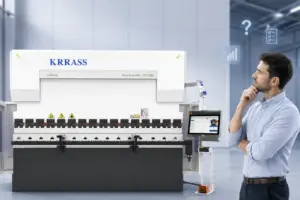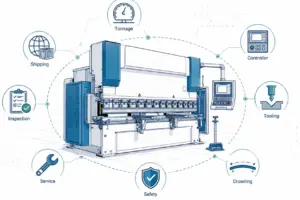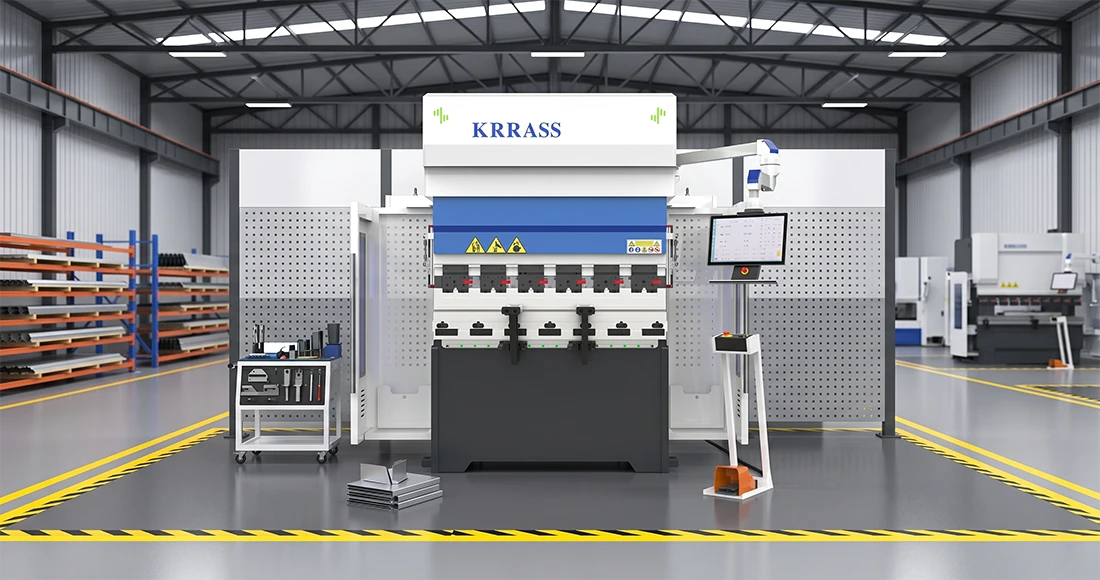
When buyers first hear the phrase электрический листогибочный пресс, they often focus on one thing only: oil-free operation. That is understandable, but it is far too narrow a way to evaluate a serious production machine. A high-end electric press brake is not merely a hydraulic machine with the oil removed. It is a different engineering philosophy. The logic of the drivetrain changes, the response characteristics change, the maintenance profile changes, and the relationship between structure, control, motion, and repeatability changes as well.
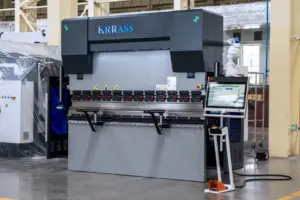
That is exactly why the KRRASS EPP Series deserves to be discussed as a complete production platform rather than as a simple green alternative to a conventional press brake. The EPP Series is positioned as a benchmark of precision bending, with 55% to 78% energy savings compared with a conventional bending press brake, a fully-electric working concept, and a direct-drive electric motor architecture that synchronizes with the ball screw while eliminating gearbox backlash. The platform is also designed around a highly precise, reliable, high-speed production system combined with energy-efficient и noise-reduced operation. These are not empty marketing adjectives. They point directly to the machine’s core value proposition: strong mechanical fundamentals, fast response, clean motion control, and stable accuracy over long production cycles.
Within the broader KRRASS press brake family, the EPP Series sits alongside the MB8, PBS, и PBE platforms, but it serves a clearly differentiated role. MB8 models represent the mature hydraulic CNC platform with a broad controller range and strong general-purpose capability. PBS pushes advanced servo-hydraulic productivity with high-end controller and backgauge configurations. PBE develops the pump-controlled hybrid path for lower energy consumption and lower hydraulic stress. The EPP Series goes one step further for customers who want direct electric actuation, minimal hydraulic dependency, quiet operation, low standby waste, и high responsiveness for thin to medium-gauge precision work.
In practical terms, the EPP Series is a machine family for fabricators who care about far more than tonnage. It is for companies that need precision parts, repeatable bend angles, quick cycle transitions, lower maintenance exposure, and a cleaner factory environment. It is also for businesses that want an equipment story aligned with modern manufacturing priorities: lower energy consumption, reduced consumables, and smarter control of motion at the source.
Оглавление
Where the EPP Series Fits in the KRRASS Press Brake Portfolio
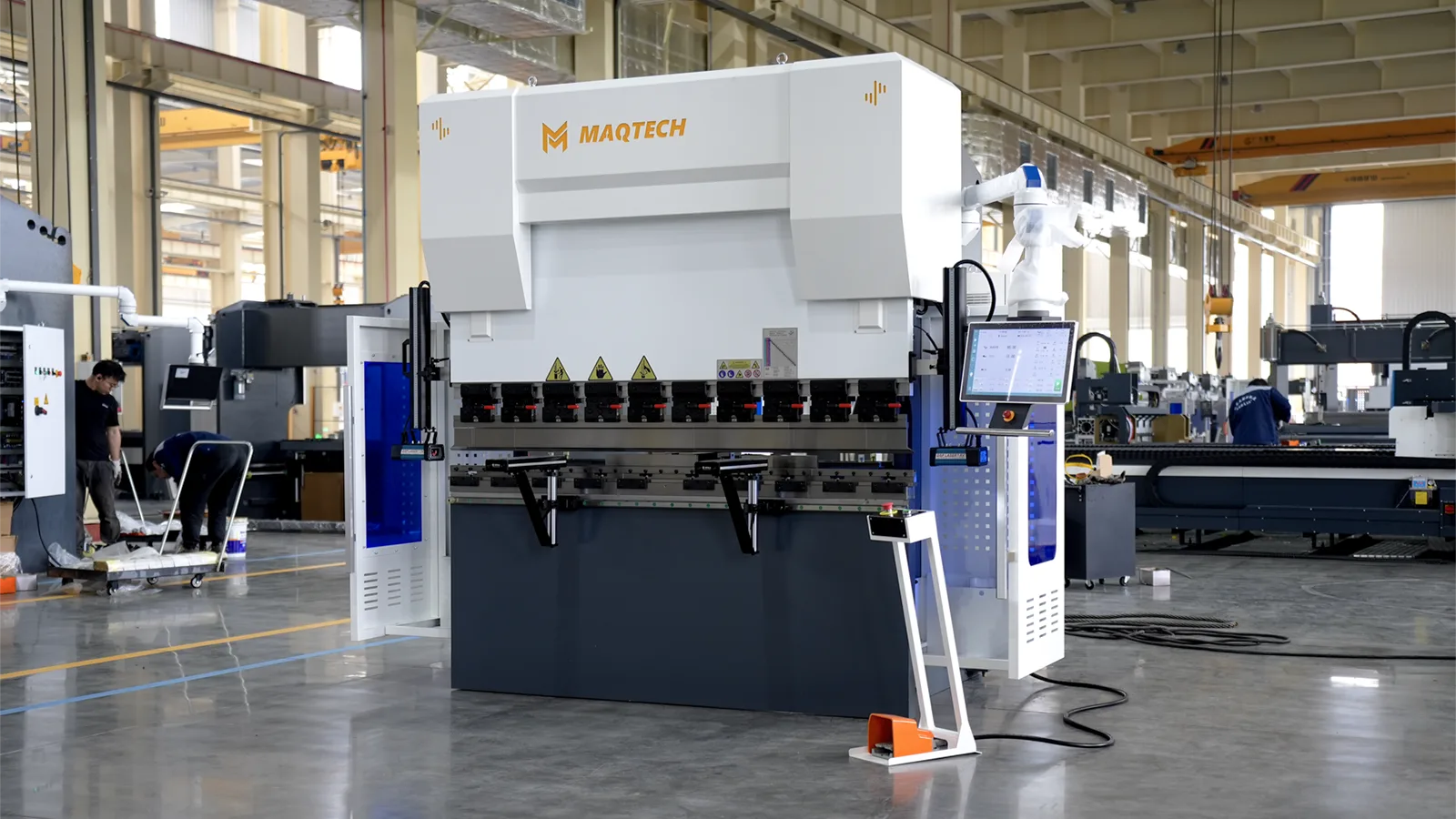
A useful way to understand the EPP Series is to compare it with the rest of the KRRASS press brake lineup. Within the KRRASS product family, electric, hybrid, servo-driven, and hydraulic solutions are positioned for different production priorities, which makes the EPP Series part of a broader product strategy rather than an isolated experiment. That matters because the EPP platform benefits from a larger configuration ecosystem in controllers, tooling, safety, software logic, and backgauge philosophy.
| KRRASS Series | Core Architecture | Series Positioning | Best-Fit Use Case |
|---|---|---|---|
| MB8 | Hydraulic CNC press brake | High-precision general-purpose CNC bending with DELEM controller options | Flexible production, broad material range, mature hydraulic CNC workflow |
| PBS | Main motor servo CNC press brake | High-performance servo-hydraulic system with advanced controller and multi-axis backgauge options | Higher throughput, advanced synchronization, complex part production |
| PBE | Pump-controlled hybrid CNC press brake | Green hybrid technology with reduced oil and energy use | Shops that want hydraulic familiarity with lower energy consumption |
| EPP | Direct-drive electric servo press brake | Fully-electric precision bending, reduced maintenance, quiet operation, and 55%–78% energy savings vs. conventional machines | Precision bending, low-noise environments, reduced oil dependence, high response speed, and modern energy-conscious production |
This comparison matters because it clarifies what the EPP Series should and should not be judged against. If the buyer’s reference point is an older torsion-bar NC machine, the EPP Series will feel like a major leap in every respect: speed control, repeatability, noise, cleanliness, interface quality, and overall production refinement. If the buyer’s reference point is a modern hydraulic CNC press brake, the EPP argument is more specific. It is not “hydraulic but cheaper.” It is “electric because the process benefits from electric behavior.”
That distinction becomes more important as manufacturers shift toward shorter runs, faster changeovers, stricter quality control, and more sensitive energy accounting. In those conditions, motion quality and idle-state efficiency matter more than many buyers initially expect. Machines no longer win only by brute forming capacity. They win by how quickly they accelerate, how smoothly they stop, how accurately they repeat, how little operator time they waste, and how little maintenance disruption they introduce into the factory.
The EPP Series therefore occupies an attractive middle ground: it delivers industrial press brake seriousness, but it also speaks the language of modern lean manufacturing. It does not try to imitate legacy hydraulics. Instead, it takes advantage of electric-drive behavior to improve the parts of the press brake cycle that operators and production managers experience every day.
EPP Series Specifications at a Glance
Before going deeper into structure and configuration, it is useful to anchor the discussion in the core EPP series technical parameters. For better readability, the data is separated below into capacity/dimensions и drive/motion tables.
Table A. EPP capacity and dimensional parameters
| Модель | Bending Pressure (kN) | Длина изгиба (мм) | Расстояние между столбцами (мм) | Глубина горла (мм) | Ход ползунка (мм) | Максимальная высота проема (мм) | Вес (кг) |
|---|---|---|---|---|---|---|---|
| EPP-35/1350 | 350 | 1350 | 1300 | 130 | 180 | 470 | 4000 |
| EPP-50/1650 | 500 | 1650 | 1300 | 210 | 180 | 470 | 5000 |
| EPP-70/2050 | 700 | 2050 | 1700 | 305 | 180 | 470 | 6250 |
| EPP-70/2500 | 700 | 2500 | 2000 | 305 | 180 | 470 | 6500 |
| EPP-100/2500 | 1000 | 2500 | 2000 | 400 | 250 | 470 | 8500 |
| EPP-100/3200 | 1000 | 3200 | 2700 | 400 | 250 | 470 | 8800 |
Table B. EPP drive, gauging, and speed parameters
| Модель | Main Motor Power (kW) | Average Power (kW) | X-axis Max. Distance (mm) | R-axis Max. Distance (mm) | Maximum Speed (mm/s) | Bending Speed (mm/s) | Return Speed (mm/s) |
|---|---|---|---|---|---|---|---|
| EPP-35/1350 | 2×8.6 | 2.3 | 400 | 150 | 200 | 0–30 | 200 |
| EPP-50/1650 | 2×16 | 2.4 | 400 | 150 | 200 | 0–30 | 200 |
| EPP-70/2050 | 2×21 | 2.6 | 600 | 150 | 200 | 0–30 | 200 |
| EPP-70/2500 | 2×21 | 2.7 | 600 | 150 | 200 | 0–30 | 200 |
| EPP-100/2500 | 2×30 | 2.7 | 600 | 150 | 200 | 0–30 | 200 |
Standard Configuration Reference for the EPP Series
To make the EPP discussion more concrete, the following standard machine specification should be treated as the baseline configuration reference for the series presentation below. This keeps the EPP discussion tied to a real production-grade equipment package rather than an abstract electric press brake concept.
Table C. Standard configuration reference supplied for the EPP series
| Configuration Item | Standard Brand / Source | Why It Matters in Production |
|---|---|---|
| Контроллер | SCS-800 (Taiwan) | Provides the CNC control environment for programming, operation, and job management |
| Electrics | Schneider Electric (France) | Supports electrical stability, switching reliability, and easier serviceability |
| Главный двигатель | Techmation (Taiwan) | Forms part of the electric powertrain that drives the bending cycle |
| Сервомотор | Techmation (Taiwan) | Supports responsive closed-loop motion control and repeatable axis behavior |
| Foot Switch | KACON (South Korea) | Affects operator control feel, durability, and basic operating safety |
| Y-axis Heavy-duty Grinding Screw | TSUBAKI NAKASHIMA - Japan | Critical for ram transmission accuracy, stiffness, and long-term wear resistance |
| Задний упор | Hiwin (Taiwan) | Supports precise blank positioning and repeat flange dimension control |
| Magnetic Linear Encoder | ГИВИ | Improves feedback quality for axis positioning and bending repeatability |
This configuration list defines the practical baseline for how the EPP should be understood: a Taiwan-origin SCS-800 control system, Techmation electric drive components, а Hiwin backgauge platform, а TSUBAKI NAKASHIMA Y-axis grinding screw, и GIVI magnetic linear feedback. Together, these components reinforce the EPP positioning as a high-response, high-precision, production-grade electric press brake.
Table D. Representative working parameters of EPP-70/2050
| Модель | Bending Pressure (kN) | Длина изгиба (мм) | Расстояние между столбцами (мм) | Глубина горла (мм) | Ход ползунка (мм) | Максимальная высота проема (мм) | Main Motor Power (kW) | Average Power (kW) | X-axis Max. Distance (mm) | R-axis Max. Distance (mm) | Вес (кг) |
|---|---|---|---|---|---|---|---|---|---|---|---|
| EPP-70/2050 | 700 | 2050 | 1700 | 305 | 180 | 470 | 2×21 | 2.6 | 600 | 150 | 6250 |
The EPP-70/2050 serves as a useful reference model because it anchors the discussion in a concrete production specification. As with any industrial machine, the exact scope should always be defined by the final quotation, confirmed parameter sheet, and signed BOM.
Three details in these tables deserve immediate attention.
First, the two-motor architecture is not a minor footnote. In the EPP series, main motor power is configured in the format 2×8.6, 2×16, 2×21, или 2×30 kW, which strongly reinforces that the machine is engineered around a dual-servo actuation concept rather than a single centralized motor. That has major consequences for synchronization, load handling, and dynamic response.
Second, the machine family combines respectable tonnage coverage with genuinely useful work lengths, from 350 kN / 1350 mm up to 1000 kN / 3200 mm. This means EPP is not just a boutique mini-bender for niche laboratories or prototype rooms. It is a real production platform aimed at commercial sheet metal manufacturing environments.
Third, the average power consumption figures are strikingly low relative to the installed main power. That is a practical signal of one of the biggest advantages of electric-drive logic: the machine does not consume energy in the same wasteful pattern as a conventional continuously running hydraulic power unit. A well-designed electric press brake uses power when motion or force is needed, and dramatically reduces or eliminates waste during non-working phases.
The Machine Body: Why Structural Integrity Still Comes First
Even on an all-electric press brake, the structure remains the foundation of everything. Buyers are sometimes so impressed by servo-drive talking points that they underweight the frame. That is a mistake. Precision bending begins with the body, not the brochure. If the machine frame lacks rigidity, thermal stability, geometric accuracy, and long-term resistance to distortion, no controller or motor can fully rescue the result.
Across the KRRASS press brake family, frame strength and process quality are treated as core machine values. In the MB8, PBS, и PBE product descriptions, KRRASS highlights premium-grade steel plate construction, thermal annealing after welding, и single-setup precision machining of critical surfaces. That manufacturing logic is directly relevant to the EPP platform as well: after welding, the frame is stress-relieved through thermal annealing, then machined on large CNC floor-type boring and milling equipment in a single setup so critical mounting surfaces remain parallel and perpendicular.
Even though the EPP platform summary is relatively concise, its product positioning is fully consistent with that manufacturing philosophy. A direct-drive electric press brake actually places an even higher premium on structural quality, because electric-drive responsiveness makes the machine more sensitive to the quality of the mechanical platform beneath it. Fast motors and precise control loops are only truly valuable when the frame can preserve alignment and absorb production stresses without geometric drift.
From a machine design perspective, there are four reasons why the body matters so much on the EPP Series.
1. Frame rigidity supports angle consistency
When the ram descends and force rises, the frame, side plates, bed, and ram assembly all experience load. If those components deform unpredictably, the actual punch-die relationship changes during bending. That leads to angle inconsistency along the bend length and increases compensation burden. A rigid body reduces those effects at the source.
2. Stress relief protects long-term accuracy
Welding introduces residual stress into thick machine components. Over time, untreated stress can relax, and the frame can creep or warp. That means a machine that looked straight when new can slowly lose alignment after months or years of service. Stress-relief processing is therefore not cosmetic manufacturing theater. It is part of the accuracy strategy.
3. Single-setup machining protects geometry
When critical features are machined in multiple repositionings, geometric stack-up errors become harder to control. A single-setup process helps maintain parallelism and perpendicularity among key surfaces: the ram guides, tooling seat, backgauge mounting structure, and drive mounting surfaces. This improves repeatability and reduces the need for compensation elsewhere.
4. A strong frame protects the value of the electric drive
Direct-drive electric actuation gives the EPP Series fast response and clean transmission characteristics, but those benefits become meaningful only when the structural platform is stable. In other words, the body is what allows electric intelligence to translate into practical bending quality.
For end users, the body question is not abstract. It affects daily production in very concrete ways. A rigid, well-machined, stress-relieved frame helps the machine stay accurate after transportation, installation, multi-shift use, and repeated tooling changes. It also reduces the frequency of corrective adjustments and lowers the risk that good programs start producing inconsistent parts for reasons that operators cannot easily diagnose.
That is why KRRASS’s structural language across the MB8/PBS/PBE ecosystem should be taken seriously when evaluating the EPP. The EPP is not simply sold as “green.” It is sold as a benchmark of precision bending. That claim only makes sense if the structural engineering is strong enough to support it.
The Control System: The Brain Behind EPP Precision
An electric press brake lives or dies by the quality of its control system. The machine body gives it rigidity, and the servo drive gives it motion, but the controller gives it judgment. Without a good controller, even a beautifully built machine becomes slower to set up, harder to program, and more vulnerable to human error.
The control discussion becomes much more precise once the standard EPP package is defined around the SCS-800 controller from Taiwan. That matters because the EPP should first be understood through its own stated control package rather than through a generic controller discussion. In practical terms, the SCS-800 becomes the operating core for programming, job execution, and day-to-day production control.
The EPP platform is also defined by several user-facing control characteristics: an intuitive control interface с advanced functions и а step-by-step guide for operators with different skill levels, together with multi-touch control mounted on a moveable arm for ergonomic positioning. That operating logic also aligns well with the broader KRRASS CNC control system approach used across the company's higher-value bending solutions. These details fit very well with the role of the SCS-800 as the standard machine control platform. They also reveal how the EPP is intended to feel in actual production: responsive, visual, easy to navigate, and efficient in day-to-day use.
Why the SCS-800 matters on an electric press brake
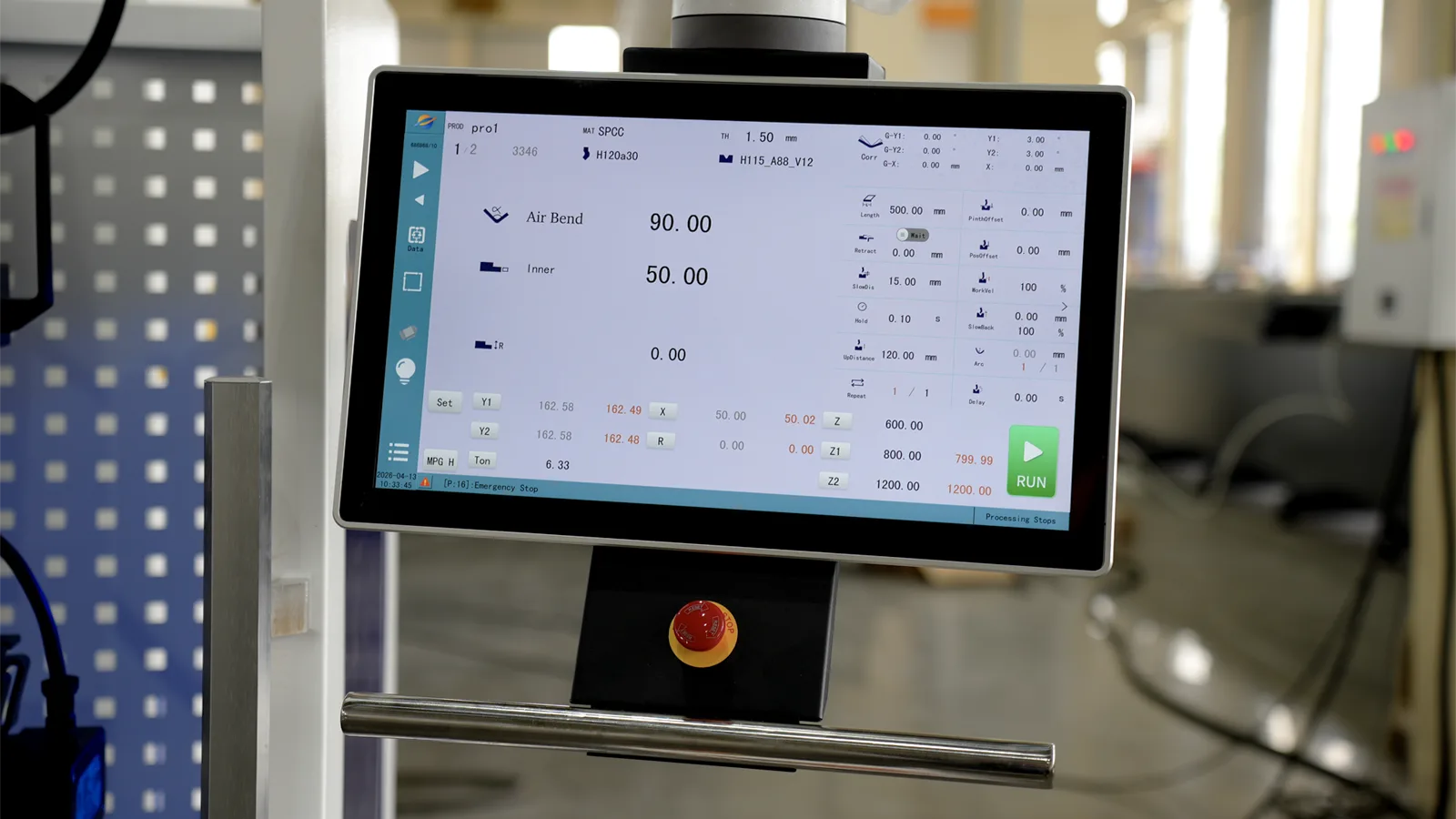
On a direct-drive electric press brake, command quality matters even more than on many hydraulic machines. Electric-drive systems respond more directly to instructions, which means the CNC has to manage stroke logic, axis coordination, speed transitions, job storage, operator prompts, and safety interlocks with high consistency. A weak interface or unstable control strategy wastes the biggest advantage of the electric architecture.
That is why the SCS-800 should not be treated as a small line item in a quotation. It is central to how the EPP performs in real use:
- it governs how quickly the operator can create, load, modify, and repeat jobs
- it affects how clearly the machine communicates each production step
- it influences how smoothly the bending cycle transitions between approach, forming, and return
- it plays a practical role in repeatability, especially when stored jobs must be recalled across shifts or operators
- it shapes the daily usability of the machine just as much as the motors and frame do
Ergonomics still matter on a high-precision machine
Many buyers underestimate ergonomics until they observe how often operators interact with the control in real life. A multi-touch screen mounted on a moveable arm reduces unnecessary body movement, improves visibility during setup, and helps the operator stay oriented between the drawing, the part, and the tooling zone. That is not decorative convenience. It is part of cycle efficiency.
For an EPP machine built around fast response and precision, the control interface should feel equally direct. The operator should not be slowed down by clumsy navigation while the machine itself is capable of rapid, accurate motion. Good ergonomics and good CNC logic therefore reinforce the same business objective: higher output with fewer avoidable errors.
Software is part of accuracy
Accuracy is often reduced to encoder resolution or axis repeatability, but software quality is part of accuracy as well. Good bend sequence logic avoids unnecessary reorientation of the workpiece. Good tool libraries reduce mismatches between assumed and actual tooling conditions. Good material libraries reduce guesswork. Good job storage reduces repeat setup variation. All of these factors affect whether the machine produces the same result today, next month, and six months from now.
That is why the EPP’s controller should be viewed as part of the machine’s precision system rather than as a screen bolted to the side. The controller is where production knowledge, operator behavior, and servo motion meet.
Two Main Servo Motors and the Direct-Drive System: The Core of the EPP Advantage
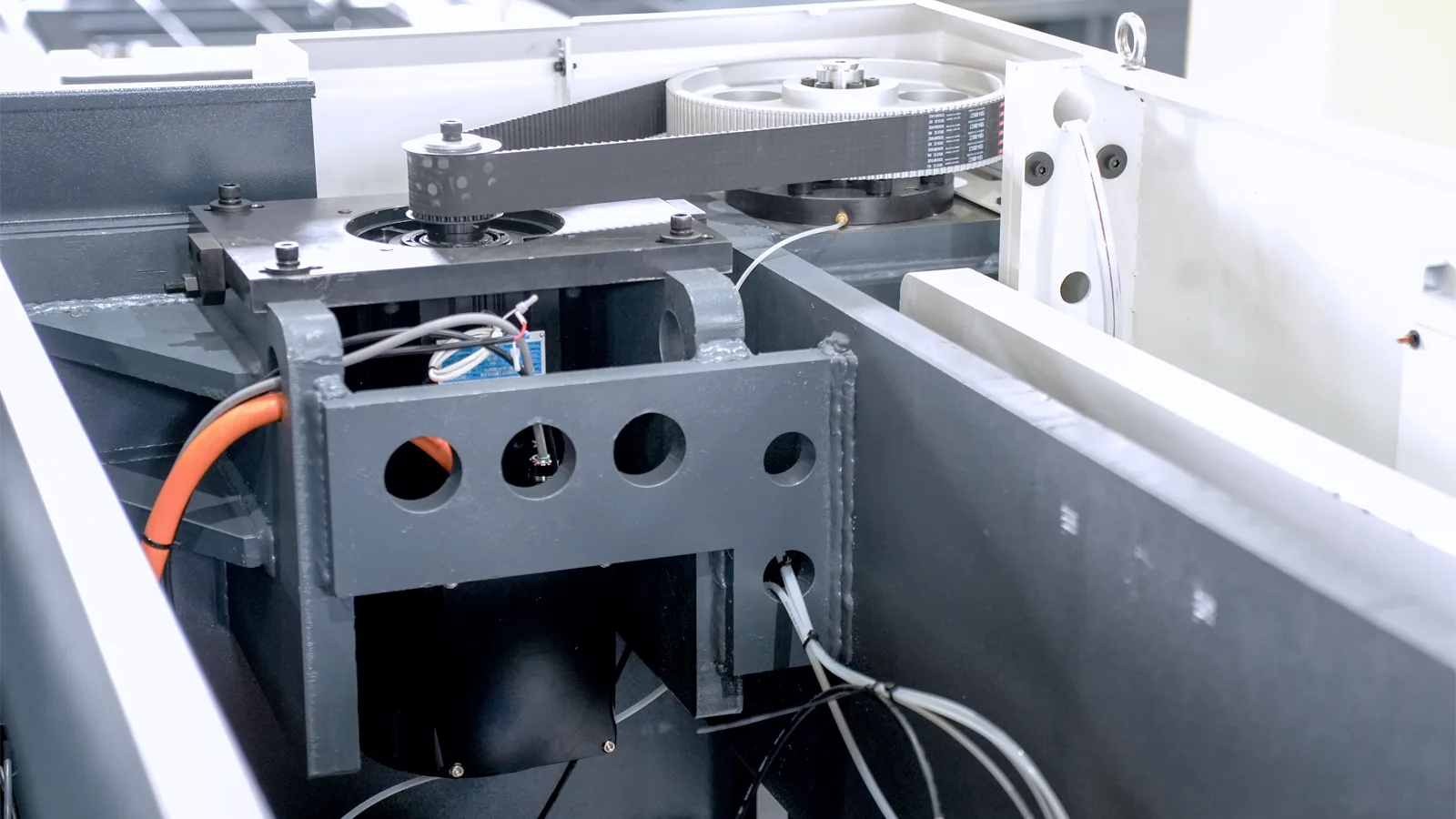
If one feature defines the KRRASS EPP Series technically, it is the drive architecture. The machine uses two main motors, and the underlying design philosophy is a patented direct-drive electric motor architecture that connects the ball screw in direct synchronization with the torque motor, while eliminating the need for gearboxes and reducing backlash.
This is the heart of the EPP value proposition.
The standard EPP configuration adds another important layer of clarity: the machine is specified here with Techmation (Taiwan) main motor and servo motor components, together with a TSUBAKI NAKASHIMA heavy-duty grinding screw on the Y-axis. In practical machine-tool terms, that combination strongly supports the EPP design logic: direct electric actuation, controlled linear transmission, and fast, repeatable response.
Traditional hydraulic press brakes generate force through a hydraulic power unit, cylinders, valves, and oil flow. Their best versions can be extremely capable, especially in advanced servo-hydraulic forms. But an electric press brake like the EPP behaves differently because it creates ram motion through a more direct electromechanical transmission chain. Instead of maintaining a continuously operating hydraulic circuit, it applies electric power precisely when motion and force are needed, and it transfers that power with far fewer intermediate losses.
Why the EPP uses two main servo motors
The dual-motor configuration is important for several reasons.
Balanced actuation across the machine A press brake ram spans the machine width. Using two coordinated main servo motors helps distribute actuation more symmetrically, supporting more stable movement and better synchronization from left to right. In practical terms, that helps protect accuracy and improves machine behavior under real workloads.
Fast and clean response Electric servo systems can change speed rapidly. With two appropriately controlled motors, the machine can transition between approach, bending, and return phases very quickly without waiting for a hydraulic system to build or redirect flow in the same way.
Improved control over energy use Two motors can be driven exactly according to process demand. That means the machine is not forced into a constant-energy operating pattern. Instead, power delivery can follow the actual cycle requirement.
Reduced transmission losses Because the EPP page emphasizes direct synchronization between torque motor and ball screw, the system is engineered to minimize intermediate components that generate backlash, wear, or efficiency loss.
Direct drive changes the feel of the machine
Operators who move from older hydraulic equipment to a serious electric press brake often comment on the machine’s “feel.” That is not a vague impression. It comes from the drive architecture. Direct-drive systems usually deliver:
- cleaner acceleration and deceleration
- quicker speed changes
- tighter correlation between command and movement
- less delay caused by fluid dynamics
- reduced mechanical play when gearboxes are eliminated
The KRRASS EPP page explicitly highlights one of the biggest benefits here: no gearbox backlash. Backlash is more than a mechanical nuisance. In precision forming equipment, backlash can degrade repeatability, introduce positioning uncertainty, and make machine behavior less predictable. Eliminating it improves control fidelity and helps the machine respond more honestly to the controller.
Ball screws are not a detail; they are a precision mechanism
Он EPP product page says the direct-drive motor connects the ball screw in direct synchronization with the torque motor. That is a strong engineering choice for precision-driven motion. HIWIN, one of the most recognized motion-control manufacturers, describes low-friction linear-motion components as key enablers of precise, efficient movement, which is exactly why ball-screw-driven actuation is such a strong fit for an electric press brake. In simple terms, a ball screw is what allows rotational servo energy to become highly controlled linear ram movement.
That matters because a press brake does not just need force. It needs force delivered in a controlled, repeatable, measurable way. Ball-screw-based motion transmission supports that goal by reducing friction and enabling fine positioning behavior compared with cruder mechanical alternatives.
Fast return is not just a speed number
KRRASS publishes up to 200 mm/s for return speed, with bending speed listed at 0–30 mm/s. Those numbers tell an important story about how the EPP is intended to perform. Rapid non-working motion is critical to productivity, but working speed must remain controllable and appropriate to the bending process. A good electric press brake therefore uses speed intelligently rather than indiscriminately. It moves quickly when distance must be closed or cleared, and it transitions to controlled forming speed where accuracy and process stability matter.
Why electric drive supports energy efficiency so strongly
The energy argument for the EPP is not just that electric motors are modern. It is that direct electric control reduces waste that is common in conventional hydraulic architectures.
A conventional hydraulic system often keeps the motor and pump running even when the machine is not forming. That means energy is consumed in standby and partial-load conditions that do not directly create parts. By contrast, an electric press brake can align power consumption much more closely with actual machine motion. That is why the EPP platform can emphasize both 55%–78% energy savings и very low average power consumption figures in the technical table.
This matters in real factories more than many people assume. The press brake operator is not bending continuously every second of the shift. There is programming time, handling time, gauging time, part inspection time, and setup time. A machine that burns much less power during those non-forming intervals can materially lower operating cost over the long term, even if electricity price is not the buyer’s first concern.
Fewer hydraulic elements can mean fewer maintenance variables
The EPP page also notes that reducing the hydraulic complexity lowers maintenance costs significantly. That is logical. Hydraulic systems require oil, seals, hoses, valves, filtration discipline, leak management, and thermal management. Electric-drive systems are not maintenance-free, but they remove or reduce several maintenance categories that hydraulic press brake owners know very well. For manufacturers trying to simplify preventive maintenance routines and reduce downtime caused by fluid-side issues, this is a meaningful operational advantage.
Taken together, the dual-servo direct-drive system is not just another feature in the EPP brochure. It is the technical center of the machine. It explains why the EPP can combine high speed, high repeatability, low noise, low oil dependence, and low average power consumption in one platform.
The Backgauge System: Positioning Accuracy Beyond the Bend Axis
A press brake can have an excellent ram drive and still produce poor parts if the backgauge is weak. This is one of the most common misunderstandings among non-specialist buyers. They focus on tonnage and control brand, but they underestimate the backgauge. In actual production, however, the backgauge is what establishes flange dimensions, locates the blank, supports repeat positioning, and determines how easily the machine can handle part families with multiple bend stations.
The EPP technical table gives a direct view into the backgauge baseline by listing X-axis maximum distance и R-axis maximum distance for each model. That tells us two things immediately.
First, KRRASS treats the EPP as a true CNC bending platform rather than as a barebones electric ram with manual gauging. Second, the machine is designed around meaningful positioning travel, with 400 or 600 mm X-axis travel и 150 mm R-axis travel depending on model size. That is enough to make the EPP practical for a wide range of real fabrication work, not just trivial short-flange jobs.
The standard configuration confirms the EPP backgauge brand directly as Hiwin (Taiwan). That means the EPP is positioned around a recognized linear-motion brand for its gauging system, which fits the machine’s broader precision and response-oriented design logic.
Why the backgauge matters so much on an electric press brake
On the EPP Series, the ram can move fast and the controller can compute efficiently. If the backgauge is slow to settle, mechanically weak, or dimensionally unstable, the productivity benefits of the electric platform are partially wasted. The backgauge must therefore support the same philosophy as the rest of the machine: fast response, precise positioning, and minimal lost motion.
X-axis and R-axis: simple on paper, powerful in production
The baseline EPP specification confirms at least the Ось X и Ось R dimensions.
- Ось X controls the depth position of the backgauge, which directly affects flange length.
- Ось R controls the vertical movement of the backgauge beam or fingers, allowing the machine to adapt to different part geometries, bend sequences, and material handling requirements.
Even with only X and R defined in the baseline specification, that already covers an important production starting point. For many manufacturers working with repeatable part programs, a well-executed X/R backgauge is enough to achieve excellent dimensional consistency while keeping the programming workflow straightforward.
Motion components matter
The standard configuration also names a GIVI magnetic linear encoder. That is an important addition, because an electric press brake depends heavily on reliable position feedback. In practical terms, the backgauge and the main motion system are only as accurate as the feedback chain that tells the controller where the machine actually is. Combined with a Hiwin-based gauge arrangement, the GIVI magnetic linear feedback strengthens the EPP’s case as a serious precision platform rather than a simplified electric alternative.
HIWIN’s official literature explains that ballscrews convert rotary motion to linear motion with very low friction, while HIWIN linear guideways are designed for precise linear movement with low friction coefficients, high efficiency, and zero backlash characteristics. These are exactly the kinds of component behaviors a good CNC backgauge needs. They help the gauge move quickly to position, settle accurately, and resist drift during repetitive operation.
Rigidity matters as much as speed
Backgauge performance is often discussed in terms of speed, but rigidity is equally important. During real production, operators load different sizes of blanks, slide material against gauge fingers, and sometimes work with larger or less cooperative sheets. A weak gauge structure can deflect, vibrate, or lose consistency even if its nominal servo system is fast. That is why KRRASS places such importance on heavy-duty construction and load-bearing capacity across its CNC press brake gauge designs. A backgauge should not just move precisely; it should stay precise in the rough, repetitive physical reality of the factory floor.
When buyers should ask for more than baseline X/R
Some EPP users will be completely well served by the standard X/R logic. Others should discuss wider configuration options with KRRASS. Examples include:
- parts with multiple bend stations that benefit from more advanced finger positioning
- tapered or asymmetrical geometries
- workpieces requiring frequent lateral repositioning
- higher-mix production environments where gauge automation can save substantial setup time
In those cases, the broader KRRASS experience with multi-axis gauge systems becomes strategically important, even if every optional gauge configuration is not listed in the baseline series summary. The main point is that the EPP should not be viewed as a machine with a token backgauge. Its specification already shows it is designed for real CNC locating work, and the platform can be scaled according to application complexity.
Upper and Lower Tooling: The Point Where Precision Becomes Part Quality
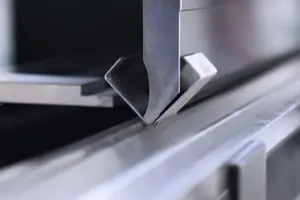
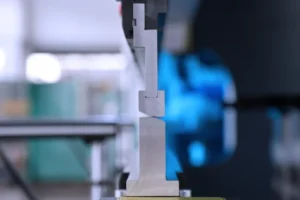
No matter how advanced the frame, controller, and motors are, the sheet metal does not care about the brochure. It only touches the tooling. That is why upper punches, lower dies, clamping systems, and compensation methods are inseparable from the real performance of the press brake.
The EPP Series supports a customizable work area, и different types of tool clamping systems can be installed. That is strategically important because it means the EPP is not a rigidly closed machine concept. It is a configurable production platform that can be matched to different tooling standards and user preferences.
Across the KRRASS press brake pages for MB8, PBE, и PBS, we can see the company’s broader tooling philosophy much more clearly. KRRASS repeatedly references:
- European clamping systems
- fast and safe upper tool clamping
- compatibility with European standard lower dies
- support for 60 mm and 90 mm die bases
- compatibility with single-V dies with 13 mm tang
- electric mechanical crowning integrated with control logic
This is the right context for understanding how an EPP should be specified.
Upper tooling and quick clamping
In a modern fabrication environment, time lost during tool changes is often more expensive than buyers admit. A machine that bends accurately but wastes operator time during every setup is less competitive than it appears. That is why quick, safe, repeatable upper clamping systems matter.
A good upper clamping arrangement should do four things:
- hold the punch securely under dynamic conditions
- allow reasonably fast tool changes
- maintain vertical and longitudinal alignment
- reduce operator risk during setup
Across the KRRASS press brake range, advanced manual and semi-automatic clamping solutions are designed to support faster changeovers and safer handling. For EPP buyers, this matters because a responsive electric machine deserves an equally efficient tooling workflow. There is little value in a fast direct-drive ram if every changeover is slow and awkward.
Lower dies and real-world compatibility
The ability to accept mainstream European tooling formats, together with access to dedicated инструменты для листогибочного пресса, is a major practical advantage. It expands sourcing options, simplifies replacement planning, and makes it easier for customers with existing tool inventories to integrate the new machine. The KRRASS family’s repeated references to 60 mm and 90 mm European lower die bases и 13 mm tang single dies suggest a compatibility mindset that most professional buyers appreciate.
Tooling quality affects more than angle
A poor tooling package can cause:
- inconsistent bend angles
- marking on sensitive surfaces
- poor flange repeatability
- accelerated tool wear
- unstable part seating
- extra setup time due to shimming or repeated trial bends
A serious EPP installation should therefore be specified with tooling quality in mind from the beginning. The buyer should consider material range, bend radii, part family complexity, and expected changeover frequency. The machine’s electric precision only becomes profitable when the tooling system can take advantage of it.
Crowning and compensation: why they still matter on a precise machine
Some buyers assume that because an electric press brake is precise, compensation becomes less important. That is incorrect. Frame deflection, bed behavior, material variation, and bending physics still exist. Across the KRRASS press brake range, electric crowning или electric mechanical crowning remains a practical solution for maintaining consistent bend angle along the full bend length, especially when paired with angle measurement support and application-specific tooling setup.
That logic is just as relevant to the EPP Series.
In practical terms, crowning allows the machine to compensate for natural elastic behavior in the machine and tooling system so that the center of the bend does not differ from the ends. Controller-linked crowning adjustment is far more efficient than manual shimming. In a factory environment, that means faster setup, fewer correction bends, and more reliable first-piece performance.
For buyers evaluating the EPP Series, the best way to think about tooling is simple: the machine should be configured as a complete bending system, not purchased as a bare machine body and treated as if tooling is an afterthought. The higher the expectations for precision, the more important the tooling strategy becomes.
Safety Systems and DSP Laser Protection: Protecting Operators Without Killing Productivity
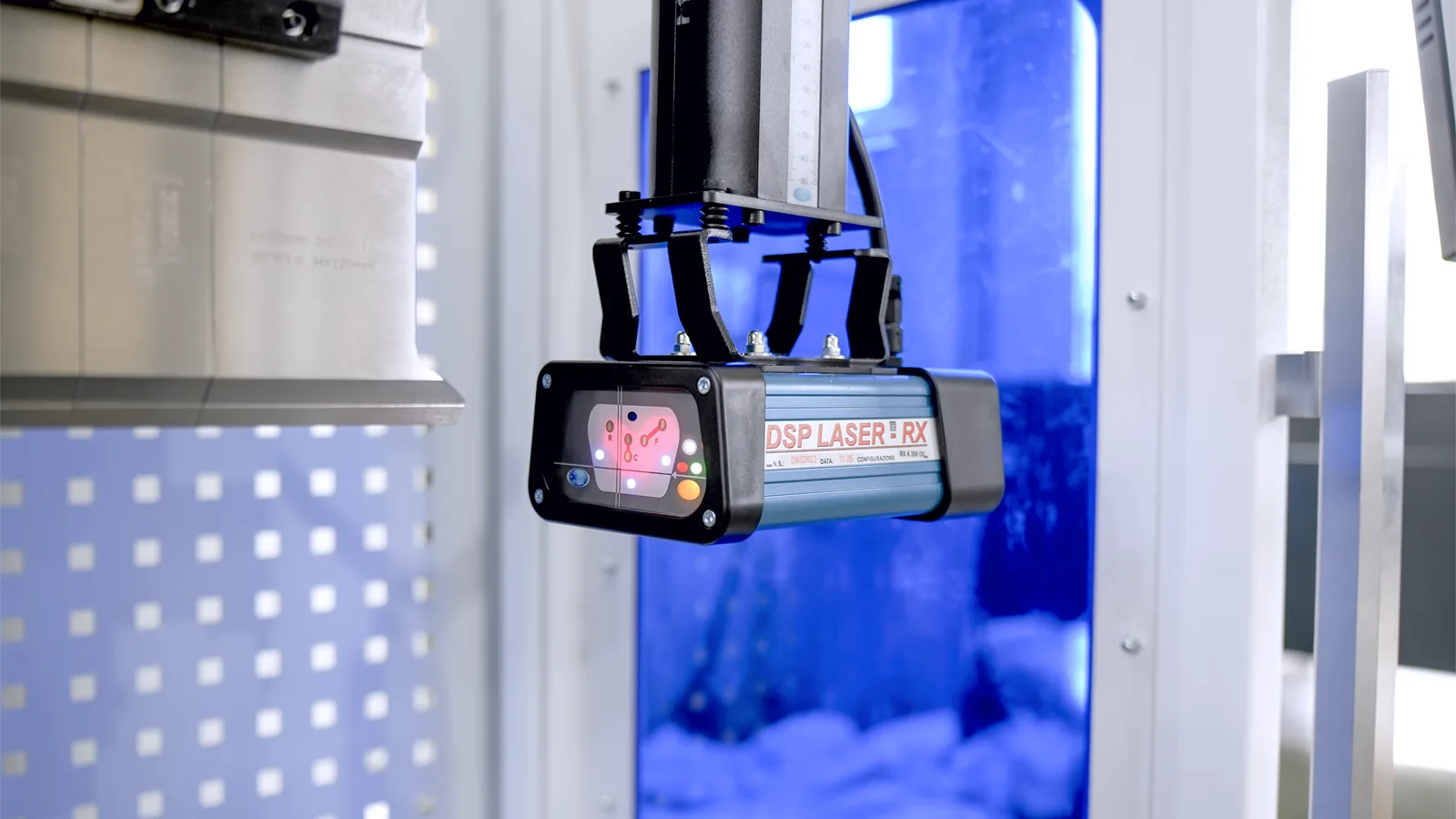
No discussion of a modern CNC press brake is complete without safety. KRRASS treats this as part of the machine package, not as an afterthought, which is why the broader brand offering includes dedicated меры безопасности for press brake applications. This is especially true for a machine like the EPP, because the combination of high responsiveness, fast non-working speed, and precision motion demands a safety strategy that is equally intelligent.
Safety on the EPP platform should be understood in practical production terms rather than as a checkbox item. Within the broader KRRASS press brake range, DSP laser protection is presented as an optional high-level safety system. The logic is straightforward: traditional physical barriers or basic light curtains can protect the operator, but they may also slow the machine earlier than necessary and reduce productivity. A high-quality laser protection solution aims to maintain both safety and production efficiency.
That is exactly the kind of optional system that makes sense on a high-performance electric press brake like the EPP.
Why standard guarding alone is not always enough
OSHA's powered press brake safeguarding guidance notes that press brake hazards remain real even when the operator is not intentionally placing hands into the point of operation. Foot pedals, part movement, and the geometry of the forming process can all introduce risks. OSHA identifies safeguarding methods such as presence sensing devices, two-hand controls, pullback devices, and restraint devices. In other words, safety is not a decorative add-on. It is central to proper press brake operation.
Why DSP laser protection is attractive on advanced machines
DSP laser protection is especially relevant for customers with high safety requirements. A laser-based system can be integrated with the machine’s actuation logic to provide very fast reaction without forcing the machine to remain at slow speed too far above the sheet. That is important because conventional guarding methods can create a painful productivity trade-off.
A reference DSP-AP laser protection system from Gasparini describes visible laser protection compliant with EN12622, notes that the mute point can be reduced to about 4 mm from the sheet metal, and states that this can save roughly 1.2 seconds per bend compared with more conventional arrangements. Even though buyers should verify the exact performance of the selected safety package, that general logic explains why advanced fabricators often choose laser-based safeguarding for higher-performance press brakes.
Why DSP protection fits the EPP philosophy
The EPP platform is about fast, efficient, controlled motion. A crude safety arrangement that forces excessive slowdown would weaken one of the machine’s main advantages. A well-integrated DSP laser protection system, by contrast, fits the EPP philosophy because it aims to:
- protect the operator near the tooling zone
- maintain productive approach speed as long as safe
- respond quickly to intrusion risk
- support high-efficiency bending without compromising modern safety expectations
Safety should be specified as a system, not a checkbox
When buying an EPP machine, the user should think about safety in layers:
- optical protection near the tool zone
- foot pedal design and accidental-cycle prevention
- side and rear guarding where appropriate
- emergency stop logic
- machine status indication
- operator training and setup procedures
- tooling suitability for the planned parts
The best outcome is not merely “a CE sticker” or “a laser device.” It is an integrated operating environment where the machine remains productive while the operator remains protected.
Precision, Speed, and Real Production Efficiency
The EPP Series is positioned as a benchmark of precision bending, but what does that mean in the practical language of a fabrication factory? It means the machine is not valuable because it is electric in theory. It is valuable because the combination of structure, drive, software, backgauge, tooling compatibility, and optional safety systems creates a more efficient real-world bending process.
Precision is a system result
There is a temptation in equipment marketing to isolate one component and declare it the reason for accuracy. In reality, precision on the EPP Series comes from the interaction of several elements:
- a rigid machine body
- controlled and synchronized electric actuation
- low-backlash transmission behavior
- useful CNC control logic
- appropriate tooling and clamping
- a stable backgauge
- compensation strategy where needed
- operator usability that reduces programming and setup mistakes
A machine can only truly be called precise when all of these factors work together.
Speed is not just top speed
The EPP data lists up to 200 mm/s maximum speed and 200 mm/s return speed, with 0–30 mm/s bending speed. Those numbers are meaningful, but the real production story is broader. What matters is not only how fast the machine can move, but how quickly it can complete the full cycle from setup to finished part:
- how fast the operator can call the program
- how fast the backgauge positions
- how fast the ram approaches safely
- how stably the bend is executed
- how fast the ram returns
- how little corrective re-bending is needed
An electric platform often performs very well in this holistic sense because its motion is highly responsive and its idle losses are low. The machine feels ready rather than sluggish.
Noise reduction is a production quality factor
The EPP page highlights reduced-noise operation. That should not be dismissed as a secondary comfort feature. Lower machine noise improves operator experience, supports better communication on the factory floor, and reflects the reduced reliance on continuously running hydraulic power. For many modern factories, especially those trying to build cleaner and more professional working environments, this is part of the value proposition.
The linked product demo reinforces the machine’s positioning
The linked EPP product demo is useful because it shifts the conversation from abstract specification language to visible machine behavior. A buyer can see the EPP working as a practical CNC bending system rather than as a conceptual “green machine.” That matters because the real selling point of the EPP is not novelty. It is the combination of controlled motion, clean operation, and production-grade usability.
Energy Saving, Clean Operation, and Sustainability Without Hype
One of the easiest ways to make an electric machine sound cheap is to over-focus on utility savings and low price. That is the wrong strategy for the EPP Series. The machine should not be framed as a bargain substitute. Its strongest story is that it delivers a more modern production architecture.
That said, the energy and environmental advantages are real and should be discussed properly.
55%–78% energy savings is strategically significant
For the EPP platform, the energy-saving target is 55% to 78% compared with a conventional bending press brake. Even without turning the article into a utility-cost spreadsheet, that is a substantial operational claim. It suggests that the EPP is particularly attractive for factories that:
- run frequent short cycles
- experience significant idle time between bends
- care about total equipment energy intensity
- want lower heat and noise from power transmission systems
- are actively modernizing their sustainability profile
Zero or reduced hydraulic oil dependency changes the factory environment
The EPP page emphasizes reduced need for hydraulic oil. From a production-management perspective, that affects more than maintenance. It touches cleanliness, spill risk, oil purchasing, fluid disposal, and environmental messaging. A cleaner machine is easier to integrate into factories that are trying to standardize leaner and more controlled production spaces.
IE3-class efficiency thinking fits the EPP story
Across KRRASS’s press brake pages, the company references high-efficiency IE3 motors in its broader equipment ecosystem, while suppliers such as Schneider Electric underline how industrial automation and control choices influence energy stability and long-term serviceability. The International Electrotechnical Commission identifies IE3 as a premium-efficiency motor class in modern industrial energy-efficiency regulation. While buyers should always confirm the exact motor specification on their final EPP quotation, the broader KRRASS emphasis on efficient industrial electrics aligns well with the EPP’s design philosophy.
Sustainability is strongest when it improves operations
The best industrial sustainability story is never “we sacrificed performance to look green.” The best story is “we improved performance and reduced waste at the same time.” That is where the EPP is strongest. Lower energy consumption, low standby waste, lower hydraulic dependence, reduced noise, and potentially lower maintenance burden all reinforce the machine’s technical value rather than distracting from it.
Which Manufacturers Benefit Most from the EPP Series
Not every press brake buyer needs the same machine. The EPP Series is especially compelling in the following cases.
Precision-oriented sheet metal fabrication
If the buyer’s production profile includes cabinets, electrical enclosures, telecommunications components, architectural sheet metal, appliance parts, stainless covers, or other parts where repeatability and surface control matter, the EPP’s electric response and precision logic become very attractive.
Factories that value cleaner and quieter operation
Plants pursuing cleaner production spaces, better operator comfort, and lower dependence on hydraulic maintenance often find electric bending especially appealing. The EPP supports that transition without abandoning industrial-grade machine capability.
Medium-format parts in repeat or semi-repeat production
The EPP parameter range shows it can handle useful commercial machine sizes, from compact machines to 3200 mm class models. That gives it broad relevance for many general fabrication environments, especially where accuracy and responsiveness are more valuable than extreme heavy-plate tonnage.
Buyers modernizing their manufacturing image
For many companies, capital equipment is not only about production output. It also affects how customers, auditors, and staff perceive the factory. A direct-drive electric press brake communicates modern engineering, process control, and environmental seriousness. That can matter in industries where supplier image and technical credibility influence business relationships.
Companies that want lower lifecycle friction
The EPP is especially interesting for buyers who think beyond purchase price and care about lifecycle friction: maintenance interruptions, oil handling, machine noise, wasted standby energy, and operator training burden. In those categories, a well-configured electric platform can offer advantages that are not obvious in a simple initial-price comparison.
What Buyers Should Confirm Before Ordering an EPP Machine
Because machine scope can vary by application, serious buyers should confirm the final specification carefully. The most important checklist includes:
| Item to Confirm | Почему это важно |
|---|---|
| Controller package (standard SCS-800, plus any project-specific software options) | Determines programming depth, workflow, training requirements, and operator efficiency |
| Backgauge axis configuration | Determines part-handling flexibility and setup time |
| Tool clamping system | Affects changeover speed, tooling compatibility, and operator safety |
| Lower die compatibility | Important for existing tooling inventory and future sourcing |
| Crowning configuration | Important for angle consistency on longer bends |
| Safety package | Decide whether DSP laser protection or other safeguarding is appropriate |
| Foot pedal and control logic | Important for both usability and safety |
| Material and part range | Ensures the selected tonnage, length, throat depth, and stroke match actual production |
| Installation requirements | Electrical requirements, floor planning, and operator space |
| Training and after-sales support | Crucial for faster commissioning and long-term value realization |
This is not a sign of uncertainty. It is simply good industrial buying practice. The EPP is a serious CNC machine, and serious CNC machines should be ordered with full awareness of configuration details.
Final Evaluation: Why the KRRASS EPP Series Stands Out
The strongest way to understand the KRRASS EPP Series is this: it is not a hydraulic press brake with a fashionable label, and it is not a low-cost machine disguised as advanced technology. It is a modern electric bending platform built around a specific engineering logic.
That logic starts with a strong mechanical foundation and extends through an intuitive SCS-800 CNC control environment, a Techmation-based electric drive package, a TSUBAKI NAKASHIMA Y-axis grinding screw, practical Hiwin backgauge capability, ГИВИ magnetic linear feedback, customizable tooling and clamping options, and compatibility with advanced safety solutions such as DSP laser protection. Around that core, KRRASS positions the machine for what modern fabricators increasingly care about: точность, fast response, stable repeatability, low noise, lower hydraulic dependency, reduced maintenance burden, и substantial energy savings.
For buyers who want a machine that feels durable, intelligent, efficient, and contemporary, the EPP Series is a compelling option. Its selling point is not that it is cheap. Its selling point is that it brings together industrial-grade body construction, responsive electric actuation, CNC usability, and cleaner factory operation in one coherent press brake concept.
That is why the EPP deserves attention from serious sheet metal manufacturers, especially those already comparing it with the broader KRRASS press brake lineup. It offers a credible path toward high-precision bending with the practical advantages of direct electric drive. In a market where equipment decisions increasingly depend on both performance and operational discipline, that combination is not a niche feature. It is a strategic advantage.