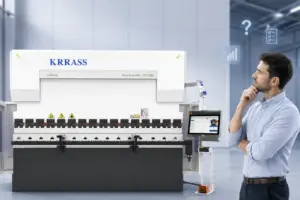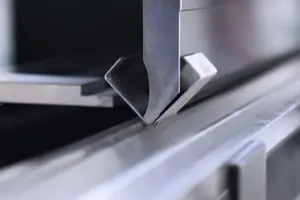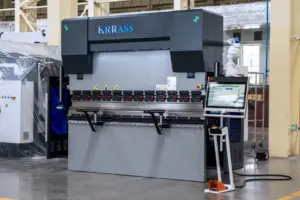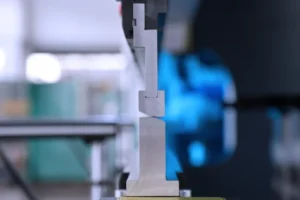
When a buyer searches for a Гидравлический листогибочный пресс на продажу, the real question is rarely just “What is the price?” The better question is: “Which hydraulic press brake can bend my heaviest parts safely, accurately, repeatedly, and profitably?” Heavy bending is different from light sheet metal bending. It puts more load on the frame, tooling, hydraulic cylinders, crowning system, backgauge, operator handling process, and production planning. A machine that looks strong on a quotation sheet may still be wrong if the V-die opening is unsuitable, the flange is too short, the tooling load rating is too low, or the frame deflection is not managed correctly.
At KRRASS, we build and supply sheet metal forming equipment for global customers, including прессовые тормоза, hydraulic shearing machines, fiber laser cutting machines, and ironworker machines. For heavy bending projects, we do not recommend choosing a machine only by nominal tonnage. We start from the buyer's actual parts: material grade, thickness range, bending length, inside radius, flange size, bend angle, annual production volume, tolerance requirement, safety requirement, and future product plan. Only after that can we match the right hydraulic press brake, tooling, CNC control, backgauge, crowning, clamping, and support options.
This guide explains how to choose the right hydraulic press brake for sale for heavy bending. It is written for purchasing managers, factory owners, production engineers, and metal fabrication teams who need a practical decision framework. It uses clear language, but it also includes the technical details that matter in real production.
Оглавление
What heavy bending really means
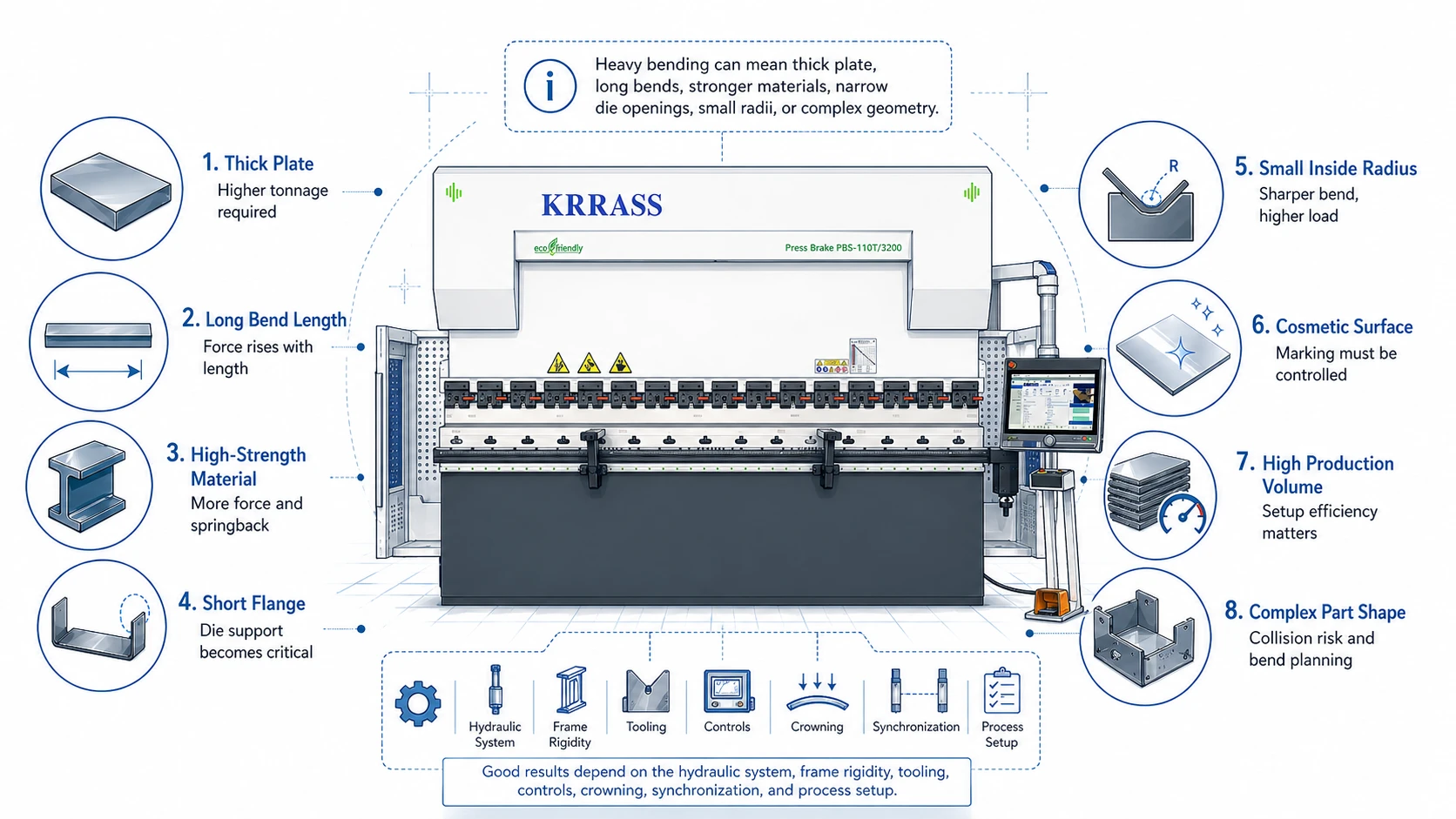
Heavy bending does not only mean bending thick plate. It can also mean long bending length, high-strength material, narrow V-die opening, small inside radius, high repeatability demand, or a part geometry that concentrates load in a short tooling section. A factory bending 6 mm mild steel over 4 meters may face a heavy bending problem. Another factory bending 12 mm stainless steel over 1 meter may also face a heavy bending problem. The machine selection logic must account for all of these variables.
In practical press brake selection, heavy bending normally appears in one or more of these conditions:
| Heavy bending factor | Why it matters | Buying implication |
|---|---|---|
| Thick plate | Tonnage rises approximately with the square of thickness in air bending estimates | Machine capacity and tooling load rating must be checked carefully |
| Long bend length | Total bending force increases with length | Frame rigidity, crowning, and bed deflection become critical |
| Stainless steel or high-strength steel | Higher tensile strength increases required force and springback | More tonnage, wider V opening, and better angle control may be needed |
| Short flange | A wide die opening may not support the part safely | V-die selection must balance tonnage reduction against minimum flange length |
| Small inside radius | A sharper bend usually needs more force and may increase cracking risk | Tooling radius, material ductility, and grain direction must be reviewed |
| Cosmetic surface | Tool marks can be costly on stainless panels or painted parts | Anti-marking film, larger V openings, polished dies, or special tooling may be required |
| High production volume | Setup time, tool change time, and operator consistency affect cost | CNC control, quick clamps, tooling storage, and offline programming become valuable |
| Complex part shape | Return flanges, boxes, channels, and deep profiles create collision risk | Gooseneck punches, segmented tools, and bend sequence planning are necessary |
A hydraulic press brake is often selected for heavy bending because hydraulic cylinders can deliver high force with controlled ram movement. However, the hydraulic system alone does not guarantee good bending. The machine frame, ram, bed, tooling, control system, deflection compensation, hydraulic synchronization, and operator process must work together.
Why hydraulic press brakes remain important for heavy bending
Electric press brakes and hybrid servo press brakes are attractive for speed, energy efficiency, and precision in many sheet metal applications. For heavy bending, however, hydraulic press brakes remain a strong and widely used choice because they can deliver high tonnage across long bending lengths at a competitive investment level. A well-designed hydraulic press brake gives factories a practical balance of strength, flexibility, machine cost, and serviceability.
A hydraulic press brake is especially suitable when the buyer needs to bend medium-thick and thick sheet, structural parts, agricultural equipment parts, machinery covers, elevator components, truck parts, container parts, power cabinet components, stainless steel panels, and general fabrication parts. It can also be configured with CNC control, multi-axis backgauge, hydraulic or mechanical crowning, safety light curtains or laser guards, quick clamps, front support arms, and customized tooling.
| Selection point | Why a hydraulic press brake fits heavy bending |
|---|---|
| High force requirement | Hydraulic cylinders are well suited for high-tonnage bending |
| Long machine lengths | Hydraulic press brakes can be built in common lengths such as 3200 mm, 4000 mm, 6000 mm, and longer custom configurations |
| Wide material range | Mild steel, stainless steel, aluminum, galvanized sheet, and many structural materials can be processed with correct tooling |
| Tooling flexibility | Standard punches, heavy-duty dies, radius tooling, segmented tooling, and special tools can be used |
| Cost-performance balance | Hydraulic machines are often more cost-effective than high-tonnage electric alternatives |
| Maintenance familiarity | Many factories already understand hydraulic pumps, valves, cylinders, seals, and oil maintenance |
The key is not to choose “hydraulic” as a label. The key is to choose the right hydraulic press brake configuration for the parts. A 160-ton machine and a 320-ton machine are both hydraulic press brakes, but they serve very different production needs. A torsion-bar machine and a full CNC electro-hydraulic synchronized machine may also look similar from a distance, but they differ greatly in angle control, backgauge flexibility, repeatability, and long-term productivity.
Start from the part, not from the machine
The most common buying mistake is starting from a machine model instead of starting from the part. A buyer may request a 160-ton 3200 mm hydraulic press brake because that size is common in the market. But if the factory needs to bend 10 mm stainless steel over 3 meters, 160 tons will not be enough. Another buyer may request 400 tons because the parts look heavy, but the actual bending length may be short, and a smaller machine with the correct tooling may be more economical.
Before asking for a hydraulic press brake quotation, prepare the following information:
| Information needed | Пример | Why it affects machine selection |
|---|---|---|
| Material type | Mild steel, stainless steel 304, aluminum 5052, high-strength steel | Different tensile strength changes required tonnage and springback |
| Толщина материала | 3 mm, 6 mm, 10 mm, 16 mm | Thickness has a major effect on bending force |
| Maximum bending length | 2500 mm, 3200 mm, 4000 mm | Determines machine length and total force |
| Common bending length | 800 mm, 1500 mm, 3000 mm | Helps avoid overbuying only for rare jobs |
| Minimum flange | 12 mm, 25 mm, 50 mm | Limits V-die opening and affects part stability |
| Inside radius | R2, R5, R10, R20 | Determines punch radius, die opening, and possible cracking risk |
| Bend angle | 90 degrees, 135 degrees, acute bend | Affects tooling, springback, and CNC programming |
| Part geometry | U channels, boxes, return flanges | Determines collision risk and punch style |
| Tolerance | General fabrication or precision assembly | Determines CNC level, crowning, and angle correction need |
| Объём производства | One-off, batch, daily repeat production | Determines automation value and tool change requirements |
| Surface requirement | Painted, brushed stainless, visible panels | Determines anti-marking and tooling surface choices |
| Future parts | Thicker plate or longer parts planned | Helps reserve capacity and avoid short machine life |
For heavy bending, drawings are the best starting point. If drawings are not available, photos, sketches, sample parts, and a thickness list are still useful. A supplier should not only ask “How many tons do you want?” A professional supplier should ask “What do you need to bend?”
Understand tonnage before choosing nominal capacity
Tonnage is the headline specification of a hydraulic press brake, but it is also one of the most misunderstood. Press brake tonnage is the force the machine can apply through the ram. It is not the same as “what the machine can bend in every situation.” The required bending force depends on material tensile strength, thickness, bending length, V-die opening, tooling geometry, bending method, and desired radius.
For practical air bending estimates, many fabricators use an empirical formula for mild steel:
P ≈ 650 × t² × L ÷ V
Где:
- P = bending force in kN
- t = material thickness in mm
- L = bending length in meters
- V = V-die opening in mm
This is a planning formula, not a final engineering certificate. It assumes ordinary air bending of mild steel with a tensile strength around the common mild steel reference range. If the material is stainless steel, high-strength steel, or aluminum, correction factors are needed. For live estimation, buyers can also use the KRRASS Калькулятор изгибающей силы or discuss the part with our engineering team.
Sample tonnage estimates for mild steel air bending
The following table uses the formula above with a common planning V opening. It gives a quick sense of how force changes with thickness and length. Actual force may vary by material grade, die radius, punch radius, lubrication, bending method, and real material tensile strength.
| Толщина низкоуглеродистой стали | Планирование V открытие | Длина изгиба | Расчетная сила | Примерно метрических тонн |
|---|---|---|---|---|
| 6 мм | 48 мм | 3 м | 1,463 kN | 146 tons |
| 8 мм | 64 мм | 3 м | 1,950 kN | 195 tons |
| 10 мм | 80 мм | 3 м | 2,438 kN | 244 tons |
| 12 мм | 96 мм | 3 м | 2,925 kN | 293 tons |
| 16 мм | 160 mm | 3 м | 3,120 kN | 312 tons |
| 20 мм | 200 мм | 3 м | 3,900 kN | 390 tons |
| 10 мм | 80 мм | 4 м | 3,250 kN | 325 tons |
| 12 мм | 96 мм | 4 м | 3,900 kN | 390 tons |
This table shows why a heavy bending buyer should be careful with casual tonnage assumptions. Moving from 8 mm to 12 mm thickness does not create a small increase; it creates a major increase. Extending the bending length from 3 meters to 4 meters also raises total tonnage. A machine that can handle a 10 mm plate over 2 meters may not handle the same thickness over 4 meters.
A good buying rule is to avoid running the machine at its maximum rated tonnage every day. For heavy bending, a practical reserve is important. Many factories plan around a 15% to 30% capacity margin, depending on material variation, tooling condition, production frequency, and safety policy. If the calculated force is around 245 tons for a common job, selecting a 250-ton machine may be too tight for daily production. A 300-ton or 320-ton configuration may be more stable.
Apply material correction factors carefully
A hydraulic press brake does not feel material names. It feels resistance. Stainless steel, aluminum, mild steel, and high-strength steel behave differently because their tensile strength, yield behavior, ductility, and springback are different. Technical standards such as ISO 6892-1 define tensile testing methods for metallic materials, and standards such as ISO 7438 relate to bend testing of metallic materials. In purchasing work, the exact material certificate is more useful than a general material name.
For early planning, the table below can help buyers understand common correction logic. The factors are practical planning ranges, not universal values.
| Материал | Typical planning force factor vs. mild steel | тенденция к пружинению | Selection note |
|---|---|---|---|
| Низкоуглеродистая сталь | 1.0 | Умеренный | Standard reference for many tonnage charts |
| Нержавеющая сталь 304/316 | 1.4 to 1.6 | Выше | Often needs more tonnage, wider V opening, and stronger angle control |
| Алюминий 5052 | 0.5 to 0.7 | Умеренный или высокий уровень в зависимости от темперамента | Lower tonnage, but surface protection and cracking limits must be checked |
| Высокопрочная сталь | 1.8 to 3.0+ | Высокий | Requires careful radius, V opening, tooling load, and material data review |
| Оцинкованная сталь | Around mild steel, varies by grade | Умеренный | Coating marking and cracking should be considered |
| Copper/brass | сильно различается | Often lower than steel but grade-dependent | Soft material can mark easily; tooling surface matters |
For example, if a mild steel estimate gives 200 tons, the same geometry in stainless steel may require around 280 to 320 tons. This is why “we only bend 8 mm” is not enough information. The material grade matters. A buyer should send the material specification or at least identify whether it is mild steel, stainless steel, aluminum, or high-strength steel.
Choose the V-die opening with both tonnage and flange length in mind
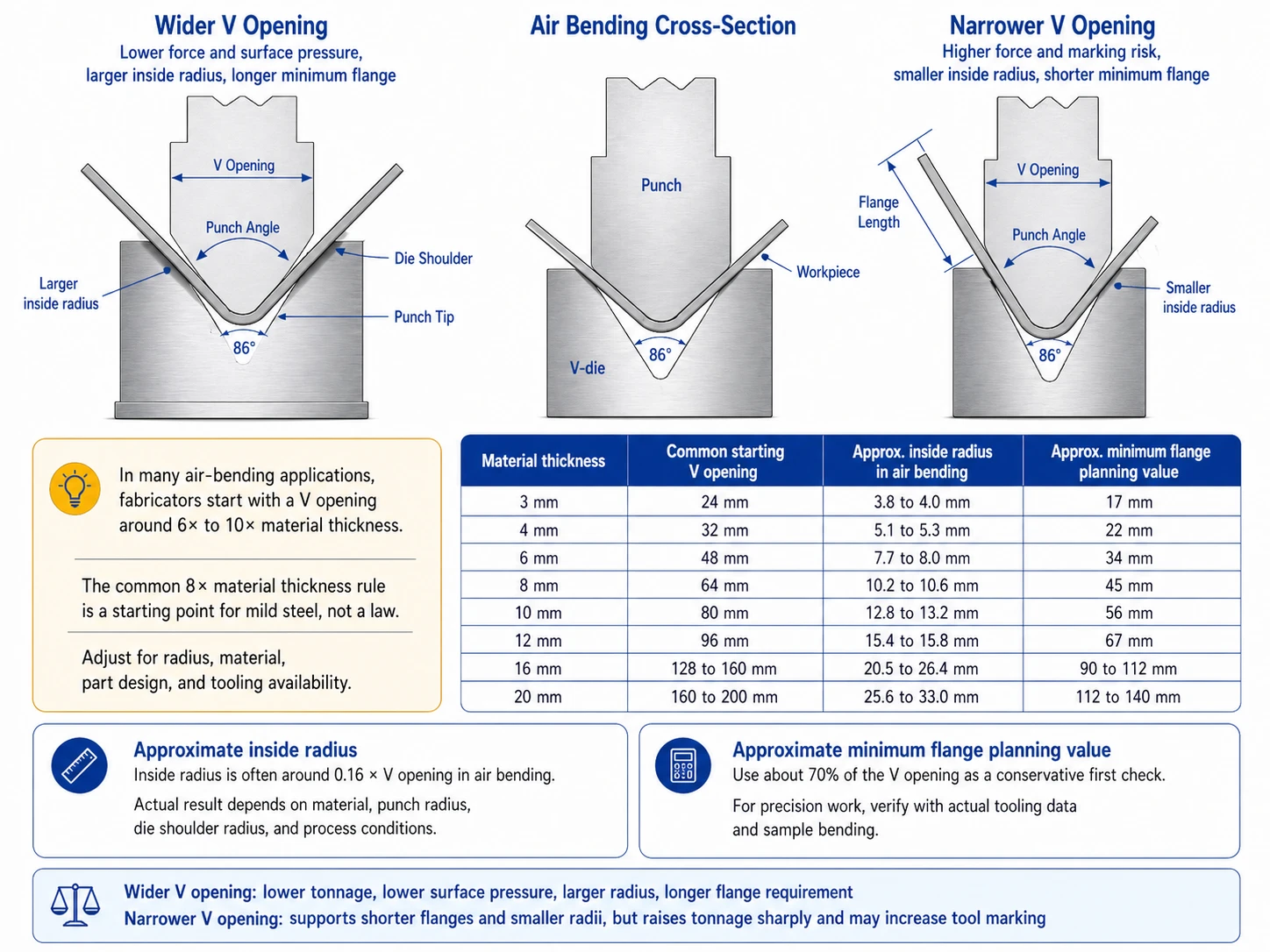
The V-die opening is one of the most important tooling decisions in heavy bending. A wider V opening reduces bending force and surface pressure. It also increases the inside radius and the minimum flange needed for stable bending. A narrower V opening supports shorter flanges and smaller radii, but it raises tonnage sharply and may increase tool marking.
In many air bending applications, fabricators start with a V opening around 6 to 10 times material thickness, then adjust based on radius, material, part design, and tooling availability. The common “8 × material thickness” rule is a starting point for mild steel, not a law. Thick plate, stainless steel, high-strength material, or cosmetic parts may need a different choice.
| Толщина материала | Общее начало V-образного отверстия | Приблизительный внутренний радиус при изгибе в воздухе | Примерное минимальное значение планировки фланца. |
|---|---|---|---|
| 3 мм | 24 мм | 3.8 to 4.0 mm | 17 мм |
| 4 мм | 32 мм | 5.1 to 5.3 mm | 22 мм |
| 6 мм | 48 мм | 7.7 to 8.0 mm | 34 мм |
| 8 мм | 64 мм | 10.2 to 10.6 mm | 45 mm |
| 10 мм | 80 мм | 12.8 to 13.2 mm | 56 mm |
| 12 мм | 96 мм | 15.4 to 15.8 mm | 67 mm |
| 16 мм | 128 to 160 mm | 20.5 to 26.4 mm | 90 to 112 mm |
| 20 мм | 160 to 200 mm | 25.6 to 33.0 mm | 112 to 140 mm |
The “approximate inside radius” column uses the common air-bending idea that inside radius is often around 0.16 × V opening, though the actual result depends on material, punch radius, die shoulder radius, and process conditions. The minimum flange planning value uses about 70% of the V opening as a conservative first check. For precision work, you should verify with actual tooling data and sample bending.
KRRASS provides press brake tooling support because tooling is not a secondary accessory. Buyers can review our Направляющая для инструмента листогибочного пресса и инструменты для листогибочного пресса to understand how punch and die selection affects radius, tonnage, collision clearance, and production flexibility.
Do not ignore tooling load rating
Machine tonnage and tooling tonnage are different. A hydraulic press brake may have 300 tons of machine capacity, but a specific punch or die section may have a lower load rating. If the operator concentrates high tonnage into a short tooling section, the tool can crack, deform, or fail even when the machine itself is capable of producing the force. This is especially important for heavy brackets, short parts, thick plates, and narrow dies.
For heavy bending, always check:
- maximum tool load per meter or per foot;
- minimum recommended bend length for high-tonnage work;
- punch tip radius and allowable load;
- die shoulder strength and V opening;
- clamping system load rating;
- segmented tool arrangement and tool alignment;
- whether the load is centered or offset;
- whether special radius tooling is needed.
A buyer should not accept a hydraulic press brake quotation that lists only the machine body. The quotation should also discuss tooling. For heavy bending, the wrong tooling can turn a good machine into a poor production solution.
Match machine length to real bending work
The bending length of the machine should cover the longest part, but buyers should also consider common part length. A factory that bends one 4000 mm part per month and hundreds of 1200 mm parts per day may not need the same configuration as a factory bending 4000 mm parts every shift. In some projects, a longer machine is necessary. In others, tandem machines, outsourcing rare long parts, or redesigning a part may be more economical.
For heavy bending, longer length affects not only size but also deflection. A 4000 mm bend puts more demand on the frame, ram, bed, and crowning system than a 1000 mm bend. Long bends also require better sheet support, more operator coordination, and stronger attention to safety.
| Production situation | Machine length consideration |
|---|---|
| Most parts are shorter than 1500 mm | Do not overbuy length only for rare long parts unless future demand is clear |
| Common parts are 2500 to 3200 mm | A 3200 mm hydraulic press brake is often a practical standard configuration |
| Common parts are 4000 mm or longer | Crowning, sheet support, and frame rigidity become more important |
| Very long parts appear frequently | Consider long-bed machines or tandem press brake solutions |
| Heavy short parts | Tonnage concentration and tooling load rating may be more important than total machine length |
When a buyer sends part drawings, we check both the maximum length and the common daily length. This helps prevent two problems: buying a machine that is too small for real work, or buying an oversized machine that increases cost without improving daily productivity.
Choose enough daylight, stroke, and throat depth
Heavy bending buyers often focus on tonnage and length, but daylight, stroke, and throat depth can decide whether the machine can physically make the part.
Светлый день is the open height between the ram and bed area when the machine is open. It matters when using tall tooling, gooseneck punches, large radius tooling, or when removing tall formed parts.
Строк is the travel range of the ram. It matters for deep forming, large tools, and parts requiring enough opening after the bend.
Глубина горла is the distance from the tooling centerline to the frame side. It affects how deep a flange or panel can pass into the machine before contacting the side frame.
| Machine parameter | Why it matters in heavy bending |
|---|---|
| Светлый день | Needed for tall punches, large dies, and formed parts with high profiles |
| Строк | Needed for deep channels, large-radius bends, and safe part removal |
| Глубина горла | Needed for wider panels and parts that must extend behind the tooling line |
| Open height with tooling installed | More useful than nominal daylight alone |
| Расстояние между столбцами | Limits the real usable length for some part geometries |
| Table width | Affects die support, large tooling, and heavy plate handling |
A machine can have enough tonnage but still fail the job if the formed part cannot clear the tooling or frame. For heavy bending, collision review should be part of the buying process.
Crowning is not optional for long heavy bending
When a press brake bends a long part, the frame and ram deflect under load. Without compensation, the angle may be different in the center compared with the ends. This is why crowning is important. Crowning compensates for deflection so the bend angle remains more consistent along the length.
For short light parts, crowning may not seem critical. For long heavy bending, it becomes a quality-control requirement. KRRASS offers crowning solutions, and buyers can read more on our Crowning System for Press Brake page.
| Crowning type | Practical meaning | Best fit |
|---|---|---|
| Manual crowning | Operator adjusts compensation manually | Lower volume, simpler work, budget-sensitive applications |
| Mechanical CNC crowning | CNC system controls wedge compensation | Repeated production, long bends, higher consistency |
| Гидравлическое выравнивание выпуклостей | Hydraulic compensation supports bending accuracy | Heavy-duty machines and demanding long bending work |
| No crowning | No active compensation | Shorter parts or low-precision work only |
For heavy bending, we normally recommend a crowning system if the machine length and part tolerance justify it. It improves first-part accuracy, reduces trial bending, and helps operators maintain more stable results across different materials and lengths.
Decide between NC, CNC, and electro-hydraulic synchronized configurations
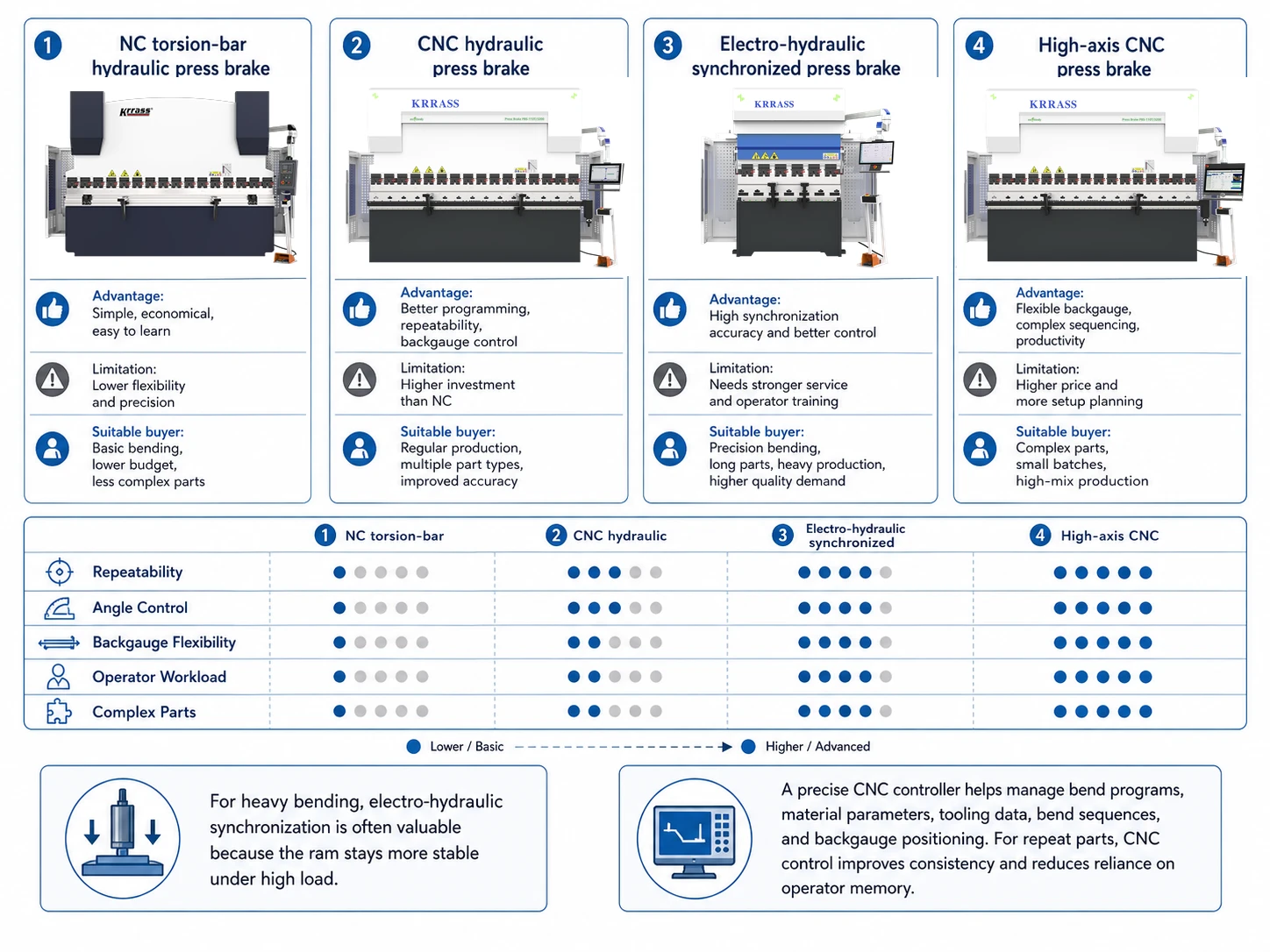
A hydraulic press brake for sale may be described as NC, CNC, torsion-bar, or electro-hydraulic synchronized. These terms affect more than convenience. They affect repeatability, angle control, backgauge flexibility, operator workload, and the ability to handle complex heavy parts.
| Configuration | Typical advantage | Typical limitation | Suitable buyer |
|---|---|---|---|
| NC torsion-bar hydraulic press brake | Simple, economical, easy to learn | Lower flexibility and precision than full CNC systems | Basic bending, lower budget, less complex parts |
| Гидравлический листогибочный пресс с ЧПУ | Better programming, repeatability, backgauge control | Higher investment than NC | Regular production, multiple part types, improved accuracy |
| Electro-hydraulic synchronized press brake | High synchronization accuracy and better control | Requires stronger service and operator training | Precision bending, long parts, heavy production, higher quality demand |
| High-axis CNC press brake | Flexible backgauge, complex sequencing, productivity | Higher price and more setup planning | Complex parts, small batches, high-mix production |
For heavy bending, electro-hydraulic synchronization is often valuable because the ram must remain stable under high load. A precise CNC controller also helps manage bend programs, material parameters, tooling data, bend sequences, and backgauge positioning. If the factory makes repeat parts, CNC control reduces dependence on operator memory and improves consistency.
Backgauge selection affects productivity, not only positioning
The backgauge positions the sheet before bending. In heavy bending, it must be strong, repeatable, and suitable for the size and weight of the part. A simple X-axis backgauge may be enough for basic work. More complex parts may require R-axis adjustment, Z-axis fingers, or multi-axis systems.
| Backgauge feature | Выгода |
|---|---|
| X-axis movement | Controls flange depth and part position |
| R-axis movement | Supports different tool heights and step bends |
| Z-axis fingers | Helps position different parts and asymmetrical shapes |
| Servo drive | Improves speed and repeatability |
| Heavy-duty fingers | Better support for thick or heavy plates |
| CNC-controlled multi-axis system | Improves flexibility for complex parts and repeat production |
A strong backgauge also reduces setup errors. Heavy plates are harder to reposition manually. If the backgauge is weak, slow, or difficult to adjust, the operator may lose time on every bend. In high-mix production, better backgauge control can be worth more than extra tonnage.
Evaluate hydraulic system quality
The hydraulic system is the power center of a hydraulic press brake. In heavy bending, the machine must deliver high force smoothly, repeatedly, and safely. A good hydraulic system should provide stable pressure, controlled ram movement, reliable sealing, manageable oil temperature, and serviceable components.
Key hydraulic system points include:
| Hydraulic element | What to check |
|---|---|
| Main cylinders | Bore size, sealing quality, synchronization, leakage control |
| Hydraulic valves | Response stability, pressure control, availability of replacement parts |
| Oil pump | Output capacity, noise, durability, efficiency |
| Мотор | Power reserve and duty suitability |
| Hydraulic oil tank | Capacity, cooling, filtration, maintenance access |
| Seals and hoses | Quality, pressure rating, resistance to aging |
| Pressure control | Stability under repeated heavy bending |
| Oil temperature | Whether the system remains stable during long production runs |
Hydraulic maintenance is also part of buying. A low-cost machine with poor hydraulic access may become expensive over time. Ask about recommended oil type, oil change interval, filter maintenance, seal replacement, spare parts availability, and service documentation.
Think about the frame as a precision structure
A hydraulic press brake is not only a pressure machine. It is a precision structure under load. The side frames, ram, bed, weldments, machining accuracy, stress relief, and assembly alignment all affect bending accuracy. Heavy bending magnifies every weakness. If the frame is not rigid enough, angle variation and long-term deformation can appear.
Important frame questions include:
- Is the frame designed for the rated tonnage and length?
- How is stress relieved after welding?
- Are the bed and ram machined accurately?
- Is the ram guided well under eccentric load?
- How is deflection handled?
- Does the machine maintain accuracy after repeated high-load work?
- Is the table suitable for heavy-duty dies?
A heavy-duty hydraulic press brake should not be selected only by weight, but machine weight can still indicate material mass and structural strength. A very light machine claiming high tonnage should be reviewed carefully.
Heavy bending needs safe material handling
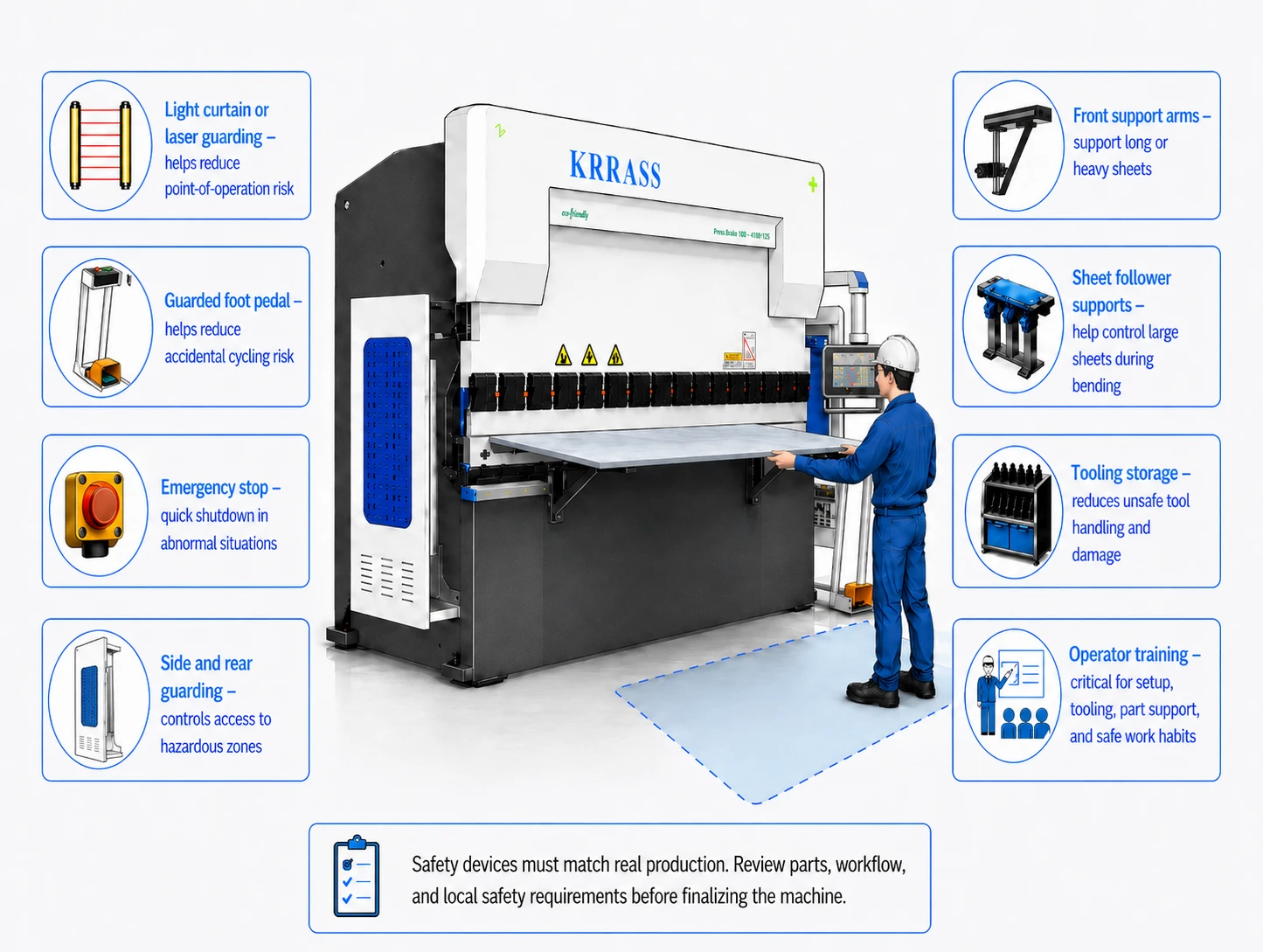
A heavy bending project often involves large and heavy sheets. The operator may need to support the part during bending, and the part may swing upward or downward as the bend forms. OSHA's machine guarding guidance for powered press brakes notes hazards related to operators holding stock and cycling the press, and OSHA's 29 CFR 1910.212 requires guarding of machine points of operation when exposure to injury exists. The ANSI B11.3-2022 standard addresses safety requirements for power press brakes.
For buyers, safety should be part of machine specification, not an afterthought. The correct configuration depends on the country, factory rules, risk assessment, machine type, and part type.
| Safety or handling feature | Why it matters |
|---|---|
| Light curtain or laser guarding | Helps reduce point-of-operation risk when properly selected and used |
| Guarded foot pedal | Helps reduce accidental cycling risk |
| Emergency stop devices | Allow quick shutdown in abnormal situations |
| Side and rear guarding | Helps control access to hazardous zones |
| Front support arms | Help support long or heavy sheets |
| Sheet follower supports | Help control large sheets during bending |
| Tooling storage | Reduces unsafe tool handling and damage |
| Operator training | Critical for setup, tooling, part support, and safe work habits |
Safety devices must match real production. A device that works well for one part may interfere with another if it is poorly selected. The supplier and buyer should review the parts, workflow, and local safety requirements before finalizing the machine.
Do not buy only for today's easiest part
A hydraulic press brake is a long-term investment. Many buyers choose a machine based on the part they need to produce immediately, then discover a year later that the machine is too small for new orders. Others buy too large a machine and spend more money than necessary. The correct approach is to divide parts into three groups:
| Part group | How to use it in selection |
|---|---|
| Current common parts | The machine must handle these efficiently every day |
| Current maximum parts | The machine must be able to handle these safely, even if not daily |
| Future target parts | The machine should reserve reasonable capacity if growth is expected |
The future target part is important. If your factory plans to enter truck body parts, construction machinery panels, heavy electrical enclosures, or stainless steel fabrication, a small hydraulic press brake may limit future business. But future capacity should still be realistic. A machine that is too large may increase investment, floor space, energy use, tooling cost, and handling difficulty.
Compare three buying levels
Not every buyer needs the same hydraulic press brake. A factory making simple brackets has different needs from a factory producing precision stainless steel assemblies. The table below gives a practical comparison.
| Buying level | Typical configuration | Good for | Risk if used incorrectly |
|---|---|---|---|
| Entry heavy-duty | NC hydraulic press brake, standard tooling, manual crowning or basic compensation | General fabrication, simple parts, moderate accuracy | More operator dependence, slower setup, less flexibility |
| Production CNC | CNC hydraulic press brake, servo backgauge, CNC crowning, quick clamps | Repeat batches, mixed parts, better accuracy | Requires better tooling management and operator training |
| Advanced heavy bending | Electro-hydraulic synchronized CNC, multi-axis backgauge, advanced crowning, custom tooling, support devices | Long heavy parts, stainless, complex parts, high production value | Higher initial investment; needs process discipline |
The right purchase is not always the most expensive machine. The right purchase is the configuration that gives the lowest long-term cost per acceptable part.
Calculate total cost, not only purchase price
The lowest quotation is not always the lowest cost. Heavy bending creates costs through scrap, setup time, slow tool changes, angle correction, rework, operator fatigue, tooling damage, oil leakage, unplanned downtime, and missed delivery. A more suitable machine may cost more at the beginning but save money through better productivity and fewer mistakes.
| Cost factor | Low-price risk | Better purchasing approach |
|---|---|---|
| Tonnage margin | Machine runs near limit and wears faster | Select capacity with practical reserve |
| Инструменты | Standard tools cannot bend real parts | Match tools to thickness, radius, flange, and geometry |
| Коронация | Long bends have angle variation | Add crowning for long or precision parts |
| Задний упор | Slow setup and positioning errors | Choose servo/CNC backgauge if production needs it |
| Безопасность | Retrofitting later can be costly | Specify safety system during purchase |
| Service | Downtime from unavailable parts | Check spare parts and technical support |
| Обучение | Operators cannot use CNC functions fully | Include training and process documentation |
For export buyers, also consider shipping, installation, voltage, language, documentation, local service capability, spare parts kits, customs, and payment terms. A hydraulic press brake is not just a product; it is a production system.
Use sample scenarios to check your decision
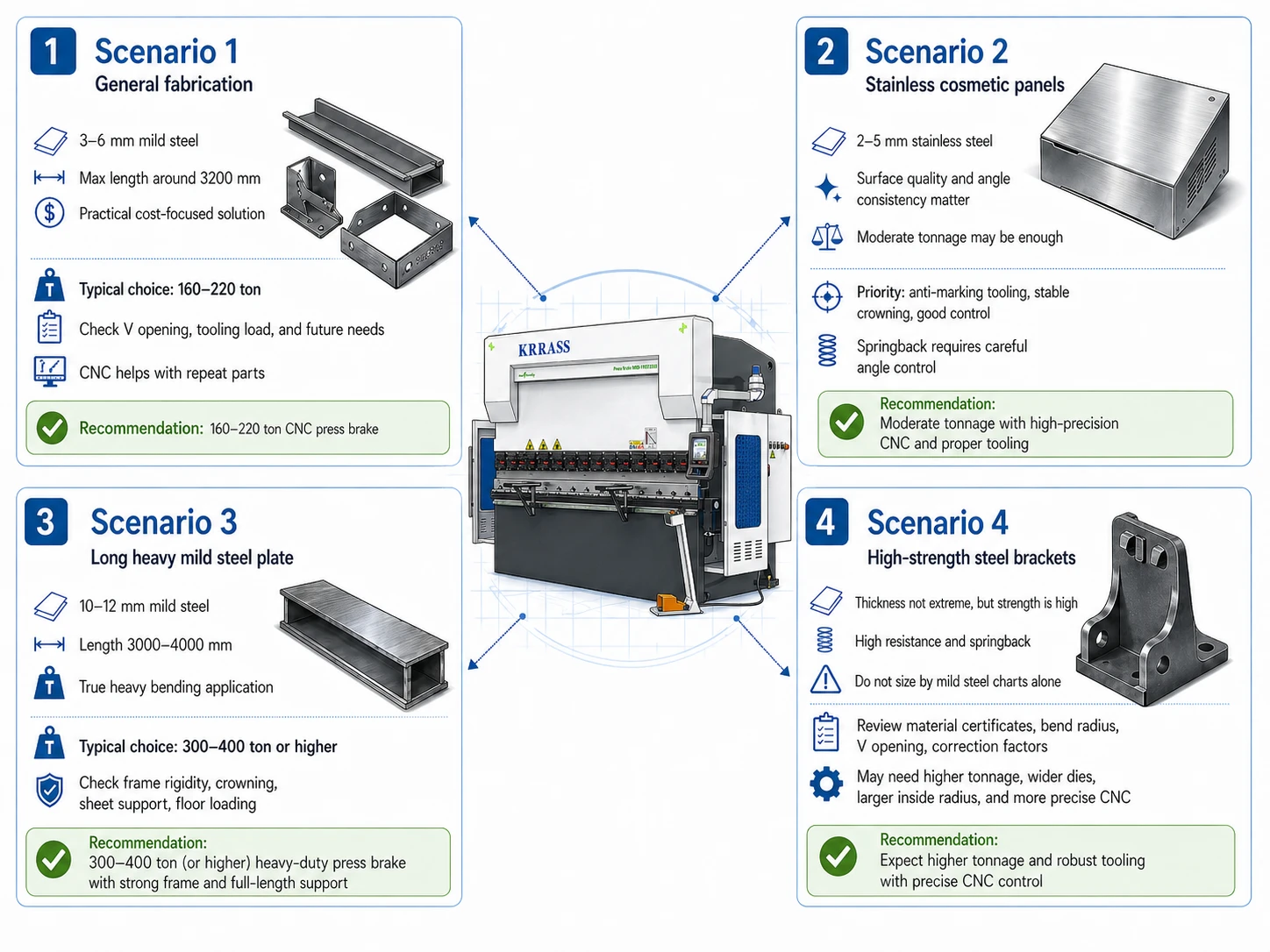
The following examples show how selection changes with real applications.
Scenario 1: General fabrication with 6 mm mild steel
A factory mainly bends 3 mm to 6 mm mild steel, with maximum length around 3200 mm. Parts include frames, brackets, and panels. The factory wants a practical hydraulic press brake for sale with reasonable cost.
A 160-ton to 220-ton hydraulic press brake may be considered depending on actual length, V opening, and future needs. Standard punches and dies may cover many jobs, but the buyer should still check minimum flange length and tooling load. CNC control becomes valuable if the factory has many repeat parts.
Scenario 2: Stainless steel panels with cosmetic surface
A factory bends stainless steel visible panels and equipment covers. Thickness may be 2 mm to 5 mm, but surface quality and angle consistency are important.
The machine may not need extreme tonnage, but it needs good control, appropriate tooling, anti-marking solutions, and stable crowning for longer parts. Stainless steel springback requires careful angle control. The buyer should not focus only on tonnage; tooling finish and process control are equally important.
Scenario 3: 10 mm to 12 mm long mild steel plate
A machinery manufacturer bends long structural parts from 10 mm to 12 mm mild steel over 3000 mm to 4000 mm. This is a true heavy bending application.
The required force can move into the 300-ton to 400-ton range or higher depending on V opening and length. The buyer should check frame rigidity, crowning, heavy-duty tooling, sheet support, hydraulic system capacity, and floor loading. A smaller machine may bend short test pieces but fail in daily long-part production.
Scenario 4: High-strength steel brackets
A factory bends high-strength steel parts. Thickness is not extreme, but material resistance and springback are high.
The buyer must provide material certificates and bend radius requirements. Tooling radius, V opening, and tonnage correction factors must be reviewed. A machine selected by mild steel charts alone can be underpowered. The buyer may need higher tonnage, wider dies, larger inside radius, and a more precise CNC system.
Check the bending method: air bending, bottoming, or coining
Most modern press brake work uses air bending because it is flexible and requires less force than bottoming or coining. However, heavy bending buyers should understand the method because it changes force demand and accuracy behavior.
| Bending method | Force demand | Гибкость | Heavy bending note |
|---|---|---|---|
| Управление воздухом | Lower than bottoming/coining | Высокий | Most common for flexible production; requires good depth control |
| Дно | Выше | Середина | Can improve angle consistency for certain jobs but increases force |
| Монетизация | Очень высокий | Низкий | Rare for heavy plate; can overload tooling and machine if misunderstood |
If a buyer uses a tonnage estimate for air bending but actually plans to bottom or coin, the selected machine may be too small. Always tell the supplier which bending method your factory expects to use.
Ask for a tooling plan with the machine quotation
A professional quotation for heavy bending should include more than machine tonnage and length. It should include a tooling recommendation. The tooling plan should identify standard punches, dies, V openings, radius tooling, segmented tools, and any special tools for boxes, channels, return flanges, or cosmetic surfaces.
A basic tooling plan should answer:
- Which V openings are needed for the material thickness range?
- Which punch style is needed for the part geometry?
- Are gooseneck punches required?
- Are segmented tools required?
- Is a large-radius punch or die needed?
- Does the tooling support the required tonnage?
- Will the tooling fit the clamping system?
- Is the tool height compatible with daylight and stroke?
- Are anti-marking solutions required?
- How will tools be stored and changed safely?
KRRASS supports tooling selection because heavy bending success depends on the machine and tooling together. Buyers can start from the KRRASS Инструменты page and then confirm details with drawings.
Review the controller from the operator's point of view
A CNC controller is not only a screen. It changes how operators program parts, manage tooling data, correct angles, and repeat jobs. For heavy bending, the operator may handle large parts, so reducing setup trial and programming confusion is valuable.
Controller selection should consider:
| Controller question | Why it matters |
|---|---|
| Can it store tool libraries? | Reduces setup mistakes |
| Can it handle multi-step bend programs? | Supports complex parts |
| Does it support graphical programming? | Makes training easier |
| Can it control crowning? | Improves long-part consistency |
| Can it manage multi-axis backgauge? | Helps complex positioning |
| Is the interface language suitable? | Reduces operator error |
| Can programs be saved and reused? | Improves repeat production |
| Is offline programming needed? | Helps high-mix factories prepare jobs before the machine is free |
A simple controller may be enough for one-off fabrication. A more advanced controller is better when the factory produces repeated parts, trains multiple operators, or wants consistent quality with less trial bending.
Check installation conditions before purchase
Heavy hydraulic press brakes require proper installation conditions. A buyer should confirm factory floor capacity, lifting access, unloading method, machine foundation, electrical supply, air supply if needed, oil requirements, ambient temperature, and space around the machine.
| Installation item | What to verify |
|---|---|
| Floor strength | Can the floor support machine weight and dynamic loads? |
| Unloading access | Can forklift, crane, or rigging equipment move the machine safely? |
| Power supply | Voltage, phase, frequency, and cable capacity |
| Machine leveling | Accurate leveling supports bending accuracy |
| Working space | Enough front and rear space for long sheets |
| Tooling storage area | Safe storage near the machine |
| Oil and maintenance access | Enough space to service hydraulic components |
| Operator safety zone | Room for guarding and safe movement |
Heavy machines are difficult to relocate after installation. It is better to review layout before shipping than to solve space problems after delivery.
Confirm documentation, training, and service
A hydraulic press brake for heavy bending should come with clear documentation and training support. The buyer should ask for operation manuals, electrical diagrams, hydraulic diagrams, controller manuals, maintenance schedules, spare parts lists, installation guidance, and troubleshooting support.
At KRRASS, we encourage buyers to discuss service expectations before purchase. This includes remote support, spare parts, operator training, tooling guidance, and machine configuration review. A good buying decision includes both hardware and after-sales support.
Questions to ask before buying a hydraulic press brake for sale
Use the following list when comparing suppliers:
| Вопрос | Why it matters |
|---|---|
| What is the real maximum material, thickness, and length this machine can bend with my tooling? | Prevents overpromising based only on nominal tonnage |
| What V-die opening did you assume in the tonnage calculation? | Tonnage changes greatly with V opening |
| What material tensile strength did you assume? | Stainless and high-strength steel need more force |
| What tooling is included? | Machine body alone is not a complete solution |
| What is the tooling load rating? | Prevents tool overload |
| Is crowning included? | Critical for long heavy bending |
| What backgauge axes are included? | Affects part positioning and productivity |
| What controller is used? | Affects operation, repeatability, and training |
| What safety system is included? | Affects compliance and operator protection |
| What service and spare parts are available? | Affects long-term uptime |
| Can you review my drawings before final selection? | The best way to avoid a wrong machine |
If a supplier cannot answer these questions, the quotation may be incomplete.
How KRRASS recommends a heavy-duty hydraulic press brake
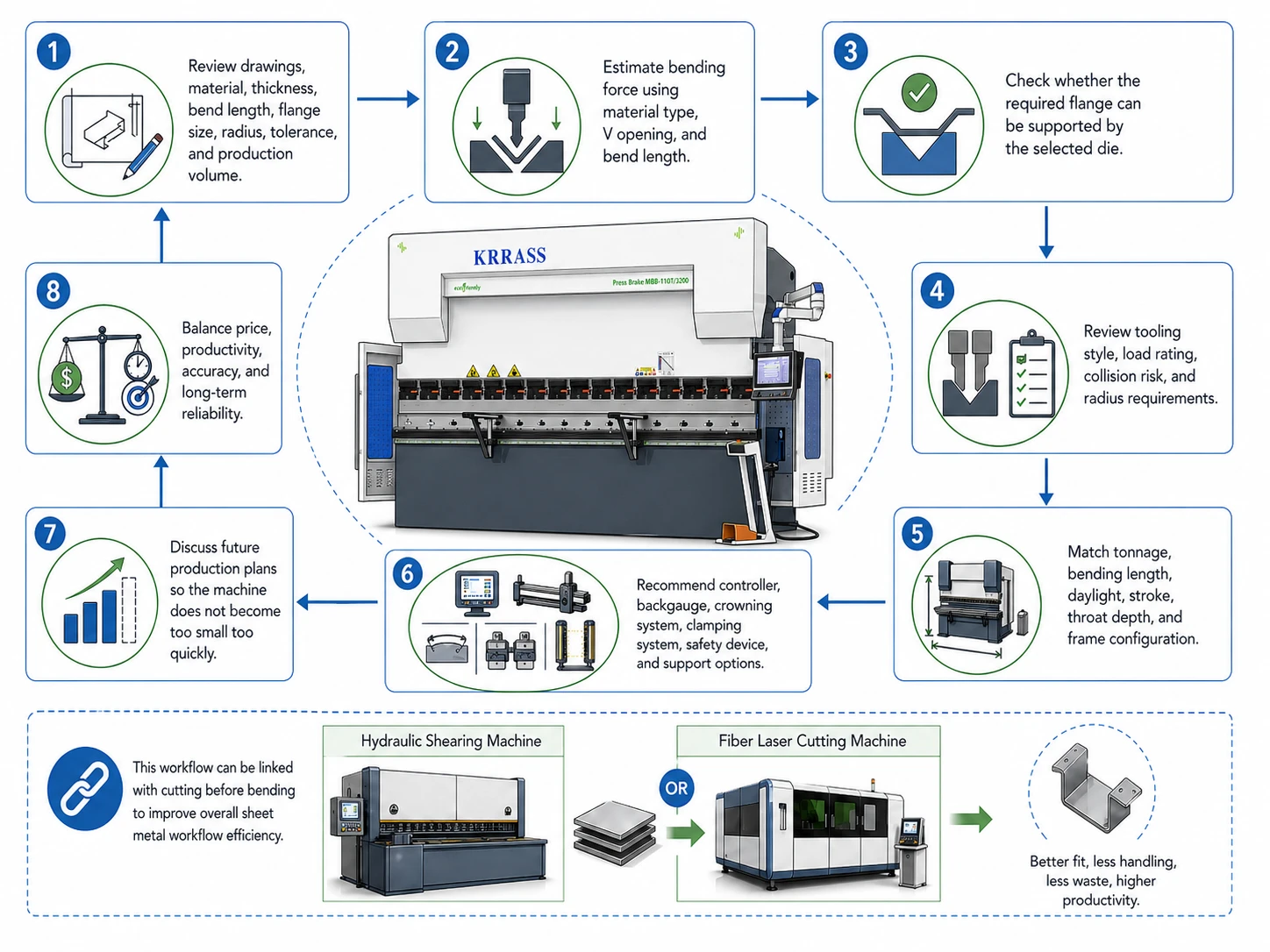
When we recommend a hydraulic press brake for heavy bending, we follow a practical engineering workflow:
- We review the buyer's drawings, material, thickness, bending length, flange size, radius, tolerance, and production volume.
- We estimate bending force using material type, V opening, and bend length.
- We check whether the required flange can be supported by the selected die.
- We review tooling style, load rating, collision risk, and radius requirements.
- We match machine tonnage, bending length, daylight, stroke, throat depth, and frame configuration.
- We recommend a controller, backgauge, crowning system, clamping system, safety device, and support options.
- We discuss future production plans so the machine does not become too small too quickly.
- We prepare a configuration that balances price, productivity, accuracy, and long-term reliability.
Buyers can begin by reviewing our Листогибочный пресс product page or using the Конфигуратор листогибочных прессов to think through the major configuration choices. If the project also includes cutting before bending, KRRASS can also support matching equipment such as Гидравлические ножницы and fiber laser cutting solutions, so the entire sheet metal workflow becomes more efficient.
Practical specification checklist
Before finalizing your purchase, complete this checklist:
| Specification item | Buyer input |
|---|---|
| Main material | Mild steel / stainless steel / aluminum / high-strength steel |
| Диапазон толщины | Minimum, common, and maximum thickness |
| Maximum bending length | Longest part |
| Common bending length | Daily production range |
| Требуемый внутренний радиус | Drawing requirement or flexible |
| Minimum flange | Shortest flange on real parts |
| Part geometry | Flat bends, U channels, boxes, return flanges, deep profiles |
| Surface requirement | Normal, cosmetic, brushed, painted, coated |
| Объём производства | One-off, batch, daily, high-volume |
| Tolerance requirement | General fabrication or precision assembly |
| Preferred controller | NC, CNC, graphical CNC |
| Backgauge requirement | X, R, Z, multi-axis |
| Crowning requirement | Manual, CNC mechanical, hydraulic |
| Safety requirement | Local standard and factory policy |
| Tooling requirement | Standard, segmented, gooseneck, radius, special tools |
| Installation condition | Floor, power, space, unloading, lifting |
| Future expansion | Thicker, longer, stainless, high-strength, automation |
This checklist makes the purchasing conversation more efficient. It also helps suppliers give a realistic quotation instead of a generic offer.
Common mistakes to avoid
Many hydraulic press brake purchasing problems repeat across factories. Avoid these mistakes:
Choosing tonnage without checking V opening
A buyer may say, “I need to bend 10 mm steel,” but not mention the V opening. If the supplier assumes an 80 mm V die and the factory later uses a 50 mm V die, the real tonnage requirement rises sharply. Always connect thickness, V opening, and bend length.
Ignoring minimum flange length
A wide V opening reduces tonnage, but it also needs a longer flange. If the part has a short flange, the material may not sit safely on the die shoulders. This can cause unstable bending, poor angle, or safety risk.
Treating stainless steel like mild steel
Stainless steel usually needs more force and has more springback. A machine selected only from mild steel charts may be underpowered for stainless parts.
Buying the machine body without a tooling plan
Heavy bending depends on tooling. The punch, die, radius, clamping, and tool load rating must match the application.
Underestimating crowning
Long heavy bends need deflection compensation. Without crowning, the center and ends of the part may not match.
Forgetting handling and safety
Heavy sheets move during bending. Front supports, sheet followers, guarding, foot pedal protection, and operator training matter.
Buying only for the current order
A press brake is a long-term asset. If your business is moving toward thicker materials or longer parts, include reasonable future capacity.
Окончательная рекомендация
Choosing the right hydraulic press brake for sale for heavy bending requires more than comparing tonnage and price. The correct machine must match the material, thickness, bending length, V-die opening, flange length, tooling load, part shape, tolerance, production volume, safety requirement, and future business plan.
For heavy bending, start with your real parts. Calculate approximate tonnage, apply material correction factors, verify tooling, check flange support, review crowning, confirm machine structure, and evaluate the controller and backgauge from the operator's point of view. A well-selected hydraulic press brake will reduce trial bending, protect tooling, improve part consistency, and support stable production for many years.
If you are comparing a hydraulic press brake for sale and need help with heavy bending, send KRRASS your drawings, material list, thickness range, bending length, and production goals. We can help review the bending process, recommend a suitable hydraulic press brake configuration, and match the tooling and options needed for your factory.