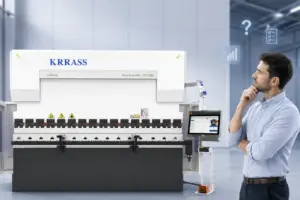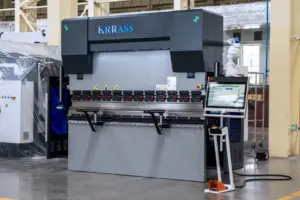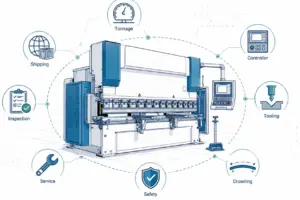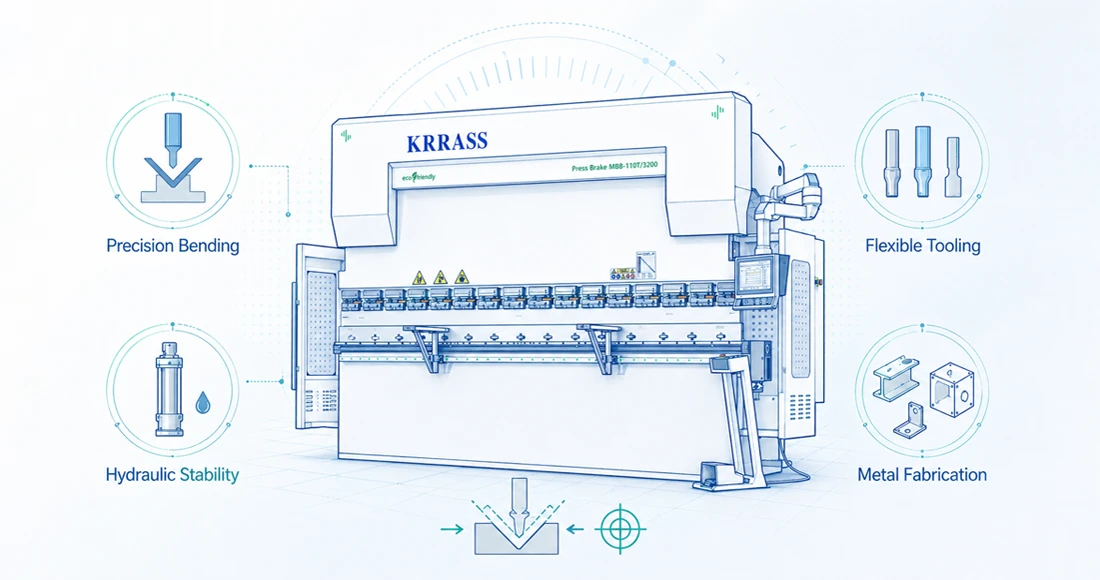
A Гидравлический листогибочный пресс с ЧПУ is one of the most important machines in modern sheet metal fabrication. It bends metal sheets and plates into accurate angles, channels, boxes, frames, brackets, panels, enclosures, cabinet parts, construction components, vehicle parts, electrical housings, HVAC parts, and many other formed products. For a buyer, however, the machine is not only a bending tool. It is a production asset that affects delivery speed, operator workload, part consistency, rework cost, tooling investment, and long-term factory flexibility.
At KRRASS, we look at a CNC hydraulic press brake from the perspective of real production. A customer may ask for a 100-ton, 160-ton, 220-ton, or 320-ton machine, but the correct recommendation depends on much more than nominal tonnage. We need to understand material type, material thickness, bending length, flange length, inside radius, part geometry, quantity, surface requirement, available operators, future product plans, and the tooling package. A press brake that looks powerful on a quotation can still be unsuitable if the backgauge travel is too limited, the crowning system cannot support long accurate bends, the selected V die creates excessive tonnage, or the controller does not match the factory's production style.
This guide explains the features, benefits, and best applications of a CNC hydraulic press brake in a practical, business-oriented way. It is written for purchasing managers, factory owners, production engineers, sheet metal contractors, and technical buyers who want to compare equipment with a clear decision framework. It also connects the machine to tooling, material behavior, safety, maintenance, and return on investment, because a press brake only creates value when the full bending system is selected correctly.
KRRASS manufactures and supplies multiple press brake solutions, including NC press brakes, CNC hydraulic press brakes, hybrid servo press brakes, tandem press brakes, and electric servo press brakes. Buyers who are comparing models can start from the KRRASS Листогибочный пресс category page, review available CNC configurations on the листогибочный пресс с ЧПУ page, and study process details in our Press Brake Tooling Guide. This article focuses specifically on the CNC hydraulic press brake because it remains one of the most balanced choices for many fabrication factories.
Оглавление
What a CNC hydraulic press brake is
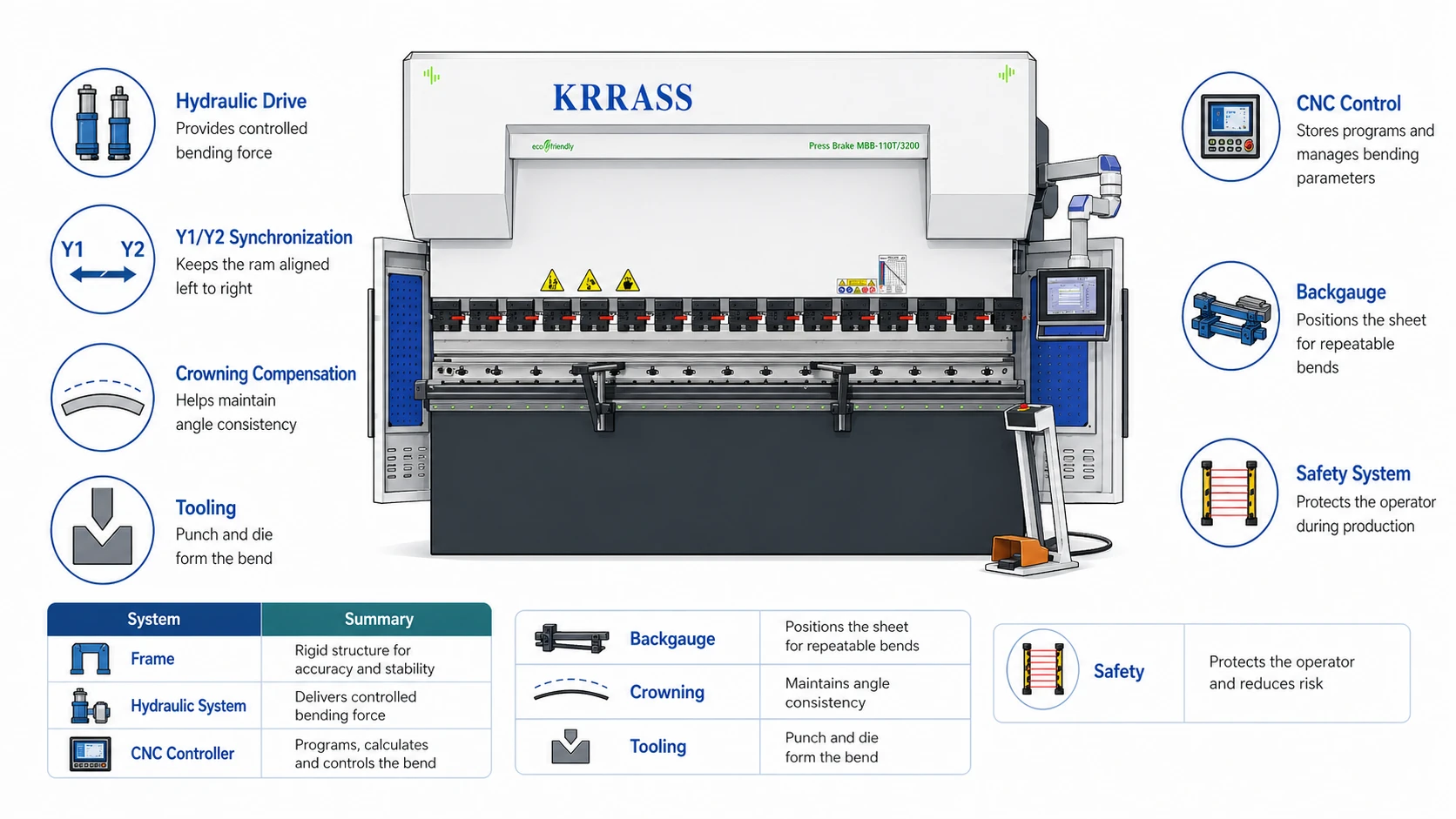
A CNC hydraulic press brake is a sheet metal bending machine that uses a hydraulic drive system to move the ram and a CNC control system to manage bending depth, ram synchronization, backgauge positioning, crowning compensation, stored programs, and production parameters. In simple terms, the hydraulic system supplies the bending force, while the CNC system controls how that force is applied and how the part is positioned.
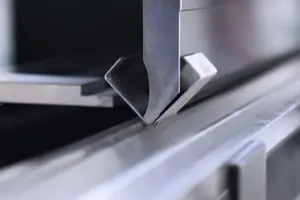
The basic bending action is easy to understand. The sheet is placed on the lower die. The backgauge positions the sheet to the correct bend line. The upper punch descends and pushes the material into the lower die opening. The material plastically deforms and forms a bend. The angle depends on the punch position, die opening, material properties, tooling geometry, and springback. With CNC control, the machine can repeat this process according to stored programs instead of relying only on manual adjustment.
A hydraulic press brake differs from a manual folding tool or simple mechanical forming device because it can deliver high controlled force over a wide bending length. A CNC hydraulic press brake differs from an NC press brake because it normally provides more advanced axis control, better synchronization, easier program management, improved repeatability, and stronger support for multi-step bending. KRRASS discusses this difference in more detail in our article CNC Press Brake VS NC Press Brake: What's the Difference.
A modern CNC hydraulic press brake usually includes the following system areas:
| System area | Typical function | Why it matters to buyers |
|---|---|---|
| Machine frame | Supports the ram, bed, side frames, tooling, and hydraulic force | A rigid frame improves bending stability and long-term accuracy |
| Hydraulic system | Generates and controls bending force | Determines power, movement stability, pressure response, and service requirements |
| CNC controller | Manages programs, axes, tooling data, materials, and production workflow | Reduces setup time and supports repeatable production |
| Y1/Y2 ram axes | Synchronize the left and right ram cylinders | Helps maintain parallelism and angle consistency |
| Задний упор | Positions the sheet before each bend | Influences flange accuracy, repeatability, and multi-bend speed |
| Crowning system | Compensates for deflection across the bending length | Helps keep angles consistent from left to right on longer bends |
| Tooling and clamping | Holds punches and dies securely | Affects setup time, radius, flange length, surface marking, and safety |
| Безопасная система | Protects the operator at the point of operation and around the machine | Essential for compliant, responsible production |
This system view is important because buyers sometimes compare machines only by tonnage and bending length. Those two numbers are necessary, but they are not sufficient. A CNC hydraulic press brake should be evaluated as a complete bending platform.
Why hydraulic technology remains commercially important
Hydraulic press brakes remain popular because they offer a strong balance of forming force, machine size flexibility, purchase cost, tooling compatibility, and application range. Servo-electric and hybrid systems are excellent choices for certain factories, especially where energy saving, speed, and precision are the top priorities. However, hydraulic machines continue to serve a broad range of general fabrication, medium-to-heavy bending, custom manufacturing, steel structure, cabinet, enclosure, construction, agricultural equipment, and repair production.
The first commercial advantage is force capability. Hydraulic systems are well suited to high-tonnage bending. When a factory needs to bend thicker plate, longer parts, or high-strength material, hydraulic technology remains a practical and familiar solution. Many buyers choose a CNC hydraulic press brake because it can handle both everyday sheet metal work and heavier occasional jobs without forcing the factory into an overly narrow production envelope.
The second advantage is mature service knowledge. Hydraulic press brakes are widely used around the world. Operators, maintenance teams, tooling suppliers, and service technicians are usually familiar with hydraulic systems, seals, oil, valves, cylinders, proportional control, ram adjustment, and common troubleshooting. For factories in developing industrial markets, this familiarity can reduce operational risk.
The third advantage is configuration flexibility. A hydraulic CNC press brake can be equipped with different controllers, backgauge axes, crowning systems, quick clamping systems, tooling packages, front supports, bending followers, safety devices, and automation options. On KRRASS product pages, buyers can find models such as the MB8-80T2500 with DELEM DA-53T controller, which lists practical machine details including 800 kN bending pressure, 2500 mm bending length, Y1/Y2/X/R/W axis configuration, CNC crowning, and a 7.5 kW main motor.
The fourth advantage is purchasing balance. A CNC hydraulic press brake can provide a strong step up from a simple NC press brake without requiring the higher investment of a fully servo-electric or advanced hybrid system. For many factories, the question is not simply which technology is most advanced. The better question is which technology delivers the best combination of accuracy, capacity, training effort, maintenance comfort, and payback for the parts they actually produce.
Core features that matter most
A CNC hydraulic press brake includes many components, but not all features carry the same commercial weight. A buyer should focus on the features that directly influence output, accuracy, uptime, flexibility, and operator efficiency.
CNC controller and programming workflow
The controller is the interface between the machine and the operator. It determines how easily the operator can create a bend program, store tooling data, call repeat jobs, adjust angles, set backgauge positions, control crowning, and move from trial bending to stable production. A strong CNC controller reduces dependency on manual memory and makes the bending process easier to standardize.
For example, Delem describes the DA-53T press brake control as a compact touch control solution for synchronized press brakes, with graphical touch programming and standard capability of controlling up to four axes. On KRRASS MB8 product configurations, DA-53T-based machines can include tool and material libraries, CNC crowning control, USB interfacing, and Y-axis control functions. Higher-level controllers can add more advanced graphics, additional axis support, 2D or 3D programming, and more sophisticated bending sequence assistance.
For a factory, the controller affects more than convenience. It affects how quickly new operators can learn, how consistently repeat jobs can be produced, and how much trial bending is needed when material or tools change. In short-batch manufacturing, the controller can be one of the biggest productivity drivers.
Y1/Y2 synchronization
A CNC hydraulic press brake commonly uses two hydraulic cylinders controlled as Y1 and Y2 axes. The controller monitors and adjusts the left and right sides of the ram so the ram remains synchronized during bending. This is important because even a small difference between the two sides can change the angle across the part.
Y1/Y2 synchronization is especially valuable when bending long parts, working with uneven loads, using segmented tooling, or producing parts with strict angle tolerance. It also supports more stable operation compared with simple torsion-bar synchronization used in many entry-level NC machines.
Backgauge axes
The backgauge positions the sheet before each bend. Its accuracy and flexibility directly affect flange size and repeatability. A basic CNC hydraulic press brake may use X-axis backgauge positioning. A more capable configuration may add R-axis height adjustment, Z-axis finger positioning, and multi-axis movement for complex parts. KRRASS CNC press brake offerings include 2-axis, 3-axis, 4-axis, and higher-axis backgauge options depending on machine class and customer requirements.
A simple part may only require accurate X-axis depth positioning. A box, enclosure, cabinet panel, or multi-flange part may benefit from R-axis and Z-axis adjustment because the backgauge fingers must support different bend sequences and flange heights. If a factory handles many different parts per shift, faster and more flexible backgauge adjustment can reduce non-cutting time.
Crowning compensation
When a press brake bends a long part, the ram and bed can deflect slightly under load. This can cause the bend angle to vary across the length of the part, often with the center angle differing from the ends. Crowning compensates for this deflection by adjusting the bed or crowning table so the tooling line produces more consistent angles.
A CNC hydraulic press brake may use manual crowning, mechanical crowning, hydraulic crowning, or electric CNC crowning. For medium and long bending lengths, crowning is not a luxury feature. It is a key accuracy feature. KRRASS product configurations show electric crowning with controller adjustment and precise positioning of the crowning table on selected MB8 models. For buyers producing long panels, doors, enclosures, cabinet sides, elevator parts, or stainless steel covers, crowning should be discussed from the beginning.
Rigid frame and machine structure
The frame is the foundation of bending accuracy. A press brake frame must resist the stress of repeated loading and unloading. Side frames, ram, bed, welding quality, heat treatment, machining accuracy, and assembly precision all influence long-term performance. A visually attractive machine can still perform poorly if the frame lacks rigidity or if the bed and ram are not accurately machined.
For buyers, the structural question should be practical: will the machine remain stable under the intended workload? A light-duty machine may be acceptable for thin sheet and occasional use, but a factory producing thicker plate or long high-volume parts needs a heavier, more stable structure. KRRASS press brake lines are positioned around stable body structure, efficient control units, multiple tooling options, and cost-effective operation for different production needs.
Tooling, clamping, and tool libraries
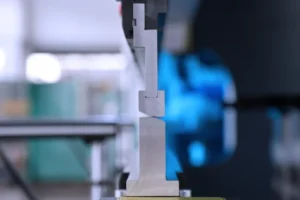
The machine cannot bend correctly without suitable tooling. Punches, dies, adapters, clamps, segmented tools, gooseneck punches, hemming tools, radius tools, and anti-marking solutions all influence the final result. Tooling affects inside radius, minimum flange length, required tonnage, collision clearance, setup time, and surface quality.
The KRRASS Press Brake Tooling Guide explains that the V-die opening is one of the most important die selection decisions because it affects inside radius, required tonnage, minimum flange length, angle stability, and marking level. A CNC controller with tool libraries helps operators store tooling information and use it consistently in production. Fast clamping systems also reduce setup time, especially for factories that run many small batches.
Safety arrangement
Press brake safety must be treated as part of the machine selection process, not an afterthought. The point of operation contains a serious pinch hazard. OSHA states that power press brakes are required to be guarded under 29 CFR 1910.212, and OSHA's guidance recognizes ANSI B11.3 as a relevant consensus standard for press brake safeguarding. ANSI also describes ANSI B11.3-2022 as a machine-specific standard for power press brakes.
Common safety arrangements may include light curtains, laser guarding, emergency stop devices, safety-rated controls, two-hand controls in certain modes, side and rear guarding, safe operating procedures, operator training, and documented maintenance checks. Safety choices depend on machine configuration, bending process, part size, local regulations, and factory policy. Buyers should always confirm the applicable requirements in their own market.
Benefits for factories and buyers
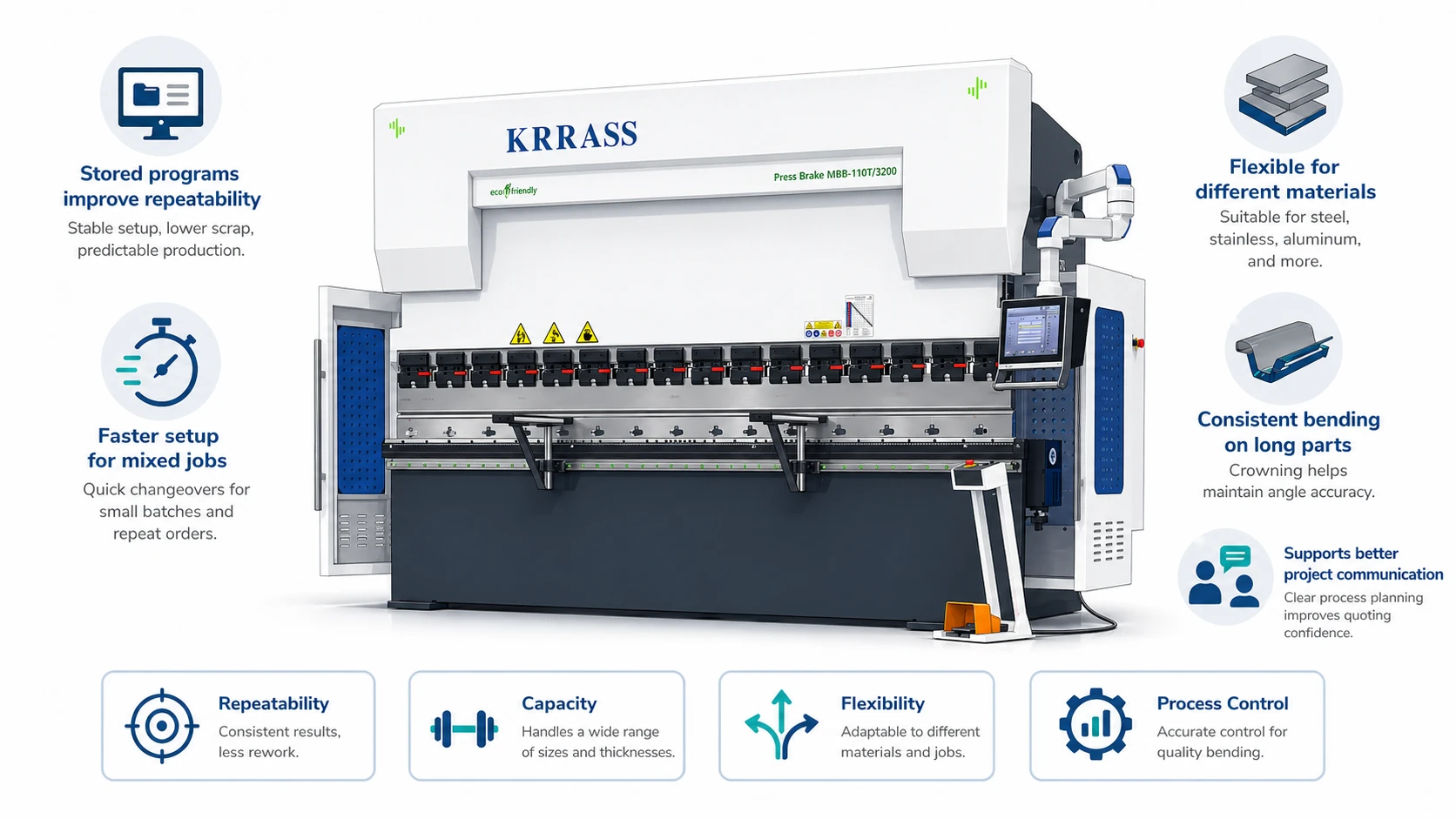
A CNC hydraulic press brake creates value through repeatability, capacity, flexibility, and better control of the bending process. The benefits below are the main reasons many factories upgrade from manual equipment or basic NC press brakes.
Better repeatability in daily production
Repeatability is often more important than theoretical maximum accuracy. A factory does not make money from producing one good part after several test bends. It makes money from producing acceptable parts repeatedly with predictable setup time and low scrap. CNC control helps store programs, material data, axis positions, and crowning settings. This gives operators a more stable starting point when the same job returns.
Repeatability also supports quoting. When the production team understands how long a setup takes, how many test bends are needed, and how stable the final angle is, the sales team can quote more confidently. Better repeatability reduces hidden costs such as rework, delayed delivery, and quality disputes.
Faster setup for mixed production
Many sheet metal factories do not produce one part all day. They produce small batches, urgent orders, modified drawings, replacement parts, prototype parts, and repeat jobs. In this environment, setup time can become a bigger cost than bending time. A CNC hydraulic press brake with stored programs, faster backgauge movement, quick clamping, and organized tooling can reduce the time between jobs.
For example, if a factory produces electrical enclosures in the morning, stainless steel covers in the afternoon, and bracket parts the next day, the ability to retrieve programs and tooling data can reduce operator guesswork. When this benefit is multiplied across many shifts, the payback can be significant.
Wider material and thickness capability
A hydraulic press brake can cover a broad range of material thicknesses and lengths when properly sized. It can handle mild steel, stainless steel, aluminum, galvanized sheet, coated sheet, and certain high-strength materials. The key is not only machine tonnage but also die opening, tooling capacity, material strength, bend length, and radius requirement.
The material basis is important. ISO 7438:2020 specifies a method for determining the ability of metallic materials to undergo plastic deformation in bending. Although this standard is not a press brake buying manual, it reminds us that bending is fundamentally related to material ductility and deformation behavior. Two sheets with the same thickness can bend very differently if their grades, strength, temper, or rolling direction are different.
Better angle consistency on long parts
Long parts are more difficult than short parts because deflection becomes more visible. Without proper crowning, a long panel can show angle differences across its length. A CNC hydraulic press brake with suitable crowning compensation helps reduce this problem. This matters for doors, panels, cabinet sides, elevator parts, structural covers, and decorative stainless steel components.
The commercial impact is direct. If long panels do not match during assembly, downstream workers may need to force parts into position, rework holes, adjust weld gaps, or reject finished parts. Better bending consistency reduces these downstream costs.
More professional quoting and project communication
A CNC hydraulic press brake also improves the way a factory communicates with customers. When the equipment is matched with a clear process plan, the factory can explain why a certain bend radius, minimum flange, material grade, or tooling method is recommended. This supports a more professional sales process.
For KRRASS, this is an important part of machine recommendation. We do not only ask, “What tonnage do you want?” We ask about the parts. The drawing, material, bend sequence, surface requirement, and production volume tell us which configuration makes sense. That approach helps reduce the risk of buying a machine that looks correct by specification but creates limitations in real production.
Practical data for bending decisions
Technical data should be used carefully. Press brake calculations are not a substitute for final engineering confirmation, but they help buyers understand why configuration choices matter. The tables below provide practical planning data for early discussion.
Typical V-opening starting points
In air bending, V-die opening strongly influences inside radius, required tonnage, minimum flange length, and marking. WILA explains that for air bending steel with sheet thickness up to about 3 mm, a common rule of thumb is a V opening around 6 to 8 times material thickness, while larger V openings reduce force and marking but increase radius and minimum leg length. The following table gives practical starting points.
| Толщина материала | V opening at 6 × thickness | V opening at 8 × thickness | Practical note |
|---|---|---|---|
| 1.0 mm | 6 мм | 8 мм | Thin covers, light panels, and small brackets need clean support and accurate tool alignment |
| 1,5 мм | 9 mm | 12 мм | Common for cabinets, enclosures, appliance covers, and light frames |
| 2,0 мм | 12 мм | 16 мм | A frequent general-fabrication range for mild steel sheet |
| 3,0 мм | 18 mm | 24 мм | Check flange length, angle tolerance, and material springback |
| 4,0 мм | 24 мм | 32 мм | Tonnage and surface marking become more important |
| 6,0 мм | 36 mm | 48 мм | Machine capacity and tool load rating must be confirmed |
| 8,0 мм | 48 мм | 64 мм | Heavy bending requires careful deflection and handling planning |
| 10.0 mm | 60 mm | 80 мм | Confirm material grade, bend length, punch radius, and tooling rating before quoting |
This table is a starting point only. Stainless steel, aluminum, high-strength steel, cosmetic parts, very short flanges, or tight inside-radius requirements may need a different die opening. A narrower V opening can help create a smaller radius or shorter flange, but it increases required force and marking risk. A wider V opening reduces force but increases radius and minimum flange length.
Planning force comparison for 1-meter mild steel bends
The common air-bending force relationship can be simplified as follows: bending force increases with bend length, increases with material strength, increases with the square of thickness, and decreases as V opening becomes wider. Many press brake tonnage references express the air-bending formula as force being proportional to bend length × material thickness² × tensile strength / die opening. One public calculator explains this relationship and notes that stainless steel should be adjusted according to its higher ultimate tensile strength compared with mild steel.
The values below use a simplified planning calculation for mild steel at approximately 60,000 psi tensile strength, 1,000 mm bend length, and V opening equal to 8 × material thickness. They are approximate values for early sizing discussion, not final production certification.
| Толщина | V opening used | Approx. US tons for 1 m bend | Approx. metric tonnes for 1 m bend | Planning meaning |
|---|---|---|---|---|
| 1.0 mm | 8 мм | 5.8 | 5.3 | Light sheet bending; accuracy and handling may matter more than force |
| 1,5 мм | 12 мм | 8.7 | 7.9 | Common enclosure and cabinet range |
| 2,0 мм | 16 мм | 11.6 | 10.5 | General fabrication range |
| 3,0 мм | 24 мм | 17.4 | 15.8 | Tonnage and tooling selection become more visible |
| 4,0 мм | 32 мм | 23.3 | 21.1 | Confirm capacity for longer bends |
| 6,0 мм | 48 мм | 34.9 | 31.6 | Medium-heavy bending; check tool load ratings |
| 8,0 мм | 64 мм | 46.5 | 42.2 | Heavy plate bending for many factories |
| 10.0 mm | 80 мм | 58.1 | 52.7 | Requires a serious capacity review, especially for long parts |
The table shows why “thickness” alone is not enough. If bend length doubles, total tonnage roughly doubles. If the material changes from mild steel to stainless steel with higher tensile strength, required force can rise substantially. If the V opening is narrowed to solve a flange problem, tonnage rises again. This is why KRRASS asks for drawings or sample part details when recommending a machine.
Configuration comparison
Different CNC hydraulic press brake configurations serve different production levels. The table below is a practical comparison for buyers.
| Configuration level | Typical axis logic | Best for | Buyer advantage | Limitation to check |
|---|---|---|---|---|
| Entry CNC hydraulic | Y1/Y2 + X, often with manual or simpler adjustment | Factories upgrading from NC machines, simple flanges, general sheet metal | Better repeatability and easier programming than basic NC | May be limited for complex backgauge positioning |
| Standard production CNC | Y1/Y2 + X + R + crowning | Cabinets, enclosures, panels, brackets, mixed-batch production | Strong balance of accuracy, flexibility, and cost | Z-axis automation may still be manual or optional |
| Advanced multi-axis CNC | Y1/Y2 + X/R/Z axes + CNC crowning + advanced controller | Complex parts, frequent job changes, higher accuracy needs | Faster setup and stronger process control | Higher purchase cost; requires better operator training |
| Long bending / tandem | Two machines working independently or together | Long poles, doors, structural panels, large covers | Allows long parts without losing independent machine use | Requires careful synchronization, layout planning, and handling support |
| Hybrid or servo-enhanced | Hydraulic force with servo or inverter efficiency features | Factories prioritizing energy saving and speed | Lower consumption, reduced oil stress, improved efficiency | Higher initial investment than conventional hydraulic models |
Best applications for CNC hydraulic press brakes
A CNC hydraulic press brake is highly versatile, but it is not automatically the best solution for every bending job. It performs best where force, flexibility, and repeatability are all important.
General sheet metal fabrication
This is the most common application. A fabrication factory may produce brackets, covers, frames, channels, mounting plates, guards, support parts, and custom components. Job variety is high, batch size may change daily, and drawings may come from different customers. A CNC hydraulic press brake fits this environment because it can handle many material types and bend sequences with stored programs and configurable tooling.
The key selection points are bending length, tonnage, backgauge flexibility, tool inventory, and controller usability. A factory that bends mostly 1.5 mm to 4 mm mild steel may not need the same machine as a factory that often bends 6 mm to 10 mm plate. KRRASS can help buyers match the model to actual part families instead of choosing only by maximum thickness claims.
Electrical cabinets and control enclosures
Electrical cabinets, switchgear panels, control boxes, distribution boxes, and enclosure covers often require accurate flanges, clean surfaces, multiple bends, and repeatable dimensions. These products may include return flanges, box shapes, door panels, inner supports, and mounting rails. Tooling selection is critical because gooseneck punches, segmented tools, and suitable V dies may be required to avoid collision.
For this application, the buyer should focus on CNC program storage, backgauge repeatability, R-axis usefulness, segmented tooling, quick clamping, and surface protection. CNC crowning may be important for long cabinet sides and door panels.
Stainless steel panels and decorative metal products
Stainless steel panels, kitchen equipment covers, elevator panels, architectural trims, medical equipment housings, and decorative products require more attention to surface marking and springback. Stainless steel generally needs higher bending force than mild steel of the same thickness and may spring back more noticeably.
A CNC hydraulic press brake can be a strong solution if the tooling plan includes clean dies, suitable V openings, correct punch radius, protective film or anti-marking tools where needed, and adequate tonnage margin. For cosmetic parts, buyers should not focus only on speed. Surface quality, repeatability, and operator handling are equally important.
HVAC ducting and ventilation parts
HVAC fabrication can involve thin galvanized sheet, long bends, light-gauge channels, duct parts, frames, and covers. Many parts are not extremely thick, but they may require efficient setup and careful handling of large sheets. A CNC hydraulic press brake is useful for factories that need more flexibility than a dedicated forming line.
For this application, buyers should consider front supports, backgauge travel, sheet support methods, and fast setup tooling. If most work is very thin sheet with high-volume repetitive bends, alternative machines may also be considered, but a CNC hydraulic press brake remains valuable for flexible job-shop production.
Construction and steel structure components
Construction-related bending can involve brackets, base plates, channels, frames, stairs, guard components, structural covers, roofing parts, and heavy-duty formed sections. These jobs may require higher tonnage and longer bending length. A hydraulic CNC press brake is often suitable because it can provide robust force and stable bending over larger parts.
The main checks are tonnage, die opening, machine deflection, frame rigidity, tooling load rating, material grade, handling equipment, and safety. Buyers should avoid selecting a machine only from a maximum thickness advertisement. The real question is the maximum thickness at what bend length, with what material, using what V opening.
Agricultural, machinery, and vehicle parts
Agricultural equipment, machinery housings, vehicle brackets, trailer parts, machinery guards, and equipment frames often combine medium-thick materials with varied part sizes. These factories benefit from a flexible CNC hydraulic press brake because part families may change over time.
The machine should be selected with future products in mind. A buyer may currently bend mostly 3 mm sheet but plan to produce 6 mm brackets next year. A machine sized only for today's work may limit future growth. KRRASS normally recommends discussing future product plans before finalizing tonnage and bending length.
Prototype and short-batch manufacturing
Prototype and short-batch work rewards flexibility. The factory may produce only a few pieces of each design, but setup must be fast and accurate. CNC programming, tool libraries, and quick backgauge adjustment reduce wasted time. A CNC hydraulic press brake is especially useful when the same factory needs to produce both prototypes and normal production batches.
For prototype work, an advanced controller and organized tooling package may be more valuable than extra tonnage. The buyer should invest in tooling variety, accurate measurement, and operator training because process flexibility depends heavily on tooling availability.
Where a CNC hydraulic press brake may not be the best choice
A CNC hydraulic press brake is versatile, but good purchasing also requires knowing when another solution may be better. If a factory only bends very small, thin, high-speed parts in large quantities, a specialized forming line, panel bender, or automated solution may be more efficient. If a factory's main priority is ultra-low energy consumption and it bends mostly light-gauge precision parts, an electric servo press brake may be worth comparing. If the factory bends extremely long parts, a tandem solution may be better than a single oversized machine.
KRRASS offers multiple bending technologies, including hydraulic, hybrid, tandem, and electric servo options. On the KRRASS Листогибочный пресс page, buyers can compare MB8 CNC press brakes, PBS and PBE hybrid/servo-related options, tandem press brakes, and electric servo press brakes. The right choice depends on the part mix, budget, production speed, energy goals, and service environment.
A responsible recommendation should not force every buyer into the same product. If a standard CNC hydraulic press brake is the best balance, we explain why. If a hybrid or electric model can deliver a better payback, we discuss that option. If tooling is the real bottleneck, we start with the tooling plan.
How to choose the right CNC hydraulic press brake
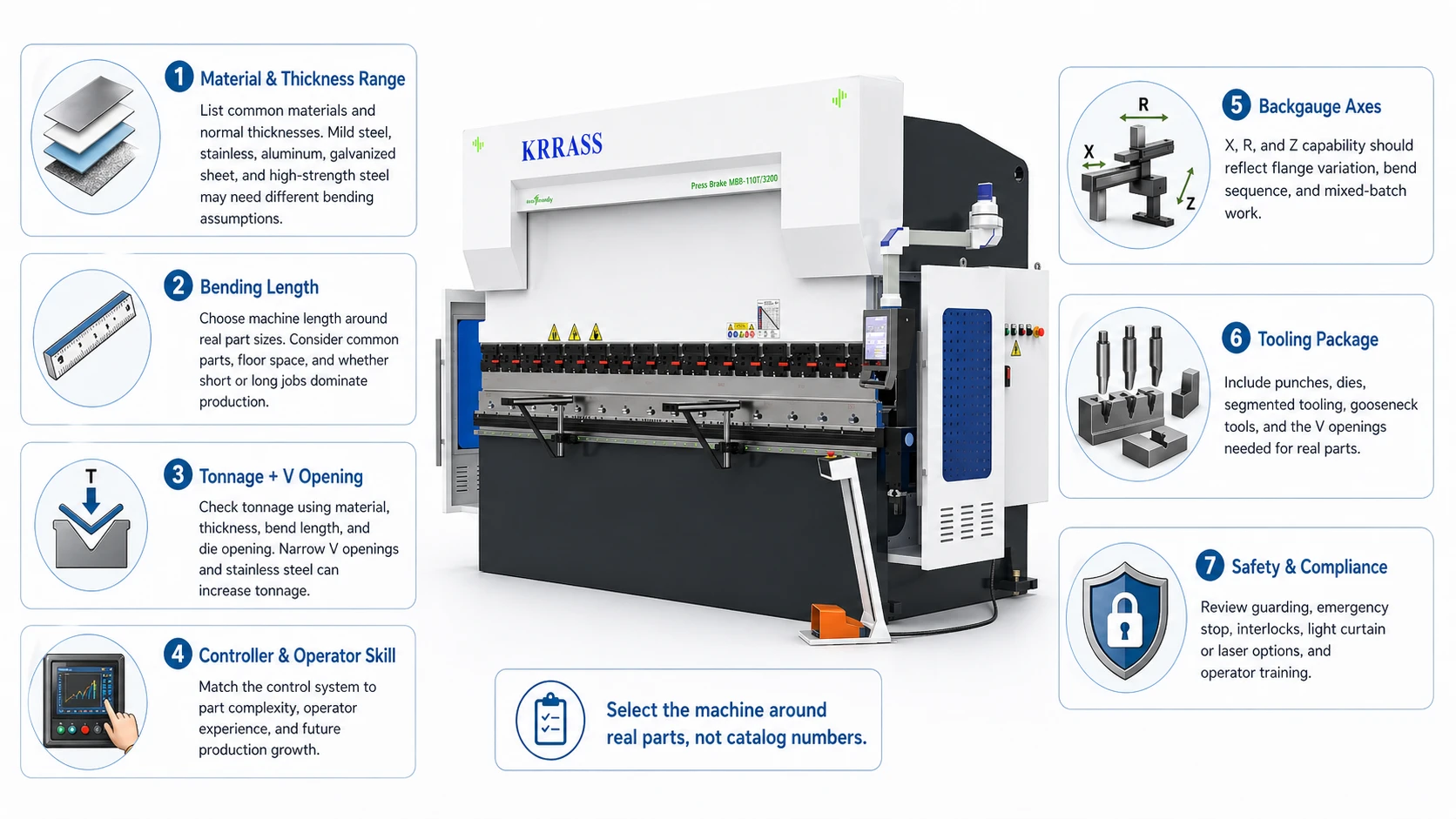
The best buying process starts with the parts, not the machine catalog. A CNC hydraulic press brake should be selected around real production requirements.
Define the material and thickness range
List the materials you bend most often, not only the maximum thickness you hope to bend once. Separate mild steel, stainless steel, aluminum, galvanized sheet, high-strength steel, and special materials. Then list normal thickness, maximum thickness, and expected future thickness.
This matters because the machine required for 3 mm mild steel is not the same as the machine required for 3 mm stainless steel over the same length. Material strength and springback change the process. If the material grade is uncertain, sample testing or conservative sizing may be necessary.
Define bending length and real part length
The advertised bending length should match the parts you actually produce. A 3200 mm press brake is common because it can handle many standard sheet sizes, but some factories need 2500 mm, 4000 mm, 6000 mm, or tandem configurations. Do not choose length only by maximum possible part. If 95 percent of your parts are short and one occasional part is long, there may be more than one reasonable solution.
Longer machines occupy more floor space and may cost more, but they provide flexibility. Shorter machines may be faster and easier for small work. KRRASS can help evaluate this balance based on part lists.
Check tonnage with die opening and bend length
Tonnage must be checked using the actual material, thickness, bend length, and V opening. A simple maximum-thickness claim can be misleading because it may assume a certain short length or wide die opening. If the part requires a narrow V opening for a short flange, tonnage may rise. If the part is stainless steel, tonnage may rise. If the bend is long, tonnage rises again.
A good quotation should make the bending assumption clear. When possible, provide drawings or at least the material, thickness, length, flange size, and bend angle. The more specific the input, the more accurate the recommendation.
Match the controller to operator skill and production complexity
Some buyers want the most advanced controller available. Others need a controller that is simple for operators to learn. The best choice depends on production complexity and training capacity. A factory making simple repeated bends may not need the same controller as a factory making complex multi-bend parts with frequent job changes.
For many standard CNC hydraulic press brakes, a controller such as DA-53T provides a strong practical starting point. Higher controllers may support more advanced graphical programming, more axes, more simulation features, and more convenient production flow. The buyer should consider both current operators and future growth.
Choose backgauge axes carefully
Backgauge configuration should match part complexity. A simple X-axis backgauge may be enough for straightforward flanges. X + R is useful when flange heights and bend sequences vary. Z-axis movement becomes valuable when different part widths, multiple stations, or complex bending sequences require more flexible finger positioning.
For factories that produce cabinets, boxes, enclosures, and mixed-batch work, backgauge capability often has a bigger impact on daily productivity than buyers expect. It is worth discussing real parts before choosing the axis package.
Include tooling in the machine decision
Tooling is part of the bending system. A factory buying a new CNC hydraulic press brake should not leave tooling as a last-minute accessory. The first tooling package should match the part mix. It may include standard punches and dies, segmented tooling, gooseneck punches, different V openings, radius tooling, hemming tools, and anti-marking solutions.
The tooling package affects what the machine can actually produce on day one. A machine with excellent tonnage and controller features can still fail to make the intended part if the punch collides with a return flange or if the V die cannot support the required minimum flange.
Review safety and compliance needs
Safety requirements vary by country and factory policy. Buyers should clarify required guarding, emergency stops, interlocks, laser or light curtain options, operating modes, and operator training. KRRASS can discuss safety arrangements as part of the machine configuration, but each factory should also confirm local compliance obligations.
The KRRASS Инструкция по эксплуатации гидравлического листогибочного пресса emphasizes basic safety precautions such as keeping hands away from the upper punch and lower dies, keeping the worktable clear, inspecting machine parts, and using emergency stop functions when necessary. These points are simple, but they are fundamental to responsible operation.
Common buying mistakes
Many press brake purchasing problems come from incomplete information rather than bad intention. The following mistakes are common in the market.
Choosing tonnage without checking tooling
A buyer may request a 160-ton machine because another factory uses one. But the real part may require a narrow V opening, high-strength material, or long bend length that changes tonnage requirements. The machine and tooling must be checked together.
Ignoring minimum flange length
A part may require a flange shorter than the selected V die can support. If the sheet cannot sit safely across the die shoulders, bending becomes unstable or impossible in one operation. This can force expensive redesign, extra operations, or special tooling.
Buying too little backgauge capability
A basic backgauge may work for simple parts, but complex boxes, enclosures, and short-batch production often need more flexibility. If the backgauge is too limited, operators spend more time adjusting manually, and repeatability suffers.
Treating crowning as optional for long parts
For long bends, crowning can determine whether the part is acceptable. Without proper compensation, the angle may vary across the length. A buyer producing long panels should treat crowning as a core feature.
Underestimating training
CNC control makes bending easier, but it does not remove the need for skilled operators. Operators still need to understand material behavior, tooling setup, safety, part handling, program selection, and quality inspection. A strong machine plus poor training does not create stable production.
Focusing only on the lowest purchase price
A lower purchase price can become expensive if the machine creates slow setup, poor repeatability, high scrap, limited tooling compatibility, weak service support, or frequent downtime. A CNC hydraulic press brake should be judged by total value, not only invoice price.
Maintenance and operating considerations
Hydraulic CNC press brakes require disciplined maintenance. The exact maintenance schedule depends on machine model, usage intensity, environment, and manual instructions, but several principles are universal.
Hydraulic oil condition matters. Contaminated oil can damage valves, seals, pumps, and cylinders. Oil level, oil temperature, filter condition, leakage, and pressure stability should be checked according to the machine manual. The hydraulic system should be kept clean because small contamination can create large control problems.
Mechanical alignment also matters. Tooling surfaces, clamps, backgauge fingers, guide rails, screws, crowning mechanisms, and ram movement should be inspected. A small mechanical problem can appear as an angle problem or dimension problem. Operators should keep the work area clean and prevent scale, chips, tools, or loose objects from entering the tooling area.
Electrical and control systems should be protected from dust, moisture, unstable power, and unauthorized modification. KRRASS product configurations often use globally known components such as Schneider electric parts, Siemens motors, Rexroth proportional valve systems, Hiwin ball screws and linear guides, and Delem controllers depending on model configuration. This kind of component selection helps buyers with service familiarity and replacement planning, but maintenance discipline remains essential.
Daily operation should include basic checks before production. Operators should confirm tool installation, clamp security, backgauge position, program selection, material thickness, safety function, emergency stop function, and test bend results. For new jobs, first-piece inspection is important. For repeated jobs, operators should still verify that material batch, thickness, tooling, and program match the previous setup.
KRRASS recommendation workflow
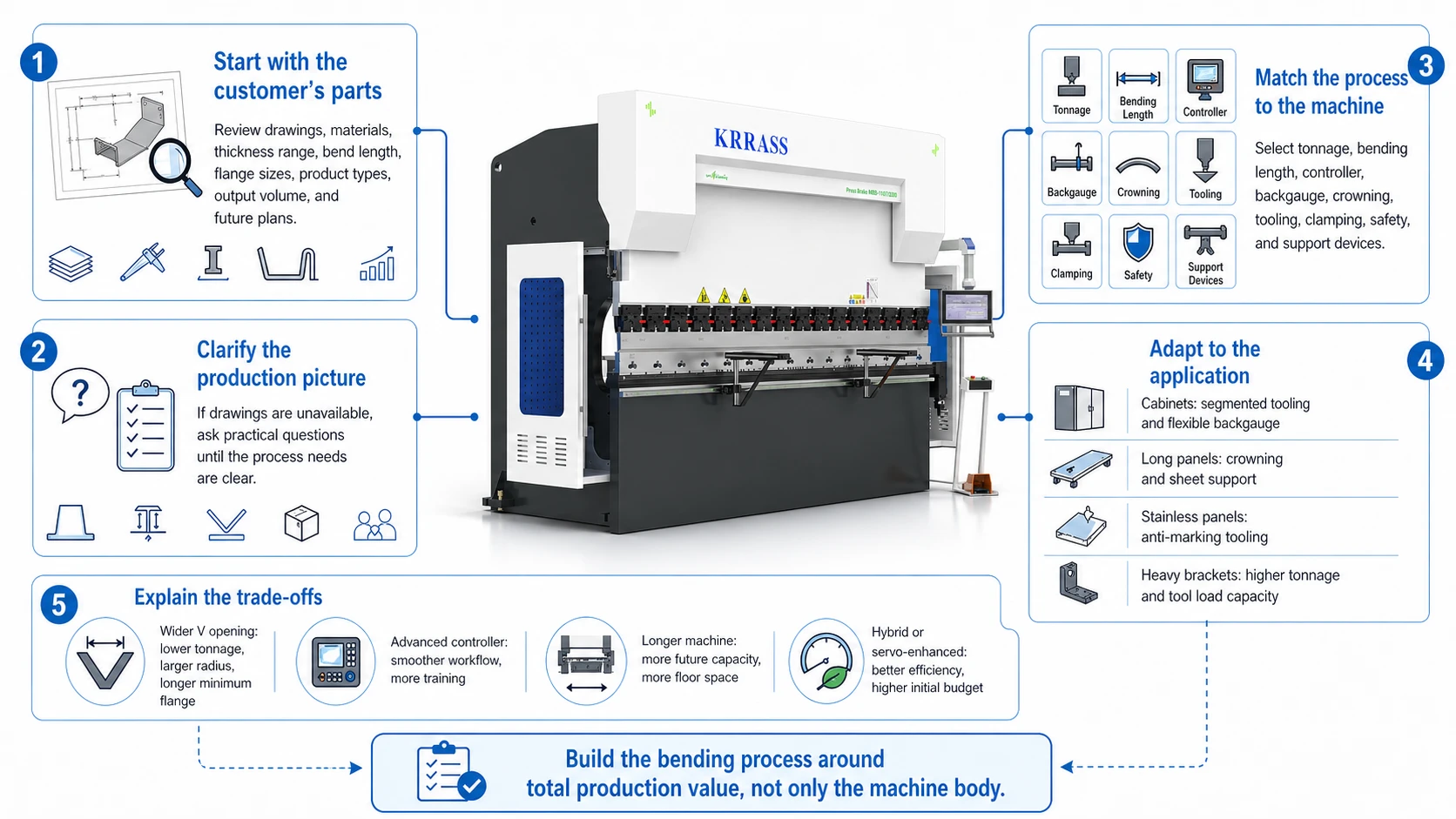
When KRRASS recommends a CNC hydraulic press brake, we start with the customer's parts. We prefer to review drawings, material types, thickness ranges, maximum bend length, common flange sizes, product categories, annual or monthly production volume, and future development plans. If the customer cannot provide drawings, we ask practical questions until the production picture becomes clear.
Then we match the bending requirement to machine tonnage, bending length, controller, backgauge, crowning, tooling, clamping, safety configuration, and optional support devices. For example, a customer making electrical cabinets may need segmented tooling and flexible backgauge movement more than extra tonnage. A customer making long construction panels may need stronger attention to crowning and sheet support. A customer bending stainless steel cosmetic panels may need a careful anti-marking tooling plan. A customer producing heavy brackets may need more tonnage and stronger tool load capacity.
We also explain trade-offs. A wider die opening may reduce tonnage and marking but increase inside radius and minimum flange length. A more advanced controller may improve workflow but require training. A longer machine may provide capacity for future parts but require more floor space and handling support. A hybrid or servo-enhanced machine may reduce energy consumption and improve efficiency, but the initial budget may be higher.
This approach helps buyers make a decision based on total production value. KRRASS is not only selling a machine body. We are helping the customer build a bending process that fits their factory.
CNC hydraulic press brake selection checklist
Before requesting a quotation, buyers can prepare the following information. This checklist makes the recommendation faster and more accurate.
| Information to prepare | Why it matters |
|---|---|
| Material type and grade | Controls tonnage, springback, cracking risk, and surface protection |
| Диапазон толщины | Determines tonnage, V opening, punch radius, and machine capacity |
| Maximum bending length | Determines machine length and deflection/crowning requirement |
| Typical flange length | Determines whether selected V openings can support the part |
| Inside radius requirement | Influences die opening, punch radius, and material suitability |
| Product drawings or photos | Reveals collision risk, bend sequence, and tooling needs |
| Monthly or daily production volume | Helps choose controller level, clamping system, and automation options |
| Surface requirement | Determines whether anti-marking tooling or protective methods are needed |
| Уровень квалификации оператора | Helps select controller complexity and training plan |
| Factory power supply and space | Confirms installation feasibility |
| Safety requirements | Determines guarding, operating modes, and compliance options |
| Future products | Prevents buying a machine that becomes too small too soon |
A complete inquiry does not need to be complicated. Even a few sample drawings and a thickness list can greatly improve recommendation accuracy.
Заключение
A CNC hydraulic press brake is a practical, powerful, and flexible bending solution for many sheet metal factories. Its value comes from the combination of hydraulic force, CNC control, repeatable backgauge positioning, Y1/Y2 synchronization, crowning compensation, suitable tooling, and safe operation. When selected correctly, it can improve part consistency, reduce setup time, support wider product variety, and help a factory build a more professional bending process.
The best machine is not always the largest machine or the cheapest machine. The best machine is the one that matches the parts, materials, tooling, operators, safety requirements, and business goals. A 80-ton machine may be the right choice for one factory, while another factory may need 160 tons, 320 tons, a longer bed, a multi-axis backgauge, advanced crowning, tandem configuration, or hybrid servo technology.
For buyers evaluating a CNC hydraulic press brake, the most important step is to share real production details. Material, thickness, bend length, flange size, inside radius, surface requirement, and drawings allow the manufacturer to make a responsible recommendation. KRRASS can support this process with machine selection, controller options, tooling discussion, and configuration planning.
If you are planning to upgrade your bending capacity or compare press brake models for a new project, visit the KRRASS Листогибочный пресс page, explore the листогибочный пресс с ЧПУ product range, or review our Press Brake Tooling Guide before sending your inquiry. A well-selected CNC hydraulic press brake is not only a machine purchase. It is a long-term production decision that can shape your factory's efficiency, quality, and competitiveness.