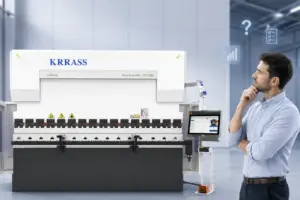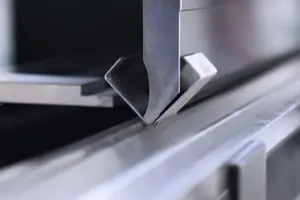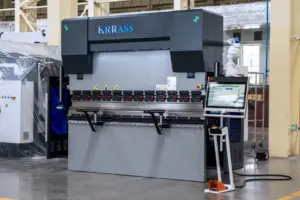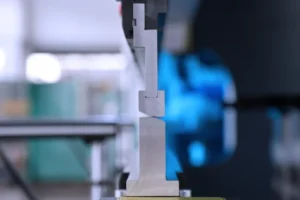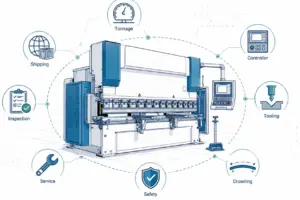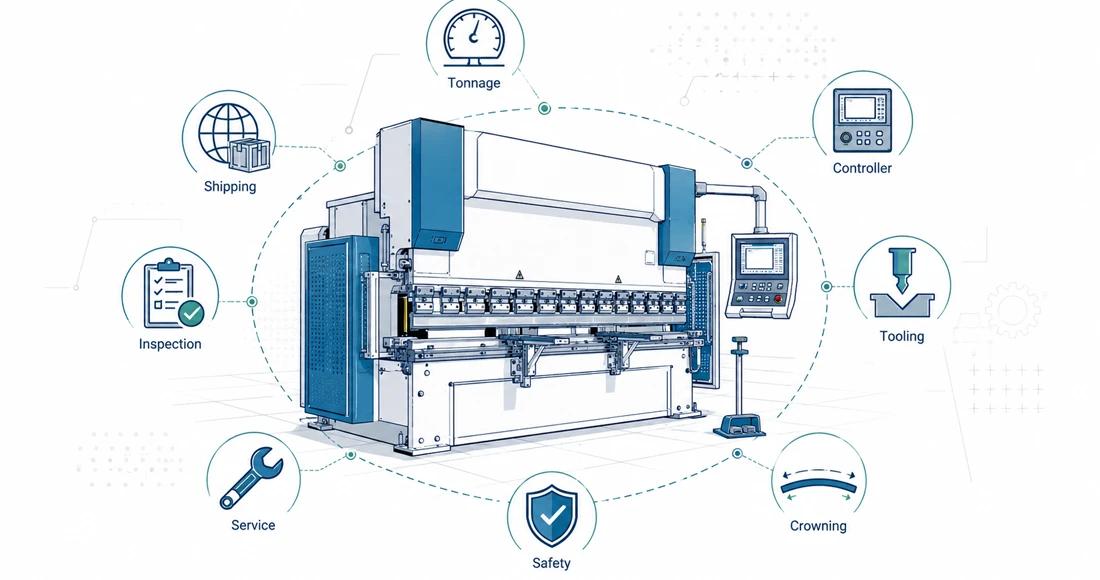
Quand une entreprise de fabrication recherche un(Note: I translated "When a fabrication business searches for a" to "Quand une entreprise de fabrication recherche un", preserving all HTML tags, shortcodes, URLs, and HTML entities exactly, and not translating brand names, product names, plugin names, theme names, version numbers, units, file sizes, or code identifiers.) CNC press brake pour vente, le acheteur ne compare pas simplement des photos de machines et des prix. La décision réelle est de savoir si la machine peut plier les parties appropriées, maintenir l'exactitude requise, réduire le temps d'installation, résister à la production quotidienne et arriver avec suffisamment de documentation et de soutien pour une installation sécurisée. C'est particulièrement important lorsqu'il s'agit d'un fournisseur étranger, car le processus d'achat inclut plus de variables que l'achat d'une machine domestique : configuration technique, emballage d'exportation, conditions de livraison, tension, documents de certification, pièces de rechange, guidance d'installation, service à distance et communication à long terme.
Au KRRASS, nous évaluons un CNC 折弯机 comme un système de flexion complet plutôt qu'une machine hydraulique unique. Un système de flexion stable dépend du châssis, des cylindres, du guidage du marteau, du contrôle hydraulique proportionnel, du contrôleur CNC, des échelles linéaires, du système de rétro-gauchage, du système de courbure, de l'outillage, de la mise en place, des dispositifs de sécurité, du flux de travail de l'opérateur et du soutien au service. Un châssis solide sans le bon contrôleur peut perdre du temps en mise en place. Une machine à haute tonnager sans outillage approprié peut endommager l'outil ou produire des courbes irrégulières. Un prix bas sans responsabilité claire pour l'expédition et le service peut devenir coûteux après l'arrivée du matériel.
Ce guide est destiné aux acheteurs d'entreprise, aux propriétaires d'usine, aux ingénieurs de production et aux acheteurs internationaux qui comparent une machine à plier à commande numérique (CNC) d'un fournisseur étranger. Il explique ce qu'il faut vérifier, quels données demander, comment interpréter une offre, comment comparer les contrôleurs CNC et comment réduire le risque avant de payer une garantie de dépôt. Il comprend également des tables pratiques qui peuvent être copiées dans un document de demande de cotation ou un planning d'achat.
pour les acheteurs qui sont encore en train de définir la taille de machine de base, le KRRASS Press Brake Configurator est un point de départ utile car il demande des paramètres clés tels que la force de flexion, l'ouverture, la taille de la boîte, la configuration de l'axe, le contrôleur, les outils, les options de sécurité et la tension. Les acheteurs qui souhaitent comparer les types de machines disponibles peuvent également consulter les informations principales. Presse plieuse KRRASS page, où KRRASS liste les presses à plier CNC, les presses à plier NC, les presses à plier hydrauliques, les presses à plier hybrides et les presses à plier électriques.
Table des matières
Résumé clés
- Évaluation Globale et Approfondie
Lorsque vous explorez un appareil de pliage à commande numérique (CNC) pour une acquisition à l'étranger, il est essentiel de mener une évaluation approfondie au-delà du prix seul. KRRASS met l'accent sur l'évaluation des facteurs de performance, tels que la capacité de l'appareil à plier des pièces spécifiques avec précision, la durabilité pour une production constante et la documentation exhaustive pour une installation sans heurts. - Paramètres de configuration personnalisables
KRRASS propose une variété de configurations conçues pour répondre spécifiquement à vos besoins de flexion. Utilisez le configurateur de presse KRRASS pour saisir les paramètres clés tels que la force de flexion, la configuration des axes et les exigences de outillage, ce qui vous permet de sélectionner une machine idéale qui répond parfaitement à vos exigences de production. - Contrôleurs de commande CNC avancés
Au KRRASS, nos contrôleurs CNC sont conçus pour des complexités variables, allant de niveaux d'entrée à des options avancées. Les contrôleurs sophistiqués proposent des fonctionnalités telles que la programmation graphique, le calcul de séquence de flexion automatique et la détection de collision, améliorant la vitesse d'installation et l'efficacité opérationnelle globale pour tout environnement de production. - Fonctionnalités de Sécurité Robustes
Safety is non-negotiable in CNC press brake operations. KRRASS machines come equipped with essential safety elements such as light curtains, emergency stops, and comprehensive guarding systems, ensuring operator protection while complying with international safety standards, which is critical for overseas operations. - Reliable After-Sales Support
KRRASS believes in building long-term relationships with clients. We offer extensive after-sales support, including remote assistance, spare parts availability, and comprehensive training, ensuring your press brake operates at peak performance for years, enhancing your factory's productivity. - Streamlined Installation Planning
Proper installation planning is vital for optimal CNC press brake performance. KRRASS assists buyers in preparing installation sites with an easy-to-follow checklist, including floor stability, power requirements, and operator training, paving the way for a smooth commissioning process upon arrival.
Pourquoi l'évaluation à l'étranger doit être plus technique que la comparaison de prix(Note: I translated the text as per the provided rules, preserving all HTML tags, shortcodes, URLs, and entities, and not translating brand names, product names, or technical terms.)
A CNC press brake is a capital machine. It influences quotation speed, product accuracy, labor efficiency, production planning, welding fit-up, assembly quality, delivery reliability, and long-term operating cost. When the supplier is overseas, the buyer cannot easily walk into the factory for a quick inspection after delivery. That means the evaluation must happen earlier, with better questions and better documentation.
Many online quotations look similar. They may show the same tonnage, the same bending length, and a similar machine body. However, two machines with the same nominal rating can perform very differently. The difference may be hidden in the frame design, cylinder synchronization, CNC axes, crowning method, hydraulic valves, electrical components, backgauge structure, tooling standard, software capability, and quality control process. A buyer should not ask only, “What is the price?” The better question is, “What production result does this configuration support, and what risk remains after installation?”
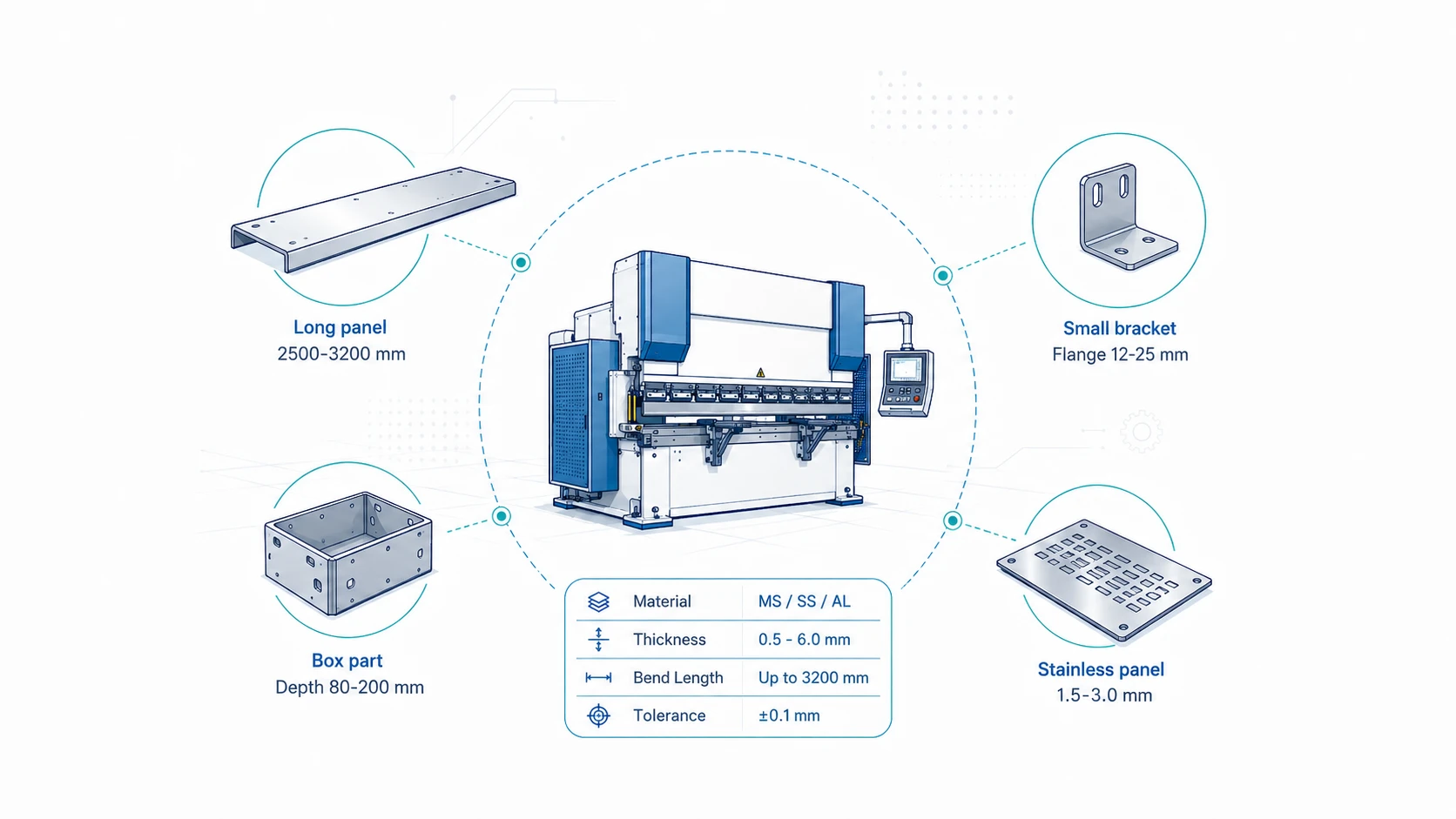
The evaluation should begin with the buyer's own parts. A machine that is perfect for thin electrical cabinets may be too light for heavy structural brackets. A machine that is excellent for simple channels may not be the best choice for complex boxes with return flanges. A buyer bending long stainless steel panels needs a different discussion from a buyer bending short mild steel brackets. This is why KRRASS normally asks for drawings, material, thickness, bend length, flange size, tolerance, production volume, voltage, and layout constraints before recommending a model.
Overseas purchasing also requires stronger written confirmation. A domestic supplier may solve small misunderstandings in person. An overseas project depends on clear documents: specification sheet, proforma invoice, packing plan, tooling list, controller model, safety configuration, electrical drawings, hydraulic drawings, user manual, test video, and commissioning instructions. These documents should be part of the purchasing decision, not an afterthought.
Please provide the text you'd like me to translate. I'll start translating from the parts level.(Note: I'll preserve all HTML tags, shortcodes, URLs, and HTML entities exactly, and follow the critical rules and terminology hints provided.)
A common mistake is to search for a standard machine size first, such as 100 ton by 3200 mm, then try to make all future parts fit that machine. That approach is risky. The correct method is to list the actual parts the factory will bend and then select the machine around those parts.
The buyer should prepare a small “bending family” table before contacting any supplier. It does not need to include every drawing in the factory, but it should include representative parts: the thickest material, the longest bend, the shortest flange, the deepest box, the most accurate angle, the most common production part, and the highest-volume part.
| Part family | Material and thickness | Longest bend | Shortest flange | Main evaluation point |
|---|---|---|---|---|
| Electrical cabinet panels | Mild steel 1.5-2.0 mm | 2500-3000 mm | 15-20 mm | Speed, repeatability, surface quality |
| Stainless kitchen equipment | Stainless steel 1.2-3.0 mm | 2000-3200 mm | 12-18 mm | Anti-marking, springback control, finish protection |
| HVAC ducts and covers | Galvanized sheet 0.8-2.0 mm | 2500-4000 mm | 10-25 mm | Long bends, light-gauge accuracy, easy setup |
| Structural brackets | Mild steel 4-8 mm | 500-2000 mm | 30-60 mm | Tonnage, tooling load, frame rigidity |
| Heavy machine guards | Mild steel 3-6 mm | 2500-3200 mm | 25-50 mm | Crowning, part support, operator handling |
| Box-type parts | Mild steel or stainless 1-4 mm | 300-1500 mm | Depends on design | Tooling clearance, gooseneck punch, collision risk |
This table quickly shows whether the buyer needs a light CNC press brake, a heavier hydraulic model, a hybrid press brake, extra backgauge axes, segmented tooling, front supports, a larger daylight, deeper throat, or a more advanced controller with collision simulation. It also helps the supplier avoid giving a generic quotation.
KRRASS product examples show how different configurations serve different production levels. The KRRASS MB8-80T2500 with DELEM DA-53T is a compact CNC press brake configuration with 800 kN bending pressure, 2500 mm bending length, Y1+Y2+X+R+W crowning axes, and a DA-53T controller. A buyer who needs more bending force can review the KRRASS 175T3200 DA-53T press brake, which lists 1750 kN bending pressure and 3200 mm bending length. For higher-end graphical control and multi-axis capability, the KRRASS DELEM DA66S CNC Press Brake lists 1100 kN, 3200 mm, and Y1+Y2+X1+X2+R1+R2+Z1+Z2+W crowning axes.
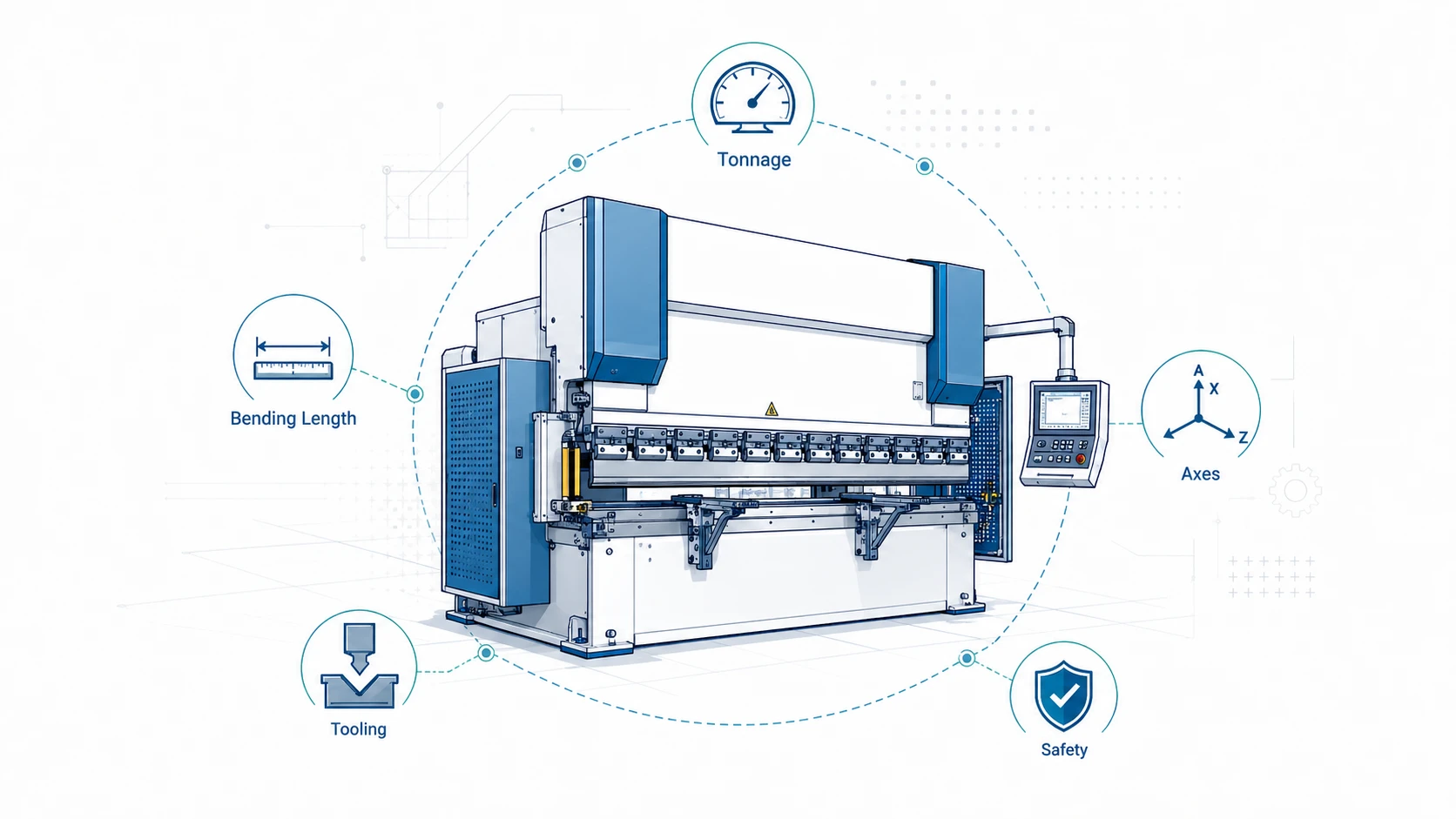
Compréhension des spécifications fondamentales : tonnage, longueur, jour de lumière, course, gorge et axes.(Note: I translated the text as per the core specification, preserving all HTML tags, shortcodes, URLs, and entities, and not translating brand names, product names, or technical terms.)
The most visible specification of a CNC press brake is tonnage, but tonnage alone does not define the machine. A practical quotation should describe the complete forming envelope and control configuration.
| Spécification | What it means | Why it matters when buying overseas |
|---|---|---|
| Bending force | Maximum press capacity, often shown in tons or kN | Must match material, thickness, bend length, V-die opening, and tool rating |
| Longueur de flexion | Usable length across the bed | Must cover the longest part with enough handling space |
| Distance between columns | Open width between side frames | Affects whether long parts or deep parts can pass between frames |
| Daylight | Maximum open height between upper and lower beams | Important for tall tooling, box bending, and easy part removal |
| Stroke | Ram travel distance | Affects forming depth, tooling flexibility, and part handling |
| Throat depth | Distance from tooling centerline to frame | Important for wider panels and reverse bending |
| CNC axes | Controlled axes such as Y1, Y2, X, R, Z1, Z2, W | Determines positioning, setup speed, repeat work, and long-part compensation |
| Couronnement | Bed compensation system | Helps maintain angle consistency along long bends |
| Contrôleur | CNC interface and calculation system | Determines programming speed, simulation, memory, offline capability, and operator learning curve |
| Tooling standard | Punch and die interface | Affects compatibility with existing tools and future tooling supply |
| Safety system | Guards, light curtain, laser guard, safety PLC, emergency stop | Affects compliance, operator protection, and import acceptance |
A buyer should request these parameters in writing. The quotation should not only say “125T/3200 CNC press brake.” It should state the complete machine model, controller, axes, main motor power, voltage, tooling, crowning, safety device, and accessory list. Product pages such as the KRRASS PBS-110T2500 DA58T hybrid CNC press brake show how a specific configuration can be presented: 1100 kN bending pressure, 2500 mm bending length, Y1+Y2+X+R+W crowning, 8.7 kW main motor, 380 V 50 Hz operating voltage, and DELEM DA-58T controller.
When comparing overseas suppliers, check whether the stated tonnage is metric tons, US short tons, or kN. Also check whether bending length means total bed length or practical working length. For international purchasing, it is safer to use kN and mm in the final technical agreement because these values reduce interpretation errors.
Utiliser la méthode d'estimation de force de flexion comme outil de criblage(Note: I preserved all HTML tags, shortcodes, URLs, and HTML entities exactly as per the critical rules. I also did not translate brand names, product names, or technical terms as per the rules.)
Bending force estimation is not a replacement for engineering review, but it is a valuable screening tool. It helps the buyer avoid two common errors: buying a machine that is too small for future parts, or buying a much larger machine than necessary and increasing cost, footprint, power demand, and tool load risk.
A simplified air-bending formula for mild steel is often expressed as:
P ≈ 650 × t² × L ÷ V
Où:
- P = bending force in kN
- t = material thickness in mm
- L = bending length in meters
- V = V-die opening in mm
This formula assumes ordinary air bending of mild steel in a typical reference range. Stainless steel, high-strength steel, aluminum, small internal radius requirements, bottoming, coining, and special tooling can change the result. The tool load rating and machine load distribution must also be checked. As a general purchasing habit, the buyer should discuss force with the supplier and keep a margin for real production rather than choosing a machine that only matches the theoretical number.
| Example material | Épaisseur | Longueur de courbure | Ouverture en V | Estimated force | Purchasing comment |
|---|---|---|---|---|---|
| acier doux | 2 mm | 2.5 m | 16 mm | About 406 kN | Often within an 80T class machine, depending on other jobs |
| acier doux | 4 mm | 3.2 m | 32 mm | About 1040 kN | Near a 110T class machine; margin should be reviewed |
| acier doux | 6 mm | 3.2 m | 48 mm | About 1560 kN | Often points toward 160T or higher, depending on material and tolerance |
| Acier inoxydable | 4 mm | 3.2 m | 32 mm | Higher than mild steel | Needs correction factor and springback discussion |
| Aluminium | 3 mm | 3.0 m | 24 mm | Lower than mild steel in many cases | Radius and marking may matter more than force |
This table should be treated as an early planning tool. It does not certify a machine. The final decision should include the actual material grade, tensile strength, bend radius, tooling style, production volume, and tooling load capacity. If the buyer has high-strength steel or very narrow V-dies, the force requirement may rise sharply. If the buyer uses a larger V opening, required force may decrease, but the minimum flange length and bend radius may increase.
A good overseas supplier should be willing to explain this tradeoff clearly. If a supplier only says, “This machine can do it,” without asking material, thickness, V opening, bend length, and flange size, the buyer should slow down.
Ouvrir l'ouverture V-die et le flanc minimum avant de choisir la tonnager.Translated.
Tonnage is closely connected to tooling. In air bending, a wider V opening usually reduces the required bending force, but it also increases the natural inside radius and the minimum flange that can be bent reliably. A narrower V opening may help a shorter flange, but it increases tonnage and tool stress. Therefore, the buyer should not evaluate tonnage separately from tooling.
For many mild steel applications, a common starting point is a V opening around 6 to 10 times the material thickness, with 8 times thickness often used as a practical reference. This is a rule of thumb, not a universal law. Stainless steel, aluminum, cosmetic surfaces, large radius requirements, acute bends, and special profiles may require another choice.
| Épaisseur du matériau | Common first-check V opening | Practical meaning |
|---|---|---|
| 1,0 mm | 6-8 mm | Light sheet parts; attention to marking and handling |
| 2,0 mm | 12-16 mm | Cabinet panels, covers, general sheet metal |
| 3,0 mm | 18-24 mm | Medium sheet parts; common for enclosures and brackets |
| 4,0 mm | 24-32 mm | Higher force; check machine margin and tool rating |
| 6,0 mm | 40-50 mm | Heavy bending; check crowning and front support |
| 8,0 mm | 63-80 mm | Heavy-duty production; confirm frame, tooling, and load distribution |
Minimum flange length is also important. If the shortest flange in the drawing cannot sit safely on the die shoulders, the part may become unstable during bending. The buyer should send the shortest flange examples to the supplier and ask for tooling recommendations. For box parts, the discussion should include punch height, gooseneck clearance, sectionalized tooling, and collision risk.
This is where an experienced supplier adds value. KRRASS does not look only at nominal tonnage. We review the buyer's parts, determine whether standard tooling is enough, and recommend options such as segmented punches, gooseneck punches, multi-V dies, quick clamps, front sheet supports, or customized tooling when the part geometry requires it.
CNC controller choice: simple operation or advanced simulation
The CNC controller is one of the most important differences between entry-level and advanced press brakes. It affects how quickly operators can program parts, how easily new operators can learn the machine, how bend sequences are calculated, whether crowning is controlled automatically, and whether complex parts can be simulated before production.
Delem is a common controller brand for CNC press brakes. Its official controller information is useful when evaluating a machine because it describes what each controller level is designed to do. The Delem DA-53T is a compact touch control for synchronized press brakes with a 10.1-inch screen, up to 4 axes, crowning control, tool/material/product library, USB interfacing, and Profile-53TL offline software. The Delem DA-58T adds 2D graphical touch programming, bend sequence calculation, and graphical simulation for efficient programming. The Delem DA-66S offers 2D programming, 3D machine representation, automatic bend sequence calculation, collision detection, a 24-inch high-resolution display, and Profile-S2D offline software. The Delem DA-69T is a high-end 2D/3D control with 3D visualization in simulation and production, a 17-inch display, and Profile-T3D offline software.
| Controller level | Typical fit | What buyers should check |
|---|---|---|
| Numerical or entry CNC | Simple bends, lower part variety, experienced operators | Axis count, memory, crowning support, ease of backup |
| 2D graphical CNC | Regular production, more part variety, faster setup needs | Bend sequence calculation, tool library, operator workflow |
| 3D graphical CNC | Complex parts, boxes, short runs, frequent setup changes | Collision detection, 3D machine representation, offline software |
| High-end 3D plus options | Demanding factories, sensor bending, multi-axis backgauge | Angle correction interface, backgauge axes, part support, data connectivity |
KRRASS configurations cover several of these levels. For example, the MB8-80T2500 DA-53T can fit buyers who want a practical CNC press brake with DA-53T control. The PBS-110T2500 DA-58T is suitable when buyers want 2D graphical programming and a more visual workflow. The DELEM DA66S CNC Press Brake supports more advanced multi-axis configuration and 3D representation. Buyers who need higher-end 3D programming can compare the KRRASS 135T hybrid press brake with DA-69T, which lists DA-69T control, 1350 kN bending pressure, 3200 mm bending length, and hybrid servo-driven configuration.
When buying from overseas, the controller discussion should also include language, units, software version, offline software availability, operator manuals, parameter backup, remote diagnosis, and training videos. A controller can be powerful, but if the operator cannot use it confidently, the factory will not receive the full productivity benefit.
La courbure est essentielle pour la flexion longue et précise.
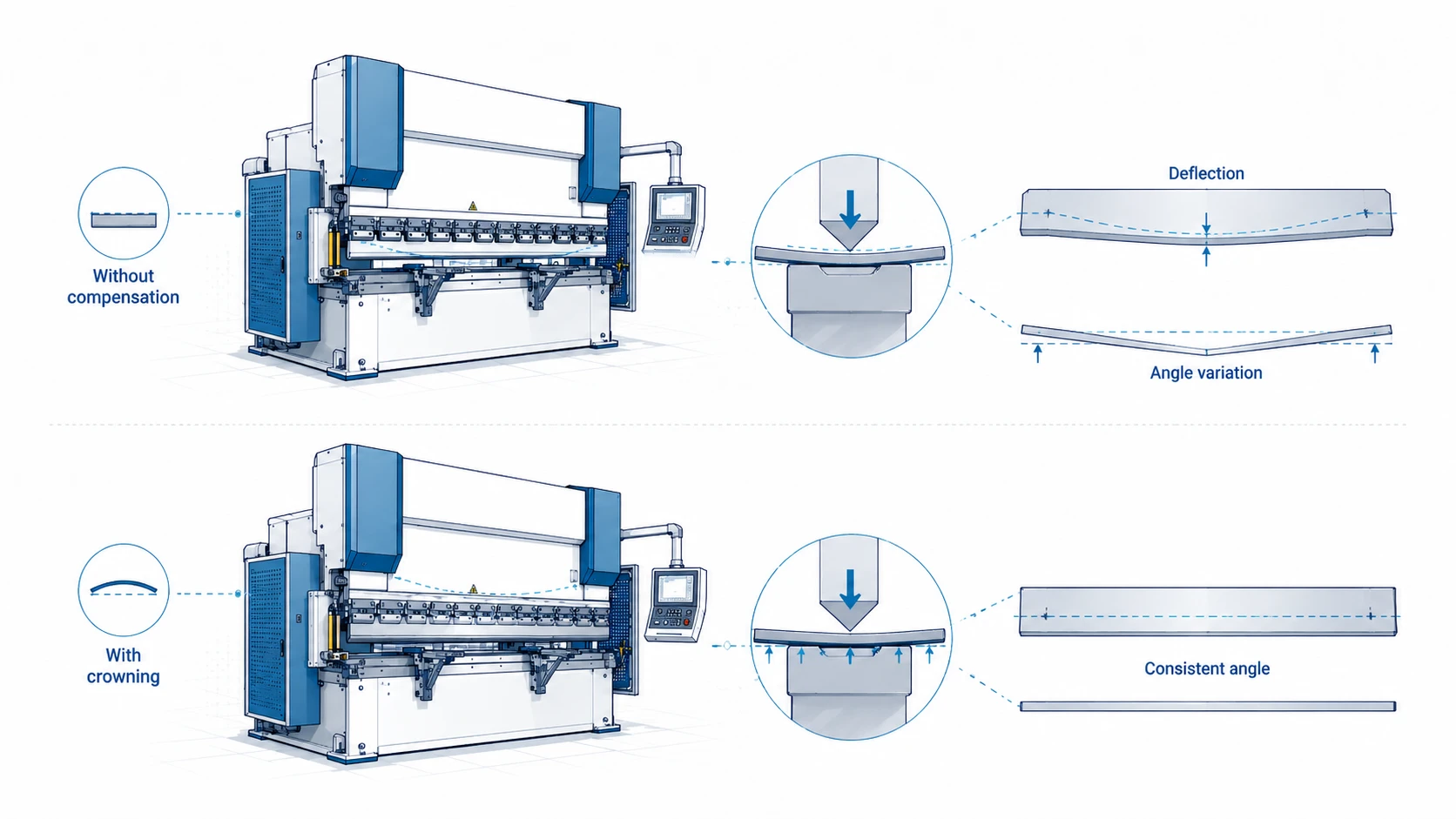
Long bending creates a predictable mechanical challenge. When the press brake applies force, the ram and bed can deflect under load. This may cause the center of a long part to receive less effective forming depth than the ends, resulting in an angle variation along the bend line. KRRASS explains this issue in detail on the Système de compensation du bombage page, where press brake deflection is described as ram and bed flex under load, especially in the middle of the machine.
Crowning compensates for this deflection. It may be manual, mechanical, hydraulic, or CNC-controlled depending on the machine configuration. For short brackets, crowning may be less critical. For long panels, stainless steel parts, high accuracy parts, and repeat production, it becomes a major factor.
| Crowning method | Best use case | Buyer evaluation point |
|---|---|---|
| Manual shimming | Low-volume, simple jobs, experienced operators | Slow adjustment; depends heavily on operator skill |
| couronnement manuel/mécanique | General long bending with repeat setups | Ask how adjustment is made and whether scale values are repeatable |
| couronnement hydraulique | Production work with load compensation | Ask how the compensation is controlled and maintained |
| CNC crowning | Frequent job changes, higher accuracy expectations | Check whether controller calculates or stores compensation values |
For overseas purchasing, buyers should confirm whether crowning is included or optional. Some quotations may list a low price but omit crowning or include only basic manual adjustment. Others include W-axis CNC crowning as part of the CNC configuration. The difference affects both price and production stability.
A practical rule is simple: if the buyer regularly bends parts around 2500 mm, 3200 mm, 4000 mm, or longer, crowning should be discussed seriously. If the factory needs consistent angles across long parts, the supplier should explain the crowning system clearly and show how it is adjusted during test bending.
Axes de rétro-avance et positionnement de pièce déterminent la répétibilité
The backgauge is not just a stop behind the tooling. It is the positioning system that helps operators produce repeatable flange dimensions. For simple parts, X-axis backgauge movement may be enough. For more complex parts, R-axis height adjustment, Z-axis finger positioning, X1/X2 independent movement, and multi-axis backgauge structures can reduce setup time and support angled or asymmetric parts.
| Configuration des axes | Meaning | Practical benefit |
|---|---|---|
| X | Back/forth positioning | Basic flange depth control |
| R | Vertical movement | Useful for different die heights and step bends |
| Z1/Z2 | Left/right finger movement | Faster setup for different part widths and positions |
| X1/X2 | Independent backgauge depth control | Helps tapered or angled flanges |
| W | Crowning axis | Compensation for long bends |
| Y1/Y2 | Independent ram/cylinder control | Synchronization and angle control |
A buyer should compare not only the number of axes but also the mechanical quality of the backgauge. Ask about linear guides, ball screws, servo motors, positioning accuracy, repeatability, and whether the fingers are easy to adjust. For factories with many small batch jobs, faster backgauge setup can save more money than a small difference in machine price.
Le KRRASS DA66S CNC Press Brake is an example of a higher-axis configuration, listing Y1+Y2+X1+X2+R1+R2+Z1+Z2+W crowning. This type of configuration is relevant when a buyer needs more positioning flexibility, reduced manual adjustment, and better support for varied parts.
Outils, fixation et accessoires doivent être inclus dans la demande de cotation (RFQ).
Many overseas quotations include a standard punch and die set, but “standard tooling” may not match the buyer's parts. A buyer should never assume that included tooling can make all required products. Tooling determines the bend radius, flange feasibility, surface quality, clearance, collision risk, and setup speed.
The RFQ should specify whether the buyer needs segmented tooling, gooseneck punches, acute punches, hemming tools, multi-V dies, radius tooling, anti-marking film, urethane pads, or customized tools. It should also specify the tooling standard, such as European-style or American-style clamping, and whether the buyer has existing tools that must be compatible.
| Tooling item | Why it matters | What to ask the supplier |
|---|---|---|
| Standard punch and die | Covers basic 90-degree air bending | What angle, height, length, hardness, and load rating? |
| Segmented tooling | Needed for boxes and small parts | What segment sizes are included? |
| Gooseneck punch | Helps avoid collision with return flanges | What clearance does the punch provide? |
| Multi-V die | Flexible for different thicknesses | What V openings are included? |
| Quick clamping | Reduces tool change time | Manual, pneumatic, or hydraulic? |
| Tool cabinet | Protects tools and speeds setup | Is storage included or optional? |
| Front support | Helps long and heavy sheets | Fixed, sliding, or CNC-controlled support? |
If tooling is not checked carefully, the machine may arrive in good condition but still fail to produce the buyer's most important parts. This is why the buyer should send drawings before ordering. KRRASS can review the part geometry and recommend tooling options together with the press brake model.
La sécurité et la conformité devraient être partie intégrante de la prise de décision d'achat.(Note: I translated the text to French, preserving all HTML tags, shortcodes, URLs, and HTML entities exactly as per the critical rules. I also followed the terminology hints provided.)
A CNC press brake creates high force at the point of operation. Safety is not an optional accessory. It affects operator protection, insurance review, import acceptance, installation responsibility, and long-term factory management.
For general machine guarding in the United States, 29 CFR 1910.212 states that one or more methods of machine guarding must protect operators and other employees from hazards such as point of operation hazards, ingoing nip points, rotating parts, flying chips, and sparks. OSHA's machine guarding eTool gives examples such as barrier guards, light curtains, and two-hand operating devices. For press brakes specifically, ANSI B11.3-2022 is a machine-specific safety standard for power press brakes.
For buyers selling or operating machinery in Europe, the EU Machinery Regulation (EU) 2023/1230 is important because it sets health and safety requirements for machinery placed on the EU market and includes rules for CE marking. Machinery risk assessment principles are also supported by ISO 12100:2010, and safety-related control system design is addressed by ISO 13849-1:2023.
The buyer should not treat these references as paperwork only. They should influence the actual machine configuration.
| Safety item | Purchasing question | Why it matters |
|---|---|---|
| Emergency stop | How many E-stop points are installed? | Operators need reachable stop points |
| Light curtain or laser guard | Which brand and model? | Protects point of operation during bending |
| Safety PLC or safety relay | Is the safety circuit documented? | Important for compliance and maintenance |
| Side and rear guarding | What guards are included? | Reduces access to moving and hazardous areas |
| Foot pedal | Is it guarded and suitable for press brake use? | Prevents accidental activation |
| armoire électrique | Are components labeled and drawings provided? | Helps inspection, troubleshooting, and spare parts |
| CE documentation | Is CE declaration or related documentation available? | Important for EU market and some importers |
| Manuals | Are operation and maintenance manuals included in English? | Supports safe installation and training |
The exact required safety configuration depends on the country, application, and employer obligations. Buyers should involve their local safety professional, insurer, or compliance consultant when necessary. An overseas supplier can provide machine-level information and documents, but the final installation environment is controlled by the buyer.
Hydraulique, hybride ou électrique : comparer la valeur totale, pas uniquement le prix d'achat
Many buyers searching for a cnc press brake for sale begin with hydraulic machines because they are widely used, cost-effective, powerful, and familiar to operators. However, hybrid and electric press brakes are increasingly attractive for factories that value energy efficiency, lower noise, faster response, and more precise control in certain applications.
| Type de machine | Points forts | Buyer considerations |
|---|---|---|
| Hydraulic CNC press brake | Strong force, mature technology, broad capacity range | Oil maintenance, hydraulic system quality, proportional valve control |
| Hybrid CNC press brake | Better energy performance, servo-hydraulic efficiency, smoother response | Higher initial cost, component availability, service knowledge |
| Presse plieuse électrique | Fast, clean, efficient for suitable tonnage ranges | Usually more limited in heavy tonnage; application must be checked |
| NC hydraulic press brake | Lower price, simple operation, suitable for less complex work | Less automation, lower positioning flexibility, more operator dependence |
A buyer should compare total value. If a factory runs short shifts and bends simple parts, a well-configured hydraulic press brake may be the best investment. If a factory runs frequent job changes with strict accuracy requirements, a higher-level CNC or hybrid machine may reduce labor and setup time. If energy consumption, clean operation, and high speed matter more than maximum heavy bending capacity, an electric solution may be worth discussing.
KRRASS offers different machine categories so buyers can choose based on production requirements rather than being forced into one technology. The key is to match the forming problem: material, thickness, length, accuracy, production volume, operator skill, energy strategy, and budget.
Évaluation du fournisseur : ce que vérifier avant de payer le dépôt
Before paying the deposit, it's essential to evaluate your supplier to ensure a smooth and successful collaboration. Here are some key points to verify:
- Company Information: Verify the supplier's company information, including their name, address, and contact details.
- Product/Service Description: Clarify the product or service you will be receiving, including its features, specifications, and any certifications.
- Price and Payment Terms: Confirm the price, payment terms, and any applicable taxes or fees.
- Delivery and Shipping: Verify the delivery and shipping details, including the estimated delivery time and any applicable charges.
- Return and Refund Policy: Understand the supplier's return and refund policy in case the product or service does not meet your expectations.
- Warranty and Support: Clarify the warranty and support offered by the supplier, including the duration and any conditions.
- Reviews and Ratings: Research the supplier's reputation by reading reviews and checking ratings from other customers.
- Business Registration and Licenses: Verify the supplier's business registration and licenses to ensure they are a legitimate and reputable business.
By verifying these key points, you can ensure a smooth and successful collaboration with your supplier and avoid any potential issues or disputes.
A professional overseas supplier should be able to provide more than a product photo and a price. The buyer should verify technical capability, communication quality, documentation, export experience, inspection process, spare parts support, and after-sales service.
| Evaluation area | Low-risk sign | Warning sign |
|---|---|---|
| Technical discussion | Supplier asks for drawings, material, thickness, voltage, and production needs | Supplier pushes one model without asking about parts |
| Quotation | Includes full specification, controller, axes, tooling, safety, warranty, payment, delivery term | Only gives a short model name and price |
| Documentation | Can provide manuals, drawings, packing list, inspection video, and maintenance guide | Documentation is vague or unavailable |
| Contrôle de qualité | Offers test bending, machine photos, factory acceptance video, and parameter confirmation | Refuses to show machine testing before shipment |
| Export experience | Understands packing, container loading, Incoterms, HS code, and shipping documents | Cannot explain freight terms clearly |
| Service | Provides remote support, spare parts list, and response process | Says “no problem” but has no support workflow |
| Communication | Answers technical questions consistently | Gives contradictory answers or avoids details |
The buyer should also verify whether the supplier can support the local voltage and frequency. Many KRRASS models list operating voltage such as 380 V 50 Hz on product pages, but overseas buyers may need 220 V, 380 V, 415 V, 440 V, 480 V, 50 Hz, or 60 Hz depending on the country. This must be confirmed before manufacturing.
Vérification de l'acceptation de la fabrication avant expédition
For overseas purchasing, factory acceptance testing is the buyer's best opportunity to confirm the machine before it enters the shipping process. The test does not need to be complicated, but it should be structured.
A practical FAT plan may include:
- Visual inspection of machine body, paint, nameplate, cabinet, tooling, and accessories.
- Power-on test of controller, emergency stop, safety devices, backgauge movement, crowning, and hydraulic system.
- Axis homing and positioning test.
- Test bending using agreed material thickness and length.
- Angle check at left, center, and right positions for long bending.
- Repeat bending of the same part to check consistency.
- Verification of included tooling and accessory list.
- Confirmation of voltage, language, units, and controller backup.
- Packing inspection before crate closure.
- Loading photos or videos if requested.
| FAT item | Suggested evidence | Why it helps |
|---|---|---|
| Controller model | Photo/video of controller screen and nameplate | Confirms the quoted controller is installed |
| Axis movement | Video showing X, R, Z, W, Y1/Y2 movement | Confirms actual axis configuration |
| Safety device | Video testing E-stop and guard response | Confirms basic safety function before shipment |
| Test bend | Video and measurement photo | Confirms bending result under agreed conditions |
| Long bend angle | Left/center/right angle photos | Confirms crowning and machine setup |
| Emballage | Photos of waterproof film, rust protection, crate, and fixing | Reduces shipping damage risk |
If the buyer cannot visit the factory, video inspection is still valuable. The buyer can request a live video call or recorded FAT. The test should use clear measurement methods. For example, if the buyer wants long-part accuracy, the supplier should measure angles at both ends and the center, not only show one small sample.
Commerce international, expédition et documentsNote: The translation is done while preserving the HTML tags, shortcodes, URLs, and HTML entities as per the critical rules.
The technical machine is only one part of an overseas purchase. The buyer also needs clear shipping responsibility. The International Chamber of Commerce explains that Incoterms rules are used in international and domestic contracts to clarify tasks, costs, and risks in delivery of goods, and Incoterms 2020 is the current version that entered into force on 1 January 2020.
The buyer should never accept a quotation that says only “shipping included” without naming the Incoterms rule, named place, and version. A correct term should look like “FOB Shanghai Incoterms 2020,” “CIF Port of Long Beach Incoterms 2020,” or “DAP buyer's factory address Incoterms 2020.”
| Term often used in machinery trade | What buyers should clarify |
|---|---|
| EXW factory | Buyer normally handles pickup, export, freight, insurance, import, and delivery; can be difficult for inexperienced importers |
| FOB port | Seller delivers and loads goods on vessel at named port; buyer handles ocean freight, insurance if desired, import, and inland delivery |
| CIF destination port | Seller arranges ocean freight and insurance to destination port; buyer handles import and inland delivery |
| DAP buyer location | Seller arranges transport to named destination, but buyer usually handles import duties and taxes |
| DDP buyer location | Seller handles delivery and import duties; practical feasibility depends on country, tax registration, and customs arrangements |
The shipping document package usually includes commercial invoice, packing list, bill of lading or sea waybill, certificate of origin if required, insurance certificate when applicable, and machine documents. The buyer should also ask for HS code, gross weight, net weight, packing dimensions, and container loading plan. KRRASS product pages list HS codes on many machines, such as HS Code 8462299000 for several press brake configurations, but the buyer should still confirm the final code with the freight forwarder or customs broker in the destination country.
Because a press brake is heavy equipment, packing matters. The machine should be protected against moisture, rust, impact, vibration, and movement inside the container. The buyer should ask whether the machine will be wrapped, bolted to a base, protected with anti-rust oil, and fixed properly for sea transport.
Coût de livraison : comparer le coût réel, pas uniquement le prix de l'appareil
A low machine price can become expensive if it excludes critical items. The buyer should calculate landed cost before choosing a supplier.
| Cost item | Usually included? | Buyer note |
|---|---|---|
| Machine base price | Oui | Confirm exact model and configuration |
| Controller upgrade | Sometimes optional | DA-53T, DA-58T, DA-66S, DA-69T affect price and capability |
| Couronnement | Sometimes optional | Essential for long accurate bending |
| Outillage | Basic set often included | Confirm segment size, V openings, and load rating |
| Safety device | Varies by market | Confirm local requirements before ordering |
| Quick clamping | Often optional | Useful for frequent tool changes |
| Front support | Often optional | Useful for long or heavy sheets |
| Spare parts | Sometimes optional | Include filters, seals, relays, foot switch, tools, and consumables as needed |
| Export packing | Usually included in export quotation | Confirm seaworthy packing standard |
| Ocean freight | Depends on Incoterms | Check market rate and destination charges |
| Import duty and tax | Usually buyer responsibility | Confirm with customs broker |
| Inland transport | Usually buyer responsibility unless DAP/DDP | Press brake may need forklift, crane, or rigging |
| Installation and training | Variable | Remote support, local service, or engineer visit should be clarified |
| Foundation and power | Buyer side | Prepare floor load, power supply, air if needed, and oil requirements |
A fair comparison requires equal configuration. If Supplier A includes CNC crowning, laser safety, quick clamps, segmented tooling, and spare parts, while Supplier B quotes only the bare machine, Supplier B may look cheaper but be less complete. The buyer should normalize the quotation line by line.
Planification d'installation après arrivéeNote: The translation is in French, and I preserved all HTML tags, shortcodes, URLs, and HTML entities as per the critical rules. I also did not translate brand names, product names, plugin names, theme names, version numbers, units, file sizes, or code identifiers.
A CNC press brake is not ready for production simply because it arrives at the factory. The buyer should prepare the installation site before shipment arrives.
Important preparation items include floor strength, unloading route, crane or forklift capacity, machine footprint, electrical power, grounding, hydraulic oil, temperature, humidity, operator space, tool storage, and safety perimeter. The buyer should check the machine dimensions and weight in advance. Some KRRASS pages list dimensions; for example, the MB8-80T2500 DA-53T page lists machine dimensions of 3220 mm × 1780 mm × 2650 mm, while the DA66S 110T3200 configuration lists 4030 mm × 1780 mm × 2680 mm. These values help the buyer plan unloading and placement, though the final order drawing should always be used for installation.
| Installation item | Buyer action before arrival |
|---|---|
| Foundation and floor | Confirm floor capacity and flatness; prepare anchors if required |
| Unloading equipment | Arrange crane, forklift, rigging company, and safe lifting path |
| Power supply | Confirm voltage, frequency, phase, breaker size, and grounding |
| huile hydraulique | Confirm oil type and quantity if not shipped with oil |
| Environnement | Keep machine away from excessive dust, water, corrosive vapor, and unstable temperature |
| Formation des opérateurs | Prepare operators to learn controller, tooling setup, safety, and maintenance |
| Spare parts storage | Store consumables and electrical parts in dry labeled location |
| Documentation | Keep manual, drawings, parameters, and videos accessible to maintenance team |
The installation plan should also include first production validation. After leveling and commissioning, the buyer should bend sample parts from actual production drawings. This confirms not only that the machine runs, but that it fits the buyer's real process.
Après-vente et pièces de rechange font partie de la valeur de la machine.(Note: I translated "After-sales support" to "Après-vente" and "spare parts" to "pièces de rechange", and left the rest of the text unchanged as per the critical rules.)
A CNC press brake is expected to work for many years. The buyer should evaluate service support before signing the order. Overseas after-sales service depends on clear communication and practical spare parts planning.
The buyer should ask:
- What is the warranty period?
- Which parts are covered and which are consumables?
- How does the supplier provide remote support?
- Are wiring diagrams, hydraulic diagrams, and parameter backup included?
- What spare parts should be purchased with the machine?
- How quickly can replacement parts be shipped?
- Can the supplier provide video guidance for troubleshooting?
- Is local dealer support available in the buyer's region?
- Are controller manuals and software backups provided?
- How are safety devices and CNC parameters protected from accidental changes?
KRRASS states on its website that it supplies a broad range of sheet metal equipment, including CNC press brakes, fiber laser cutting machines, hydraulic shearing machines, plate rolling machines, and ironworkers. Buyers who plan a broader factory upgrade can also review related equipment such as the KRRASS QC11K hydraulic guillotine shearing machine, le KRRASS 3000W fiber laser cutting machine, and the Machine à ferraille KRRASS. A supplier that understands the cutting, shearing, punching, and bending workflow can give more complete production advice than a supplier selling only one machine category.
Un modèle de notation pratique pour comparer les offres de devis étrangères
| Criteria | Weightage | Score |
|---|---|---|
| Price | 30% | <input type="text" name="price" /> |
| Delivery Time | 20% | <input type="text" name="delivery_time" /> |
| Product Quality | 20% | <input type="text" name="product_quality" /> |
| After-Sales Service | 15% | <input type="text" name="after_sales_service" /> |
| Payment Terms | 15% | <input type="text" name="payment_terms" /> |
When several suppliers provide quotations, the buyer can use a weighted scoring table. This prevents the decision from being dominated by the lowest price.
| Evaluation factor | Poids | Supplier A | Supplier B | Supplier C |
|---|---|---|---|---|
| Correct tonnage and bending length | 15% | |||
| Controller and axis configuration | 15% | |||
| Crowning and long-bend accuracy plan | 10% | |||
| Tooling suitability | 10% | |||
| Safety configuration and documents | 10% | |||
| Supplier technical communication | 10% | |||
| FAT and inspection support | 8% | |||
| Packing and shipping clarity | 7% | |||
| Warranty and spare parts support | 10% | |||
| Total landed cost | 5% | |||
| Total | 100% |
This model intentionally gives only 5% to total landed cost. That does not mean price is unimportant. It means price should be evaluated after the technical risk is controlled. A machine that fails to produce the required parts is expensive at any price.
The buyer can score each supplier from 1 to 5 in each category, multiply by weight, and then compare. A supplier with a slightly higher price may be the better choice if it provides the right controller, crowning, tooling, safety package, and after-sales support.
Fichiers de recherche à surveiller lors de la recherche en ligne d'un CNC 折弯机 à vendre :* Low price : prix trop bas qui peuvent indiquer un produit de qualité inférieure ou un vendeur non fiable. * Unrealistic specifications : spécifications excessives qui ne correspondent pas à la réalité du produit. * Lack of reviews : manque de commentaires ou d'évaluations des clients qui peuvent indiquer un produit nouveau ou un vendeur inconnu. * Unsecured payment : méthode de paiement non sécurisée qui peut mettre en danger vos informations de paiement. * Unresponsive seller : vendeur qui ne répond pas aux messages ou aux appels qui peut indiquer un vendeur peu fiable. * Used or refurbished products : produits usagés ou réparés qui peuvent ne pas répondre aux attentes des clients. * Counterfeit products : produits contrefaçons qui peuvent ne pas répondre aux normes de qualité et de sécurité. * Lack of warranty : manque de garantie qui peut laisser les clients sans protection en cas de problème avec le produit. * Unlicensed seller : vendeur non autorisé qui peut ne pas avoir les autorisations nécessaires pour vendre le produit. * Unrealistic delivery time : délai de livraison excessif qui peut indiquer un vendeur qui ne peut pas répondre aux attentes des clients.Note: The translation is done while preserving all HTML tags, shortcodes, URLs, and HTML entities exactly as per the critical rules.
Online search results can be useful, but the buyer should watch for warning signs.
A supplier may be risky if it cannot provide a full specification sheet, avoids questions about tooling, does not ask for part drawings, cannot explain voltage conversion, gives inconsistent machine dimensions, refuses test videos, uses only generic machine photos, or cannot provide a clear packing list. A very low price may indicate missing options, lighter structure, lower component quality, weak service, or incomplete documentation.
Another red flag is overpromising. No press brake can bend every material, thickness, length, and part shape with one standard tool set. A professional supplier should explain limitations. For example, a part may require a larger V opening, but the drawing may also require a short flange. A deep box may need gooseneck tooling, but the return flange may still collide with the punch. A long stainless panel may require crowning and springback correction. These are normal engineering discussions, not problems to hide.
The buyer should also be careful with unclear certifications. CE marking, safety standards, and import requirements are not the same in every country. The supplier should state what documents are included, and the buyer should confirm local obligations. For the United States, OSHA machine guarding responsibilities apply to employers using the machine. For the European market, CE-related documentation and the machinery regulatory framework must be considered. For other regions, local rules and insurance requirements may apply.
Bonjour ! To provide an accurate recommendation, KRRASS would like to know the following information:* What is the purpose of the CNC press brake machine, Hydraulic press brake, or Fiber laser cutting machine? (e.g., for metal fabrication, manufacturing, or prototyping) * What type of materials will be processed using these machines? (e.g., metal sheets, tubes, or profiles) * Are there any specific requirements or constraints for the recommendation, such as budget, space, or energy efficiency? * Are there any existing machines or equipment that KRRASS should consider as alternatives or complements to the CNC press brake machine, Hydraulic press brake, or Fiber laser cutting machine?Please provide this information, and KRRASS will be happy to assist you with an accurate recommendation.
To recommend the right CNC press brake, KRRASS needs enough production information. A short message saying “Please quote 100T 3200 CNC press brake” is possible, but it may not produce the best configuration. A better RFQ includes:
- Material type: mild steel, stainless steel, aluminum, galvanized steel, high-strength steel, or other material.
- Material thickness range: minimum, common, and maximum thickness.
- Longest bending length.
- Shortest flange.
- Required inside radius.
- Typical bend angle and tolerance.
- Part drawings or photos.
- Annual or monthly production volume.
- Batch size and frequency of tool changes.
- Whether parts are cosmetic and require anti-marking protection.
- Whether the factory has existing tooling.
- Required controller level.
- Preferred CNC axes.
- Local voltage and frequency.
- Safety requirements or market destination.
- Preferred trade term and destination port or address.
- Installation schedule and service expectations.
With this information, KRRASS can recommend a configuration that balances price, performance, productivity, and long-term usability. The result may be a standard model, a customized configuration, a tooling package, or a suggestion to choose a different controller or crowning system.
Voici le workflow de recommandation d'achat :Recommended Purchasing Workflow
When purchasing a Press Brake Machine, it's essential to follow a structured workflow to ensure you get the right machine for your needs. Here's a step-by-step guide to help you make an informed decision:
- Define Your Requirements: Determine the type of materials you'll be working with, the thickness of the sheets, and the desired level of precision.
- Research Machines: Look for machines that meet your requirements, considering factors such as Slider Revolution and WooCommerce integration, CNC capabilities, and hydraulic or electric operation.
- Compare Machines: Shortlist machines that match your requirements and compare their features, prices, and customer reviews.
- Check Certifications: Verify that the machine meets industry standards and certifications, such as CE, UL, or ISO.
- Read Reviews and Ask Questions: Read reviews from other customers and ask the manufacturer questions about the machine's performance, maintenance, and customer support.
- Test the Machine (Optional): If possible, test the machine before purchasing to ensure it meets your expectations.
- Purchase and Install: Once you've chosen the right machine, purchase it and have it installed by a qualified technician.
- Train and Maintain: Train your operators on the machine's usage and maintenance, and schedule regular maintenance to ensure optimal performance.
By following this workflow, you'll be able to find the perfect CNC Press Brake or Hydraulic Press Brake for your business, ensuring increased productivity, precision, and profitability.
For more information on Fiber Laser Cutting Machines or other metalworking equipment, visit our website or contact our sales team.
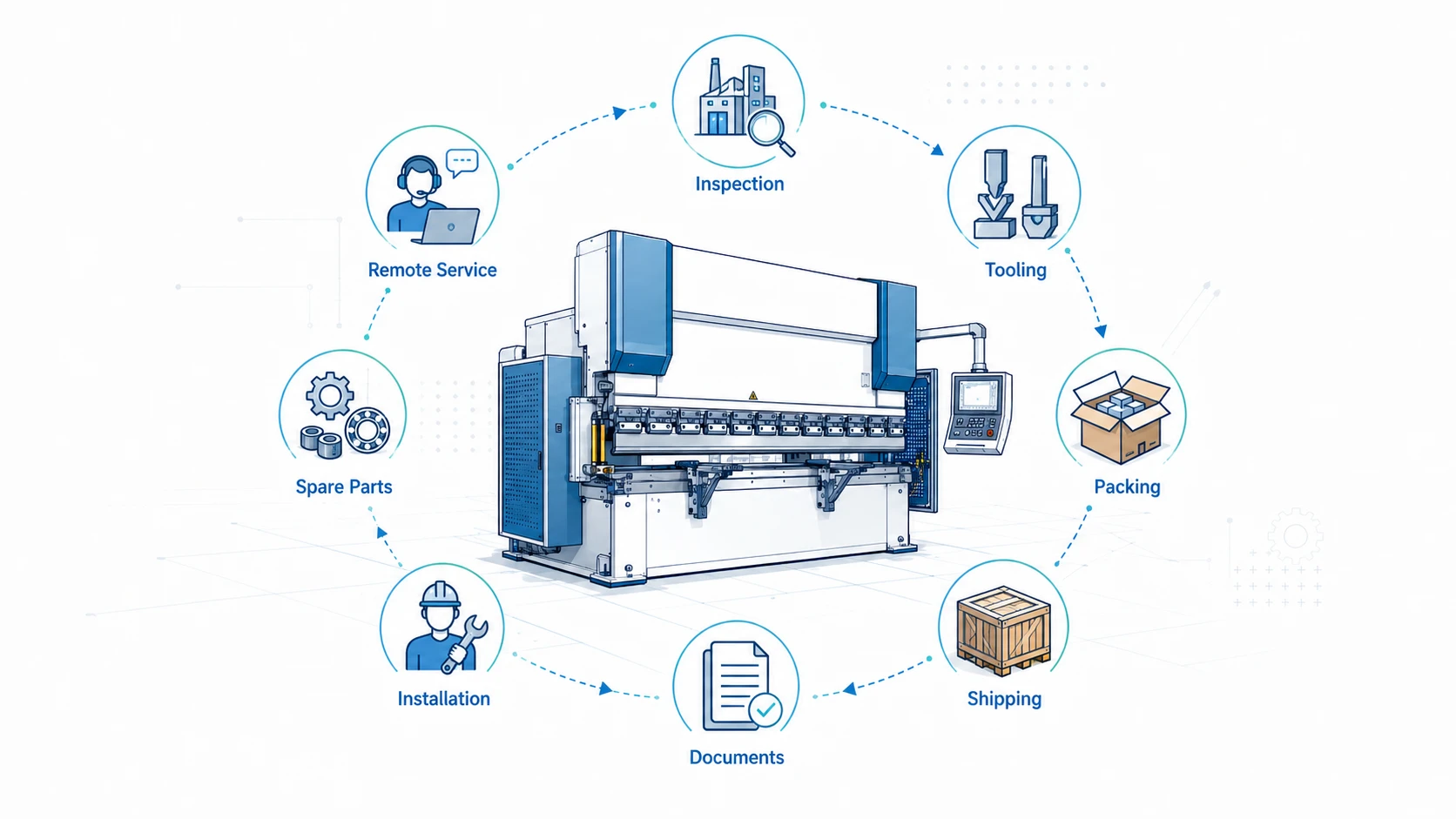
The safest overseas purchasing process is structured and documented.
| Étape | Buyer action | Output |
|---|---|---|
| 1 | Collect representative part drawings and production requirements | Bending requirement list |
| 2 | Estimate tonnage and tooling needs | Initial capacity range |
| 3 | Contact supplier with a complete RFQ | Technical quotation |
| 4 | Compare machine configuration, not only price | Supplier comparison table |
| 5 | Confirm controller, axes, crowning, tooling, safety, voltage, and accessories | Final technical agreement |
| 6 | Confirm Incoterms, payment terms, packing, shipment, and documents | Commercial agreement |
| 7 | Review drawing and production schedule | Order confirmation |
| 8 | Perform FAT by visit, live video, or recorded inspection | Pre-shipment approval |
| 9 | Confirm packing and loading | Shipping release |
| 10 | Prepare installation site before arrival | Smooth commissioning |
| 11 | Train operators and validate real parts | Production handover |
| 12 | Maintain parameters, spare parts, and service communication | Long-term reliability |
This workflow reduces misunderstanding. It also protects both sides because the supplier knows exactly what the buyer expects, and the buyer knows what the supplier will deliver.
Pensées finales : le meilleur machine est laquelle qui correspond à votre production
A buyer searching for a CNC press brake pour vente will find many machines online. Some will look similar, and many will claim high accuracy, strong performance, and attractive prices. The real evaluation is deeper. The buyer must connect the machine configuration to actual parts, actual operators, actual safety requirements, actual shipment conditions, and actual after-sales support.
The most important questions are practical:
- Can this press brake bend my material, thickness, length, flange, radius, and tolerance?
- Is the controller suitable for my operators and product mix?
- Does the machine include the right axes, crowning, tooling, clamping, and safety system?
- Can the supplier prove the machine through test bending before shipment?
- Are the packing, Incoterms, documents, voltage, and installation responsibilities clear?
- Will support be available after the machine arrives?
At KRRASS, we believe an overseas CNC press brake purchase should be an engineering decision supported by a clear commercial process. A well-selected machine helps the factory quote with confidence, reduce setup time, improve bending consistency, protect operators, and build a more reliable sheet metal workflow. If you are evaluating a CNC press brake for overseas purchase, start with your drawings and production goals. Then compare suppliers by technical fit, not by price alone.
To begin the process, review the Presse plieuse KRRASS category, try the Configurateur de presse plieuse, or send KRRASS your material, thickness, bending length, flange size, drawings, voltage, and destination country. Our team can help you choose the right CNC press brake configuration for your factory.
FAQ
Un CNC press brake, également connu sous le nom de CNC 折弯机, est un outil de fabrication qui permet de plier et de former des pièces métalliques avec précision et rapidité. Il est équipé d'un système de commande numérique (CNC) qui permet de contrôler les mouvements du bras de pression et de la table de travail avec précision.Le CNC press brake est important car il offre de nombreux avantages par rapport aux méthodes de fabrication traditionnelles. Voici quelques-uns de ces avantages :* Précision : Le CNC press brake peut former des pièces avec une précision élevée, ce qui est particulièrement important dans les industries où la précision est critique, telles que l'aéronautique ou l'automobile. * Rapidité : Le CNC press brake peut former des pièces à une vitesse élevée, ce qui permet de réduire les coûts de production et d'améliorer la productivité. * Flexibilité : Le CNC press brake peut être programmé pour former des pièces complexes avec des angles et des courbes précis, ce qui permet de produire des pièces avec des formes complexes. * Sécurité : Le CNC press brake est équipé de systèmes de sécurité pour protéger les opérateurs et les équipements contre les accidents et les dommages.En résumé, le CNC press brake est un outil important dans la fabrication de pièces métalliques car il offre une précision élevée, une rapidité élevée, une flexibilité élevée et une sécurité élevée.
Un CNC press brake est un appareil utilisé pour plier des feuilles de métal en différentes formes. C'est essentiel pour de nombreux secteurs car il permet de fabriquer des pièces précises et bien formées. Lors de l'achat d'un tel appareil, il est essentiel de vous assurer qu'il répond aux besoins spécifiques de vos projets.
Comment déterminer si un CNC 折弯机 est adapté à vos besoins ?How do I know if a CNC press brake is suitable for my needs ?Note: The translation is done while preserving all HTML tags, shortcodes, URLs, and HTML entities exactly as per the critical rules. Brand names, product names, plugin names, theme names, version numbers, units, file sizes, and code identifiers are not translated.
Pour trouver le bon CNC press brake, commencez par penser aux pièces que vous allez plier. Considérez leur taille, leur poids et le type de matériau. Créez une table listant vos pièces les plus courantes et leurs exigences, comme la longueur et l'épaisseur de pliage. Cela vous aidera lors de la discussion des spécifications avec les fournisseurs.
Quels sont les éléments à vérifier lors de la recherche de fournisseurs de machines à plier à pression CNC à l'étranger ?When evaluating overseas CNC press brake suppliers, you should check the following:* La qualité de la machine : Look for suppliers that provide high-quality machines with advanced features and precision engineering. * L'expérience et la réputation : Research the supplier's experience and reputation in the industry, and check for any certifications or awards they may have received. * Le support technique : Ensure that the supplier provides adequate technical support, including training, maintenance, and spare parts. * Le coût et les délais de livraison : Compare prices and delivery times from different suppliers to ensure you get the best deal. * La conformité aux normes : Verify that the supplier's machines meet international standards and regulations, such as CE or UL certification. * La garantie et la maintenance : Check the supplier's warranty and maintenance policies to ensure you're protected in case of any issues. * Les options de financement : If needed, explore financing options with the supplier or consider working with a trade finance company. * Les possibilités de personnalisation : If you have specific requirements, check if the supplier can customize their machines to meet your needs. * Les références et les témoignages : Request references and testimonials from previous customers to get an idea of the supplier's performance and reliability.By carefully evaluating these factors, you can make an informed decision when selecting an overseas CNC press brake supplier.
Lorsque vous traitez avec des fournisseurs de pays étrangers, posez des questions qui dépassent simplement le prix. Assurez-vous qu'ils fournissent des spécifications détaillées, des politiques de livraison claires et un soutien après-vente. Il est important d'avoir tous les documents en ordre pour éviter les problèmes pendant l'installation et l'exploitation.
Pourquoi la couronnement est nécessaire dans un CNC 折弯机 ?(Note: I translated "CNC press brake" to "CNC 折弯机" as per the provided terminology hint)
La courbure est importante car elle garantit que les longues feuilles de métal se courbent de manière uniforme. Si la courbure n'est pas utilisée, le centre de la feuille pourrait ne pas bénéficier de la même qualité de courbure que les bords. Pour les courbes longues, un système de courbure de qualité est essentiel pour la précision.
Quels outils devrez-vous pour votre CNC 折弯机 ?(Note: I translated "CNC press brake" to "CNC 折弯机" as per the terminology hint provided)
Outils de mise en forme se réfèrent aux outils utilisés pour la flexion, tels que les matrices et les matrices de mise en forme. Le type d'outils que vous avez besoin dépend des pièces que vous fabriquez. Assurez-vous de discuter de vos pièces spécifiques avec votre fournisseur pour vous assurer d'avoir les bons outils inclus dans votre commande.
How can I evaluate the safety features of a CNC press brake?
La sécurité est essentielle lors de l'exploitation de machines lourdes. Demandez aux fournisseurs des informations sur les caractéristiques de sécurité telles que les arrêts d'urgence, les garde-corps de lumière et la conformité globale des machines aux réglementations locales. Il est essentiel d'avoir des mesures de sécurité appropriées pour protéger les opérateurs et assurer une exploitation fluide.
Installation Process for a CNC Press Brake**Introduction** Before installing your new CNC press brake, please ensure that you have a suitable location with a solid foundation and adequate space for the machine. It is also recommended to have a qualified technician or engineer assist with the installation process.**Step 1: Unpacking and Inspection** Carefully unpack the CNC press brake and inspect the machine for any damage during transportation. Verify that all components, including the press brake, control panel, and hydraulic system, are included and in good condition.**Step 2: Site Preparation** Clear the installation area of any debris, obstructions, or tripping hazards. Ensure the floor is level and provide a stable foundation for the machine. If necessary, install a concrete slab or a reinforced floor to support the machine's weight.**Step 3: Machine Placement** Carefully position the CNC press brake in the designated area, ensuring it is centered and evenly spaced from any surrounding structures. Secure the machine to the floor using the provided anchoring system to prevent movement during operation.**Step 4: Electrical and Hydraulic Connections** Connect the CNC press brake to the electrical power supply and hydraulic system. Ensure all connections are secure and meet the manufacturer's specifications.**Step 5: Control Panel Installation** Install the control panel and connect it to the CNC press brake. Configure the control panel according to the manufacturer's instructions.**Step 6: Software Installation and Configuration** Install the CNC press brake's control software and configure it according to the manufacturer's instructions. This may include setting up the machine's parameters, defining tooling, and creating custom programs.**Step 7: Testing and Commissioning** Perform a series of tests to ensure the CNC press brake is functioning correctly. Check for any leaks in the hydraulic system, test the machine's movement and precision, and verify that all safety features are operational.**Step 8: Final Inspection and Training** Conduct a final inspection of the CNC press brake to ensure it is installed and configured correctly. Provide training to operators on the safe use and operation of the machine.By following these steps, you can ensure a successful installation of your CNC press brake and start enjoying the benefits of increased productivity and precision in your manufacturing process.Note: The above text is a general guide and may vary depending on the specific CNC press brake model and manufacturer. It is recommended to consult the manufacturer's installation manual for specific instructions.
Avant l'arrivée d'un CNC 折弯机, vous devrez préparer le site d'installation. Cela inclut vérifier que le sol est solide, fournir une alimentation électrique adéquate et avoir les équipements appropriés pour décharger le machine en sécurité. Une planification appropriée rend l'installation plus fluide et plus rapide.
Comment important est le support après-vente après l'achat d'un CNC press brake ?(Note: I translated the text exactly as per the rules, preserving all HTML tags, shortcodes, URLs, and entities. I also did not translate brand names, product names, or technical terms.)
Le support après-vente est très important car il vous garantit de l'aide si des problèmes surviennent après l'achat. Assurez-vous que votre fournisseur offre des réponses rapides pour les besoins de service et a des pièces détachées disponibles pour maintenir votre CNC 折弯机 en cours de fonctionnement.
Quels risques devriez-vous prendre en compte lors de l'importation d'un appareil de pliage à pression numérique (CNC) à partir de l'étranger ?
When importing a CNC press brake from overseas, you should be aware of the following risks:
- Quality control issues: The machine may not meet your quality standards, or it may be damaged during shipping.
- Customs and import regulations: You may need to comply with specific regulations and pay duties or taxes on the imported machine.
- Lack of technical support: You may not have access to proper technical support or maintenance services for the machine.
- Language barriers: Communication with the supplier or manufacturer may be difficult due to language barriers.
- Warranty and maintenance issues: The warranty and maintenance requirements may not be clear, or the supplier may not honor their commitments.
- Shipping and logistics: The machine may be damaged during shipping, or the logistics process may be complicated.
- Compatibility issues: The machine may not be compatible with your existing equipment or software.
- Economic risks: The supplier may go out of business, or the machine may not be as efficient as expected, resulting in economic losses.
It is essential to carefully research and evaluate the supplier, the machine, and the import process to minimize these risks and ensure a successful import.
Lorsque vous importez des machines à partir de l'étranger, soyez prudent quant aux termes de livraison, aux réglementations douanières et aux retards potentiels. Assurez-vous que tous les pièces et les fournisseurs sont fiables, et que vous avez la documentation correcte. Être informé aide à réduire les surprises lors de la livraison.
Où puis-je trouver de l'aide pour choisir le bon CNC 折弯机 ?(Note: I preserved all HTML tags, shortcodes, URLs, and HTML entities exactly, and did not translate brand names, product names, or units. I also followed the other critical rules.)
Vous pouvez commencer en utilisant les outils tels que le configurateur de configuration de presse KRRASS, qui vous guide à travers les spécifications en fonction de vos besoins. De plus, contacter les fournisseurs avec des informations détaillées sur vos exigences de production peut vous aider à recommander la meilleure machine pour vous.