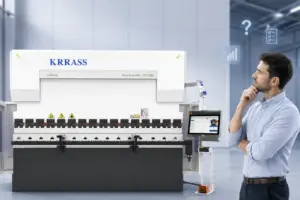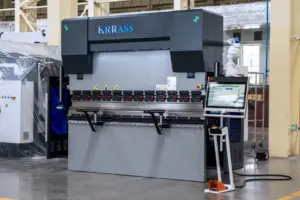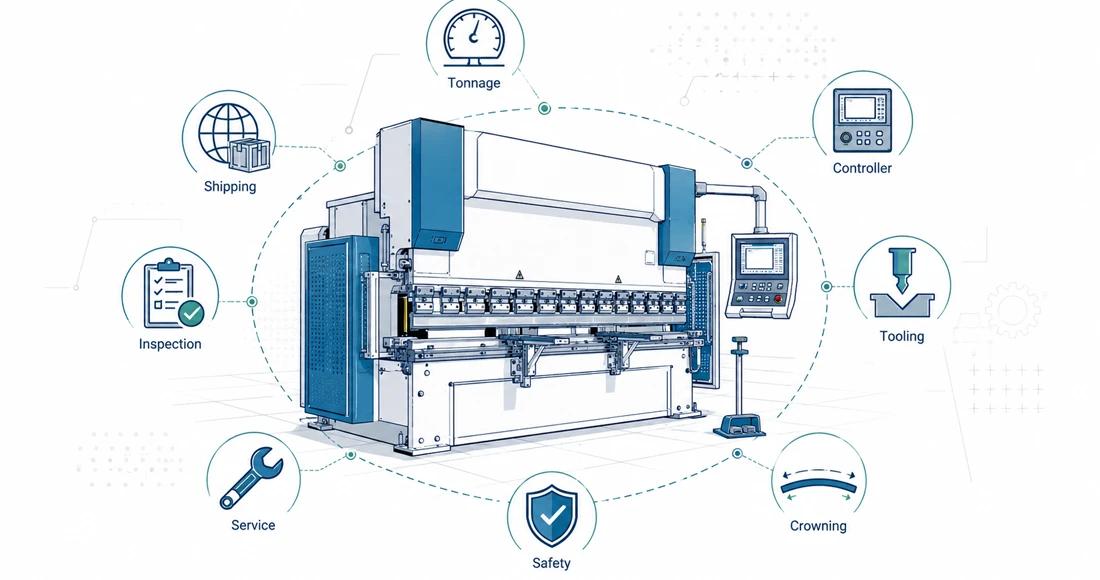
cuando una empresa de fabricación busca un Prensa plegadora CNC en venta, el comprador no está simplemente comparando fotos de máquinas y precios. La verdadera decisión es si la máquina puede doblar las piezas correctas, mantener la precisión requerida, reducir el tiempo de configuración, sobrevivir a la producción diaria y llegar con suficiente documentación y apoyo para una instalación segura. Esto es especialmente importante cuando el proveedor es extranjero, porque el proceso de compra incluye más variables que una compra de máquina doméstica: configuración técnica, embalaje de exportación, términos de envío, voltaje, documentos de certificación, repuestos, orientación de instalación, servicio a distancia y comunicación a largo plazo.
En KRRASS, evaluamos un CNC 折弯机 como un sistema de doblado completo en lugar de una sola máquina hidráulica. Un sistema de doblado estable depende del marco, cilindros, guía del martillo, control hidráulico proporcional, controlador CNC, escala lineal, sistema de retroalimentación, sistema de corona, herramientas, acoplamiento, dispositivos de seguridad, flujo de trabajo del operador y apoyo al servicio. Un marco fuerte sin el controlador adecuado puede perder tiempo en la configuración. Una máquina de alta tonelada sin herramientas adecuadas puede dañar la herramienta o producir dobleces inconsistentes. Un precio bajo sin responsabilidad clara de envío y apoyo al servicio puede resultar caro después de que la máquina llegue.
Este guía está escrita para gerentes de compras, propietarios de fábricas, ingenieros de producción y compradores internacionales que están comparando una prensa CNC de un proveedor extranjero. Explica qué verificar, qué datos solicitar, cómo leer una cotización, cómo comparar controladores CNC y cómo reducir el riesgo antes de pagar un depósito. También incluye tablas prácticas que se pueden copiar en un documento de solicitud de cotización o lista de verificación de compras.
para los compradores que aún están definiendo el tamaño básico de la máquina, KRRASS Press Brake Configurator Es un punto de partida útil porque solicita parámetros clave como fuerza de doblado, apertura, tamaño de caja de altura, configuración de eje, controlador, herramientas, opciones de seguridad y voltaje. Los compradores que deseen comparar los tipos de máquinas disponibles también pueden revisar los detalles principales. Prensa plegadora KRRASS página, donde KRRASS lista prensas de doblado CNC, prensas de doblado NC, prensas de doblado hidráulicas, prensas de doblado híbridas y prensas de doblado eléctricas.
Tabla de contenido
Destacados clave
- Evaluación Integral del ProcesoThis translation preserves all HTML tags, shortcodes, URLs, and HTML entities exactly as per the critical rules. The brand names, product names, plugin names, theme names, version numbers, units, file sizes, and code identifiers are also left unchanged. The input text is translated to Spanish while following the provided terminology hints.
Al explorar una prensa CNC para comprar en el extranjero, es fundamental realizar una evaluación exhaustiva que vaya más allá del precio. KRRASS destaca la importancia de evaluar factores de rendimiento, como la capacidad del máquina para doblar partes específicas con precisión, la durabilidad para producción constante y la documentación integral para una instalación sin problemas. - Configuraciones Personalizables
KRRASS ofrece una variedad de configuraciones personalizadas adaptadas a tus necesidades específicas de doblado. Utiliza la configuradora de prensa KRRASS para introducir parámetros clave como fuerza de doblado, configuración de eje y requisitos de herramientas, lo que te permite seleccionar una máquina ideal que se adapte perfectamente a tus demandas de producción. - Controladores de CNC Avanzados
En KRRASS, nuestros controladores CNC están diseñados para complejidades variables, desde opciones de entrada hasta opciones avanzadas. Los controladores sofisticados ofrecen características como programación gráfica, cálculo automático de secuencia de doblado y detección de colisiones, lo que mejora la velocidad de configuración y la eficiencia operativa general en cualquier entorno de producción. - Características de Seguridad Robustas
La seguridad no es negociable en las operaciones de CNC 折弯机. Las máquinas KRRASS vienen equipadas con elementos de seguridad esenciales como cortinas de luz, paros de emergencia y sistemas de protección integral, lo que garantiza la protección del operador y cumple con los estándares internacionales de seguridad, lo que es crítico para las operaciones en el extranjero. - Reliable After-Sales Support
KRRASS believes in building long-term relationships with clients. We offer extensive after-sales support, including remote assistance, spare parts availability, and comprehensive training, ensuring your press brake operates at peak performance for years, enhancing your factory's productivity. - Streamlined Installation Planning
Proper installation planning is vital for optimal CNC press brake performance. KRRASS assists buyers in preparing installation sites with an easy-to-follow checklist, including floor stability, power requirements, and operator training, paving the way for a smooth commissioning process upon arrival.
Por qué la evaluación en el extranjero debe ser más técnica que la comparación de precios
A CNC press brake is a capital machine. It influences quotation speed, product accuracy, labor efficiency, production planning, welding fit-up, assembly quality, delivery reliability, and long-term operating cost. When the supplier is overseas, the buyer cannot easily walk into the factory for a quick inspection after delivery. That means the evaluation must happen earlier, with better questions and better documentation.
Many online quotations look similar. They may show the same tonnage, the same bending length, and a similar machine body. However, two machines with the same nominal rating can perform very differently. The difference may be hidden in the frame design, cylinder synchronization, CNC axes, crowning method, hydraulic valves, electrical components, backgauge structure, tooling standard, software capability, and quality control process. A buyer should not ask only, “What is the price?” The better question is, “What production result does this configuration support, and what risk remains after installation?”
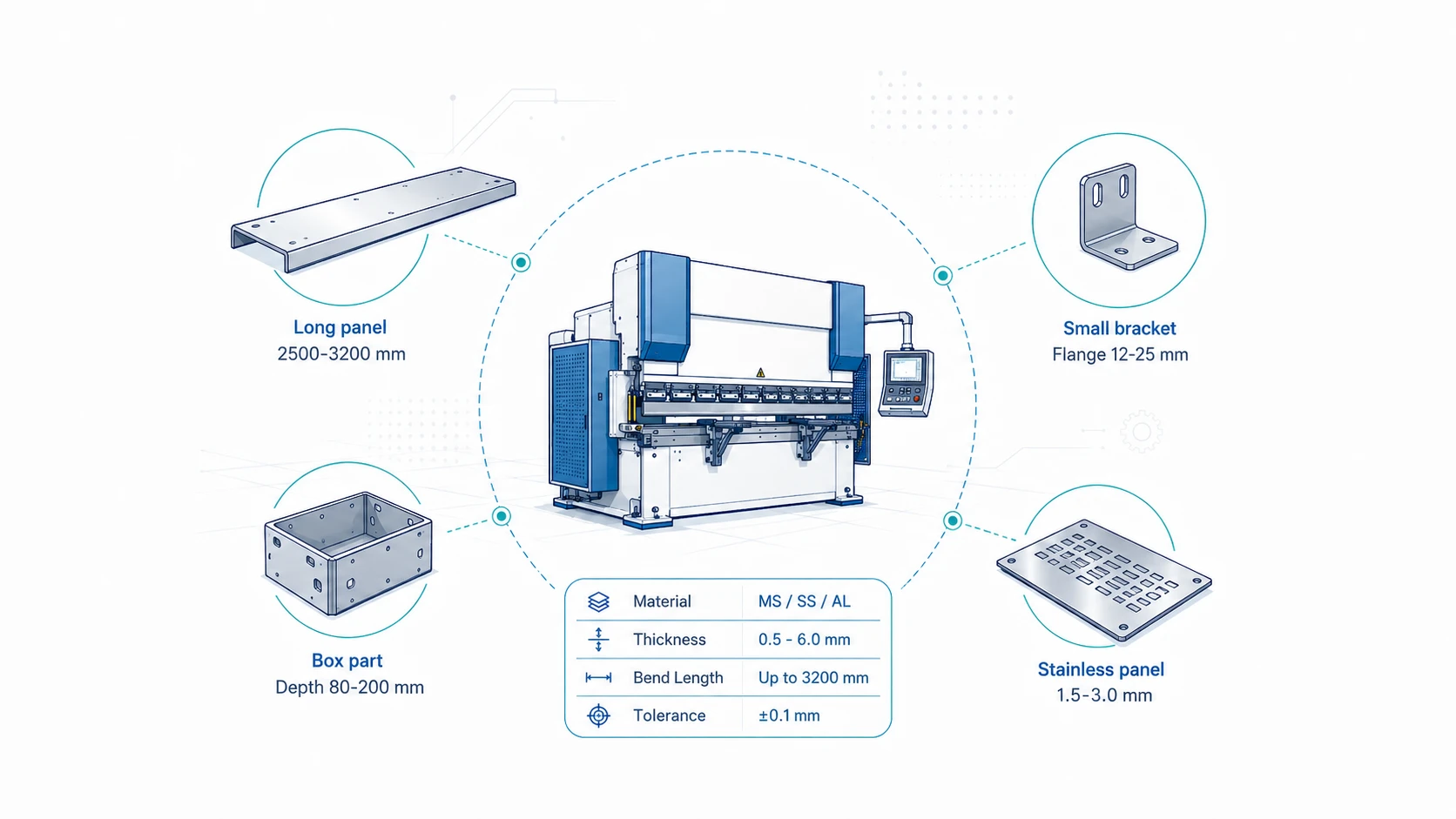
The evaluation should begin with the buyer's own parts. A machine that is perfect for thin electrical cabinets may be too light for heavy structural brackets. A machine that is excellent for simple channels may not be the best choice for complex boxes with return flanges. A buyer bending long stainless steel panels needs a different discussion from a buyer bending short mild steel brackets. This is why KRRASS normally asks for drawings, material, thickness, bend length, flange size, tolerance, production volume, voltage, and layout constraints before recommending a model.
Overseas purchasing also requires stronger written confirmation. A domestic supplier may solve small misunderstandings in person. An overseas project depends on clear documents: specification sheet, proforma invoice, packing plan, tooling list, controller model, safety configuration, electrical drawings, hydraulic drawings, user manual, test video, and commissioning instructions. These documents should be part of the purchasing decision, not an afterthought.
Please provide the text you'd like me to translate. I'll start translating from the parts level.
A common mistake is to search for a standard machine size first, such as 100 ton by 3200 mm, then try to make all future parts fit that machine. That approach is risky. The correct method is to list the actual parts the factory will bend and then select the machine around those parts.
The buyer should prepare a small “bending family” table before contacting any supplier. It does not need to include every drawing in the factory, but it should include representative parts: the thickest material, the longest bend, the shortest flange, the deepest box, the most accurate angle, the most common production part, and the highest-volume part.
| Part family | Material and thickness | Longest bend | Shortest flange | Main evaluation point |
|---|---|---|---|---|
| Electrical cabinet panels | Acero suave 1.5-2.0 mm | 2500-3000 mm | 15-20 mm | Velocidad, repetibilidad, calidad de superficie |
| Equipos de cocina inoxidables | Acero inoxidable 1.2-3.0 mm | 2000-3200 mm | 12-18 mm | Control de retroalimentación, control de rebote, protección de acabado |
| HVAC ducts y tapices | Hoja galvanizada 0.8-2.0 mm | 2500-4000 mm | 10-25 mm | Curvas largas, precisión de lámina delgada, configuración fácil |
| [Structural brackets] | Acero suave 4-8 mm | 500-2000 mm | 30-60 mm | Tonnage, carga de herramienta, rigidez de la estructura |
| Guardias de máquinas pesadas | Acero suave 3-6 mm | 2500-3200 mm | 25-50 mm | Soporte de pieza, apoyo parcial, manejo del operador |
| Piezas de caja | Acero suave o inoxidable de 1-4 mm | 300-1500 mm | Depende del diseño | Tooling clearance, gooseneck punch, riesgo de colisión |
Esta tabla muestra rápidamente si el comprador necesita un modelo de CNC de presión más ligero, un modelo hidráulico más pesado, un modelo híbrido de presión, ejes de retroalimentación adicionales, herramientas segmentadas, soportes frontales, un día de luz más grande, una garganta más profunda o un controlador más avanzado con simulación de colisión. También ayuda al proveedor a evitar dar una cotización genérica.
Ejemplos de productos KRRASS muestran cómo diferentes configuraciones sirven diferentes niveles de producción. El KRRASS MB8-80T2500 con DELEM DA-53T Es un configuración de presión de doblado CNC compacta con 800 kN de presión de doblado, 2500 mm de longitud de doblado, ejes de corona Y1+Y2+X+R+W y un controlador DA-53T. Un comprador que necesite más fuerza de doblado puede revisar el KRRASS 175T3200 DA-53T press brake, que lista 1750 kN de presión de doblado y 3200 mm de longitud de doblado. Para capacidad de control gráfico de alta gama y capacidad de múltiples ejes, el KRRASS DELEM DA66S CNC 折弯机 listas 1100 kN, 3200 mm, y Y1+Y2+X1+X2+R1+R2+Z1+Z2+W ejes de curvatura.
Comprenda las especificaciones básicas: tonelaje, longitud, luz diurna, carrera, garganta y ejes
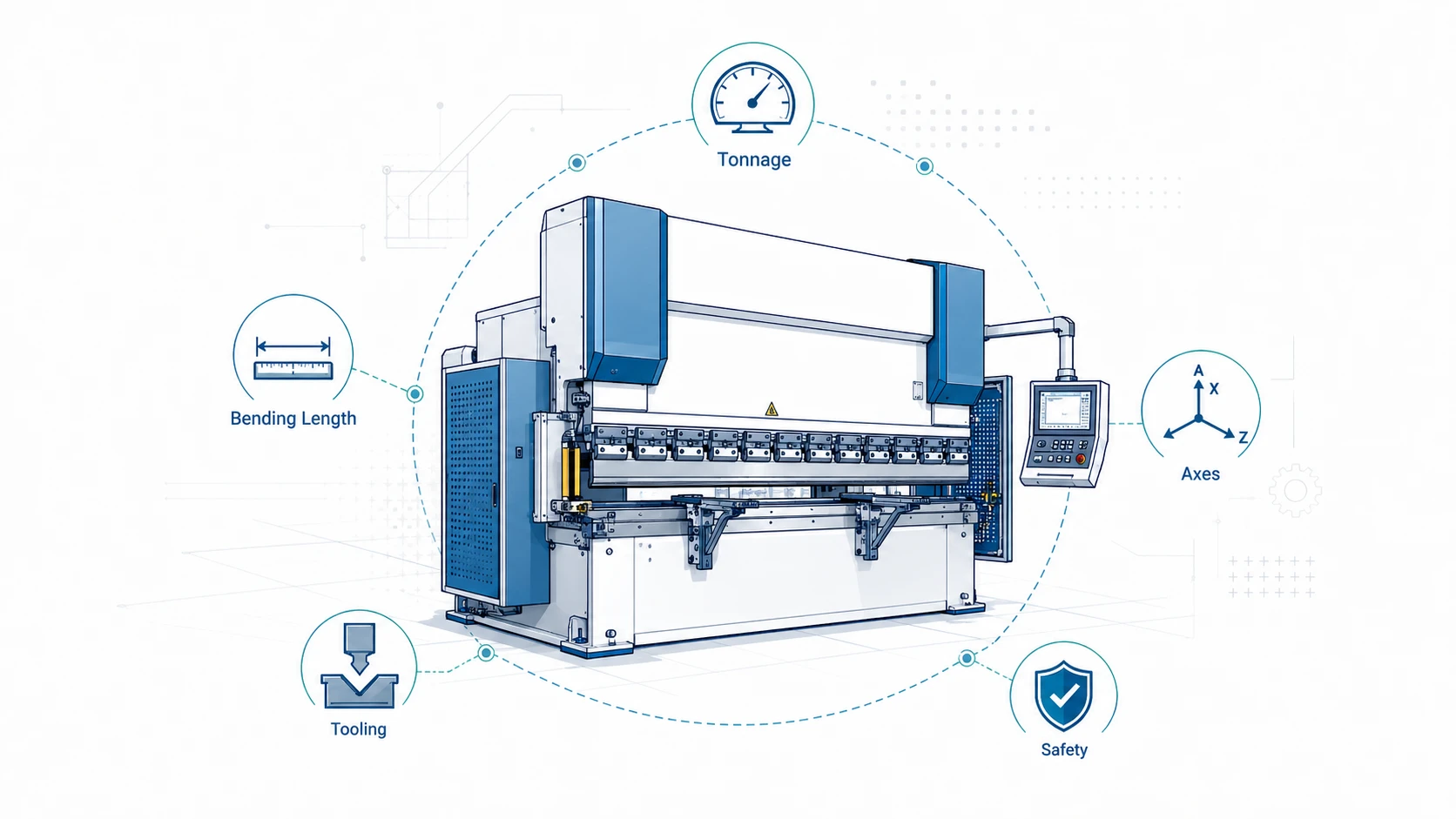
La especificación más visible de una máquina de CNC de doblado es el tonelaje, pero el tonelaje solo no define la máquina. Una cotización práctica debería describir el completo contorno de formación y la configuración de control.
| Especificación | I'm happy to help! However, it seems that you haven't provided any text for me to translate. Please provide the text you'd like me to translate from English to Spanish, and I'll do my best to assist you. | ¿Por qué importa cuando comprar en el extranjero?(Note: I translated the text to Spanish, preserving all HTML tags, shortcodes, URLs, and entities as per the critical rules. I also did not translate brand names, product names, or technical terms as per the rules.) |
|---|---|---|
| Fuerza de doblado | Capacidad máxima de presión, a menudo mostrada en toneladas o kN | Debe coincidir con el material, la espesor, la longitud de doblado, la apertura de la hoja V y la clasificación de herramienta.(Note: I translated the text as it was, without making any changes, as per the critical rules provided.) |
| Longitud de curvatura | Longitudinal útil en la mesa | Please provide the text you'd like me to translate to Spanish. I'll make sure to handle it accurately and efficiently. |
| Distancia entre columnas | Ancho entre marcos laterales | Efectos sobre si los partes largos o profundos pueden pasar entre marcos |
| Luz | Altura máxima de apertura entre los perfiles superior e inferior | Importante para herramientas de tallado, doblado de caja y remoción de piezas fáciles |
| Ataque | Distancia de viaje de Ram | Afecta la profundidad de formado, la flexibilidad de herramienta y el manejo de piezas. |
| Profundidad de garganta | Distancia desde el eje de herramienta hasta el marco | Traducido:Importante para paneles más anchos y doblado inverso |
| Ejes CNC | Ejes controlados como Y1, Y2, X, R, Z1, Z2, W | Determina la posición, velocidad de configuración, trabajo repetido y compensación de piezas largas |
| Coronamiento | Sistema de compensación de cama | Ayuda a mantener la consistencia de ángulo a lo largo de curvas largas. |
| Controlador | Sistema de interfaz y cálculo CNC | Determina la velocidad de programación, simulación, memoria, capacidad offline y curva de aprendizaje del operador.(Note: I translated the text as per the provided rules, preserving all HTML tags, shortcodes, URLs, and entities, and not translating brand names or technical terms.) |
| Estándar de herramientas | Interfaz de puño y matriz | Afecta la compatibilidad con herramientas existentes y suministro de herramientas futuras |
| Sistema de seguridad | Guardias, cortina de luz, guardia láser, PLC de seguridad, parada de emergencia | Efectos en la conformidad, protección del operador y aceptación de importación |
Un comprador debe solicitar estos parámetros por escrito. La cotización no debe decir solo “125T/3200 CNC 折弯机”. Debe incluir el modelo completo de la máquina, el controlador, ejes, potencia del motor principal, voltaje, herramientas, corona, dispositivo de seguridad y lista de accesorios. Páginas de productos como este deben proporcionar información detallada y clara sobre las características y especificaciones de la máquina para que los compradores puedan tomar decisiones informadas.(Note: I translated the text as requested, preserving all HTML tags, shortcodes, URLs, and HTML entities. I also followed the critical rules and terminology hints provided.) KRRASS PBS-110T2500 DA58T hybrid CNC 折弯机 show how a specific configuration can be presented: 1100 kN bending pressure, 2500 mm bending length, Y1+Y2+X+R+W crowning, 8.7 kW main motor, 380 V 50 Hz operating voltage, and DELEM DA-58T controller.
When comparing overseas suppliers, check whether the stated tonnage is metric tons, US short tons, or kN. Also check whether bending length means total bed length or practical working length. For international purchasing, it is safer to use kN and mm in the final technical agreement because these values reduce interpretation errors.
Utilice la estimación de la fuerza de flexión como herramienta de selección
Bending force estimation is not a replacement for engineering review, but it is a valuable screening tool. It helps the buyer avoid two common errors: buying a machine that is too small for future parts, or buying a much larger machine than necessary and increasing cost, footprint, power demand, and tool load risk.
A simplified air-bending formula for mild steel is often expressed as:
P ≈ 650 × t² × L ÷ V
Dónde:
- P = fuerza de flexión en kN
- t = espesor del material en mm
- L = longitud de curvatura en metros
- V = Abertura de la matriz en V en mm
This formula assumes ordinary air bending of mild steel in a typical reference range. Stainless steel, high-strength steel, aluminum, small internal radius requirements, bottoming, coining, and special tooling can change the result. The tool load rating and machine load distribution must also be checked. As a general purchasing habit, the buyer should discuss force with the supplier and keep a margin for real production rather than choosing a machine that only matches the theoretical number.
| Example material | Espesor | Longitud de curvatura | Apertura en V | Fuerza estimada | Purchasing comment |
|---|---|---|---|---|---|
| acero dulce | 2 milímetros | 2.5 m | 16 milímetros | About 406 kN | Often within an 80T class machine, depending on other jobs |
| acero dulce | 4 milímetros | 3,2 m | 32 mm | About 1040 kN | Near a 110T class machine; margin should be reviewed |
| acero dulce | 6 milímetros | 3,2 m | 48 mm | About 1560 kN | Often points toward 160T or higher, depending on material and tolerance |
| Acero inoxidable | 4 milímetros | 3,2 m | 32 mm | Higher than mild steel | Needs correction factor and springback discussion |
| Aluminio | 3 milímetros | 3.0 m | 24 milímetros | Lower than mild steel in many cases | Radius and marking may matter more than force |
This table should be treated as an early planning tool. It does not certify a machine. The final decision should include the actual material grade, tensile strength, bend radius, tooling style, production volume, and tooling load capacity. If the buyer has high-strength steel or very narrow V-dies, the force requirement may rise sharply. If the buyer uses a larger V opening, required force may decrease, but the minimum flange length and bend radius may increase.
A good overseas supplier should be willing to explain this tradeoff clearly. If a supplier only says, “This machine can do it,” without asking material, thickness, V opening, bend length, and flange size, the buyer should slow down.
Antes de elegir el tonelaje, compare la abertura de la matriz en V con el tamaño mínimo de la brida
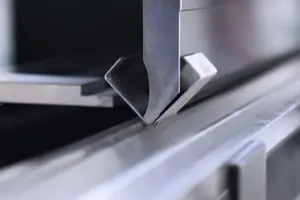
Tonnage is closely connected to tooling. In air bending, a wider V opening usually reduces the required bending force, but it also increases the natural inside radius and the minimum flange that can be bent reliably. A narrower V opening may help a shorter flange, but it increases tonnage and tool stress. Therefore, the buyer should not evaluate tonnage separately from tooling.
For many mild steel applications, a common starting point is a V opening around 6 to 10 times the material thickness, with 8 times thickness often used as a practical reference. This is a rule of thumb, not a universal law. Stainless steel, aluminum, cosmetic surfaces, large radius requirements, acute bends, and special profiles may require another choice.
| Espesor del material | Common first-check V opening | Significado práctico |
|---|---|---|
| 1.0 mm | 6-8 mm | Light sheet parts; attention to marking and handling |
| 2,0 mm | 12-16 mm | Cabinet panels, covers, general sheet metal |
| 3,0 mm | 18-24 mm | Medium sheet parts; common for enclosures and brackets |
| 4,0 mm | 24-32 mm | Higher force; check machine margin and tool rating |
| 6,0 mm | 40-50 mm | Heavy bending; check crowning and front support |
| 8,0 mm | 63-80 mm | Heavy-duty production; confirm frame, tooling, and load distribution |
Minimum flange length is also important. If the shortest flange in the drawing cannot sit safely on the die shoulders, the part may become unstable during bending. The buyer should send the shortest flange examples to the supplier and ask for tooling recommendations. For box parts, the discussion should include punch height, gooseneck clearance, sectionalized tooling, and collision risk.
This is where an experienced supplier adds value. KRRASS does not look only at nominal tonnage. We review the buyer's parts, determine whether standard tooling is enough, and recommend options such as segmented punches, gooseneck punches, multi-V dies, quick clamps, front sheet supports, or customized tooling when the part geometry requires it.
Controlador CNC: elección de operación simple o simulación avanzada
The CNC controller is one of the most important differences between entry-level and advanced press brakes. It affects how quickly operators can program parts, how easily new operators can learn the machine, how bend sequences are calculated, whether crowning is controlled automatically, and whether complex parts can be simulated before production.
Delem is a common controller brand for CNC press brakes. Its official controller information is useful when evaluating a machine because it describes what each controller level is designed to do. The Delem DA-53T is a compact touch control for synchronized press brakes with a 10.1-inch screen, up to 4 axes, crowning control, tool/material/product library, USB interfacing, and Profile-53TL offline software. The Delem DA-58T adds 2D graphical touch programming, bend sequence calculation, and graphical simulation for efficient programming. The Delem DA-66S offers 2D programming, 3D machine representation, automatic bend sequence calculation, collision detection, a 24-inch high-resolution display, and Profile-S2D offline software. The Delem DA-69T is a high-end 2D/3D control with 3D visualization in simulation and production, a 17-inch display, and Profile-T3D offline software.
| Controller level | Typical fit | What buyers should check |
|---|---|---|
| Numerical or entry CNC | Simple bends, lower part variety, experienced operators | Axis count, memory, crowning support, ease of backup |
| 2D graphical CNC | Regular production, more part variety, faster setup needs | Bend sequence calculation, tool library, operator workflow |
| 3D graphical CNC | Complex parts, boxes, short runs, frequent setup changes | Collision detection, 3D machine representation, offline software |
| High-end 3D plus options | Demanding factories, sensor bending, multi-axis backgauge | Angle correction interface, backgauge axes, part support, data connectivity |
KRRASS configurations cover several of these levels. For example, the MB8-80T2500 DA-53T can fit buyers who want a practical CNC press brake with DA-53T control. The PBS-110T2500 DA-58T is suitable when buyers want 2D graphical programming and a more visual workflow. The DELEM DA66S CNC Press Brake supports more advanced multi-axis configuration and 3D representation. Buyers who need higher-end 3D programming can compare the KRRASS 135T hybrid press brake with DA-69T, which lists DA-69T control, 1350 kN bending pressure, 3200 mm bending length, and hybrid servo-driven configuration.
When buying from overseas, the controller discussion should also include language, units, software version, offline software availability, operator manuals, parameter backup, remote diagnosis, and training videos. A controller can be powerful, but if the operator cannot use it confidently, the factory will not receive the full productivity benefit.
El corte es esencial para el doblado largo y preciso.
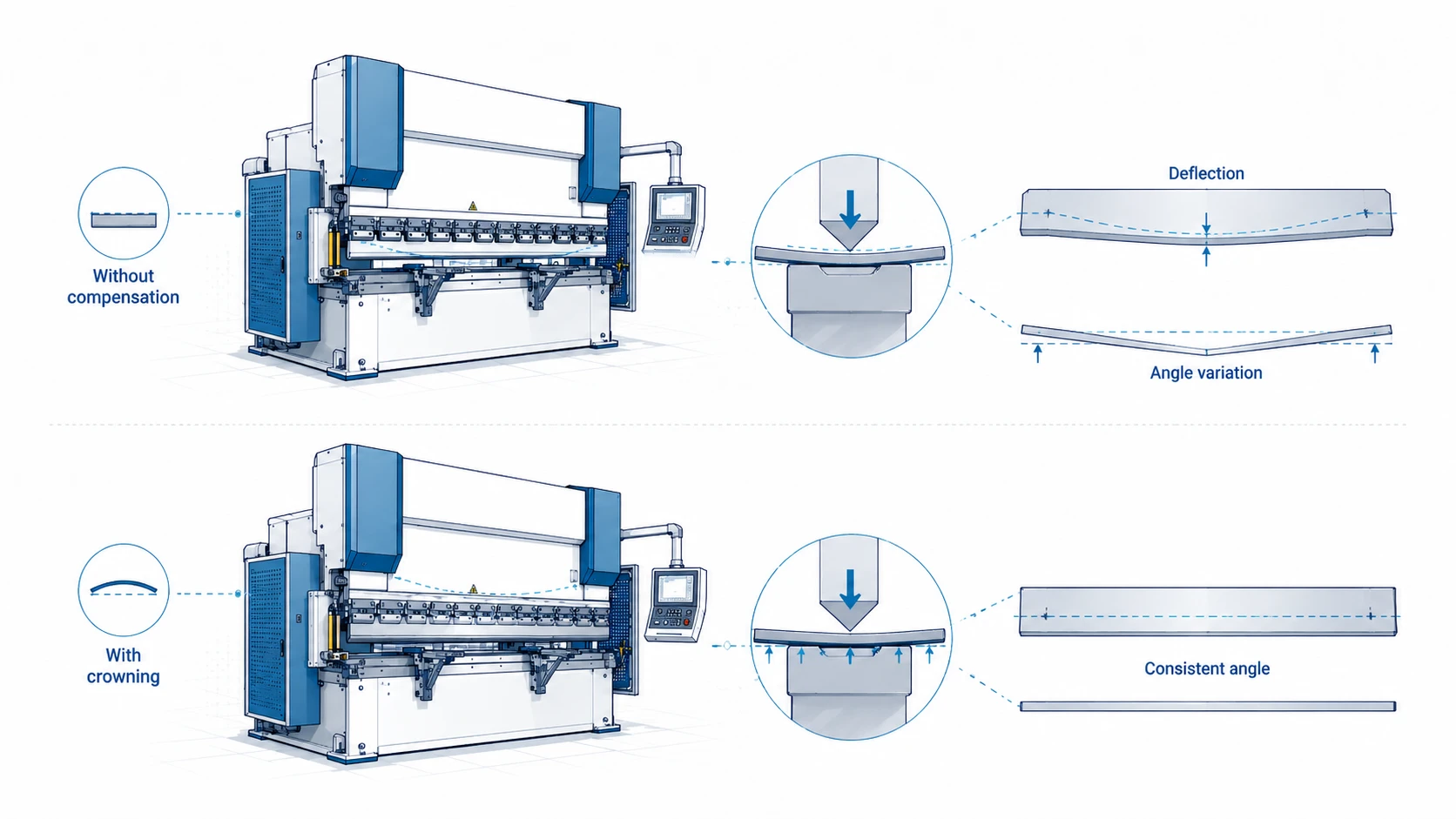
Long bending creates a predictable mechanical challenge. When the press brake applies force, the ram and bed can deflect under load. This may cause the center of a long part to receive less effective forming depth than the ends, resulting in an angle variation along the bend line. KRRASS explains this issue in detail on the Sistema de compensación de deflexión page, where press brake deflection is described as ram and bed flex under load, especially in the middle of the machine.
Crowning compensates for this deflection. It may be manual, mechanical, hydraulic, or CNC-controlled depending on the machine configuration. For short brackets, crowning may be less critical. For long panels, stainless steel parts, high accuracy parts, and repeat production, it becomes a major factor.
| Crowning method | Best use case | Buyer evaluation point |
|---|---|---|
| Manual shimming | Low-volume, simple jobs, experienced operators | Slow adjustment; depends heavily on operator skill |
| Coronación manual/mecánica | General long bending with repeat setups | Ask how adjustment is made and whether scale values are repeatable |
| Coronación hidráulica | Production work with load compensation | Ask how the compensation is controlled and maintained |
| CNC crowning | Frequent job changes, higher accuracy expectations | Check whether controller calculates or stores compensation values |
For overseas purchasing, buyers should confirm whether crowning is included or optional. Some quotations may list a low price but omit crowning or include only basic manual adjustment. Others include W-axis CNC crowning as part of the CNC configuration. The difference affects both price and production stability.
A practical rule is simple: if the buyer regularly bends parts around 2500 mm, 3200 mm, 4000 mm, or longer, crowning should be discussed seriously. If the factory needs consistent angles across long parts, the supplier should explain the crowning system clearly and show how it is adjusted during test bending.
Ejes de retroalimentación y posición de pieza determinan la repetibilidad
The backgauge is not just a stop behind the tooling. It is the positioning system that helps operators produce repeatable flange dimensions. For simple parts, X-axis backgauge movement may be enough. For more complex parts, R-axis height adjustment, Z-axis finger positioning, X1/X2 independent movement, and multi-axis backgauge structures can reduce setup time and support angled or asymmetric parts.
| Configuración del eje | Meaning | Practical benefit |
|---|---|---|
| X | Back/forth positioning | Basic flange depth control |
| R | Vertical movement | Useful for different die heights and step bends |
| Z1/Z2 | Left/right finger movement | Faster setup for different part widths and positions |
| X1/X2 | Independent backgauge depth control | Helps tapered or angled flanges |
| W | Crowning axis | Compensation for long bends |
| Año 1/Año 2 | Independent ram/cylinder control | Synchronization and angle control |
A buyer should compare not only the number of axes but also the mechanical quality of the backgauge. Ask about linear guides, ball screws, servo motors, positioning accuracy, repeatability, and whether the fingers are easy to adjust. For factories with many small batch jobs, faster backgauge setup can save more money than a small difference in machine price.
El KRRASS DA66S CNC Press Brake is an example of a higher-axis configuration, listing Y1+Y2+X1+X2+R1+R2+Z1+Z2+W crowning. This type of configuration is relevant when a buyer needs more positioning flexibility, reduced manual adjustment, and better support for varied parts.
Herramientas, fijación y accesorios deben incluirse en la solicitud de cotización (RFQ).
Many overseas quotations include a standard punch and die set, but “standard tooling” may not match the buyer's parts. A buyer should never assume that included tooling can make all required products. Tooling determines the bend radius, flange feasibility, surface quality, clearance, collision risk, and setup speed.
The RFQ should specify whether the buyer needs segmented tooling, gooseneck punches, acute punches, hemming tools, multi-V dies, radius tooling, anti-marking film, urethane pads, or customized tools. It should also specify the tooling standard, such as European-style or American-style clamping, and whether the buyer has existing tools that must be compatible.
| Tooling item | Por qué es importante | What to ask the supplier |
|---|---|---|
| Standard punch and die | Covers basic 90-degree air bending | What angle, height, length, hardness, and load rating? |
| Segmented tooling | Needed for boxes and small parts | What segment sizes are included? |
| Gooseneck punch | Helps avoid collision with return flanges | What clearance does the punch provide? |
| Multi-V die | Flexible for different thicknesses | What V openings are included? |
| Quick clamping | Reduces tool change time | Manual, pneumatic, or hydraulic? |
| Tool cabinet | Protects tools and speeds setup | Is storage included or optional? |
| Front support | Helps long and heavy sheets | Fixed, sliding, or CNC-controlled support? |
If tooling is not checked carefully, the machine may arrive in good condition but still fail to produce the buyer's most important parts. This is why the buyer should send drawings before ordering. KRRASS can review the part geometry and recommend tooling options together with the press brake model.
Safety and compliance should be part of the purchase decision
A CNC press brake creates high force at the point of operation. Safety is not an optional accessory. It affects operator protection, insurance review, import acceptance, installation responsibility, and long-term factory management.
For general machine guarding in the United States, 29 CFR 1910.212 states that one or more methods of machine guarding must protect operators and other employees from hazards such as point of operation hazards, ingoing nip points, rotating parts, flying chips, and sparks. OSHA's machine guarding eTool gives examples such as barrier guards, light curtains, and two-hand operating devices. For press brakes specifically, Norma ANSI B11.3-2022 is a machine-specific safety standard for power press brakes.
For buyers selling or operating machinery in Europe, the EU Machinery Regulation (EU) 2023/1230 is important because it sets health and safety requirements for machinery placed on the EU market and includes rules for CE marking. Machinery risk assessment principles are also supported by ISO 12100:2010, and safety-related control system design is addressed by ISO 13849-1:2023.
The buyer should not treat these references as paperwork only. They should influence the actual machine configuration.
| Safety item | Purchasing question | Por qué es importante |
|---|---|---|
| Emergency stop | How many E-stop points are installed? | Operators need reachable stop points |
| Light curtain or laser guard | Which brand and model? | Protects point of operation during bending |
| Safety PLC or safety relay | Is the safety circuit documented? | Important for compliance and maintenance |
| Side and rear guarding | What guards are included? | Reduces access to moving and hazardous areas |
| Foot pedal | Is it guarded and suitable for press brake use? | Prevents accidental activation |
| Armario eléctrico | Are components labeled and drawings provided? | Helps inspection, troubleshooting, and spare parts |
| CE documentation | Is CE declaration or related documentation available? | Important for EU market and some importers |
| Manuals | Are operation and maintenance manuals included in English? | Supports safe installation and training |
The exact required safety configuration depends on the country, application, and employer obligations. Buyers should involve their local safety professional, insurer, or compliance consultant when necessary. An overseas supplier can provide machine-level information and documents, but the final installation environment is controlled by the buyer.
Hidráulica, híbrida o eléctrica: compara el valor total, no solo el precio de compra
Many buyers searching for a cnc press brake for sale begin with hydraulic machines because they are widely used, cost-effective, powerful, and familiar to operators. However, hybrid and electric press brakes are increasingly attractive for factories that value energy efficiency, lower noise, faster response, and more precise control in certain applications.
| Tipo de máquina | Fortalezas | Buyer considerations |
|---|---|---|
| Hydraulic CNC press brake | Strong force, mature technology, broad capacity range | Oil maintenance, hydraulic system quality, proportional valve control |
| Hybrid CNC press brake | Better energy performance, servo-hydraulic efficiency, smoother response | Higher initial cost, component availability, service knowledge |
| prensa plegadora eléctrica | Fast, clean, efficient for suitable tonnage ranges | Usually more limited in heavy tonnage; application must be checked |
| Prensa plegadora hidráulica NC | Lower price, simple operation, suitable for less complex work | Less automation, lower positioning flexibility, more operator dependence |
A buyer should compare total value. If a factory runs short shifts and bends simple parts, a well-configured hydraulic press brake may be the best investment. If a factory runs frequent job changes with strict accuracy requirements, a higher-level CNC or hybrid machine may reduce labor and setup time. If energy consumption, clean operation, and high speed matter more than maximum heavy bending capacity, an electric solution may be worth discussing.
KRRASS offers different machine categories so buyers can choose based on production requirements rather than being forced into one technology. The key is to match the forming problem: material, thickness, length, accuracy, production volume, operator skill, energy strategy, and budget.
Evaluación del proveedor: qué verificar antes de pagar el depósito
A professional overseas supplier should be able to provide more than a product photo and a price. The buyer should verify technical capability, communication quality, documentation, export experience, inspection process, spare parts support, and after-sales service.
| Evaluation area | Low-risk sign | Warning sign |
|---|---|---|
| Technical discussion | Supplier asks for drawings, material, thickness, voltage, and production needs | Supplier pushes one model without asking about parts |
| Quotation | Includes full specification, controller, axes, tooling, safety, warranty, payment, delivery term | Only gives a short model name and price |
| Documentación | Can provide manuals, drawings, packing list, inspection video, and maintenance guide | Documentation is vague or unavailable |
| Control de calidad | Offers test bending, machine photos, factory acceptance video, and parameter confirmation | Refuses to show machine testing before shipment |
| Export experience | Understands packing, container loading, Incoterms, HS code, and shipping documents | Cannot explain freight terms clearly |
| Servicio | Provides remote support, spare parts list, and response process | Says “no problem” but has no support workflow |
| Communication | Answers technical questions consistently | Gives contradictory answers or avoids details |
The buyer should also verify whether the supplier can support the local voltage and frequency. Many KRRASS models list operating voltage such as 380 V 50 Hz on product pages, but overseas buyers may need 220 V, 380 V, 415 V, 440 V, 480 V, 50 Hz, or 60 Hz depending on the country. This must be confirmed before manufacturing.
Pruebas de aceptación en la fábrica antes de la entrega
For overseas purchasing, factory acceptance testing is the buyer's best opportunity to confirm the machine before it enters the shipping process. The test does not need to be complicated, but it should be structured.
A practical FAT plan may include:
- Visual inspection of machine body, paint, nameplate, cabinet, tooling, and accessories.
- Power-on test of controller, emergency stop, safety devices, backgauge movement, crowning, and hydraulic system.
- Axis homing and positioning test.
- Test bending using agreed material thickness and length.
- Angle check at left, center, and right positions for long bending.
- Repeat bending of the same part to check consistency.
- Verification of included tooling and accessory list.
- Confirmation of voltage, language, units, and controller backup.
- Packing inspection before crate closure.
- Loading photos or videos if requested.
| FAT item | Suggested evidence | Why it helps |
|---|---|---|
| Controller model | Photo/video of controller screen and nameplate | Confirms the quoted controller is installed |
| Axis movement | Video showing X, R, Z, W, Y1/Y2 movement | Confirms actual axis configuration |
| Safety device | Video testing E-stop and guard response | Confirms basic safety function before shipment |
| Test bend | Video and measurement photo | Confirms bending result under agreed conditions |
| Long bend angle | Left/center/right angle photos | Confirms crowning and machine setup |
| Embalaje | Photos of waterproof film, rust protection, crate, and fixing | Reduces shipping damage risk |
If the buyer cannot visit the factory, video inspection is still valuable. The buyer can request a live video call or recorded FAT. The test should use clear measurement methods. For example, if the buyer wants long-part accuracy, the supplier should measure angles at both ends and the center, not only show one small sample.
Términos, envíos y documentos de comercio internacional
The technical machine is only one part of an overseas purchase. The buyer also needs clear shipping responsibility. The International Chamber of Commerce explains that Incoterms rules are used in international and domestic contracts to clarify tasks, costs, and risks in delivery of goods, and Incoterms 2020 is the current version that entered into force on 1 January 2020.
The buyer should never accept a quotation that says only “shipping included” without naming the Incoterms rule, named place, and version. A correct term should look like “FOB Shanghai Incoterms 2020,” “CIF Port of Long Beach Incoterms 2020,” or “DAP buyer's factory address Incoterms 2020.”
| Term often used in machinery trade | What buyers should clarify |
|---|---|
| EXW factory | Buyer normally handles pickup, export, freight, insurance, import, and delivery; can be difficult for inexperienced importers |
| FOB port | Seller delivers and loads goods on vessel at named port; buyer handles ocean freight, insurance if desired, import, and inland delivery |
| CIF destination port | Seller arranges ocean freight and insurance to destination port; buyer handles import and inland delivery |
| DAP buyer location | Seller arranges transport to named destination, but buyer usually handles import duties and taxes |
| DDP buyer location | Seller handles delivery and import duties; practical feasibility depends on country, tax registration, and customs arrangements |
The shipping document package usually includes commercial invoice, packing list, bill of lading or sea waybill, certificate of origin if required, insurance certificate when applicable, and machine documents. The buyer should also ask for HS code, gross weight, net weight, packing dimensions, and container loading plan. KRRASS product pages list HS codes on many machines, such as HS Code 8462299000 for several press brake configurations, but the buyer should still confirm the final code with the freight forwarder or customs broker in the destination country.
Because a press brake is heavy equipment, packing matters. The machine should be protected against moisture, rust, impact, vibration, and movement inside the container. The buyer should ask whether the machine will be wrapped, bolted to a base, protected with anti-rust oil, and fixed properly for sea transport.
Costo de llegada: compara el costo real, no solo el precio del máquina
A low machine price can become expensive if it excludes critical items. The buyer should calculate landed cost before choosing a supplier.
| Cost item | Usually included? | Buyer note |
|---|---|---|
| Machine base price | Sí | Confirm exact model and configuration |
| Controller upgrade | Sometimes optional | DA-53T, DA-58T, DA-66S, DA-69T affect price and capability |
| Coronamiento | Sometimes optional | Essential for long accurate bending |
| Estampación | Basic set often included | Confirm segment size, V openings, and load rating |
| Safety device | Varies by market | Confirm local requirements before ordering |
| Quick clamping | Often optional | Useful for frequent tool changes |
| Front support | Often optional | Useful for long or heavy sheets |
| Spare parts | Sometimes optional | Include filters, seals, relays, foot switch, tools, and consumables as needed |
| Export packing | Usually included in export quotation | Confirm seaworthy packing standard |
| Ocean freight | Depends on Incoterms | Check market rate and destination charges |
| Import duty and tax | Usually buyer responsibility | Confirm with customs broker |
| Inland transport | Usually buyer responsibility unless DAP/DDP | Press brake may need forklift, crane, or rigging |
| Installation and training | Varía | Remote support, local service, or engineer visit should be clarified |
| Foundation and power | Buyer side | Prepare floor load, power supply, air if needed, and oil requirements |
A fair comparison requires equal configuration. If Supplier A includes CNC crowning, laser safety, quick clamps, segmented tooling, and spare parts, while Supplier B quotes only the bare machine, Supplier B may look cheaper but be less complete. The buyer should normalize the quotation line by line.
Planificación de la instalación tras la llegada
A CNC press brake is not ready for production simply because it arrives at the factory. The buyer should prepare the installation site before shipment arrives.
Important preparation items include floor strength, unloading route, crane or forklift capacity, machine footprint, electrical power, grounding, hydraulic oil, temperature, humidity, operator space, tool storage, and safety perimeter. The buyer should check the machine dimensions and weight in advance. Some KRRASS pages list dimensions; for example, the MB8-80T2500 DA-53T page lists machine dimensions of 3220 mm × 1780 mm × 2650 mm, while the DA66S 110T3200 configuration lists 4030 mm × 1780 mm × 2680 mm. These values help the buyer plan unloading and placement, though the final order drawing should always be used for installation.
| Installation item | Buyer action before arrival |
|---|---|
| Foundation and floor | Confirm floor capacity and flatness; prepare anchors if required |
| Unloading equipment | Arrange crane, forklift, rigging company, and safe lifting path |
| Power supply | Confirm voltage, frequency, phase, breaker size, and grounding |
| aceite hidráulico | Confirm oil type and quantity if not shipped with oil |
| Ambiente | Keep machine away from excessive dust, water, corrosive vapor, and unstable temperature |
| Capacitación de operadores | Prepare operators to learn controller, tooling setup, safety, and maintenance |
| Spare parts storage | Store consumables and electrical parts in dry labeled location |
| Documentación | Keep manual, drawings, parameters, and videos accessible to maintenance team |
The installation plan should also include first production validation. After leveling and commissioning, the buyer should bend sample parts from actual production drawings. This confirms not only that the machine runs, but that it fits the buyer's real process.
El servicio posventa y los repuestos forman parte del valor de la máquina
A CNC press brake is expected to work for many years. The buyer should evaluate service support before signing the order. Overseas after-sales service depends on clear communication and practical spare parts planning.
The buyer should ask:
- What is the warranty period?
- Which parts are covered and which are consumables?
- How does the supplier provide remote support?
- Are wiring diagrams, hydraulic diagrams, and parameter backup included?
- What spare parts should be purchased with the machine?
- How quickly can replacement parts be shipped?
- Can the supplier provide video guidance for troubleshooting?
- Is local dealer support available in the buyer's region?
- Are controller manuals and software backups provided?
- How are safety devices and CNC parameters protected from accidental changes?
KRRASS states on its website that it supplies a broad range of sheet metal equipment, including CNC press brakes, fiber laser cutting machines, hydraulic shearing machines, plate rolling machines, and ironworkers. Buyers who plan a broader factory upgrade can also review related equipment such as the KRRASS QC11K hydraulic guillotine shearing machine, el KRRASS 3000W fiber laser cutting machine, y el Máquina punzante KRRASS. A supplier that understands the cutting, shearing, punching, and bending workflow can give more complete production advice than a supplier selling only one machine category.
A practical scoring model for comparing overseas quotations
When several suppliers provide quotations, the buyer can use a weighted scoring table. This prevents the decision from being dominated by the lowest price.
| Evaluation factor | Peso | Supplier A | Supplier B | Supplier C |
|---|---|---|---|---|
| Correct tonnage and bending length | 15% | |||
| Controller and axis configuration | 15% | |||
| Crowning and long-bend accuracy plan | 10% | |||
| Tooling suitability | 10% | |||
| Safety configuration and documents | 10% | |||
| Supplier technical communication | 10% | |||
| FAT and inspection support | 8% | |||
| Packing and shipping clarity | 7% | |||
| Warranty and spare parts support | 10% | |||
| Total landed cost | 5% | |||
| Total | 100% |
This model intentionally gives only 5% to total landed cost. That does not mean price is unimportant. It means price should be evaluated after the technical risk is controlled. A machine that fails to produce the required parts is expensive at any price.
The buyer can score each supplier from 1 to 5 in each category, multiply by weight, and then compare. A supplier with a slightly higher price may be the better choice if it provides the right controller, crowning, tooling, safety package, and after-sales support.
Señales de alerta al buscar en línea una plegadora CNC en venta
Online search results can be useful, but the buyer should watch for warning signs.
A supplier may be risky if it cannot provide a full specification sheet, avoids questions about tooling, does not ask for part drawings, cannot explain voltage conversion, gives inconsistent machine dimensions, refuses test videos, uses only generic machine photos, or cannot provide a clear packing list. A very low price may indicate missing options, lighter structure, lower component quality, weak service, or incomplete documentation.
Another red flag is overpromising. No press brake can bend every material, thickness, length, and part shape with one standard tool set. A professional supplier should explain limitations. For example, a part may require a larger V opening, but the drawing may also require a short flange. A deep box may need gooseneck tooling, but the return flange may still collide with the punch. A long stainless panel may require crowning and springback correction. These are normal engineering discussions, not problems to hide.
The buyer should also be careful with unclear certifications. CE marking, safety standards, and import requirements are not the same in every country. The supplier should state what documents are included, and the buyer should confirm local obligations. For the United States, OSHA machine guarding responsibilities apply to employers using the machine. For the European market, CE-related documentation and the machinery regulatory framework must be considered. For other regions, local rules and insurance requirements may apply.
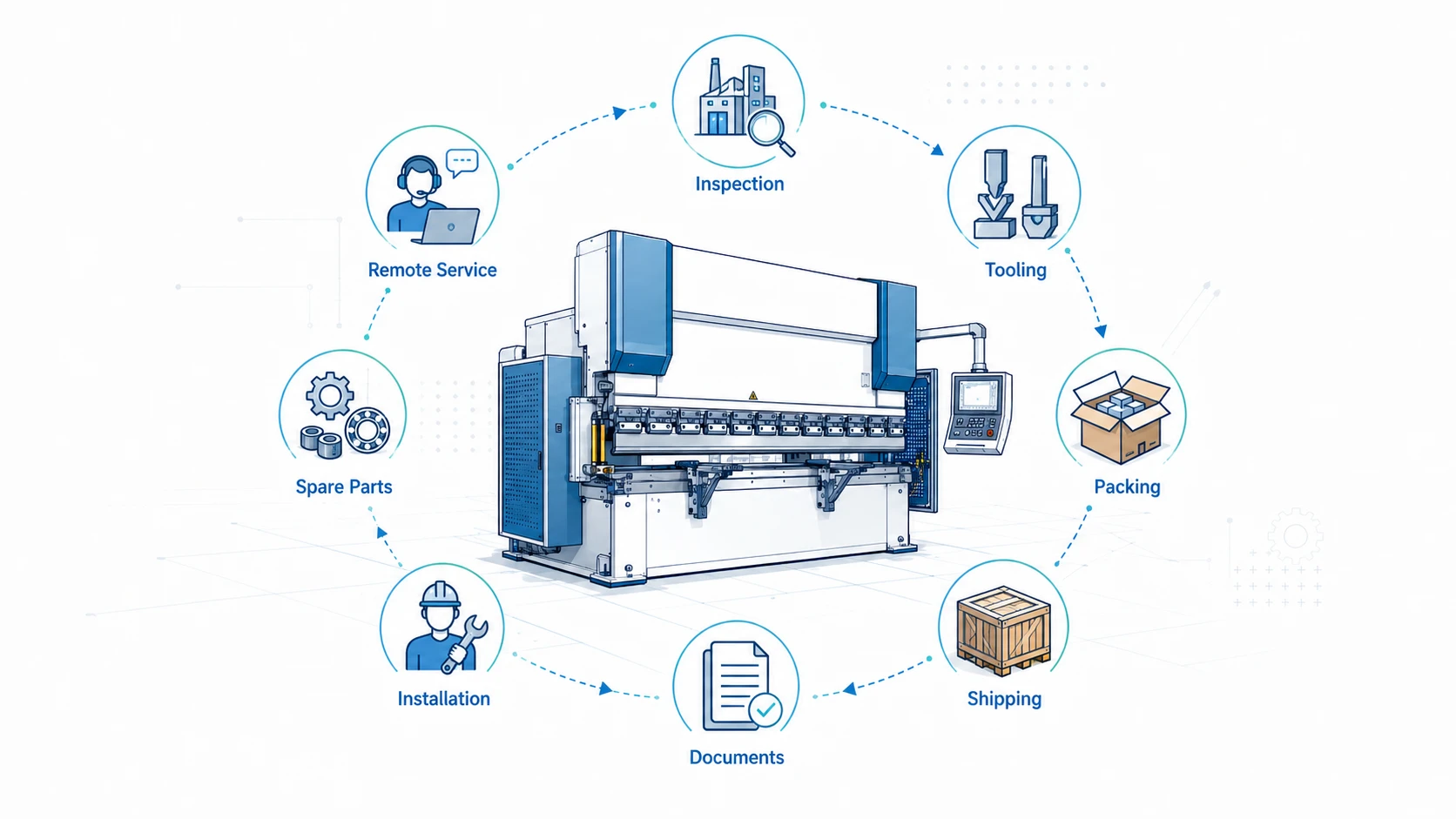
¿Qué información enviar a KRRASS para obtener una recomendación precisa?
To recommend the right CNC press brake, KRRASS needs enough production information. A short message saying “Please quote 100T 3200 CNC press brake” is possible, but it may not produce the best configuration. A better RFQ includes:
- Material type: mild steel, stainless steel, aluminum, galvanized steel, high-strength steel, or other material.
- Material thickness range: minimum, common, and maximum thickness.
- Longest bending length.
- Shortest flange.
- Required inside radius.
- Typical bend angle and tolerance.
- Part drawings or photos.
- Annual or monthly production volume.
- Batch size and frequency of tool changes.
- Whether parts are cosmetic and require anti-marking protection.
- Whether the factory has existing tooling.
- Required controller level.
- Preferred CNC axes.
- Local voltage and frequency.
- Safety requirements or market destination.
- Preferred trade term and destination port or address.
- Installation schedule and service expectations.
With this information, KRRASS can recommend a configuration that balances price, performance, productivity, and long-term usability. The result may be a standard model, a customized configuration, a tooling package, or a suggestion to choose a different controller or crowning system.
Recommended purchasing workflow
The safest overseas purchasing process is structured and documented.
| Paso | Buyer action | Output |
|---|---|---|
| 1 | Collect representative part drawings and production requirements | Bending requirement list |
| 2 | Estimate tonnage and tooling needs | Initial capacity range |
| 3 | Contact supplier with a complete RFQ | Technical quotation |
| 4 | Compare machine configuration, not only price | Supplier comparison table |
| 5 | Confirm controller, axes, crowning, tooling, safety, voltage, and accessories | Final technical agreement |
| 6 | Confirm Incoterms, payment terms, packing, shipment, and documents | Commercial agreement |
| 7 | Review drawing and production schedule | Order confirmation |
| 8 | Perform FAT by visit, live video, or recorded inspection | Pre-shipment approval |
| 9 | Confirm packing and loading | Shipping release |
| 10 | Prepare installation site before arrival | Smooth commissioning |
| 11 | Train operators and validate real parts | Production handover |
| 12 | Maintain parameters, spare parts, and service communication | Long-term reliability |
This workflow reduces misunderstanding. It also protects both sides because the supplier knows exactly what the buyer expects, and the buyer knows what the supplier will deliver.
Pensamientos finales: el mejor máquina es la que se ajusta a tu producción
A buyer searching for a Prensa plegadora CNC en venta will find many machines online. Some will look similar, and many will claim high accuracy, strong performance, and attractive prices. The real evaluation is deeper. The buyer must connect the machine configuration to actual parts, actual operators, actual safety requirements, actual shipment conditions, and actual after-sales support.
The most important questions are practical:
- Can this press brake bend my material, thickness, length, flange, radius, and tolerance?
- Is the controller suitable for my operators and product mix?
- Does the machine include the right axes, crowning, tooling, clamping, and safety system?
- Can the supplier prove the machine through test bending before shipment?
- Are the packing, Incoterms, documents, voltage, and installation responsibilities clear?
- Will support be available after the machine arrives?
At KRRASS, we believe an overseas CNC press brake purchase should be an engineering decision supported by a clear commercial process. A well-selected machine helps the factory quote with confidence, reduce setup time, improve bending consistency, protect operators, and build a more reliable sheet metal workflow. If you are evaluating a CNC press brake for overseas purchase, start with your drawings and production goals. Then compare suppliers by technical fit, not by price alone.
To begin the process, review the Prensa plegadora KRRASS category, try the Configurador de prensas plegadoras, or send KRRASS your material, thickness, bending length, flange size, drawings, voltage, and destination country. Our team can help you choose the right CNC press brake configuration for your factory.
Preguntas frecuentes
¿Qué es una plegadora CNC y por qué es importante?
Un CNC press brake es una máquina utilizada para doblar hojas de metal en diferentes formas. Es vital para muchas industrias porque ayuda a crear piezas precisas y bien formadas. Al comprar uno, es esencial asegurarse de que se adapte a las necesidades específicas de tus proyectos.
¿Cómo puedo saber si una plegadora CNC se ajusta a mis necesidades?
Para encontrar el CNC presbrake adecuado, comience pensando en las piezas que va a doblar. Considere su tamaño, peso y tipo de material. Crea una tabla que liste sus piezas más comunes y sus requisitos, como la longitud de doblado y la espesor. Esto le ayudará al momento de discutir especificaciones con proveedores.
What should I check when looking at overseas CNC press brake suppliers?
Cuando se trate con proveedores de otros países, pregunte sobre más que solo el precio. Asegúrese de que proporcionen especificaciones detalladas, políticas de envío claras y apoyo al cliente después de la venta. Es importante tener todos los documentos en orden para evitar problemas durante la instalación y el funcionamiento.
¿Por qué es necesario el abombamiento en una plegadora CNC?
La coronación es importante porque garantiza que las hojas de metal largas se doblen de manera uniforme. Si no se utiliza la coronación, el centro de la hoja puede no recibir la misma calidad de doblez que los bordes. Para doblajes largos, un buen sistema de coronación es esencial para la precisión.
¿Qué tipo de herramientas necesitaré para mi plegadora CNC?
Tecnología de herramientas se refiere a los herramientas utilizadas para doblar, como punzones y matrices. El tipo de tecnología de herramientas que necesitas depende de las piezas que estás haciendo. Asegúrate de discutir tus piezas específicas con tu proveedor para asegurarte de que incluyas las herramientas adecuadas en tu orden.
¿Cómo puedo evaluar las características de seguridad de una plegadora CNC?
La seguridad es crucial al operar máquinas pesadas. Pregunte a los proveedores sobre características de seguridad como frenos de emergencia, guardas de luz y cumplimiento general de las regulaciones locales. Es esencial tener medidas de seguridad adecuadas para proteger a los operadores y garantizar el funcionamiento suave.
¿Cómo es el proceso de instalación de una plegadora CNC?
Antes de que llegue un CNC 折弯机, necesitarás preparar el sitio de instalación. Esto incluye asegurarte de tener un suelo fuerte, proporcionar una adecuada suministro eléctrico y tener el equipo adecuado para descargar la máquina de manera segura. Un planificación adecuada hace que la instalación sea más suave y rápida.
¿Qué importancia tiene el servicio de asistencia posventa tras la compra de una plegadora CNC?
El apoyo al cliente después de la venta es muy importante porque garantiza que tengas ayuda si surgen problemas después de la compra. Asegúrate de que tu proveedor ofrezca respuestas rápidas para necesidades de servicio y tenga repuestos disponibles para mantener tu CNC 折弯机 en funcionamiento de manera suave.
¿Qué riesgos debo tener en cuenta al importar una plegadora CNC del extranjero?
Al importar máquinas desde el extranjero, ten cuidado con los términos de envío, regulaciones aduaneras y posibles retrasos. Asegúrate de que todas las piezas y proveedores sean confiables, y que tengas la documentación correcta. Ser informado ayuda a reducir sorpresas durante el envío.
¿Dónde puedo obtener ayuda para seleccionar la plegadora CNC adecuada?
Puedes empezar utilizando herramientas como el configurador de configuración de prensa de KRRASS, que te guía a través de las especificaciones según tus necesidades. Además, contactar con proveedores con información detallada sobre tus requisitos de producción puede ayudarles a recomendarte la mejor máquina para ti.