
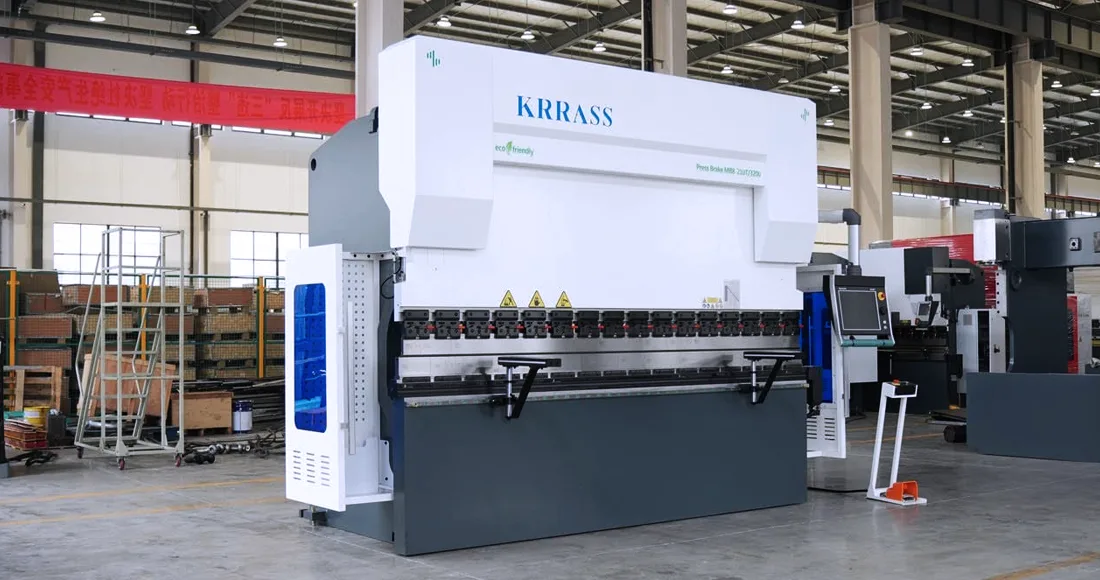
In the world of metal fabrication, the phrase “standard solution” is becoming increasingly obsolete. When you search for a bending machine for sale, you are rarely looking for a generic piece of iron; you are looking for a solution to a specific geometric problem. Whether you are manufacturing aerospace components requiring $\pm 0.01^\circ$ angular precision, or heavy-duty structural beams for the construction industry, the equipment must fit the application—not the other way around.
En KRRASS (www.krrass.com), we have observed a fundamental shift in the global marketplace. The demand for generic hydraulic presses is stabilizing, while the demand for high-specification, customized CNC press brakes is surging. According to recent data from Grand View Research, the global metal forming market is pivoting toward automation and high-precision machinery, projected to reach significant valuations by 2030. This shift is driven by the need for tighter tolerances and the capability to handle complex exotic alloys.
This guide is not just a sales listing; it is a comprehensive technical resource designed to help you navigate the engineering, financial, and operational complexities of purchasing a custom bending machine. Drawing from years of R&D and production experience at KRRASS, we will dissect the anatomy of modern bending technology.
Tabla de contenido
The Economics of Customization: Why “One Size Fits All” Fails
Before diving into the hydraulics and electronics, we must address the business case. Why should a fabrication shop invest in a custom KRRASS solution rather than a stock machine?
1. Material Diversity and Springback Management
Modern fabrication involves more than just mild steel (A36). We are seeing a surge in High-Strength Low-Alloy (HSLA) steels, Hardox, and specialized aluminum alloys. Each material has a unique Resistencia a la tracción y Fuerza de fluencia, which dictates the “Springback” factor.
A standard machine with a pre-set database may fail to calculate the correct Tolerancia de curvatura y Factor K for these specialized materials. A custom KRRASS machine can be equipped with real-time angle measurement systems (like the laser-check systems) that actively measure and correct the bend angle during the cycle, eliminating scrap parts.
2. Tonnage and Length Ratios
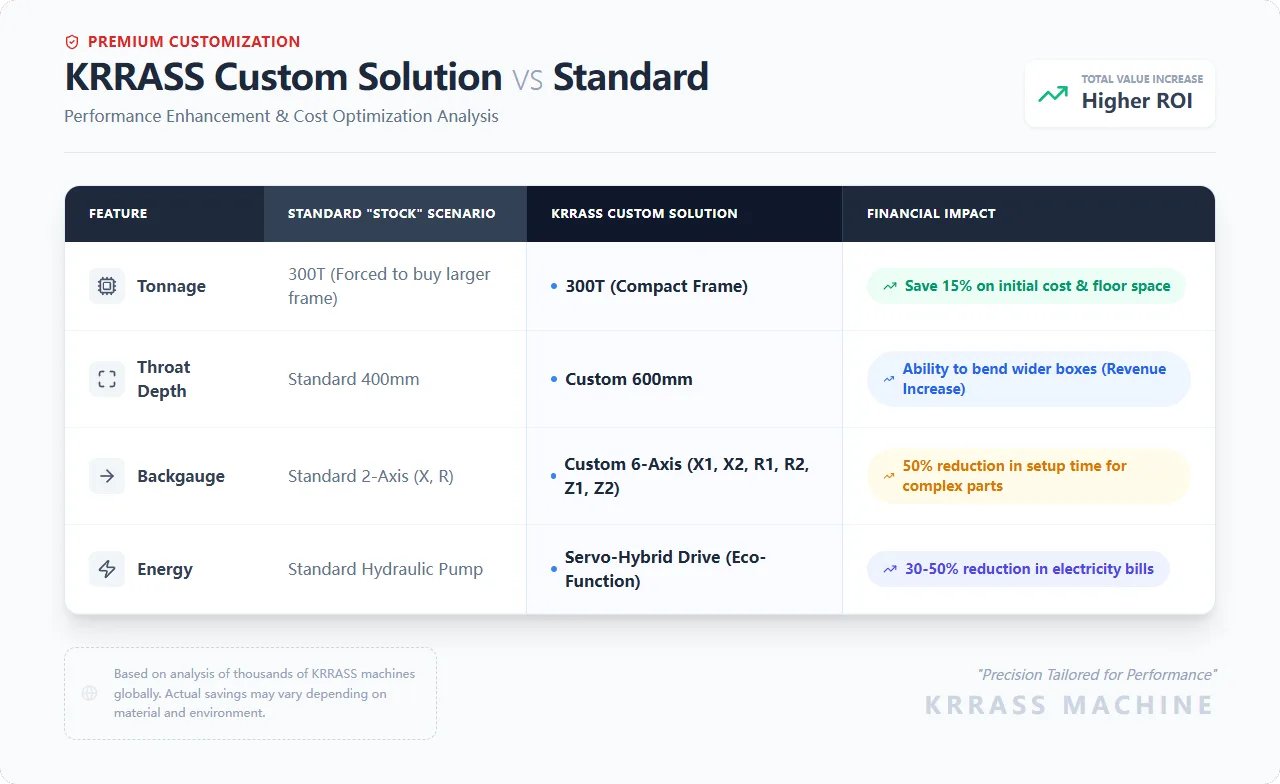
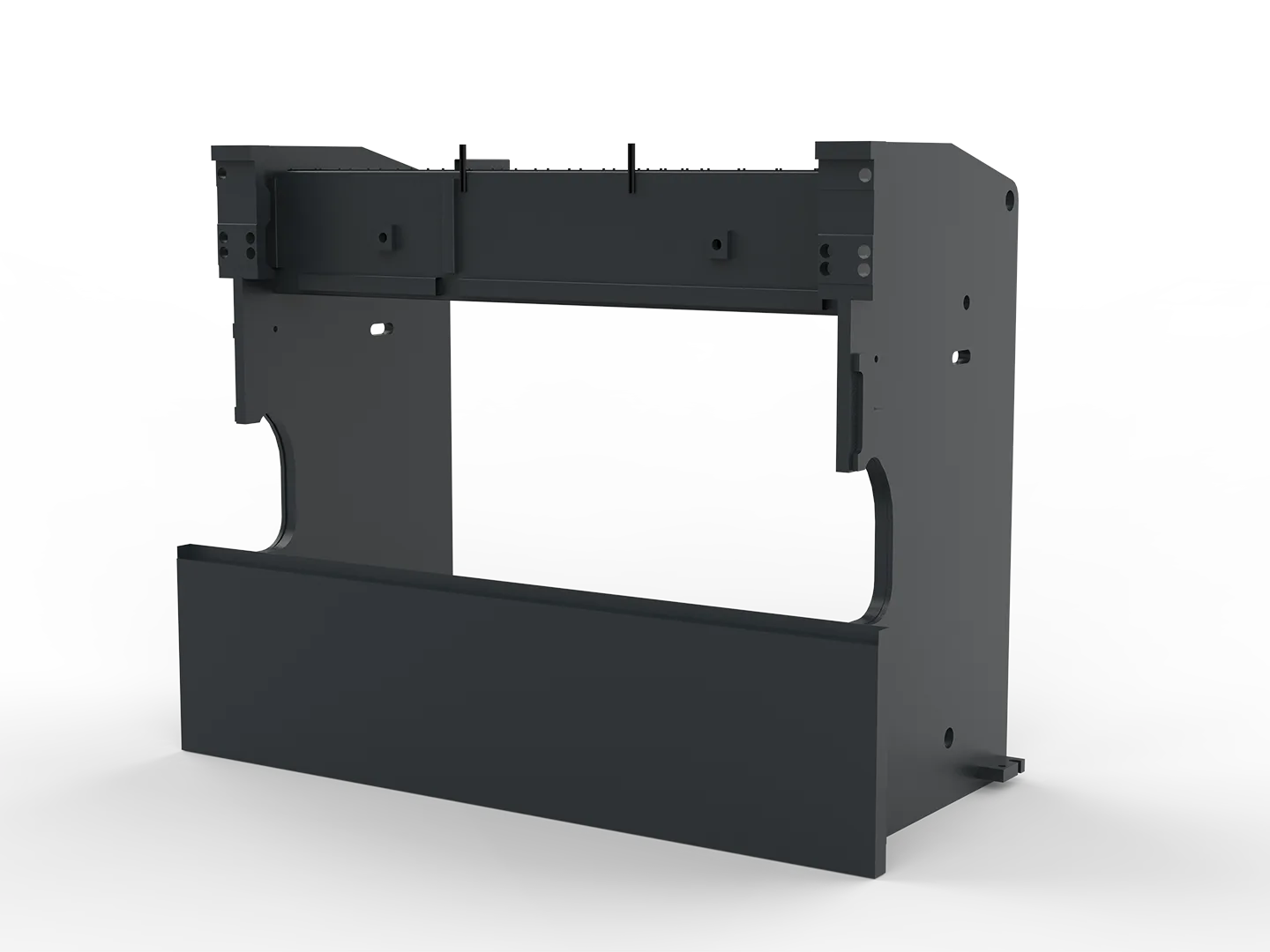
Standard catalogs usually offer fixed pairings: 100 Ton/3200mm, 200 Ton/4000mm. However, what if you manufacture deep boxes from thick plate but short lengths? You might need 300 Tons of force but only over 2000mm of bed length. Buying a 4-meter machine to get the tonnage is a waste of floor space and capital. Customization allows us to build the frame (C-frame) specifically for high-intensity, short-span work.
Table 1: The Cost of Over-Specification vs. Custom Optimization
Defining the Architecture: Drive Systems and Mechanics
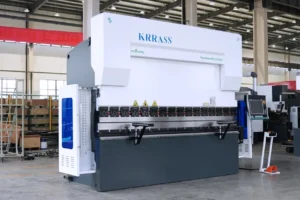
When browsing a bending machine for sale, the drive system is the heart of the decision. As a former engineer, I categorize the market into three distinct technologies, each with specific pros and cons.
1. Torsion Bar Synchronized NC Press Brake (The Entry Level)
This is the traditional technology. A torsion bar (a solid metal shaft) connects the left and right cylinders mechanically to force them to move up and down together.
- Ventajas: Low cost, easy maintenance, rugged.
- Contras: Cannot perform off-center bending (eccentric loads damage the torsion bar); lower speed; lower precision (typically $\pm 0.5^\circ$).
- Ideal para: Simple structural steel bending, tank manufacturing, and workshops with limited budgets.
2. Electro-Hydraulic Synchronized CNC Press Brake (The Industry Standard)
This is the core of the KRRASS lineup. We eliminate the mechanical torsion bar. Instead, precision linear scales (encoders) from brands like Heidenhain or Givi Misure are mounted on the C-frames. These scales provide feedback to the CNC controller, which adjusts the proportional valves on the hydraulic cylinders in milliseconds.
- Mecanismo: Y1 and Y2 axes operate independently but are synchronized electronically.
- Ventajas: High precision ($\pm 0.01mm$ ram positioning), ability to perform off-center bending, compatible with advanced CNCs (Delem, Cybelec).
- Ideal para: Precision sheet metal, job shops, aerospace, and general fabrication.
3. Hybrid and All-Electric Press Brakes (The Future)
For customers prioritizing speed and sustainability, we offer Hybrid solutions (Servo-pump technology).
- Mecanismo: A servo motor drives the hydraulic pump only when the ram moves.
- Ventajas: The oil doesn’t heat up (extending seal life), near-silent operation, and massive energy savings.
- Data Verification: According to energy efficiency studies by El fabricante, switching from a standard hydraulic to a servo-electric or hybrid system can reduce energy consumption by up to 50%.
The Anatomy of Precision: Critical Components Breakdown
A bending machine for sale is only as good as its weakest component. At KRRASS, we believe in transparent sourcing. Let’s break down the critical subsystems that determine the longevity and accuracy of your machine.
The Frame (The Skeleton)
The rigidity of the frame determines the machine’s resistance to deflection. When you apply 200 tons of force, the side frames naturally want to “yawn” (open up).
- KRRASS Advantage: We use Q345E high-strength steel plates. The frames are welded and then subjected to High-Temperature Annealing (thermal stress relief) before machining. This prevents the frame from deforming over time—a common issue in cheaper machines where the frame warps after 2-3 years of heavy use.
The Crowning System (Fighting Physics)
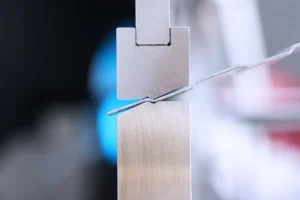
When bending long sheets (e.g., 4 meters), the Ram (upper beam) and the Table (lower beam) will bow away from each other in the center due to the force. This results in the “Canoe Effect,” where the angle in the center is open (e.g., $92^\circ$) while the ends are perfect ($90^\circ$).
To solve this, KRRASS integrates advanced Crowning Systems:
- Coronación hidráulica: Cylinders inside the lower beam push upward to counteract deflection. This is controlled automatically by the CNC based on tonnage calculations.
- Mechanical Crowning (Wila Style): This is the premium option. A series of opposing wedges slide against each other to create a precise curve that perfectly matches the deflection of the upper beam.
- Why choose Mechanical? It is generally faster and maintains accuracy over a longer lifespan compared to hydraulic seals which can wear.
Deep Dive: The CNC Control System – The Brain of the Operation
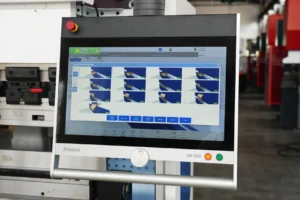
When you see a bending machine for sale, the screen you look at is not just a monitor; it is the brain. The choice of CNC controller dictates the skill level required by your operator.
Delem (The Netherlands) – The Gold Standard
KRRASS frequently integrates Delem controllers (DA-53Tx, DA-58Tx, DA-66S, DA-69S).
- DA-66S/69S: These offer full 3D visualization. The operator imports a STEP file or DXF, and the software automatically calculates the bend sequence, checks for collisions with the tooling or backgauge, and sets the tonnage.
- Benefit: This reduces setup time from hours to minutes. An inexperienced operator can execute complex bends because the “Brain” does the math.
ESA (Italy) and Cybelec (Switzerland)
We also offer customized solutions using ESA and Cybelec, which are preferred in specific European and South American markets for their interface logic.
Technical Insight:
Modern CNC systems on KRRASS machines manage the “Neutral Zone” calculation. When metal bends, the inner fibers compress and the outer fibers stretch. The neutral axis shifts. Our controllers use advanced algorithms to predict this shift based on the DIN 6935 standard, ensuring the blank length is calculated correctly before you even cut the material on your Laser Cutter.
Tooling: The Interface of Contact
You can have the most expensive machine, but without the right tooling, it is useless.
- Promecam / Amada Style: The most common standard. Easy to change, affordable, and widely available.
- Wila / Trumpf Style: Uses a hydraulic clamping button mechanism. Tool changes are instantaneous.
- Herramientas personalizadas: KRRASS specializes in designing specific dies for hemming, offset bends (joggles), and curling (hinges).
Pro Tip for Buyers: When inquiring about a machine, always send us the drawing of your most complex profile. We work backward from the finished part to determine the Open Height and Stroke needed. If you buy a standard machine with 400mm Open Height, but your tool is 200mm tall and your part flange is 250mm, you physically cannot remove the part after bending.
The Backbone of Accuracy: The Backgauge System Explained
When evaluating a bending machine for sale, the backgauge is often the second most critical component after the hydraulic system. In my years of designing press brakes, I have seen more production bottlenecks caused by inadequate backgauges than by lack of tonnage.
The backgauge is a motorized robotic system at the rear of the machine that positions the metal sheet for the bend. A standard machine typically comes with a 2-axis backgauge (X and R), but modern fabrication demands much more. At KRRASS, we configure our CNC press brakes with up to 8-axis backgauges.
Understanding the Axes: A Buyer’s Guide
To make an informed decision, you must understand what you are paying for:
- X-Axis: The forward/backward movement. This determines the flange length.
- R-Axis: The up/down movement. This is critical when bending parts with existing flanges (like a box or tray) where the gauge fingers need to “jump” over a previous bend.
- Z1/Z2-Axes: The left/right movement of the gauge fingers.
- Why you need this: If you are bending a part with multiple stations (e.g., a complex bracket that moves from left to right across the machine), the Z-axes automatically position the fingers for the next step. Without this, the operator must walk around the back of the machine to manually slide the fingers—a huge safety risk and time waster.
- X1/X2-Axes (Delta X): Used for conical bending or tapered parts where one side of the flange is deeper than the other.
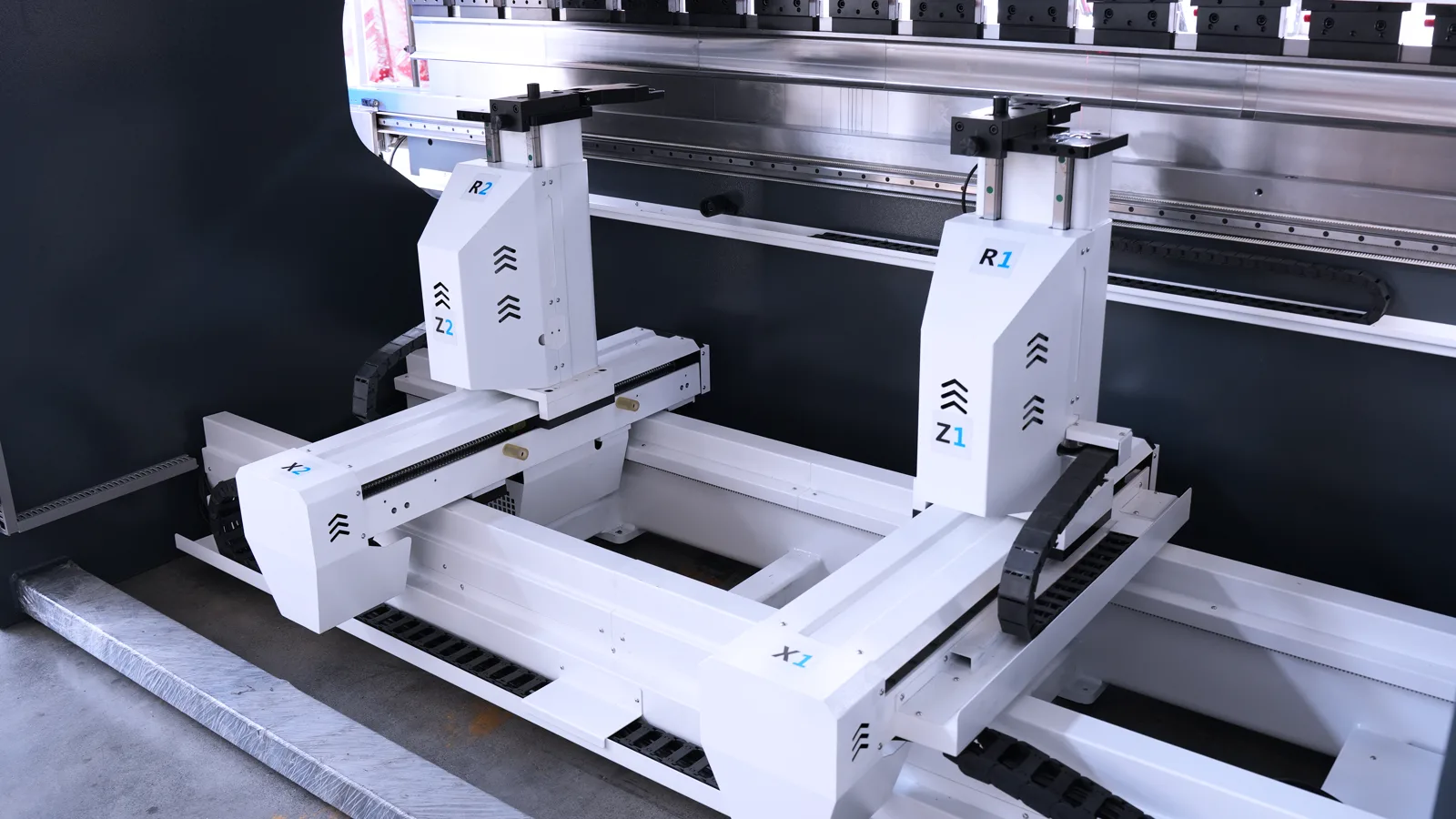
Table 2: KRRASS Backgauge Configuration & Application Matrix
| Configuration | Axes Controlled | Ideal Application | Setup Time Reduction |
|---|---|---|---|
| Estándar | X, R (Manual Z) | Simple brackets, consistent part runs | Baseline |
| Avanzado | X, R, Z1, Z2 | Job shops, high-mix/low-volume parts | 35% Faster |
| Complejo | X1, X2, R1, R2, Z1, Z2 | Conical parts, asymmetric bending | 60% Faster |
| Heavy Duty | X (Heavy Structure) | Thick plate (20mm+), structural beams | N/A (Focus on durability) |
Safety First: Laser Guarding and Operator Protection
In the European and North American markets, safety regulations (CE, OSHA, ANSI B11.3) are non-negotiable. Old-school press brakes relied on light curtains that stopped the machine if anything broke the beam. This was safe but slow, as the operator had to stand far back.
Modern KRRASS machines integrate DSP Laser Safety Systems o LazerSafe (Australia) technology. These systems allow the ram to approach the metal at high speed (200mm/s) and switch to bending speed (10mm/s) just millimeters above the pinch point.
Cómo funciona
The laser transmitter and receiver are mounted directly on the upper ram, moving with the tool.
- High-Speed Descent: The ram moves down fast.
- Obstruction Detection: If the operator’s finger blocks the laser (just below the tool tip), the machine stops instantly (within milliseconds).
- Box Bending Mode: Intelligent systems can detect the side of a box and ignore the interruption, allowing complex box bending without disabling the safety system.
According to safety audits, upgrading from a standard light curtain to a LazerSafe system can improve cycle times by 20-30% because the “Mute Point” (where the machine slows down) is much lower.
The Rise of Automation: Robotic Bending Cells
The shortage of skilled labor is a global crisis. Finding an operator with 10 years of experience who understands bend allowances, grain direction, and crowning is becoming impossible. This is why the search volume for “robotic bending machine for sale” has tripled in the last five years.
At KRRASS, we don’t just sell standalone machines; we integrate Bending Cells.
The Components of a KRRASS Bending Cell:
- The Press Brake: Usually a high-precision electric or hybrid model for consistency.
- The Robot: We partner with KUKA, Yaskawa, or Fanuc. The robot is mounted on a linear track (7th axis) to cover the full length of the machine.
- The Gripper: A universal gripper or a tool changer that can handle different part geometries.
- Centering Station: Before bending, the robot places the sheet on a gravity table to ensure it is perfectly square.
The Economic Argument for Robotics:
- Consistencia: A robot does not get tired. The 1000th part is identical to the 1st.
- Lights-Out Manufacturing: The machine can run a shift at night with zero human supervision.
- Seguridad: The operator is removed from the heavy lifting and pinch points entirely.
Editor’s Note: While robotic integration has a higher upfront cost, the ROI is typically realized within 18-24 months due to labor savings and increased throughput. For detailed case studies on automation, refer to The Metalforming Association’s guide on automation.
Eco-Friendly Fabrication: The Servo-Electric Revolution
The traditional hydraulic press brake is a power hog. The main motor runs constantly, churning oil even when the machine is idle (idling phase). This generates heat and wastes electricity.
El KRRASS Hybrid and All-Electric Series solve this.
Hybrid Technology (Servo-Pump)
We replace the standard AC motor with a Servo Motor.
- Idle: When the ram is not moving, the motor stops. Power consumption drops to near zero.
- Active: The servo responds instantly, pumping oil only when needed.
- Resultado: 60% Energy Savings and a drastic reduction in hydraulic oil temperature. Cooler oil means the viscosity stays stable, ensuring the bend angle remains consistent throughout a tropical summer or a freezing winter.
All-Electric (The E-Brake)
No oil. No tanks. No leaks.
Driven purely by belts, pulleys, and heavy-duty servo motors.
- Exactitud: $\pm 1$ micron.
- Mantenimiento: Virtually zero. No filter changes, no oil disposal fees.
- Ruido: Silent operation.
- This is the preferred choice for clean-room environments, medical device manufacturing, and high-precision electronics.
Offline Programming: The Hidden Efficiency Booster
A machine that is not bending is not making money. If your operator is standing at the console, typing in numbers and testing bends for 30 minutes, that is 30 minutes of lost revenue.
KRRASS machines are compatible with Software de programación fuera de línea (e.g., Delem Profile-T, ESA, or specialized third-party software like Radan or Metalix).
The Workflow of the Future:
- Office Engineering: The engineer imports the 3D model (SolidWorks, Inventor, Catia) into the software on their PC.
- Simulation: The software automatically selects the tools, calculates the bend sequence, and checks for collisions.
- Optimization: It optimizes the tool setup to minimize changes.
- Transfer: The program is sent via LAN or Wi-Fi directly to the KRRASS machine.
- Acción: The operator simply scans a barcode on the traveler, loads the tools shown on the screen, and starts bending immediately.
Data Point: Implementation of offline programming reduces machine downtime by an average of 45% (Fuente: KRRASS Internal Time-Study Analysis, 2024).
Industry-Specific Solutions: Tailoring the Machine to the Market
A bending machine for sale is not a generic tool; it is a specialized instrument. Here is how KRRASS customizes machines for specific industries:
1. The Light Pole & Transmission Tower Industry
- Challenge: Bending incredibly long sheets (12 meters to 16 meters) of thick high-tensile steel.
- KRRASS Solution: Prensas plegadoras en tándem. We synchronize two heavy-duty machines (e.g., 2 x 800 Ton / 6000mm) to work as one giant 12-meter machine. When needed, they can operate independently for smaller parts.
- Key Feature: Heavy-duty front supports and side discharge systems.
2. The Aviation & Aerospace Sector
- Challenge: Exotic alloys (Titanium, Inconel) with unpredictable springback. Zero surface scratches allowed.
- KRRASS Solution: Electric Press Brakes with active angle measurement and synthetic non-marking tooling.
3. Kitchenware & Stainless Steel Catering
- Challenge: Complex boxes, deep pans, and aesthetic finishes.
- KRRASS Solution: High open-height machines with specific “Window” frames to allow parts to pass through the side frames.
The Critical Phase: Installation, Commissioning, and Calibration
When you finalize the purchase of a bending machine for sale, the transaction does not end; the engineering partnership begins. A custom press brake is a precision instrument weighing several tons. If it is not installed correctly, even the most expensive Delem controller cannot save your bend angles.
At KRRASS, we have standardized our Global Installation Protocol to ensure that whether you are in Texas, Berlin, or Dubai, your machine performs exactly as it did on our factory floor.
1. Foundation and Leveling: The Bedrock of Accuracy
Many operators underestimate the impact of the floor. A 200-ton press brake exerts massive dynamic loads. If the concrete is less than 250mm (10 inches) thick or lacks reinforcement, the machine will settle unevenly over time.
- The Twist Effect: If the left side settles 2mm lower than the right, the frame twists. This physically misaligns the Y1 and Y2 cylinders.
- KRRASS Requirement: We provide a detailed Foundation Drawing 30 days before delivery. We recommend high-grade concrete (C30 standard) and the use of heavy-duty leveling pads or chemical anchor bolts.
- Laser Leveling: During commissioning, our technicians use laser interferometers to level the bed to within 0.05mm/m.
2. Hydraulic Fluid Management
The lifeblood of a hydraulic press brake is the oil.
- Viscosity Matters: For colder climates (Northern Europe, Canada), we recommend ISO VG 32 hydraulic oil to prevent sluggish startups. For hotter climates (Middle East, Southeast Asia), ISO VG 68 is essential to maintain viscosity and seal integrity under heat.
- Cleanliness Standard: We adhere to the NAS 1638 Class 7 cleanliness standard for hydraulic systems. Before the machine leaves KRRASS, the oil is filtered through a 3-micron filtration system to ensure no debris damages the proportional valves (Rexroth/Hoerbiger).
3. Electrical Stability
Modern CNC press brakes are sensitive to voltage fluctuations.
- The Risk: A spike in voltage can fry a servo drive or corrupt the CNC memory.
- The Solution: We strongly advise installing a dedicated Voltage Stabilizer (Automatic Voltage Regulator – AVR) if your facility’s power grid fluctuates by more than $\pm 10\%$.
Predictive Maintenance: Extending the Lifecycle to 15+ Years
A standard “bending machine for sale” might last 5-7 years before major overhauls. A maintained KRRASS machine is designed for 15-20 years of service. The difference lies in Preventative Maintenance.
We categorize maintenance into three tiers:
Tier 1: Operator Daily Checks (The “5-Minute Rule”)
Before the first shift begins, the operator must:
- Check Oil Level: Ensure it is within the sight glass range.
- Inspect Tooling: Check the punch tip and die V-opening for cracks or embedded metal debris. Damaged tooling damages the machine ram.
- Wipe the Scales: Use a clean, lint-free cloth to wipe the linear encoder scales (Givi/Heidenhain). Dust here causes “Y-axis positioning errors.”
Tier 2: Monthly Technical Review
- Greasing Points: Lubricate the backgauge rails (X and R axes) and the ram guides. Note: Over-greasing attracts dust; use sparingly.
- Filter Check: Check the hydraulic return filter indicator. If it’s in the red, change it immediately.
- Emergency Stop Test: Physically test the E-Stop buttons and the Laser Guarding system to ensure the machine stops instantly.
Tier 3: Annual Calibration (The “Health Check”)
Once a year, a qualified technician should:
- Re-Level the Machine: Check for foundation settling.
- Verify Parallelism: Measure the parallelism between the Ram and the Bed at max tonnage.
- Valve Tuning: Adjust the Null Bias and Gain on the proportional valves to ensure Y1/Y2 synchronization is within 0,01 mm.
Troubleshooting Guide: Common Bending Issues Solved
Even with the best machine, issues arise. Here is a troubleshooting matrix based on our Service Department’s data.
Table 3: Common Press Brake Anomalies & Solutions
| Symptom | Probable Cause | Technical Solution |
|---|---|---|
| Angle Variance (Left vs. Right) | Y1/Y2 Calibration Drift or Tool Misalignment | 1. Recalibrate Y1/Y2 reference points in CNC. 2. Check if the top tool is seated correctly in the clamps. |
| “Canoe Effect” (Open Angle in Center) | Insufficient Crowning | 1. Increase Crowning value in CNC. 2. Check hydraulic crowning cylinders for leaks. 3. Verify the mechanical wedges (if equipped). |
| Ram Drifts Down when Idle | Leaking Cylinder Seal or Counterbalance Valve | 1. Inspect cylinder seals for bypass. 2. Check the counterbalance valve setting. |
| Loud Hydraulic Noise (Cavitation) | Low Oil Level or Clogged Suction Filter | 1. Top up hydraulic oil immediately. 2. Replace suction strainer. Do not run machine. |
| Inconsistent Flange Length | Backgauge Backlash or Material Slippage | 1. Check X-axis belt tension. 2. Ensure the sheet is firmly against the finger stops before pinching. |
The Business Case: ROI Analysis of a Custom KRRASS Machine
When you search for a bending machine for sale, the price tag is only the tip of the iceberg. The Costo total de propiedad (TCO) is the real metric.
Let’s compare two scenarios:
- Scenario A: Buying a cheap, standard “off-the-shelf” machine ($40,000).
- Scenario B: Buying a custom KRRASS CNC Press Brake with Delem DA-66S and 6-Axis Backgauge ($65,000).
The Variables
- Labor Rate: $30/hour.
- Daily Production: 8 hours.
- Setup Time per Job: Standard (45 mins) vs. KRRASS (10 mins).
- Scrap Rate: Standard (5%) vs. KRRASS (0.5% due to laser correction).
The Calculation
1. Setup Time Savings:
If you change setups 4 times a day:
- Estándar: $4 \times 45 \text{ mins} = 180 \text{ mins lost/day}$.
- KRRASS: $4 \times 10 \text{ mins} = 40 \text{ mins lost/day}$.
- Daily Savings: 140 mins (2.33 hours).
- Annual Savings: $2.33 \text{ hours} \times \$30 \times 250 \text{ days} = \mathbf{\$17,475}$.
2. Scrap Reduction:
If you process $500,000 of material annually:
- Standard Scrap (5%): $25,000 lost.
- KRRASS Scrap (0.5%): $2,500 lost.
- Annual Savings: $\mathbf{\$22,500}$.
3. Total Annual Benefit:
$\$17,475 \text{ (Labor)} + \$22,500 \text{ (Material)} = \mathbf{\$39,975/year}$
Conclusión:
The price difference between the cheap machine and the KRRASS custom machine is $25,000.
Payback Period: $\frac{\$25,000}{\$39,975} = \mathbf{0.62 \text{ Years}}$ (approx. 7.5 months).
After 8 months, the KRRASS machine is pure profit, whereas the cheap machine continues to bleed labor and material costs for its entire life.
Global Support and The KRRASS Promise
Buying machinery from overseas used to be a risk. KRRASS has eliminated that risk through our established global network.
1. Component Transparency
We do not use “mystery box” parts. Every critical component in a KRRASS machine is sourced from Tier-1 global suppliers, meaning you can find replacements locally if needed.
- Hydraulics: Bosch Rexroth (Germany) / Hoerbiger (Germany).
- Electrónica: Schneider (France) / Siemens (Germany).
- Seals: NOK (Japan) / SKF (Sweden).
- Motors: Siemens (Germany) / ABB (Switzerland).
2. Remote Diagnostics (Industry 4.0)
Our advanced CNC controllers (Delem DA-66S/69S) are equipped with Tele-Service capabilities. If you have an issue, you connect the machine to Wi-Fi. Our engineers in the KRRASS HQ can remotely log into your controller to diagnose error codes, adjust parameters, and update software patches in real-time. This reduces service downtime from days to minutes.
3. Warranty
We offer a standard 2-Year Parts Warranty on all custom machines, with an optional extension to 5 years for the main frame structure.
Engineering Your Competitive Edge
The search for a bending machine for sale is a search for capability. In a market flooded with generic equipment, KRRASS stands apart by offering engineering-led solutions. We don’t just sell tonnage; we sell the ability to bend complex geometries faster, more accurately, and more profitably than your competitors.
Whether you need a compact 40-ton electric brake for small brackets or a massive 2000-ton tandem system for shipbuilding, our process remains the same: Consultation -> Customization -> Precision Execution.
Do not let your machinery be the bottleneck in your growth. Upgrade to a solution that thinks as fast as you do.
Preguntas frecuentes
What is a custom bending machine?
A custom bending machine is a special type of equipment designed to bend metal sheets into specific shapes and angles. Unlike standard machines, which might only do basic bending, a custom machine can be made to meet the unique needs of your projects, offering precision down to very fine measurements. This means whether you’re making small parts or large structures, you can get exactly what you need.
Why should I choose a custom machine instead of a standard one?
Choosing a custom machine means you get an equipment that fits your specific needs better. Standard machines may not handle the materials you work with well or the shapes you need to create. With a custom machine from KRRASS, you will have better efficiency and less waste, as it can be tailored to handle your unique operations, saving both time and money.
How does a bending machine work?
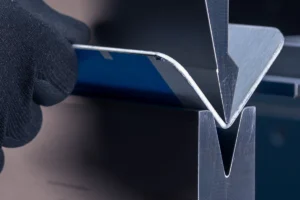
A bending machine works by using a strong ram to press down on metal sheets against a shaped die. This pressure causes the metal to bend at a precise angle. It’s similar to pressing down on a piece of clay to shape it. Modern machines often have smart controls that help to make sure the bends are accurate.
What materials can be bent using these machines?
Custom bending machines can work with a variety of materials. Common ones include mild steel and aluminum, but they can also handle tougher materials like high-strength steel and exotic alloys. Each material has its own properties, and custom machines can be tailored to handle the unique challenges of each one.
What is the backgauge system in a bending machine?
The backgauge system is a part of the bending machine that helps position the metal sheet correctly before bending. It can move the sheet backward or forward and allows for precise placements to ensure the bends are accurate. Advanced machines might use multiple axes to allow for more complex bending tasks.
Are the bending machines safe to operate?
Yes, safety is a top priority for KRRASS. Our machines come with modern safety features, including laser guarding systems, which can detect objects or people close to the machine and stop it quickly if needed. This helps to protect operators while they work.
How long do these machines last?
With proper maintenance, KRRASS bending machines can last 15 years or longer. Regular checks and routines ensure that the machines operate smoothly and maintain their accuracy over time. This longevity can help your business by reducing the frequency of equipment replacement.
What is predictive maintenance?
Predictive maintenance is a proactive approach to maintaining machines. It involves regularly checking certain components and using technology to predict when something may go wrong. By fixing issues before they become major problems, businesses can minimize downtime and keep operations running smoothly.
Can I get support after purchasing a machine?
Absolutely! KRRASS offers strong support after purchase, including a two-year warranty for parts and optional extended coverage. Additionally, we provide remote diagnostics to help quickly troubleshoot any issues, minimizing the time your machine is out of action.
Ready to Transform Your Fabrication Line?
Contact the KRRASS Engineering Team today for a free consultation on your specific bending requirements.
- Visit us: www.krrass.com
- Correo electrónico: [email protected]
- WhatsApp/WeChat: +0086-189-5208-7956
KRRASS: Smart Manufacturing, Precision Bending.
 English
 العربية
 Français
 Português
 Русский
 Español